
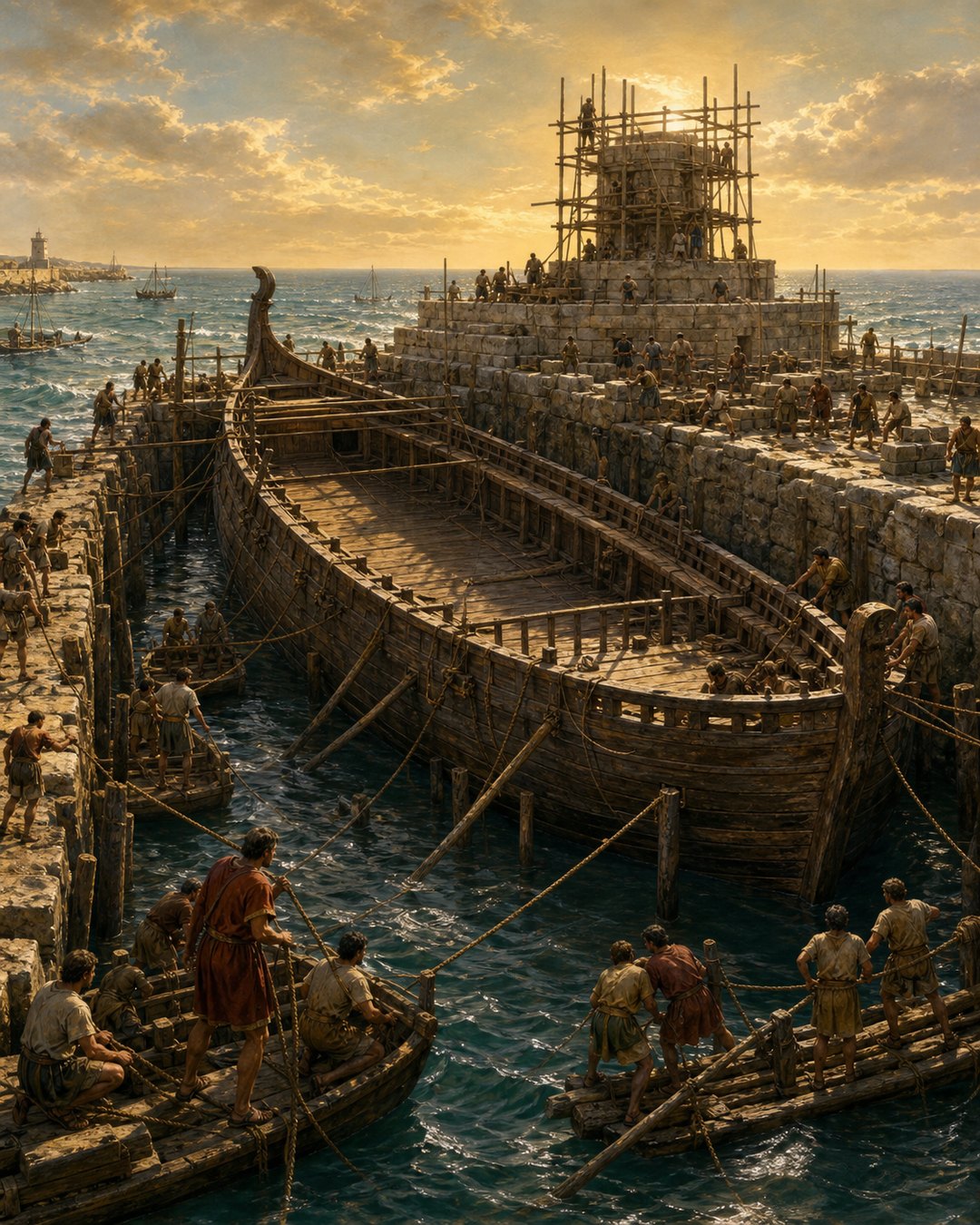
A ship built to carry an Egyptian obelisk ended its working life beneath masonry. Claudius had the enormous carrier sunk in deep water outside Ostia, fixed with piles and incorporated into the foundation of a harbour mole. Above it rose a tower whose night light guided ships toward Rome.
The transformation joined two imperial projects. Under Gaius, better known as Caligula, the vessel had moved a monumental stone from Egypt. Under Claudius, its hull became invisible infrastructure for a port intended to reduce the danger surrounding Rome’s imported grain.
Suetonius supplies the ship, piles and tower. Cassius Dio explains the larger harbour problem and the works dug into land and pushed into the sea. Neither author gives a builder’s drawing. Read together, however, they preserve a remarkable sequence: transport, deliberate sinking, stabilization and construction.
The Cargo Had Been Designed to Be Seen
Suetonius identifies the vessel by its former burden: it was the ship in which “the great obelisk” had been brought from Egypt. That phrase points backward to Gaius’s reign and to an undertaking defined by exceptional weight and spectacle. An Egyptian monolith crossed the Mediterranean before it could become part of an imperial setting at Rome.
The ancient account does not preserve the carrier’s dimensions in this passage, nor does it describe every stage of loading and unloading. Its later reuse nevertheless implies that Claudius’s engineers regarded the hull as unusually substantial. A ship remembered by its singular cargo offered a ready-made mass large enough to matter beneath a marine structure.
An obelisk made power visible through distance. Stone quarried and shaped in Egypt arrived under Roman command and entered a new political landscape. The ship was the temporary machine that made that transfer possible. Once the stone stood on land, the carrier no longer held the same ceremonial role.
Claudius did not preserve it as a floating relic. He treated it as material. The decision is easy to miss because the tower later occupied the eye, but the harbour began by taking a famous vessel out of sight.
Rome’s appetite also depended on less glamorous hulls. The pressure placed on ordinary grain shipping explains why a former prestige carrier could acquire a second value. Monumental transport had demonstrated reach; harbour construction had to make repeated arrivals less hazardous.
Winter Exposed the Coast’s Weak Point
Cassius Dio frames Claudius’s harbour as an answer to seasonal danger. He says practically all the grain used by the Romans was imported, while the Tiber mouth lacked safe landing places and suitable harbours. Cargoes delivered in summer could be stored, but winter voyages risked disaster.
The statement is broad and rhetorical, yet its mechanism is concrete. Rome could dominate routes across the sea and still remain vulnerable at the final approach. A cargo that reached the Italian coast had not completed its task if weather, shoals or an exposed landing prevented safe transfer.
Warehouses helped bridge time once food was ashore. Ostia’s storage system managed the interval between arrival and consumption. Claudius’s project addressed the interval immediately before that one: the dangerous passage from open water into protected harbour space.
Dio dramatizes the projected expense. When Claudius asked architects what the work would cost, they reportedly answered, “You don’t want to do it!” They expected the scale of expenditure to deter him. The emperor proceeded, and Dio presents completion as an undertaking matched to Rome’s size.
Suetonius makes a similar point by contrast. He calls Claudius’s completed public works great and essential rather than numerous. The harbour had been considered before and abandoned because of its difficulty. In both accounts, expense and engineering resistance are not side notes; they explain why solving an obvious supply problem required an imperial commitment.
Engineers Cut a Basin and Pushed Walls into the Sea
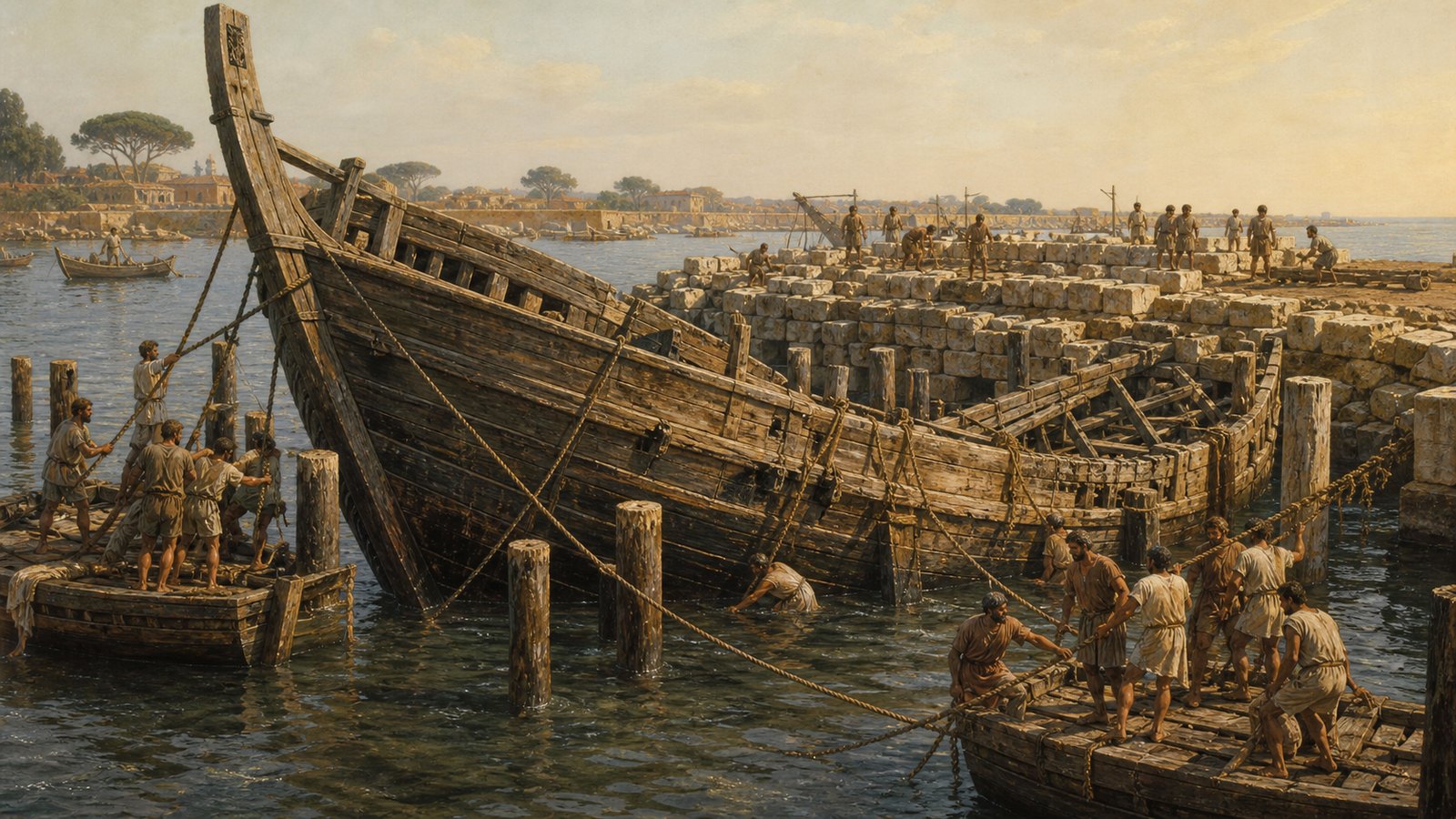
Dio divides the work between land and water. First, Claudius excavated a very large tract, built retaining walls around it and admitted the sea. This created protected space by removing earth rather than simply building outward from the existing shore.
Second, workers constructed huge moles on both sides of the entrance. These arms enclosed a large body of water. The harbour was therefore not one object but a system of excavation, retaining structures, sea walls, entrance geometry and controlled access.
Suetonius describes curving breakwaters to the right and left. In front of the entrance, out in deep water, Claudius placed another mole. The position mattered. A structure before the opening could interrupt waves, mark the approach and support a beacon where arriving crews could see it.
Ancient vocabulary can conceal the physical difficulty. A mole demanded material placed where water moved, depth complicated work and a weak seabed could undermine accumulated weight. Suetonius’s reference to a firmer foundation shows that the builders were not merely dumping stone until land appeared. They needed a stable core.
The obelisk ship offered that core in a form already assembled. Its timbers enclosed volume and defined a large footprint. Sinking it was not disposal followed accidentally by construction. Suetonius explicitly connects the act to making the foundation firmer.
A Working Ship Became a Deliberate Wreck
The sequence is unusually clear. Claudius first sank the vessel. He then secured it with piles. Construction continued above this stabilized mass.
That order distinguishes the operation from a wreck opportunistically buried by later sediment. The hull entered the water as a planned component of the mole. Men had to position it, bring it down where the structure was intended, and drive or set piles strongly enough to keep the foundation from shifting while more weight accumulated.
Suetonius does not tell us exactly how the ship was flooded, what ballast was added or how the piles were arranged. Those gaps should remain gaps. The surviving detail supports deliberate reuse, not a modern engineering diagram reconstructed line by line.
The choice also compressed two reigns into one object. Gaius had commissioned or used the carrier for the obelisk’s crossing. Claudius inherited both the vessel and the political world that had produced it. By sinking the ship, he did not erase its earlier achievement; he made that achievement support a new claim about essential public work.
The object’s visibility reversed. As an obelisk carrier, the ship’s significance lay in the extraordinary cargo above its deck. As a foundation, significance lay in remaining fixed below the surface. One task demanded movement. The second demanded permanent immobility.
The Tower Made the Buried Hull Legible at Night
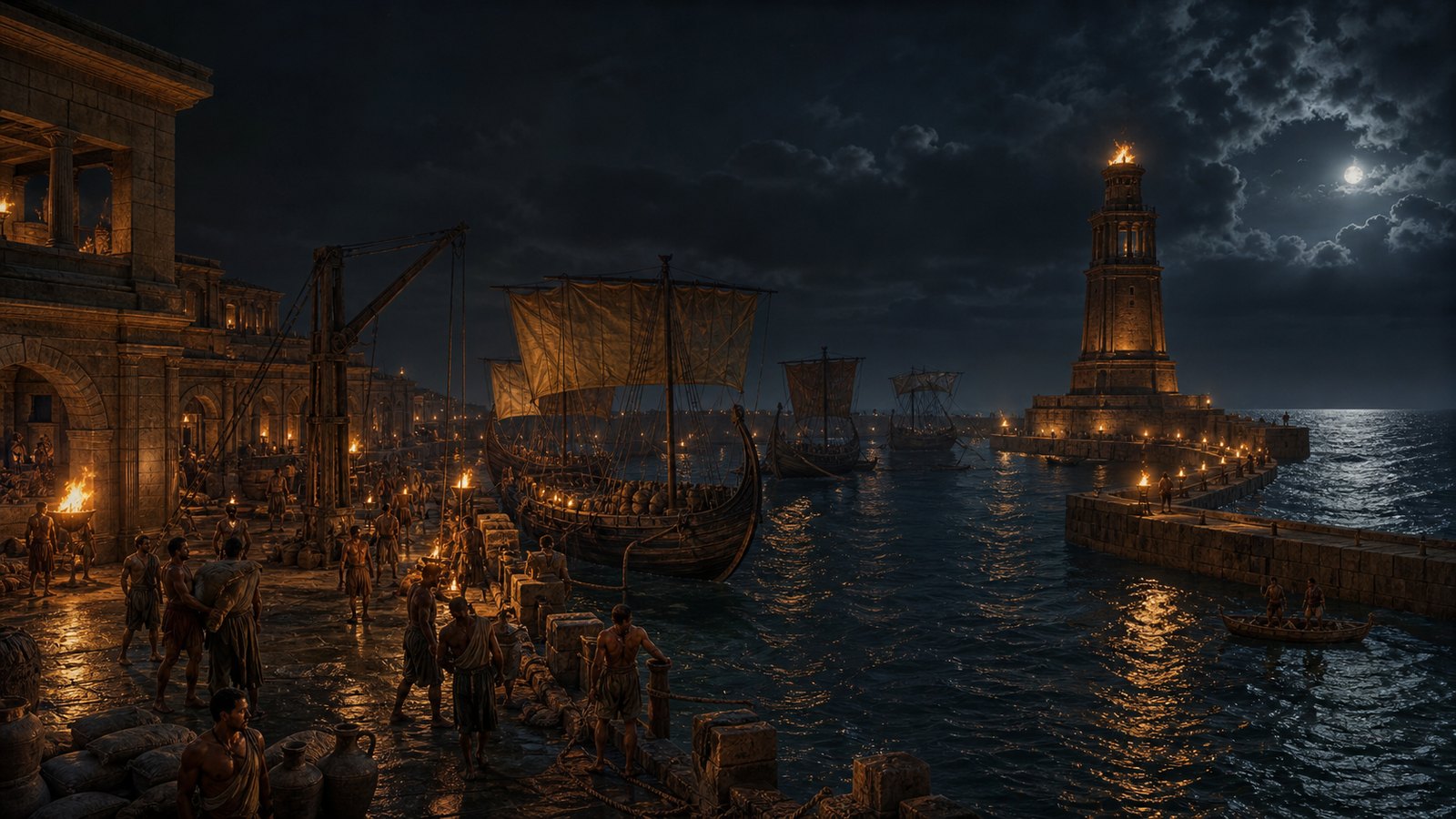
Upon the mole, Suetonius says, Claudius built a very lofty tower modeled on the Pharos at Alexandria. It was to be lighted at night and guide the course of ships. Dio likewise places an island and beacon tower amid the enclosed water.
The reference to Alexandria joined function to comparison. The Pharos was antiquity’s most famous maritime tower. Rome’s harbour did not need to copy every feature for the model to communicate ambition: crews approaching in darkness would see a light standing over a work designed at imperial scale.
The beacon completed a vertical stack of meanings. Egyptian stone had once travelled on the ship. The ship now lay beneath a Roman mole. Above it stood a tower recalling an Egyptian harbour landmark. Cargo, hull, foundation and light connected Rome’s command of distant material with the repetitive needs of sailors.
The light could not calm a storm or guarantee a safe voyage. It could show the entrance, identify the artificial offshore structure and turn darkness into a navigational problem with a visible reference point. Its usefulness depended on all the less visible work below: piles, timbers, masonry and protected water.
That is the sharpest contrast in the project. The tower announced state care from far away, while the reused ship did its work by disappearing. Claudius’s harbour converted an imperial spectacle into infrastructure and then placed a new spectacle above it. Every night the beacon made the approach visible; beneath it, Gaius’s obelisk carrier held still.
Sources
Suetonius, Claudius 20.
Cassius Dio, Roman History 60.11.