
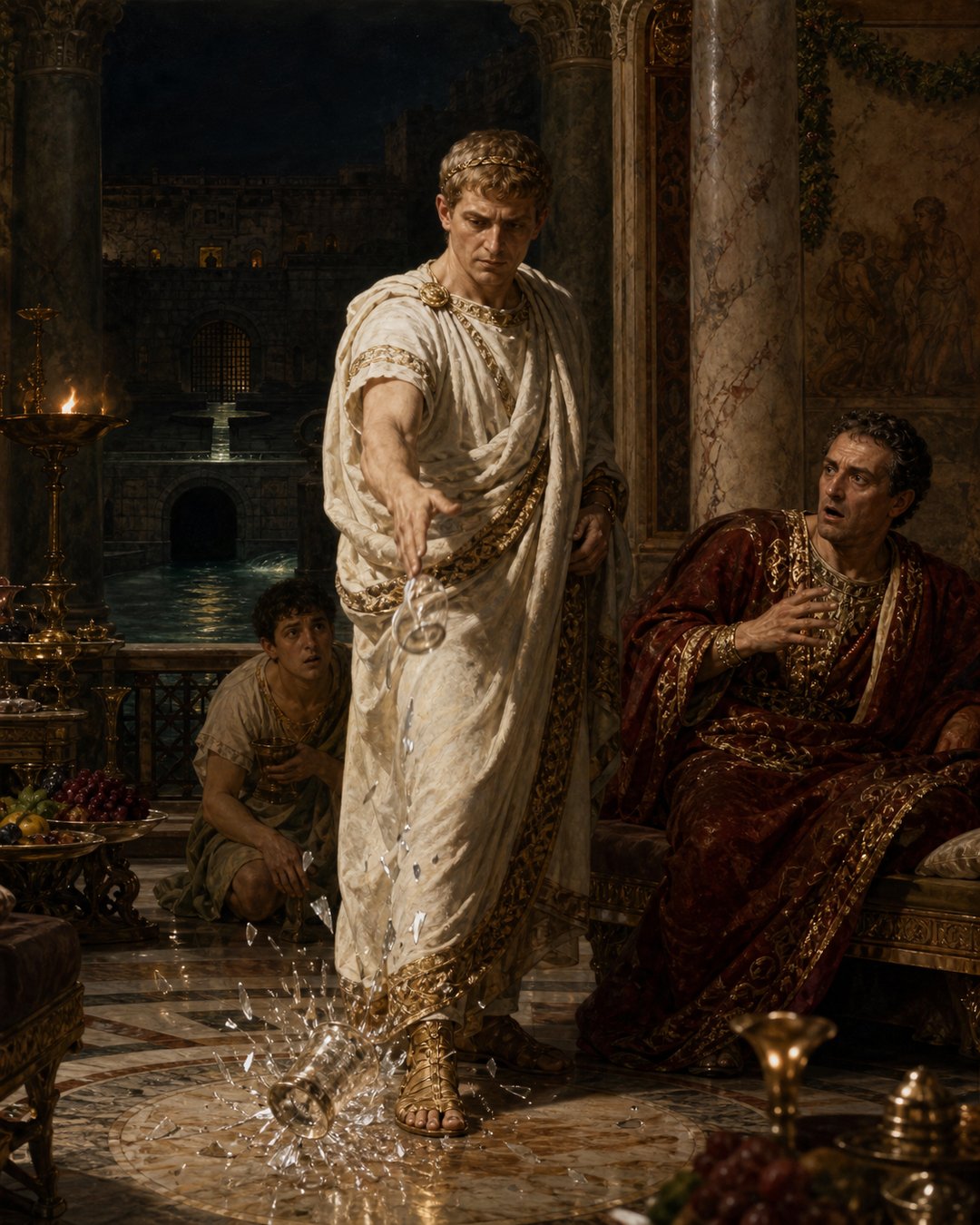
A cup-bearer broke a crystal goblet during a banquet given by Vedius Pollio. The wealthy host ordered the enslaved man thrown to the huge lampreys he kept in reservoirs. Emperor Augustus was dining there.
Augustus first asked Vedius not to carry out the punishment. Vedius refused. The emperor then requested every similar or valuable drinking vessel in the house—and ordered all of them smashed.
The intervention worked because it attacked the logic of the sentence. One broken cup could be framed as an enslaved servant’s unforgivable offense. A roomful of shattered luxury, broken at imperial command, made that single accident impossible to punish without confronting Augustus.
A Banquet Exposed the Master’s Private Rule
Cassius Dio introduces Vedius as an equestrian of freedman ancestry who had won historical notoriety not through brilliant deeds but through wealth and cruelty. His household displayed both.
Vedius kept huge lampreys in reservoirs. Dio says they had been trained to eat people and that he threw enslaved people to them when he wished to put them to death. The claim is part of a hostile moral portrait written long afterward, but it defines the danger inside the banquet.
The cup-bearer’s mistake involved crystal, a costly material whose fragility magnified elite display. A vessel could demonstrate wealth precisely because it was difficult to obtain and easy to destroy.
Service at such a dinner demanded movement among couches, tables, guests and delicate vessels. The enslaved attendant was expected to make luxury appear effortless. Once a cup slipped, the labor supporting the spectacle became visible only as a fault.
Dio does not say whether the goblet fell through carelessness, crowding or chance. That absence prevents a reconstruction of blame. Vedius did not investigate degrees of fault in the account; the broken object itself triggered the order.
Vedius’s response turned breakage into a declaration of ownership over a person. The goblet had a price; the servant’s body would pay it. Nothing in Dio’s scene suggests a hearing or measured penalty.
Augustus’s presence changed the audience. Private household discipline was now performed before the most powerful Roman. Vedius nevertheless issued his command “without regard for his guest,” making refusal to relent part of the host’s authority.
The Cup-Bearer Asked for Imperial Intercession
The enslaved man fell to his knees before Augustus and begged. Dio does not preserve a speech from him. His movement shows the only available appeal: from a master who had condemned him to a guest whose status might override the household.
Augustus began with persuasion. He asked Vedius not to commit what Dio calls a monstrous deed. The sequence matters because the emperor did not immediately seize the servant or pronounce a legal rule.
Vedius paid no heed. In the biographer’s moral architecture, his cruelty outweighed hospitality, deference and political sense. He insisted on possessing the decision even after Augustus entered it.
The failed request revealed a limit to ordinary patronage. Asking mercy left the master free to say no. Augustus needed a move that would alter the material basis of Vedius’s anger.
Roman enslaved people sometimes reached for protection through relationships rather than reliable rights. The market treated enslaved bodies as inspected property; this banquet showed how another elite’s power might interrupt ownership without abolishing it.
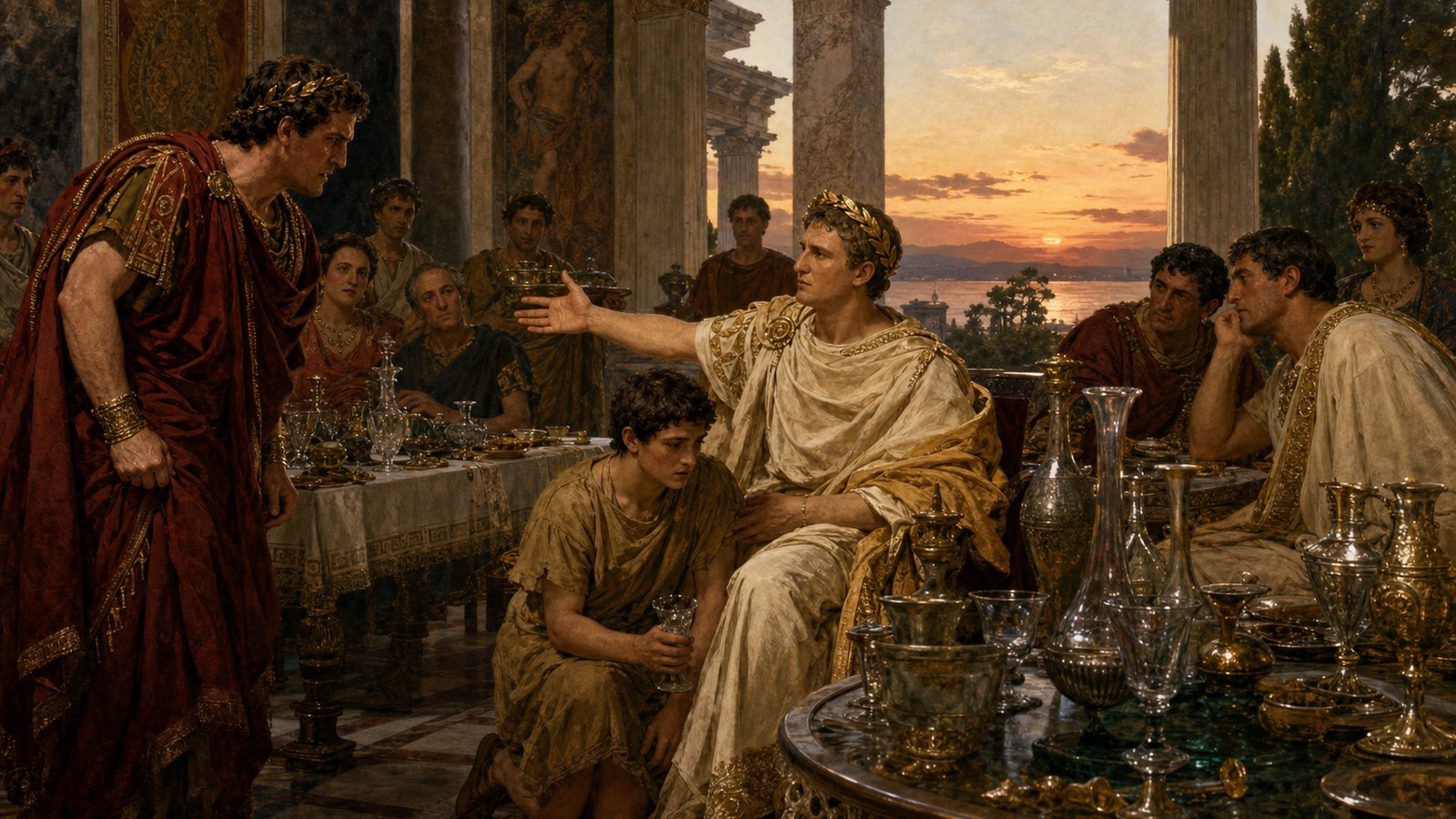
Every Valuable Vessel Became Expendable
Augustus asked that all drinking vessels of the same kind—or any others of value—be brought out so he could use them. Servants assembled the luxury objects at his command.
Then he ordered them broken. The scale transformed an accident into deliberate destruction. What one cup-bearer had done once, the emperor now did across the collection.
Dio explains the practical trap. Vedius was angry at the loss, but the one goblet no longer stood apart after many others had been ruined. He also could not punish his servant for an act Augustus had committed on a much larger scale.
The emperor did not argue that crystal lacked value. He demonstrated that its value was subordinate to his will. Vedius’s wealth had supplied the threat; Augustus used the same wealth to disable it.
The request to “use” the vessels created a moment of compliance before destruction. Vedius’s household brought the collection forward because an imperial guest had asked for it. By the time the purpose became clear, the objects were gathered within Augustus’s command.
Breaking all of them also redistributed humiliation. The servant’s accident had exposed one person to terror; the emperor’s order exposed the master’s inability to protect his own treasures. The watching guests saw authority change hands through household things.
Public dining often converted objects into status. Banquet seating arranged rank around the table. Here rank became visible through who could order objects preserved, broken, or exchanged for a life.
The Rescue Was Powerful but Not Universal
The cup-bearer survived the scene because Augustus happened to be present and chose to act. Dio does not turn the intervention into a general emancipation of Vedius’s household or a new code governing all masters.
That limitation is central. Imperial mercy could be spectacular while remaining personal. It protected one supplicant without making comparable protection predictable for others beyond the emperor’s view.
Augustus’s method also retained the language of mastery. He issued orders to Vedius’s servants, commanded the treatment of Vedius’s property and made the host absorb the result. He defeated cruelty by displaying superior control.
The story therefore flatters and troubles at once. Augustus appears humane beside Vedius, but the rescue depends on concentrated power rather than equal standing before law.
It also depends on the historian choosing an extreme comparison. Against a host associated with man-eating fish and arbitrary killing, imperial intervention can look moderate even when it operates by command. Vedius’s monstrosity supplies Augustus’s moral light.
The saved servant remains unnamed. Augustus and Vedius carry identities, offices, estates and reputations through the story; the person at risk survives as a household role. The imbalance reflects the social world Dio records as much as the intervention he praises.
Dio’s scene is crafted to contrast two rulers of households. One treated a fragile object as more valuable than a person. The other proved that both the object and its owner’s anger could be overruled.

Vedius Lost Control of His Own Memorial
Vedius later died and left Augustus a large share of his estate, including Pausilypon between Neapolis and Puteoli. He requested a public work of great beauty.
Augustus accepted the opportunity but denied Vedius the memorial he expected. Dio says the emperor razed Vedius’s Roman house, officially to prepare another structure but really so that no monument to him would remain in the city.
A colonnade rose there under Livia’s name, not Vedius’s. The afterlife of the estate repeats the banquet’s pattern at architectural scale. Property passed into imperial hands, while Vedius lost authority over how it would preserve his identity.
The official justification and Dio’s attributed motive do not perfectly match. Clearing a site for a new building could explain demolition; denying Vedius a monument supplies moral intention. Dio explicitly asks readers to see the second purpose behind the first.
Naming the colonnade for Livia redirected the social credit of construction. Vedius’s assets contributed to an urban improvement, but the inscription associated the finished space with the imperial household. Wealth survived as material after its owner’s name was detached.
The broken goblets had already shown that wealth could not shield him from an emperor’s command. The demolished house showed that even a bequest could be accepted while its donor’s desired memory was refused.
We should read the symmetry as Dio’s moral construction, not a transcript of private motives. Yet it gives the cup-bearer’s rescue lasting political meaning. Augustus did not only stop one punishment; the historian made him dismantle Vedius’s claims over bodies, objects and commemoration in a sequence of public reversals.
Sources
Cassius Dio, Roman History 54.23.