
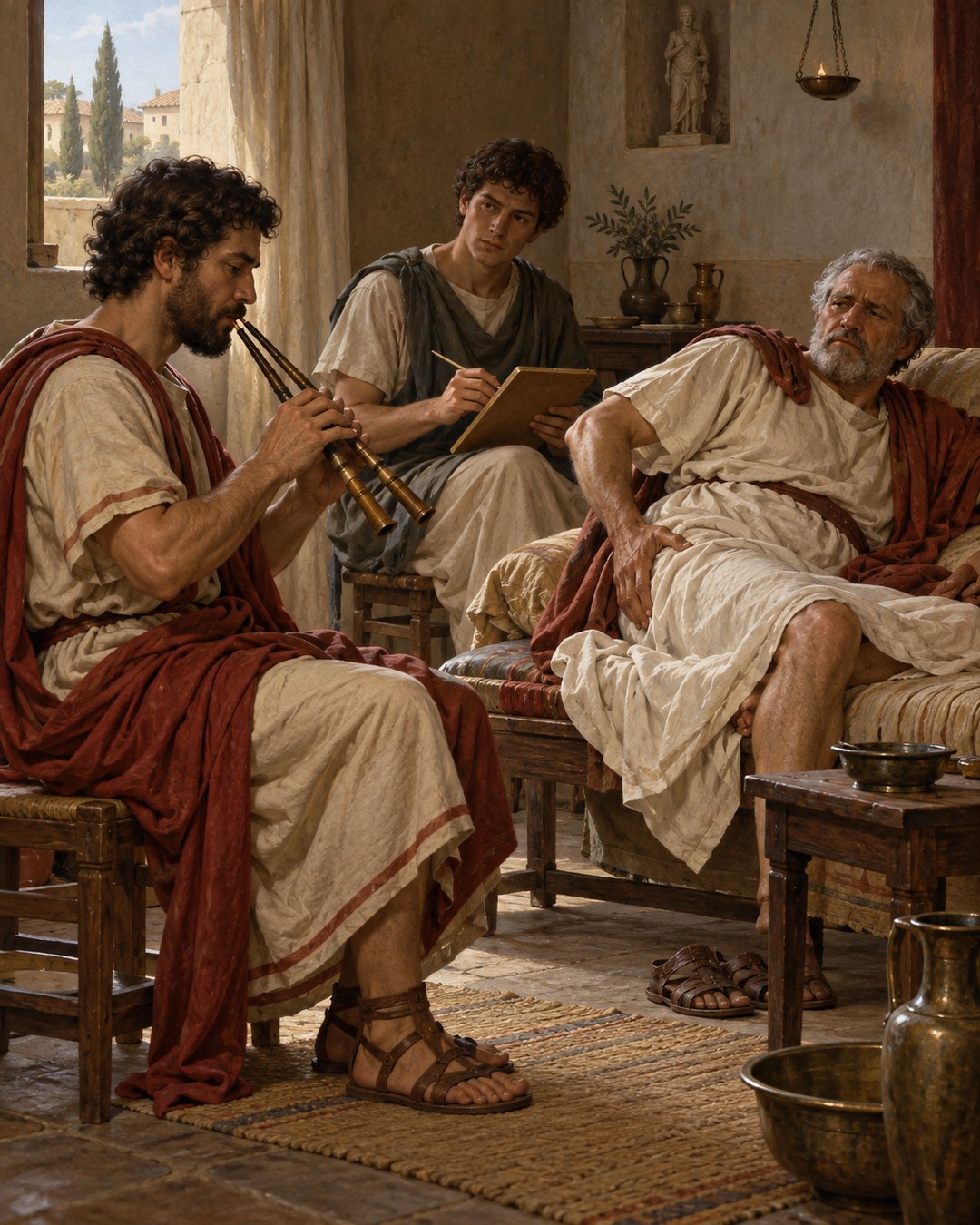
A flute-player enters Aulus Gellius’s notebook at the edge of severe pain. The claim he had read was precise enough to picture: when gout in the hips became most intense, soothing measures played on a flute were said to bring relief.
A second book carried the instrument into a more dangerous setting. Music played skilfully and melodiously was reported as a remedy for snakebite and other bodily ills. Gellius did not say that he watched either treatment work.
That distance is the key to the chapter. He named Theophrastus, Democritus, two book titles, two conditions, and the manner of performance. The result is not a clinical demonstration. It is a compact record of how an educated Roman reader preserved extraordinary therapeutic claims without disguising their route to him.
The gout remedy arrived through a named book
Gellius says he had encountered the statement very recently in Theophrastus’s On Inspiration. The phrase locates the claim in reading, not bedside experience.
He also says many people had believed it and committed that belief to writing. That wording is cautious. It reports a history of acceptance without turning acceptance into proof.
The complaint was gouty pain in the hips at its most severe. The treatment was not any noise from any pipe. A flute-player had to perform soothing measures. Tempo, mode, rhythm, volume, and skill could all hide inside that short qualification, though Gellius does not supply a score.
The detail matters because it makes the intervention repeatable in principle. A reader knows the affected region, the intensity, the instrument, and the emotional quality of the music. Yet the report provides no duration, comparison, dosage, or outcome beyond relief.
Pain is also unusually exposed to attention and expectation. Music might alter breathing, tension, fear, or the experience of waiting even if it did not change the underlying joint disease. That modern distinction is an interpretive caution, not a diagnosis supplied by Gellius.
His report therefore belongs beside, but not inside, a procedure such as Celsus’s sequence from finger pressure to a tonsil hook. Celsus describes bodily manipulation and fallback technique. Gellius preserves a claim about sound whose mechanism remains unstated.
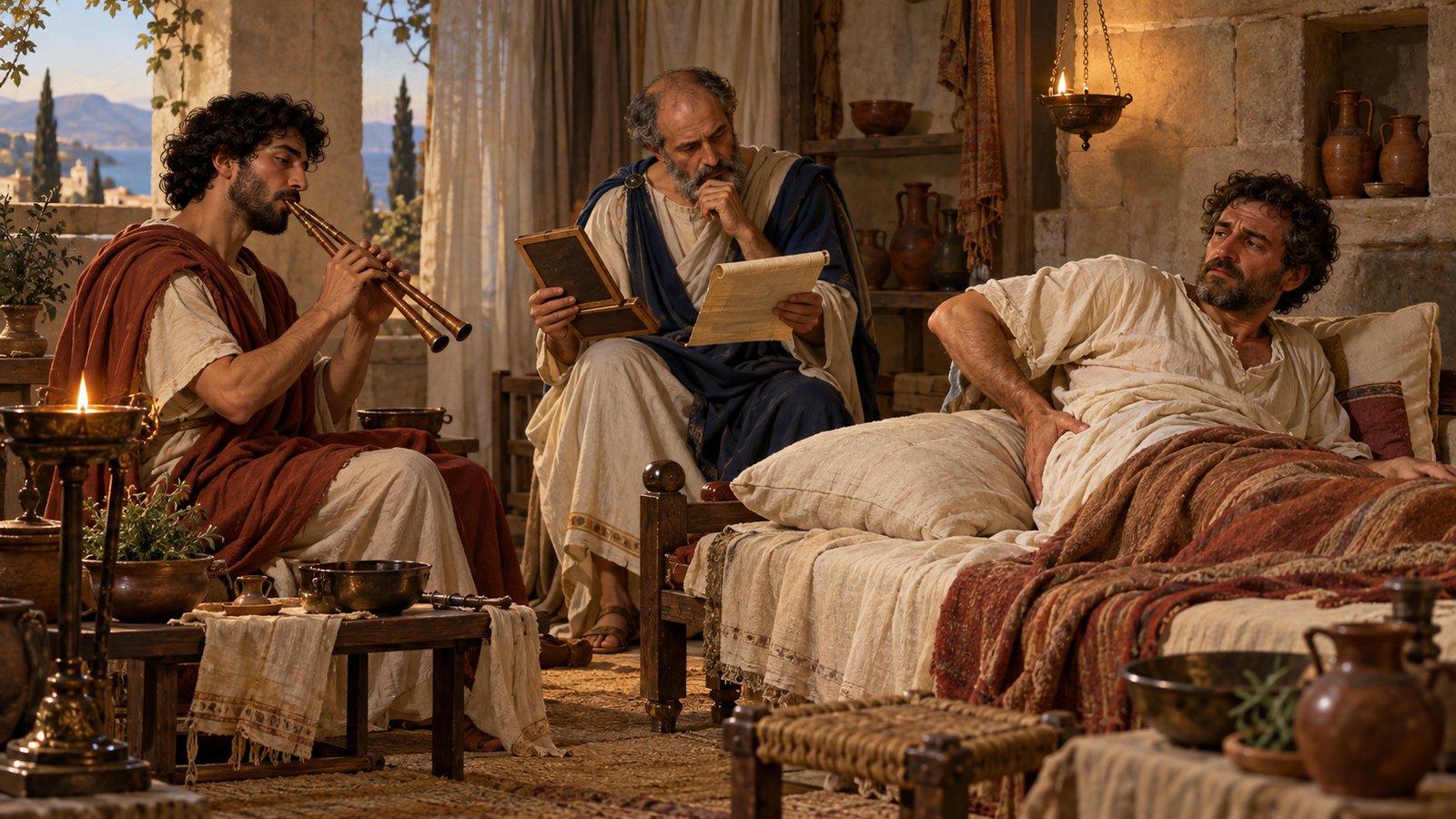
Snakebite raised the stakes and the evidentiary distance
The second example came from a work Gellius attributes to Democritus, On Deadly Infections. It said snakebites could be treated by flute music when performed skilfully and melodiously.
Here the danger of careless reading becomes greater. A report that someone believed in musical treatment is not permission to replace effective care. Gellius supplies no patient, species of snake, progression of symptoms, or survival record.
The wording nevertheless shows how ancient learned medicine could join natural philosophy, music, and collections of unusual remedies. A compiler could preserve a striking proposition because a respected name and book stood behind it.
Attribution acted as an intellectual handle. Readers could repeat “Democritus” and “Theophrastus” rather than presenting the cures as anonymous tavern stories. Named pedigree made the claim easier to store, debate, and transmit.
But names carried their own hazards. Works circulated under famous authors, excerpts lost context, and later compilers inherited claims they could not test. Gellius’s accuracy in naming his route helps us reconstruct transmission without guaranteeing the therapy.
The requirement for skilful, melodious playing also protected the claim from easy failure. If music did not help, an advocate might blame the performer rather than the remedy. Such elasticity is one reason a vivid treatment can survive without decisive evidence.
The evidentiary posture contrasts with the surgical warning that too many stitches worsened a summer wound, where material handling, season, and drainage organize a practical rule. The flute chapter offers authority and analogy rather than anatomy.
Gellius filed the claim under the bond between mind and body
After the two reports, Gellius draws a broad conclusion: bodies and minds are closely connected, and so are physical and mental ailments and their remedies.
His inference is broader than either case. Hip pain and snakebite do not share an obvious cause, yet the musical remedy allows him to group them under a common traffic between sensation and body. The analogy supplies unity where pathology does not.
That intellectual move explains why a miscellany is the right container. Gellius could place a medical curiosity beside grammar, law, biography, and philosophy because the value lay partly in the connection a learned reader drew between fields.
That sentence gives the anecdotes a shelf. The flute is not merely a curiosity; it becomes an example of influence crossing between sensation, emotion, and flesh.
Ancient listeners already knew music could change marching, worship, mourning, theater, and work. Extending that power to pain may have felt less abrupt than it does when isolated as a medical claim. Rhythm coordinated bodies in public before it entered this therapeutic note.
The chapter’s structure moves from recent reading to cited authority and then to general principle. It is a miniature argument: two attributed examples make a larger connection imaginable.
Yet Gellius never gives us the experiment needed to decide whether the cures worked. No untreated comparison appears. No recurrence is tracked. No failed performance is counted. The chapter records intellectual confidence, not controlled verification.
That does not make it useless for medical history. It reveals which details a Roman miscellanist thought worth preserving: where he read the statement, who wrote it, what hurt, what was played, and how the playing had to sound.
It also demonstrates responsible verbs. Gellius “ran across” a statement; people “believed” and “recorded” it; another book “stated” a cure. Those layers let a modern reader separate the existence of a claim from the truth of its outcome.
The book titles perform similar work. On Inspiration suggests one intellectual setting, while On Deadly Infections suggests another. Gellius brings their claims together, but he does not pretend they came from one unified therapeutic manual.
A physical notebook or roll could outlast the performance it described. The melody vanished when the player stopped; the attributed sentence remained available for excerpting centuries later. Preservation therefore favored the portable claim over the irrecoverable sound.
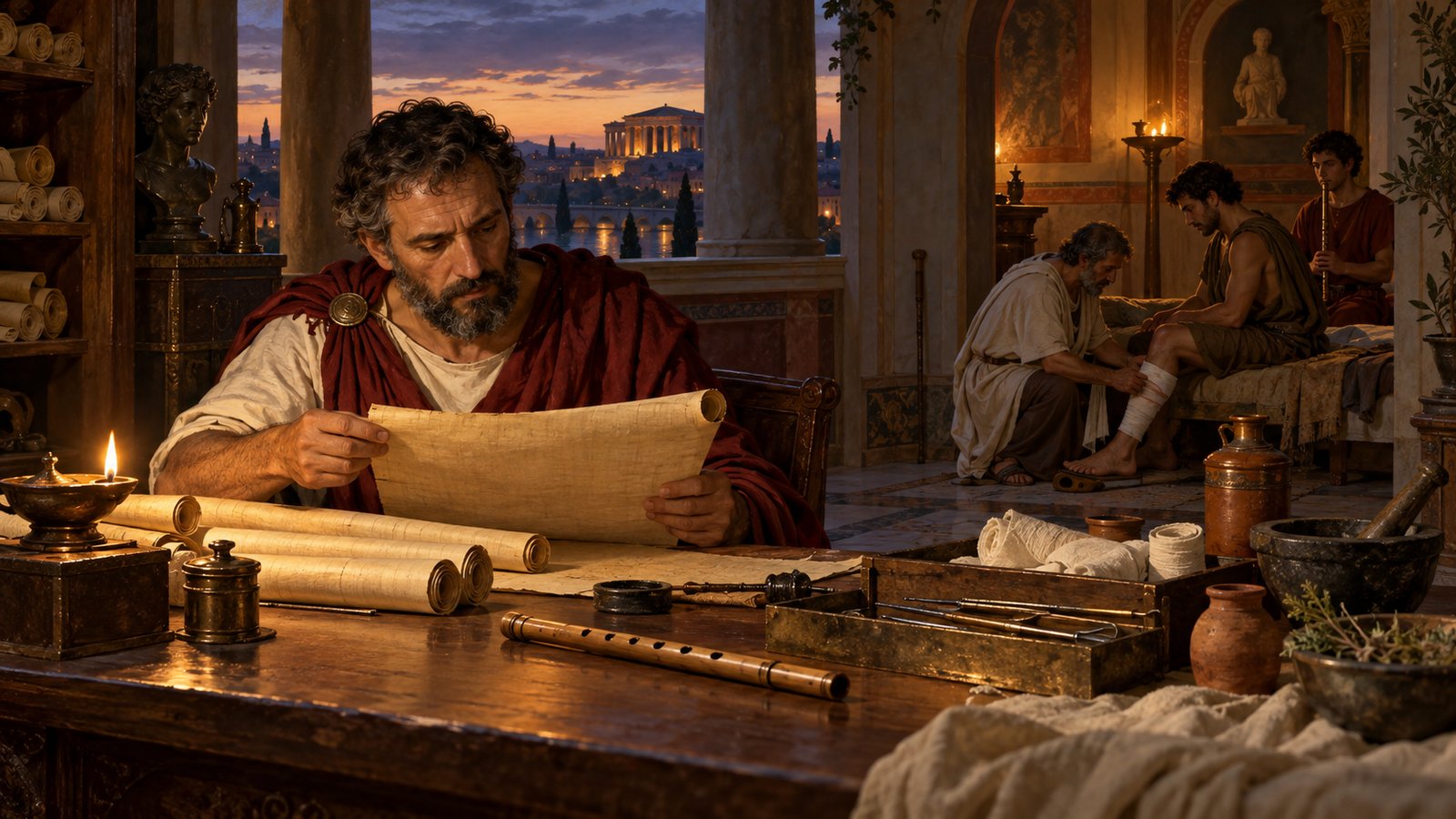
The compiler’s restraint is visible in what he leaves out. He supplies no dramatic recovery, no grateful patient, and no claim that the remedy belonged to his own household. A less careful retelling could convert the citations into a miracle story. Gellius keeps them as propositions encountered in books.
That restraint also protects the history from a false choice between gullibility and modern science. Ancient readers could be curious about an implausible remedy, reason from a mind-body connection, and still preserve attribution. Their standards were not ours, but neither were they devoid of distinctions between observation, report, and authority.
The flute-player consequently stands at the intersection of practice and archive. Someone had to perform, a sufferer had to listen, an author had to write, and Gellius had to select. By the time the scene reached Attic Nights, the surviving fact was not a healed joint or neutralized venom. It was a carefully attributed belief about music’s reach into the body.
That is a narrower conclusion than the ancient remedy promised, but a stronger historical one. Roman readers could treat the mind-body connection as a reason to keep surprising therapies in learned circulation, while the wording still allows us to see how far the compiler stood from the cure.
Sources
Aulus Gellius, Attic Nights, 4.13; Theophrastus, On Inspiration, and Democritus, On Deadly Infections, as cited by Gellius.