
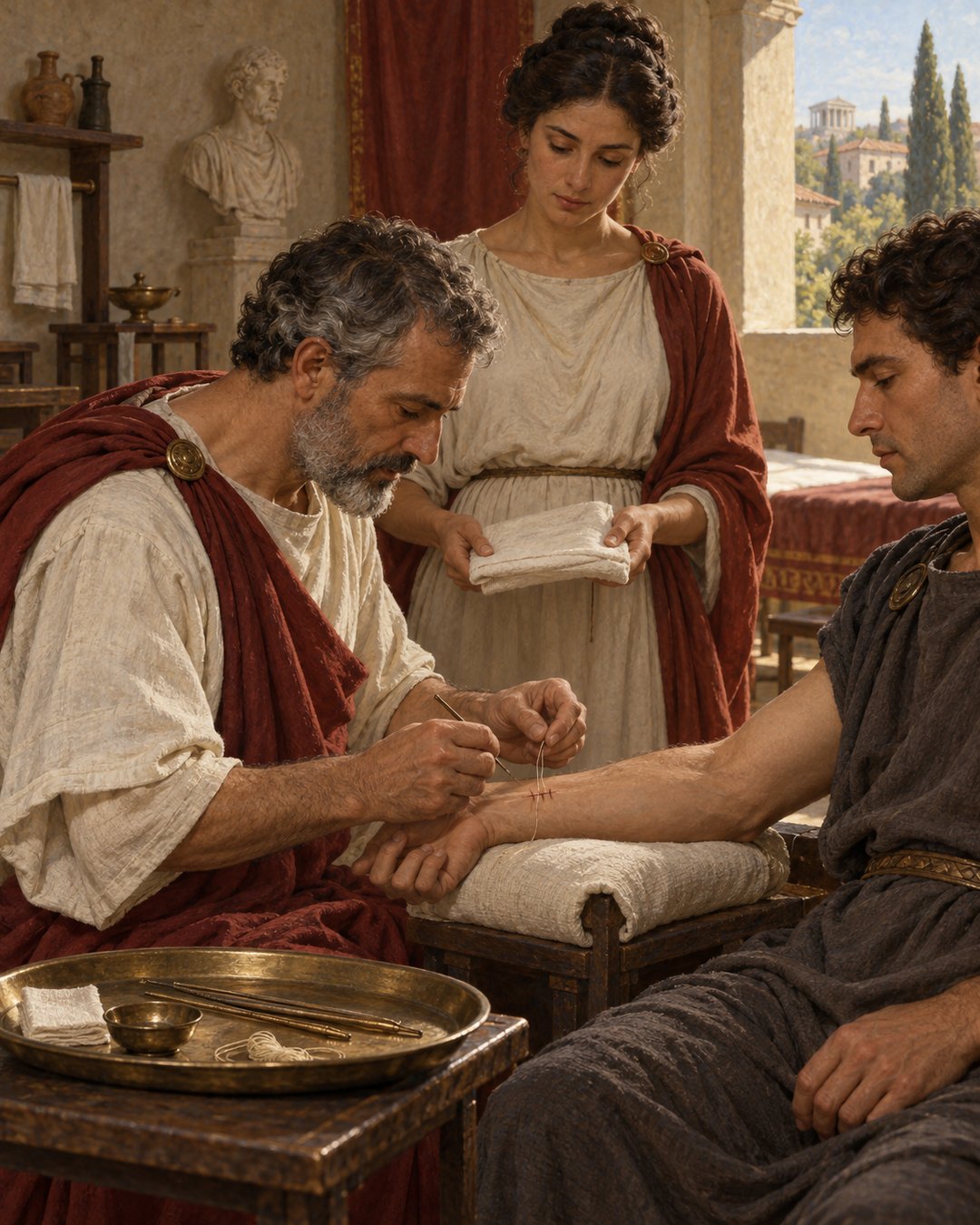
A Roman practitioner could make a wound worse by closing it too neatly.
Aulus Cornelius Celsus warned that stitches placed too far apart failed to hold. Placed too close, they multiplied the small injuries made by the needle and increased inflammation, especially in summer.
The task was not to force every edge into perfect contact. It was to join living tissue while leaving the wound a way to empty itself.
Closure Began with Deciding What Could Still Unite
Celsus introduces wound closure as one possible path, not an automatic response to every cut. When the condition of the injury allowed it, he considered agglutination—the joining of the separated parts—the best outcome. Skin could unite, and so could some wounds in flesh, provided no further damage prevented it.
Even a flap of flesh hanging free at one part was not necessarily lost. If it remained sound and retained a connection through which the body could nourish it, Celsus allowed that it might join again. Viability depended on attachment and condition, not simply on whether tissue had been displaced.
This was an observational decision. The practitioner first had to judge what kind of material lay at the margins, whether the tissue remained alive enough to recover and whether bringing the sides together would help rather than strain them.
Celsus names soft parts as suitable for stitching. His list is remarkably concrete: the tip of the ear, point of the nose, forehead, cheek, eyelid, lip, skin over the throat and skin over the abdomen. These were places where a separated edge could be guided back into position, but also places where a broad scar or badly aligned margin would be conspicuous or troublesome.
The list does not amount to a universal promise that every wound in those locations was safe. It shows the kinds of soft tissue for which Celsus expected a suture to be useful. His next distinction makes clear that the behaviour of the margins still governed the choice.
Another surviving operation shows the same habit of matching a method to the physical problem. Celsus used two protective blades when a broad weapon had to be withdrawn without cutting a second path. In both passages, the instrument mattered because of what the surrounding tissue would do as it moved.
A Gaping Wound Called for Clips, Not More Pull
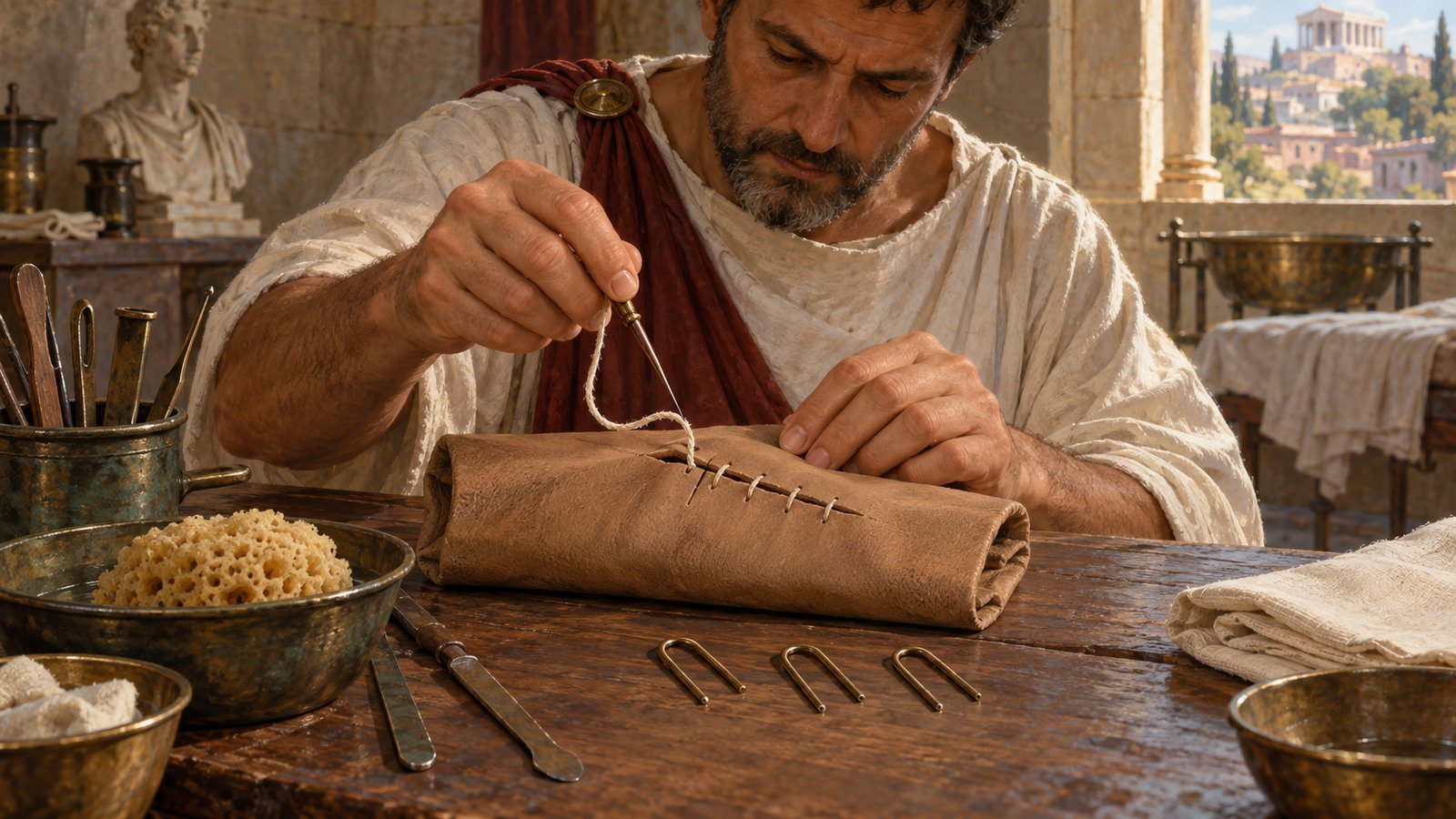
When a wound ran through flesh, gaped open and could not easily be drawn together, Celsus rejected ordinary stitching. More thread was not the answer to resistant margins.
He recommended fibulae, devices he notes were called ancteres in Greek. The word can evoke dress fasteners, but here it describes wound-closing clips or pins. Their purpose was limited and practical: draw the margins somewhat nearer and make the eventual scar less broad.
“Somewhat” carries the logic of the whole procedure. The clips narrowed the opening without pretending that difficult flesh should be made to behave like an easy skin cut. Celsus accepted a wider gap than a suture would leave because the alternative—forcing the margins—created its own damage.
The choice between suture and fibula therefore followed tension. A soft part whose edges answered gentle guidance could be stitched. A fleshy, resistant gap needed a device that reduced separation without demanding complete opposition.
Celsus applies the same choice to a partly detached flap: if the tissue remained capable of joining, its condition and the way its edges met determined whether it required thread or clips. He was not assigning one tool to one named injury. He was reading the mechanics of each margin.
This makes Roman wound care look less like a catalogue of heroic operations and more like controlled handling. A practitioner needed enough confidence to intervene, but also enough restraint to notice when the tissue refused the prettier closure.
Nothing Was Tied Until the Interior Was Clean
Before either a suture or a fibula entered the wound, Celsus required the interior to be cleaned. Closure performed over retained material merely hid a new source of trouble.
He singled out a blood clot. In his account, a clot left inside turned to pus, provoked inflammation and prevented agglutination. His explanation belongs to ancient medicine, not modern microbiology, but the procedural instruction is unmistakable: inspect and clear the space before reducing its opening.
Lint used to stop bleeding also had to come out. Celsus says it too inflamed the wound. A material that had served one purpose during bleeding became harmful when trapped beneath the next stage of treatment.
The sequence protected the decision already made. If the aim was union, the practitioner could not leave obstacles between the surfaces expected to join. If the wound needed drainage, he could not pack the route with forgotten dressing material.
That attention to sequence also appears in Celsus’s eye surgery. his cataract procedure depended on the needle’s entry point, angle and controlled movement rather than on the instrument alone. The wound passage is similarly procedural: cleaning, tool choice, depth, spacing and dressing form one chain. Removing any step changes the risk of the steps after it.
The text preserves no patient chart and gives no success rate. It cannot tell us how consistently practitioners followed these directions. What it does preserve is a reasoned order in which closing too early counted as a technical mistake.
Thread, Depth and Distance Had to Share the Load
Celsus did not want a stitch to catch skin alone. Where underlying flesh was available, the suture or fibula had to take up some of it as well. A deeper hold distributed the pull and reduced the chance that the closure would tear through the skin.
Material mattered too. He preferred soft wool that was not tightly twisted, explaining that it irritated the body less. The recommendation turns an ordinary fibre into part of the treatment: softness and twist altered how the closure sat against living tissue.
Then came spacing. If stitches or clips stood too far apart, the wound was not held together. If they crowded one another, the remedy became injurious. Every pass of a needle fixed another piece of tissue, but it also wounded another place.
Celsus explicitly says this inflammation was worse in summer. The season therefore entered the practitioner’s calculation at the scale of stitch intervals. Warm weather did not change the purpose of closure, but it raised the cost of unnecessary punctures.
The correct number cannot be recovered as a fixed measurement because Celsus gives none. That omission fits his rule. Distance depended on the size and behaviour of a particular wound: close enough to support, sparse enough not to turn closure into a row of fresh injuries.
Force had the same boundary. Neither thread nor fibula should drag tissue against serious resistance. The device was useful only as far as the skin followed its pull almost of its own accord. Once closure became a contest of strength, technique had crossed into trauma.
This is the central discipline of the passage. More closure was not automatically better closure. Depth, spacing, fibre and tension had to cooperate, and excess in any one could defeat the purpose of all the others.
The Last Gap Was Part of the Treatment
Celsus distinguishes the result produced by the two methods. Fibulae generally left a wound more open. A suture brought the margins together more closely.
Yet even the closer method was not supposed to create an uninterrupted seal. Celsus instructed the practitioner not to bring the edges into contact along the entire length. Any fluid collecting inside needed an outlet.
The unclosed portion was therefore not unfinished work. It was an intentional route, preserved because the internal condition could change after the hands and tools had left. A wound that looked tidier from outside could become more dangerous if tidiness trapped what needed to escape.
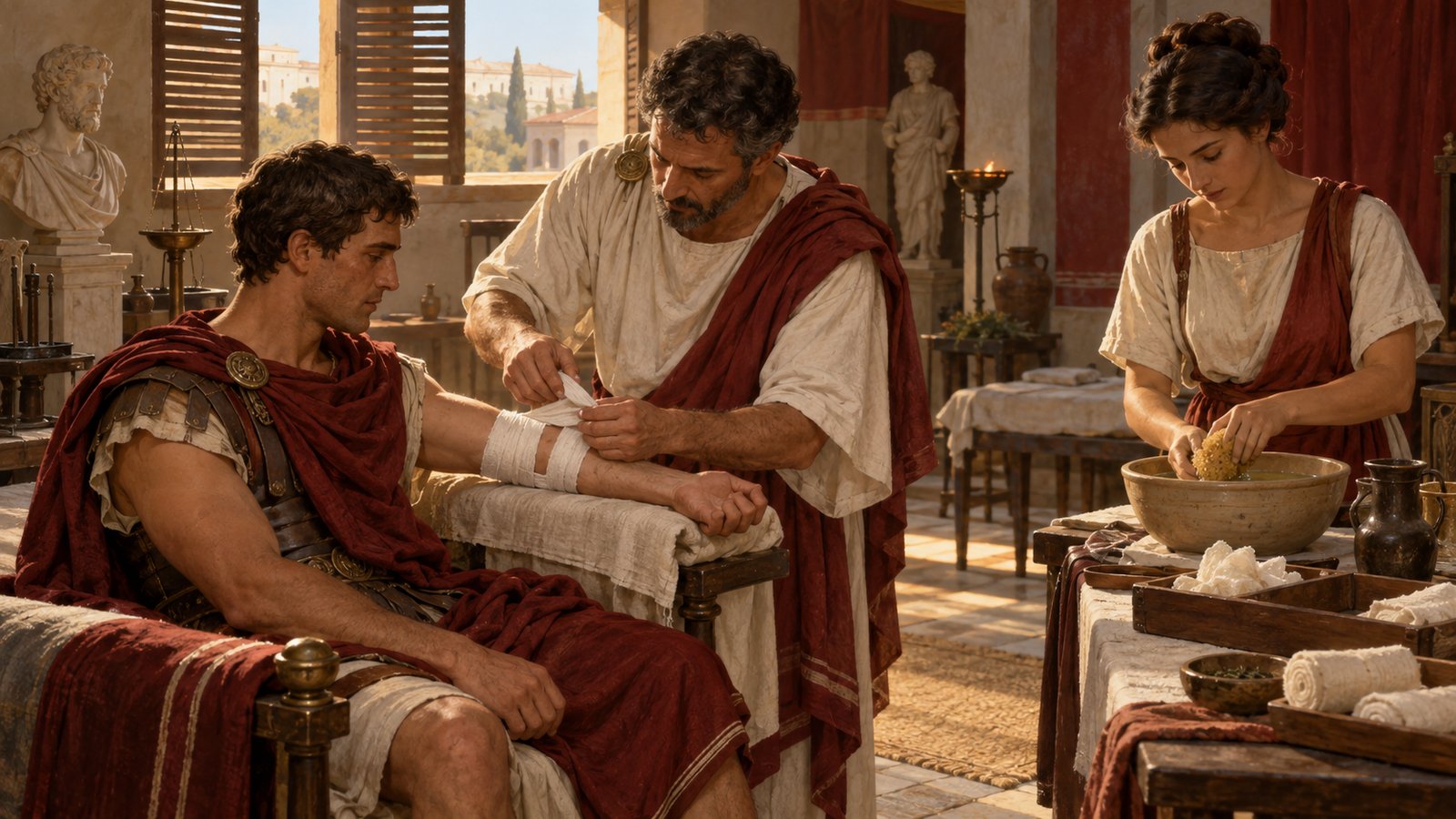
Celsus next turns to what lay over the injury. He recommends a sponge squeezed from vinegar, or from wine if the patient could not tolerate vinegar’s strength. For a slight wound, even cold water might be used. Whatever the liquid, the sponge helped only while it remained moist and should not be allowed to dry.
Bandaging followed the same middle path described for stitching. Elsewhere in the treatment he says the bandage should hold the wound together without constricting it: insufficient support let it gape, while excessive tightness carried grave danger. Knots were kept away from the wound because pressure there caused pain.
The entire procedure worked by calibrated incompleteness. Not every viable flap was cut away. Not every gaping edge was forced shut. Not every stitch was placed as close as possible. Not every part of the wound was sealed.
Modern readers should not turn these instructions into medical advice. They belong to a first-century medical text with ancient theories, materials and risks. Their historical value lies in the decisions Celsus believed a competent practitioner had to make with eyes and hands: what could unite, what should be removed, how the pull travelled and where an opening had to remain.
The most revealing part of his closure system was the space it preserved. Celsus understood that treatment could fail not only through neglect, but through doing too much of the apparently correct thing.
A row of stitches demonstrated intervention. The deliberate gap demonstrated judgment.
Sources
Aulus Cornelius Celsus, De Medicina, book five, section 26.23.