
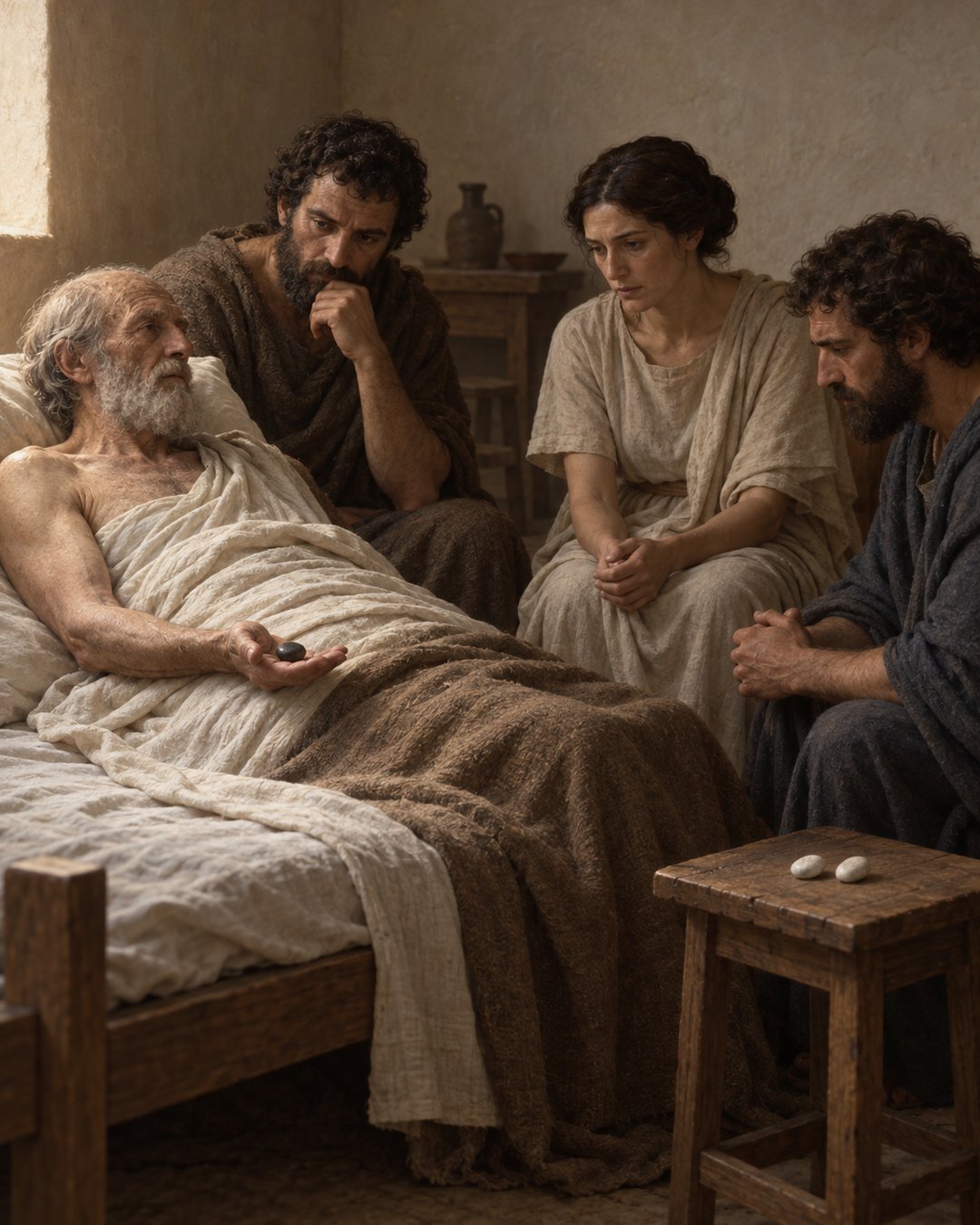
Chilo had one vote, two fellow judges and a friend facing death.
He secretly voted to convict. Then he persuaded the other two judges to acquit.
At the end of his life, the solution still felt less like an answer than an unpaid debt.
A Deathbed Memory Returned to One Ballot
Aulus Gellius introduces Chilo as a Lacedaemonian counted among the famous sages. Yet the story he preserves does not present wisdom as certainty. It begins with an old man examining the one decision that remained unsettled when almost everything else in his life could be remembered without regret.
Death was close. Friends stood around his bed, and Chilo told them that very little he had said or done over a long life troubled him. He did not claim perfection. One act still resisted a clean verdict, and even at that final hour he could not decide whether he had acted rightly or wrongly.
The event had placed him on a panel of three judges. The life of his friend was at stake. In Chilo’s own framing, the available paths seemed to demand either capital punishment for the friend or violence against the law.
That framing matters because it denies him an innocent option. He did not describe evidence that could honestly support either result. He understood the lawful judgment as conviction and the personal obligation as rescue.
Gellius does not identify the charge, the court, the date or the friend. Inventing those details would turn an ethical example into a false case file. What survives is the mechanism needed for the dilemma: three votes, one friendship and a penalty that could not be reversed after death.
Chilo said he considered the problem for a long time. The arrangement he finally chose appeared less objectionable than the alternative, not positively good. Its ingenuity lay in separating what a single person could not reconcile.
His Hand Chose Law While His Voice Chose Friendship
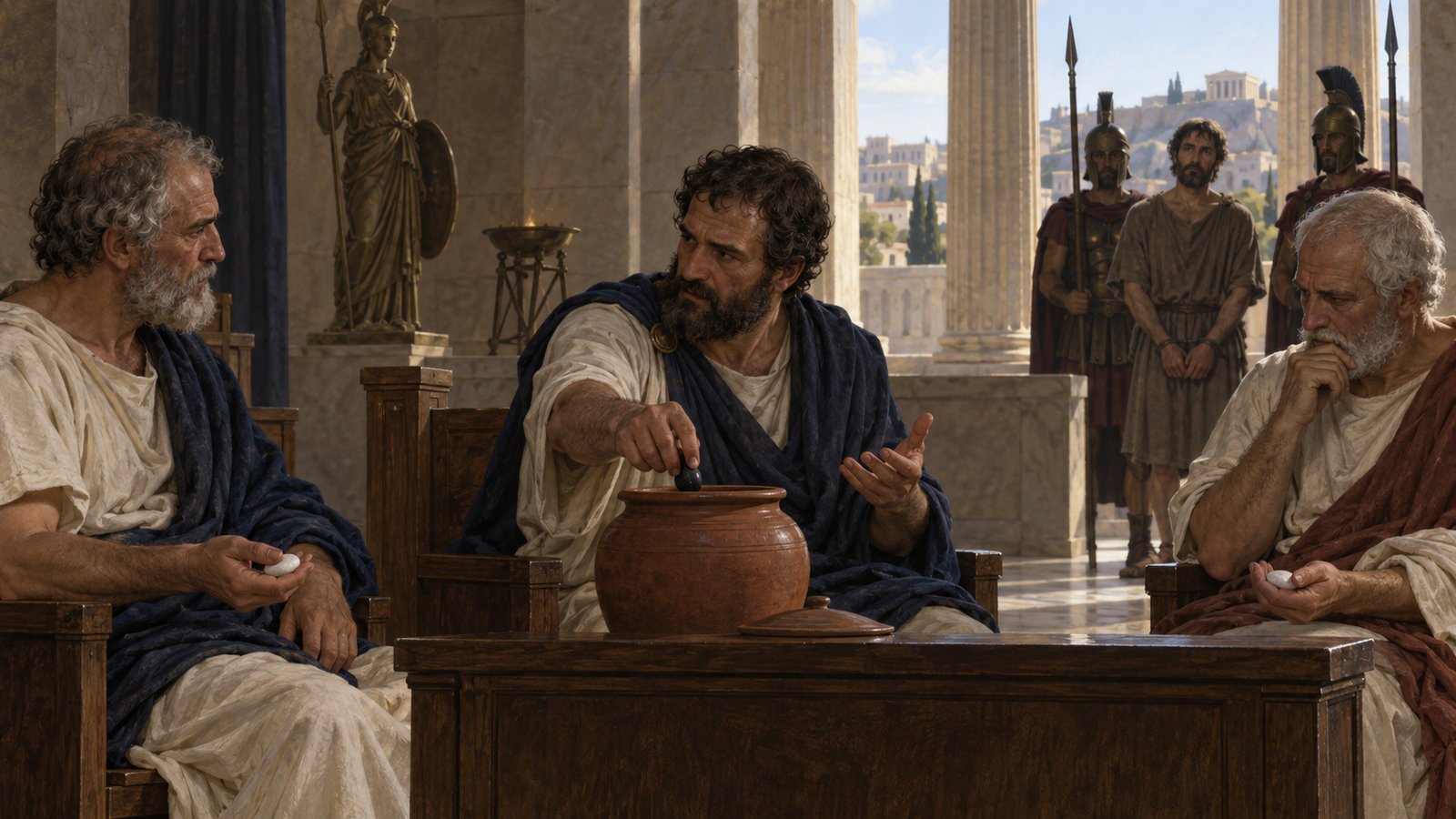
Chilo cast his own vote secretly for conviction. In the same proceeding, he persuaded the other two judges to choose acquittal.
The majority saved his friend. His private ballot allowed Chilo to tell himself that, in his own formal act as judge, he had followed the verdict demanded by law. He described the result as performing his duty both to justice and to friendship.
But the duties were not actually fulfilled in separate worlds. His speech shaped the other ballots. If acquittal violated the law, then Chilo helped produce that violation even while keeping his own pebble on the lawful side.
This was the source of his deathbed fear. He had recommended to colleagues, in the same case and under the same shared duty, a course contrary to the one he judged best for himself. The device may have distributed the actions, but Chilo remained the author of the distribution.
Secrecy sharpened the problem. His fellow judges heard an argument for acquittal without seeing that its advocate had voted to convict. The account does not say whether they knew his reasoning or whether the ballots were later revealed. Chilo’s confession emphasizes the split between private choice and public influence.
A recent Roman legal episode in the archive turns on a different restoration of context: tribunes stopped an aedile from prosecuting Manilia after hearing what had happened at her doorway. Chilo’s story moves in the opposite direction. The facts of the unknown case disappear, leaving only the judge’s attempt to occupy two moral positions at once.
His plan succeeded procedurally. The friend lived. Its moral accounting failed to close, because the vote that kept Chilo’s hand lawful depended on two votes he had urged away from law.
Cicero Drew a Boundary but Left It Unmeasured
Gellius expands the episode into a question studied by later philosophers: may someone act contrary to law or precedent for a friend, and if so, under what circumstances and how far?
He names Theophrastus’s On Friendship as an especially thorough treatment, while carefully noting that he recalls its location in the first book. He then turns to Cicero, who had read Theophrastus when composing his own work on friendship.
Cicero’s general boundary allowed friends to depart from the straight path when a companion’s life or reputation was endangered, provided that “utter disgrace” did not follow. Friendship could justify a bend, but not an unlimited collapse.
Gellius found that formula too broad at exactly the point where guidance was needed. What kind of deviation was permitted? How far could it extend? Which dishonourable request remained tolerable, and what transformed an accommodation into utter disgrace?
The criticism is practical rather than merely verbal. Chilo already knew that friendship had limits. His problem was locating the limit inside one capital case. A rule that says “not too far” cannot identify whether persuading two judges to cast votes one refuses to cast is before or beyond the boundary.
Gellius quotes an easier prohibition from Cicero: one must not take up arms against the fatherland for a friend. He dismisses its usefulness because an extreme case does little to guide the crowded middle, where public peace remains intact but law, equity, reputation and rescue pull in different directions.
Pericles supplied a memorable answer when asked to perjure himself for a friend: aid friends only as far as the gods allow. That refusal marks a boundary, but it still leaves the evaluator to determine what divine or moral permission requires in a less obvious case.
Broad maxims can identify the cliffs. Chilo’s torment occupied the slope.
Theophrastus Put Rescue and Reputation on Scales
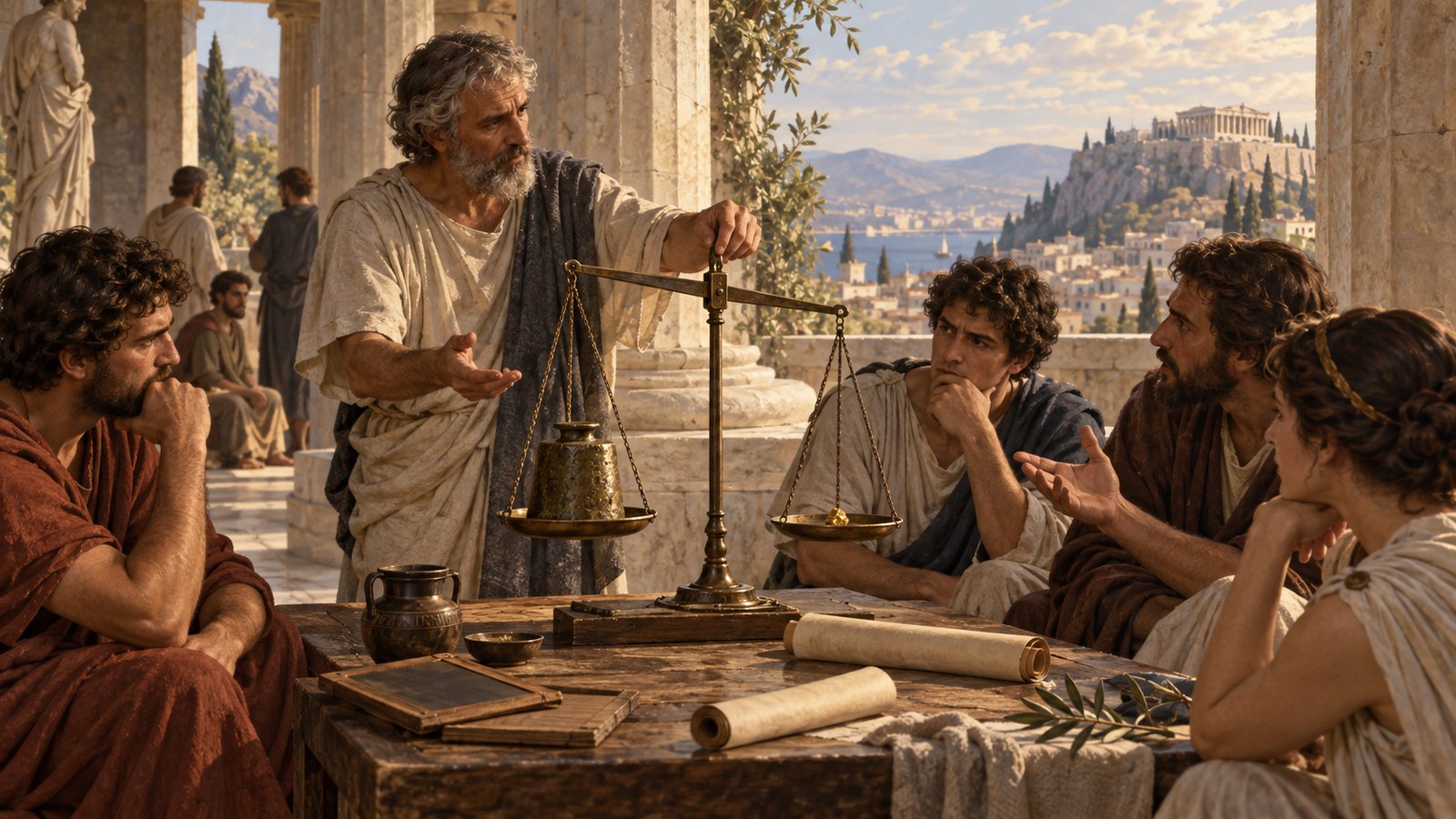
Theophrastus approached the problem by comparing magnitudes. A small amount of disgrace, he argued, might be accepted if it produced a great advantage for a friend.
The comparison did not treat every piece of honour as automatically superior to every practical benefit. When a friend’s interest and one’s own honour were equal or nearly equal in importance, honour should prevail. When the friend’s advantage was far greater and the reputational sacrifice slight, the balance could reverse.
His material analogy made the point vivid. Gold is more valuable than bronze when corresponding portions are compared. Yet a great weight of bronze can exceed a tiny fragment of gold. The class to which something belongs does not settle the value of every unequal quantity.
Applied to friendship, the image prevents labels from deciding the case too early. “Honour” cannot win merely because it is honour, just as “benefit” cannot excuse every betrayal. The size and consequence of each stake have to be weighed.
Chilo’s friend faced death, the heaviest advantage imaginable for the person being helped. What did Chilo place on the other pan? Not only his reputation. The integrity of a shared judgment and the agency of two colleagues also entered the balance.
That is where his device complicates Theophrastus’s scale. Chilo did not openly accept a small stain on his own name to save another. He preserved his personal vote, while persuading other judges to perform the unlawful part of the rescue. The question becomes not merely how much honour may be sacrificed, but whose honour is being spent.
Favorinus offered a compact definition: favour is a relaxation of strictness in a time of need. Chilo certainly relaxed strictness. The secret ballot asks whether he accepted that relaxation honestly or concealed it inside a division of labour.
The Missing Universal Rule Was the Point
Gellius praises Theophrastus for care and precision, yet says even that fuller discussion did not deliver a decision for every separate action. It described classes of conduct and the forces that alter their weight.
Individuals, conditions, necessities and existing circumstances can steer duty. Those factors are difficult to reduce to rules and can make similar-looking acts appear justifiable in one setting and unjustifiable in another.
This conclusion does not make judgment arbitrary. It explains why more facts, not fewer, are required. A maxim about loyalty needs the friend’s danger, the requested act, the public harm, the available alternatives and the person expected to bear the compromise.
Roman political stories often preserve the same pressure in material form. Cicero’s denial of a house purchase became revealing only when the two-million-sesterce loan behind it entered public view. Chilo’s confession likewise restores the hidden transaction behind a successful acquittal: his own contrary vote.
The tale offers no secure information about whether the friend was guilty, and it does not ask readers to retry the lost case. It examines Chilo’s authorship of the outcome. He chose conviction with his hand, acquittal with his influence and uncertainty with the memory he carried to his deathbed.
His cleverness saved a life without requiring him to cast the decisive unlawful vote. That may be the source of its attraction. It is also the source of its ugliness. A person can preserve a record of personal correctness while arranging the collective result he claims not to endorse.
Gellius refuses to rescue Chilo with a slogan. The sage remains wise enough to see the unresolved cost of his own solution.
Three judges made the acquittal possible. One man’s divided agency made it impossible, even at the end of a long life, to say where duty had ended and betrayal begun.
Sources
Aulus Gellius, Attic Nights, book one, chapter three. Gellius discusses Theophrastus, On Friendship, and Cicero, On Friendship.