
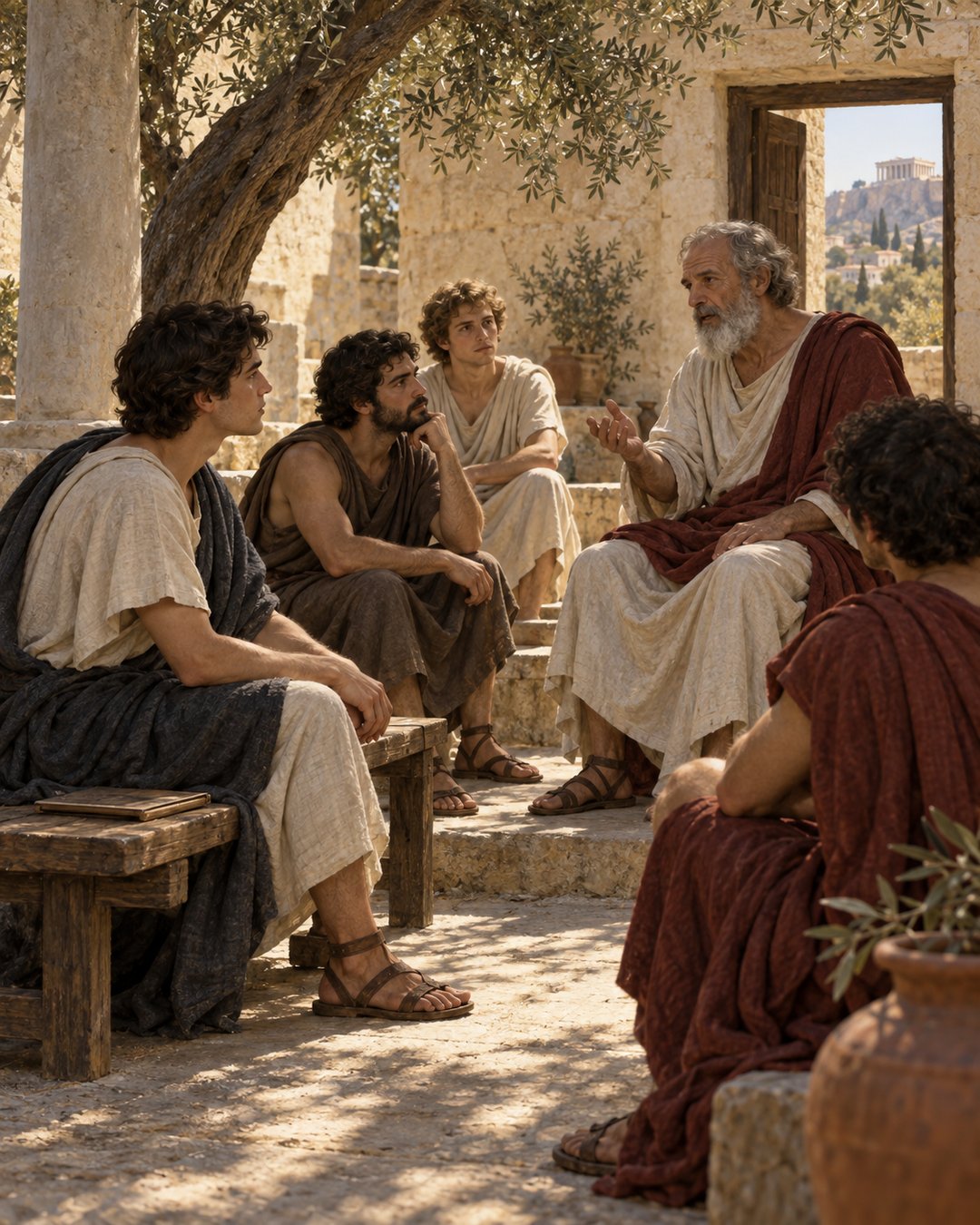
A new pupil entered the Pythagorean school with a restriction more demanding than any reading list. He could listen, but he could not ask a question.
Aulus Gellius says the shortest such period lasted two years. For some candidates, the silence lasted longer.
The school did not begin by filling a mind with doctrines. It began by controlling when a student could join the conversation at all.
Admission Began with a Reading of the Body
Gellius presents the procedure as the order followed by Pythagoras and then by his school and successors. His immediate setting is a discussion by the philosopher Taurus, who used the old curriculum to criticize the habits of students in Gellius’s own day.
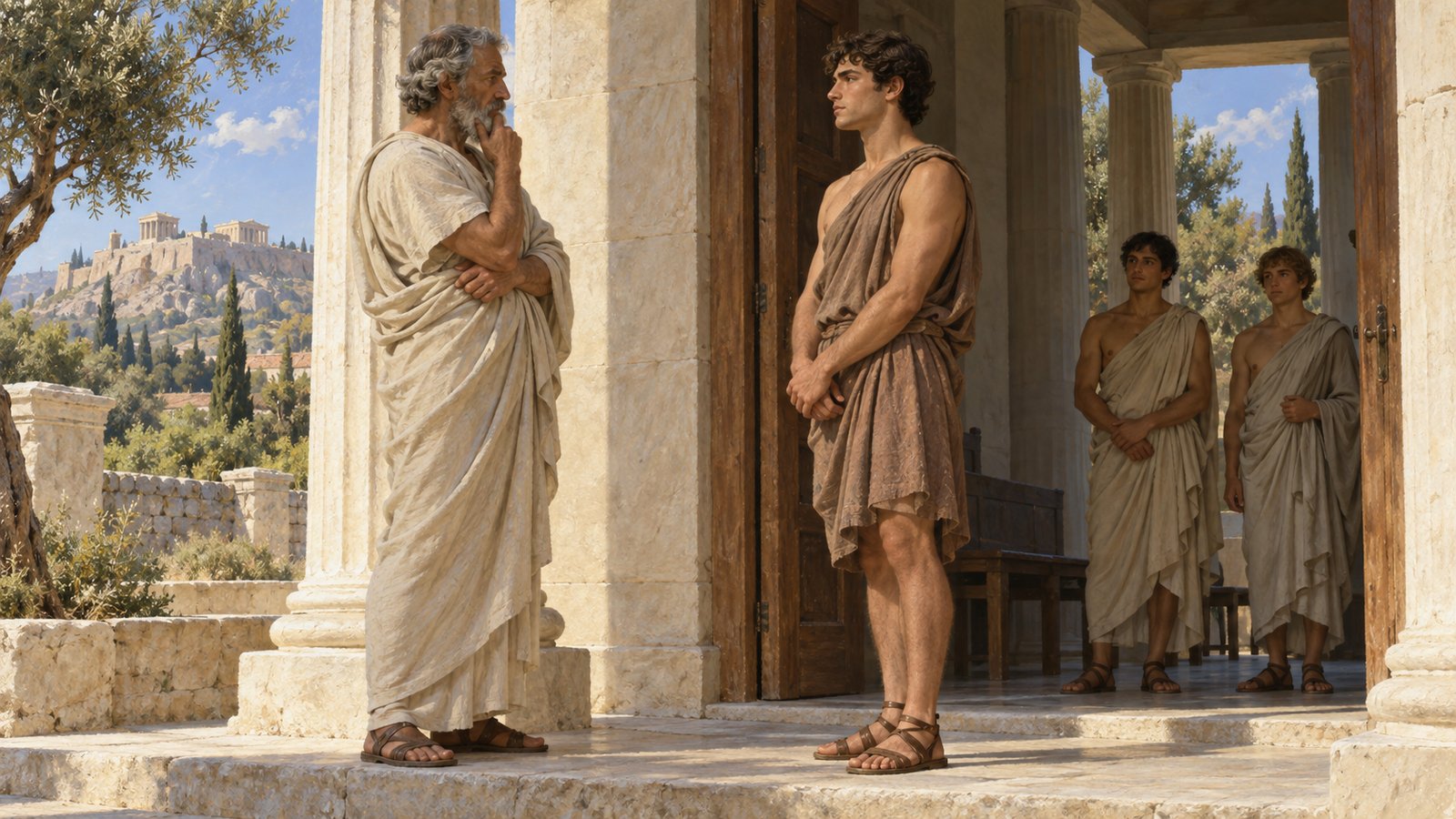
The first test came before admission. Pythagoras, Gellius says, “physiognomized” the young men who offered themselves for instruction. Gellius pauses to define the unfamiliar verb rather than leaving it as a mysterious technique.
It meant drawing an inference about character and disposition from facial appearance and expression, together with the form and bearing of the whole body. The account does not describe a written examination, an interview about preferred authors or a demonstration of memorized propositions. The candidate’s visible manner became the first evidence.
That practice should be reported as the ancient source describes it, not converted into a reliable science of personality. Gellius tells us what the school was said to inspect. He does not prove that expression and posture disclosed character accurately.
If the candidate appeared suitable, admission followed. Yet acceptance did not release him into debate. Pythagoras assigned a fixed period of silence, and its length differed according to his estimate of how quickly that particular student could learn.
The variable term matters. Silence was not merely a ceremonial number imposed identically on everyone. In Gellius’s description, it was an individual probation decided by the teacher who had just judged the candidate’s bearing.
The doorway therefore separated two decisions. First came a judgment that someone could enter. Then came a judgment about how long he had to remain present without a speaking role.
The First Rank Could Listen but Not Interrupt
No one, Gellius says, kept silent for less than two years. During that period the pupils were called “auditors,” a name that defined them by the faculty the school permitted them to use.
They listened to what others said. If they failed to understand something fully, they still could not ask for an explanation. They could not add a remark about what they had heard. The rule withheld both clarification and display.
That makes the silence more exacting than ordinary classroom quiet. A student was not simply waiting politely while a teacher completed a sentence. He had to carry confusion forward without immediately turning it into a question, and he had to hear an argument without demonstrating that he possessed a competing one.
Gellius calls this stage a training in keeping quiet and listening. Its object was “continence in words”: the ability to restrain speech rather than release every thought at the moment it formed.
The surviving description does not tell us what an auditor did outside the lessons, how instructors corrected misunderstanding or what caused a particular probation to end. Those gaps prevent a full reconstruction of daily school life. The secure mechanism is narrower: a minimum term, a prohibition on questions and comments, and a rank named for listening.
Silence also made progress difficult to counterfeit. A novice could not seize attention with a polished intervention or perform intelligence through constant objections. He remained exposed to a simpler test: whether he could continue listening under a rule he had not designed.
Another philosophical episode in Gellius measures seriousness through conduct rather than costume. Herodes Atticus confronted a visitor whose beard and cloak advertised philosophy before his behaviour did. The Pythagorean probation placed that problem at the entrance and delayed the privileges by which a clever novice might advertise himself.
Permission to Speak Changed the Student’s Name
The end of silence did not simply return a freedom temporarily removed. It marked entry into a different category within the school.
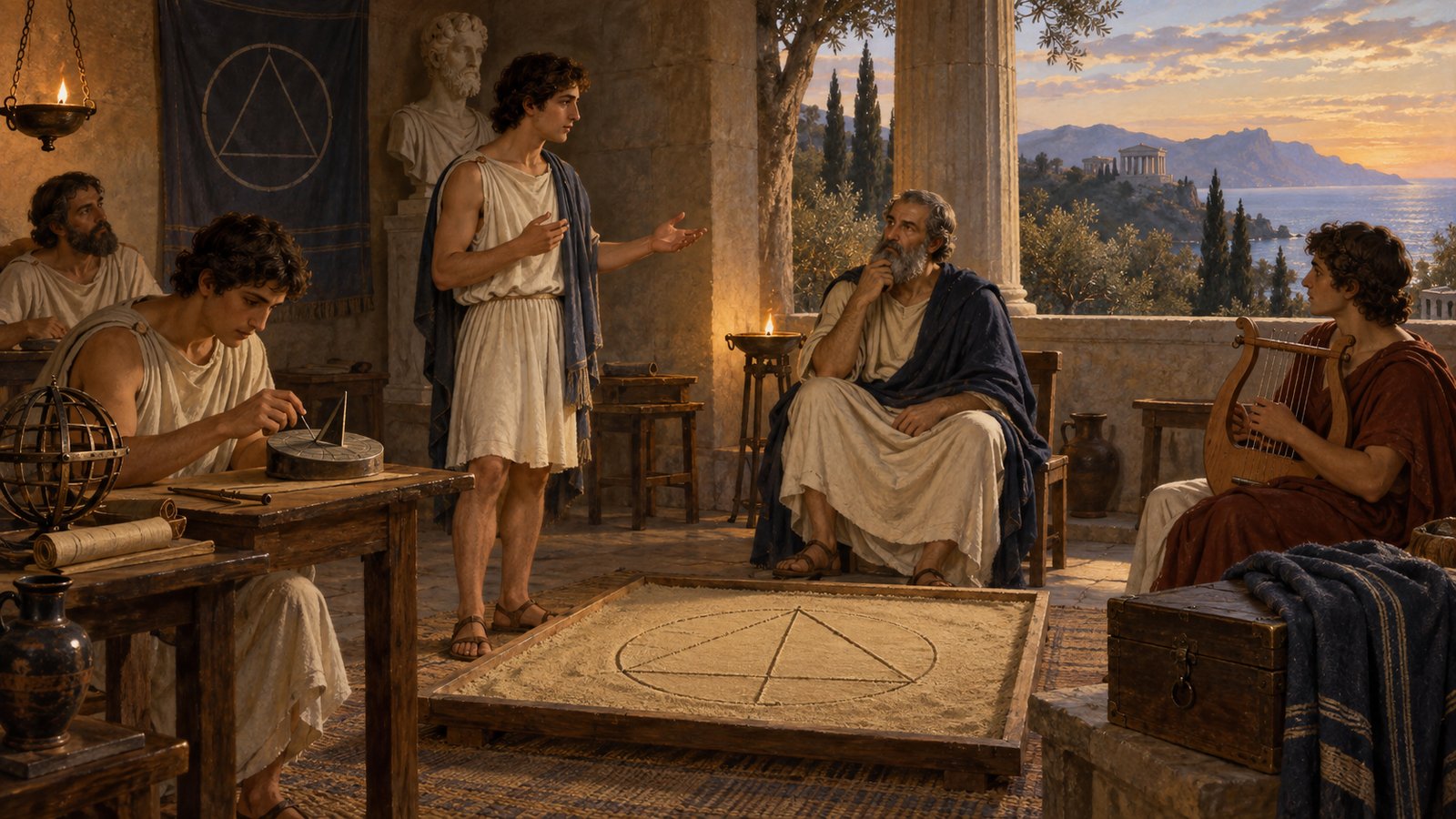
Once pupils had learned the difficult discipline of quiet attention, Gellius says, they were allowed to speak. They could ask questions, write down what they heard and express opinions of their own. Voice, inquiry, notes and judgment arrived together.
The list shows why the earlier rule cannot be reduced to a ban on noise. Writing was also withheld. The novice did not construct a private transcript while remaining orally silent. The later pupil gained several methods of handling teaching at once: preserve it, test it and answer it.
At this stage the pupils were called “students of science.” Gellius connects the name with the subjects they now began to learn and practise. He lists geometry, gnomonics and music among the branches that ancient Greeks classified as higher studies.
The new title therefore recorded a change in activity. An auditor received speech. A student of science could work with forms, measures, shadows and harmonies, then bring a question or opinion into the room.
This sequence resists the modern temptation to make every phase sound equally participatory. The source describes unequal permissions, deliberately arranged. A person inside the school could be a recognized pupil and still lack the right to ask why.
Gellius does not say that every question was welcomed or that every opinion carried equal weight. He says only that those actions became permitted after the initial discipline had been learned. Promotion opened the tools of inquiry; it did not erase the hierarchy that granted them.
Science Was a Middle Stage, Not the Summit
Geometry, gnomonics and music did not complete the progression. Equipped with scientific training, pupils moved onward to investigating the phenomena of the universe and the laws of nature.
Only then, Gellius says, were they called natural philosophers. The school’s vocabulary thus preserved at least three stages: auditors who listened, students of science who could question and practise higher studies, and natural philosophers who pursued the order of nature.
The arrangement gave names to earned capacities rather than applying one impressive label from the beginning. A newly accepted candidate was not treated as a natural philosopher because he had entered a philosophical building. His title identified what he was currently trusted to do.
Taurus used that old sequence as a rebuke to contemporary students. In his complaint, newcomers arrived “with unwashed feet” and tried to lay down the law about their own education. One demanded to start with this subject; another announced what he did and did not wish to learn.
Some wanted Plato’s Symposium for the revel involving Alcibiades, while another wanted the Phaedrus because of the speech of Lysias. Taurus sharpened the criticism with the example of a man who asked to read Plato not to improve his life or judgment, but to ornament his diction and style.
The contrast is not between ancient obedience and a documented modern university. It is Taurus’s polemic, preserved by his student Gellius. Yet the target becomes clear when placed beside the Pythagorean ranks. The impatient student wanted to select the attractive surface of philosophy before accepting its sequence of formation.
A recent Roman teacher could also distrust the wrong sign of success. Musonius treated an audience’s silent absorption as better evidence than loud applause. Taurus’s example goes further backward: before a pupil could impress an audience, he first had to endure being only an audience.
Property Crossed the Threshold with the Pupil
Gellius adds one final fact that changes the scale of admission. Those accepted into the Pythagorean band immediately devoted whatever estate and property they possessed to common use.
He describes the result as an inseparable fellowship and compares it with an old Roman legal arrangement called an undivided inheritance. The analogy translated a Greek philosophical community into a form his Roman readers could recognize: goods not partitioned into separate portions, but held together.
This pooling of property did not wait until a pupil became a natural philosopher. In Gellius’s wording, it happened as soon as disciples were admitted. A candidate could therefore surrender separate control of possessions before earning the right to interrupt a lesson.
The combination makes the curriculum more than a timetable of subjects. Admission reorganized material life. Silence reorganized social presence. Promotion reorganized access to speech, writing and opinion. Scientific training then opened the path toward inquiry into nature.
We do not know from this chapter how property was administered, whether every later Pythagorean community followed the same rule or how departures were handled. Gellius offers a compact idealized order, not account books or school regulations recovered from an archive.
Even within those limits, the architecture is unusually clear. The school did not treat curiosity as sufficient proof of readiness. It placed thresholds between desire and participation, then named pupils by the work each threshold allowed.
Two years of silence can sound like the whole story because the number is memorable. In Gellius’s account, however, the minimum term was only one component. The more revealing system linked observation at the entrance, disciplined listening, permission to record and question, mathematical training, natural inquiry and common property.
The first question mattered because it was not free. It announced that the listener had crossed from receiving a discipline to practising one.
Sources
Aulus Gellius, Attic Nights, book one, chapter nine.