

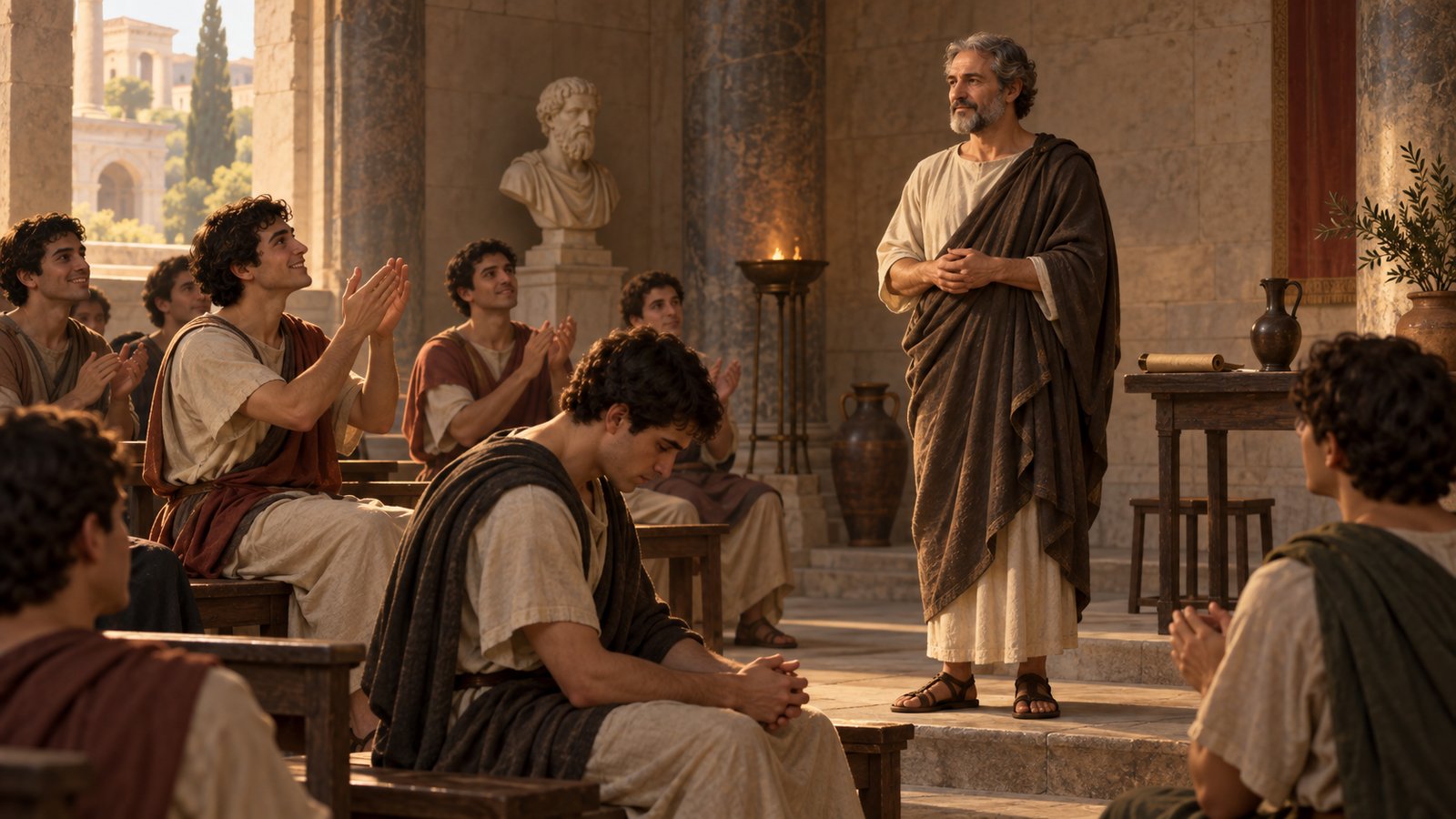
The philosopher finished, and the room erupted. Hands moved, voices rose, bodies leaned into the rhythm of approval. To Musonius, that response could be evidence of failure rather than success.
Aulus Gellius preserves his criticism in a short chapter about how people listened to philosophy. Musonius did not object merely to one rude interruption. He described an audience carried away by verbal charm, rhythm and almost musical effects. When familiar cries of praise, shouting and gestures answered those pleasures, the event resembled a flute-player’s recital more than a lesson meant to change a life.
The alternative was not boredom. Musonius expected a useful argument to produce strong effects: a shudder, private shame, repentance, joy or wonder. Those responses could alter a listener’s expression because the words had reached his awareness of what was noble or base in himself. The audience’s body still reacted, but its attention had turned inward.
His sharpest distinction comes at the end. Applause can accompany admiration, he allows. The greatest admiration, however, gives rise not to words but to silence. For proof he reaches beyond the lecture room to Homer, where Ulysses ends the account of his hardships and leaves an entire hall hushed.
Noise Could Turn a Lesson into a Flute Recital
Musonius begins with the kinds of work a philosopher’s speech is supposed to do. It may encourage, warn, persuade or rebuke. It may take up another philosophical subject. In every case, the purpose lies beyond the immediate pleasure of a well-shaped sentence.
That purpose makes the audience’s response significant. Musonius lists praise that is trite and commonplace, offered without reflection or restraint. He adds shouting and gesticulation. These are not neutral details in his comparison; they show listeners answering the performance before they have attended to the correction it carries.
Charm, verbal rhythm and musical notes can stir and sway them. Musonius does not need to claim that clear or attractive speech is itself forbidden. His criticism falls on what takes command of the occasion. If the hearers are moved chiefly by the sound and pattern of delivery, speaker and audience are wasting their time.
The flute-player comparison makes that failure visible. A recital can properly invite delight in musical movement. A philosophical warning has another claim on the listener. It asks him to examine conduct, desires and judgment. Treating both occasions as the same kind of entertainment leaves the philosopher’s harder task unfinished.
Gellius’s wording also places responsibility on both sides. The hearers waste their time, but so does the speaker when the performance supplies only material for noisy approval. The crowded room may sound successful while failing the standard Musonius applies.
Helpful Words Left No Leisure for Display
Musonius next follows the speech into the listener’s mind. So long as what is said is helpful and salutary, and so long as it offers a cure for faults and vices, the hearer has no time or leisure for continued extravagant applause.
The phrase “no leisure” changes the problem. Silence is not imposed by a rule that everyone must remain stiff and expressionless. The listener is already occupied. He cannot simultaneously inspect himself and sustain a public display of approval without one activity displacing the other.
Musonius describes philosophy in therapeutic language, as something that furnishes a cure. That image does not make the process gentle. A warning identifies danger; a rebuke exposes conduct; persuasion asks a person to abandon one judgment for another. Useful speech may be difficult precisely because it refuses to leave the hearer as he entered.
A Stoic who turned pale in a storm supplies another argument about involuntary reaction and considered judgment. Musonius’s scene is different: the pressure comes from words rather than weather. Yet both passages take bodily response seriously without treating the first visible movement as the final measure of a mind.
For Musonius, applause becomes suspect when it occupies the space needed for recognition. The sharper the cure, the less spare attention remains for proving to other people that one appreciates the doctor.
The Listener’s Face Became Part of the Evidence
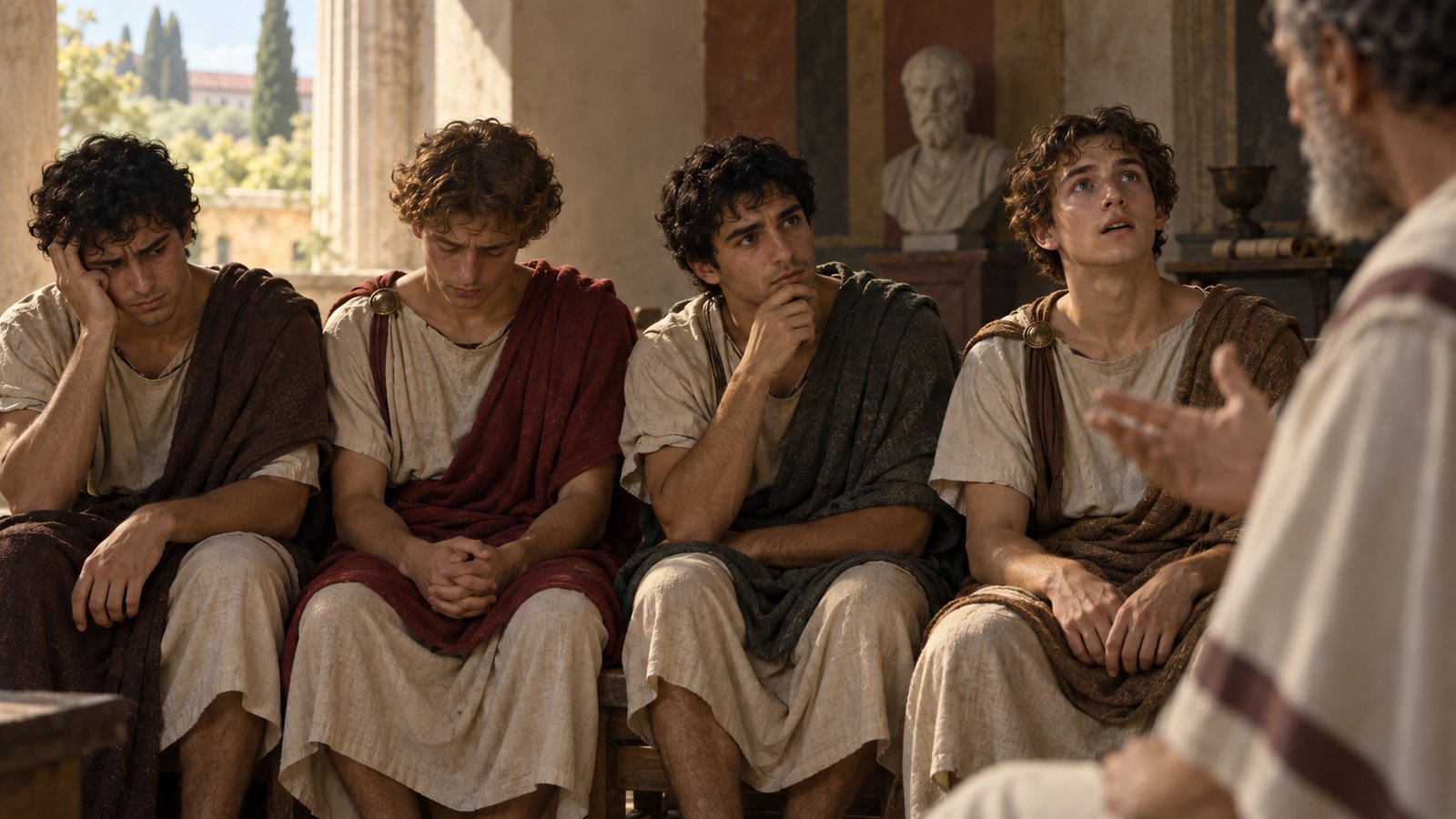
The proper audience is not blank. Musonius expects movement within it, and he names the emotions with unusual care. Unless a hearer is wholly lost, the discourse must make him shudder and feel secret shame and repentance, or else rejoice and wonder.
These responses point in different directions because philosophical speech can expose both base and noble tendencies. A rebuke may force recognition of a fault. Encouragement may reveal that a better course is possible. Wonder may answer a truth newly understood. Joy may accompany an improved judgment rather than a polished phrase.
Musonius says these effects can appear as changes of countenance. The face becomes part of his evidence because it registers a changing relation to the argument. A listener who looks troubled, relieved or astonished may be doing more of philosophy’s work than one who instantly supplies the expected cheer.
That emphasis does not give an observer perfect access to another person’s character. Gellius records no catalogue matching each expression to a guaranteed moral result. The secure claim is narrower: Musonius contrasts inwardly varied reactions with repetitive, conventional applause.
“Secret shame” is especially revealing. It does not require a listener to announce a confession to the room. The effect can remain private while still altering his awareness. Public noise is easy to count; the work Musonius values may begin where no one else can measure it.
Admiration Had Degrees, and the Highest Stopped Speech
Musonius avoids a crude equation between every clap and ignorance. Great applause, he says, is not inconsistent with admiration. A person may genuinely admire what he hears and still join a loud response.
He then establishes a higher degree. The greatest admiration gives rise not to words but to silence. At that point speech fails not because the audience has nothing to feel, but because what it feels has interrupted the ordinary machinery of response.
This distinction matters because it prevents silence from becoming merely another performance convention. If students learned to sit quietly only to look profound, the external sign would be as empty as a stock cry of praise. Musonius values the silence produced when attention is absorbed.
The contrast also explains why volume cannot rank philosophical success. Applause may be sincere, theatrical or both. Silence may be vacant or astonished. Musonius identifies the best silence by its cause: the hearer has been so affected that admiration does not immediately become words.
A similar refusal to reduce philosophy to a visible stunt appears in the story of Socrates remaining in thought from one dawn to the next. Gellius’s Musonius concentrates on a shorter interval, the pause after speech, but both scenes make sustained attention more important than a spectator’s quick reward.
Homer’s Shadowy Hall Supplied the Final Measure
Musonius closes by calling on what he presents as the wisest of poets. After Ulysses gives the splendid account of his hardships, Homer does not make the hearers leap up with shouts and noisy demonstrations. The pleasure of listening affects their power of utterance.
Gellius quotes the image of everyone hushed and held in rapture through the shadowy hall. The setting expands Musonius’s test beyond a formal philosophical lecture. A narrative of suffering can also command attention so fully that the audience does not rush to display its response.
The example is carefully chosen for contrast. Ulysses has just completed an extraordinary performance of memory and storytelling. If verbal skill alone demanded cheers, this would be the moment. Homer instead marks the force of the speech by suspending the room.
Musonius therefore judges listening by what the words prevent as much as by what they provoke. The ineffective lecture cannot prevent stock praise from arriving on cue. The useful lecture interrupts self-satisfaction. The most admired speech interrupts speech itself.
Gellius offers no count of hands, no duration for the silence and no transcript of a particular lecture by Musonius. What survives is a compact diagnostic. Shouts can reveal fascination with delivery; a changing face can reveal an argument meeting character; silence can reveal admiration that has exhausted the ready response. In that scale, the quiet room is not empty. It is full of listeners who have not yet finished hearing.
Sources
Aulus Gellius, Attic Nights 5.1.