
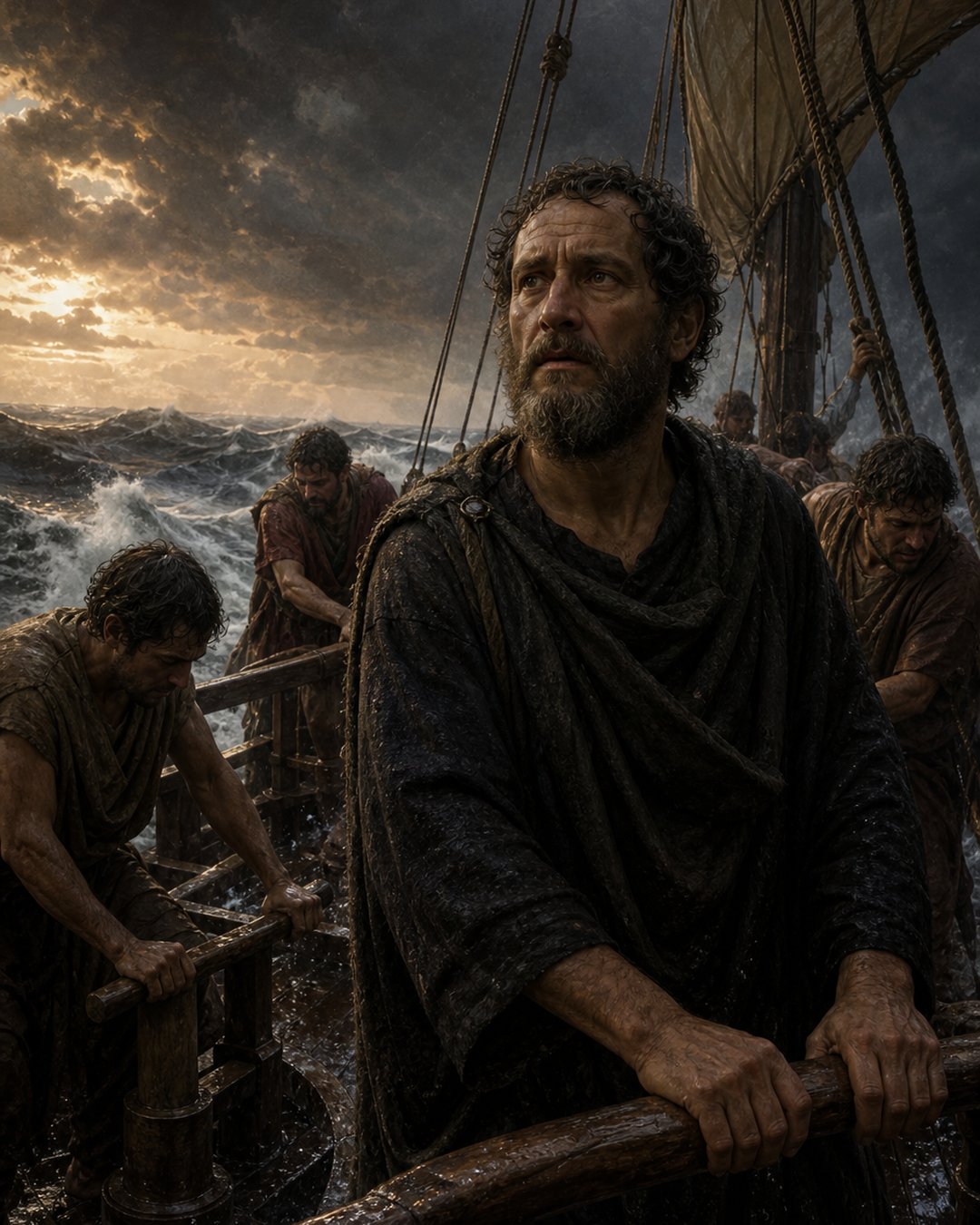
The ship had taken water through most of the night. A fierce wind struck from the side as it crossed the Ionian Sea, and passengers worked the pumps while the deck, ropes and hull answered the weather. Dawn brought no simple release. Gellius remembered a black sky, fog, whirlwinds and cloud forms that seemed ready to press the vessel under.
Among the passengers was a Stoic teacher whom Gellius had known at Athens. The man had authority over his pupils and a serious reputation. Gellius looked toward him because the storm had turned philosophy into something visible. Would a trained mind remain untouched while everyone else expected the ship to sink?
The answer appeared in the teacher’s face. He was frightened and ghastly pale. He did not join the cries around him, but his colour and distracted expression did not look very different from those of his fellow passengers. The storm had reached him before any lecture could.
Night at the Pumps Made Reputation Physical
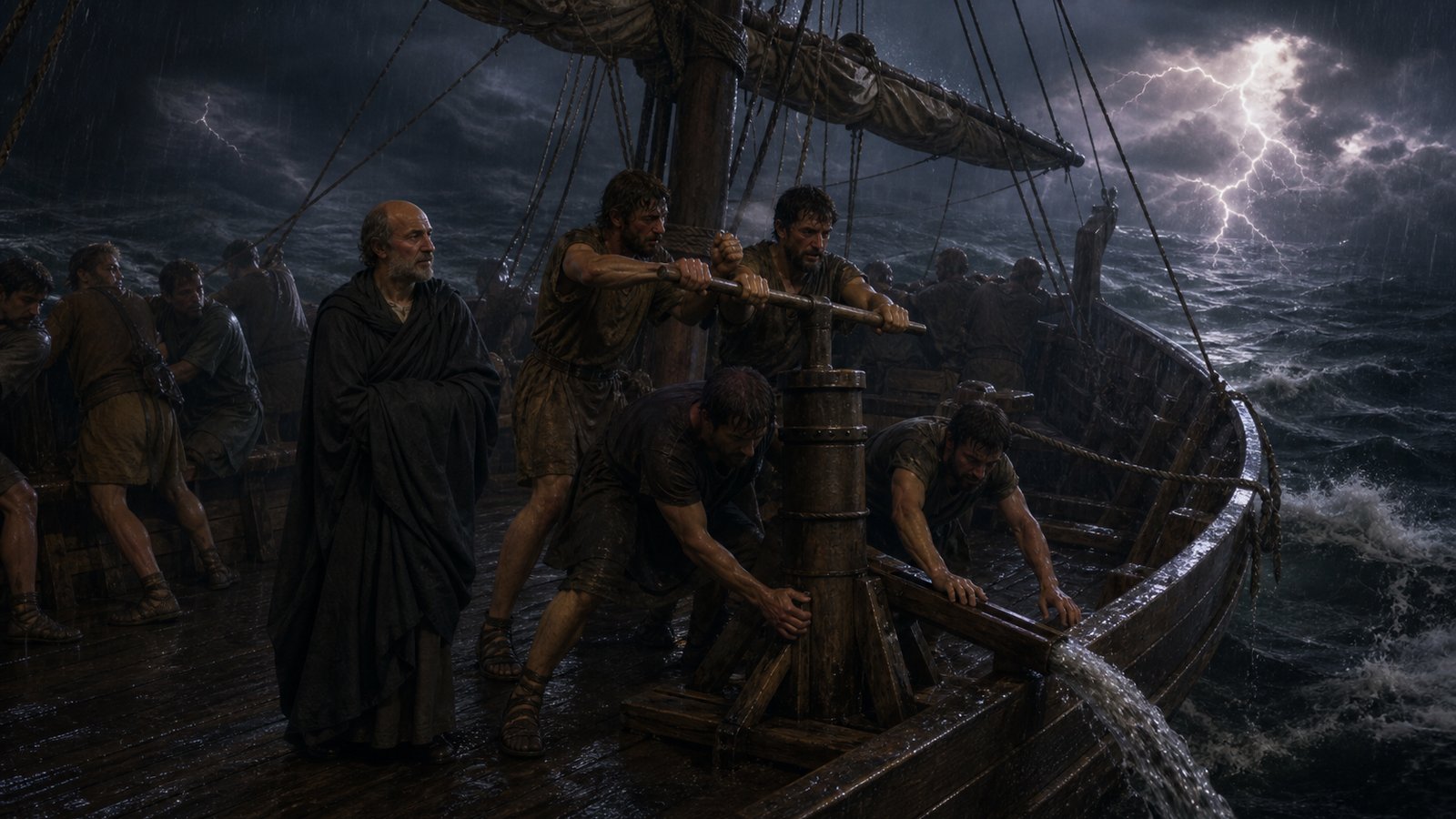
Gellius places the route first: from Cassiopa on Corcyra toward Brundisium, across water he calls violent, vast and storm-tossed. The voyage was not a classroom fable about a distant risk. A side-wind drove water into the ship, and those aboard had to pump it out through the night. Their hands were part of the vessel’s struggle to remain afloat.
The details matter because they stop the later discussion from becoming an easy performance of courage. Fog obscured distance. Black cloud masses erased the reassuring line between sea and sky. Whirlwinds appeared more often after daybreak. The passengers used a name connected with violent storm forms—typhones—for what seemed to hang above them.
Gellius did not claim that the philosopher knew the ship would survive. He watched a man confronting the same uncertain hull, weather and exhaustion as everyone else. That makes the scene different from the legal arithmetic of cargo thrown overboard to save a vessel. Here no later calculation can distribute the fear. It arrives separately in each body.
The teacher’s discipline showed in one narrow way: he made no lamentation and gave no theatrical cry. Yet Gellius refuses to turn restraint into a marble mask. Pallor and distraction remained. The body registered danger even while the voice stayed under control.
A Rich Passenger Mistook Colour for Conviction
Only after the sky cleared and the sea calmed did the challenge begin. A wealthy Greek passenger from Asia approached in elegant clothing, attended by servants and abundant baggage. His appearance supplied a sharp contrast with the wet deck and the danger just passed. He teased the teacher for having changed colour while he claimed that he himself had felt no fear.
The taunt compressed philosophy into a feed-side test: if Stoicism works, its practitioner should not look afraid. A pale face became evidence for failure. The rich passenger did not ask what the teacher had done, what judgments he had formed, or whether he had surrendered his conduct to panic. He treated an involuntary sign as a complete moral verdict.
The Stoic first hesitated over whether the question deserved an answer. Then he borrowed an older retort attributed to Aristippus, the pupil of Socrates. When another man had asked why a philosopher feared at sea, Aristippus supposedly replied that the two passengers did not risk lives of equal value. The questioner had little reason to worry about a worthless coxcomb; Aristippus had reason to fear for an Aristippus.
It is an intentionally cutting answer, not the final explanation. The Stoic uses it to dismiss an insolent examiner who had turned survival into a contest of complexion. The elegance of the insult matches the social scene: expensive clothes, attendants, baggage and a man eager to declare himself braver than his teacher.
A Small Travel Bag Held the Serious Reply
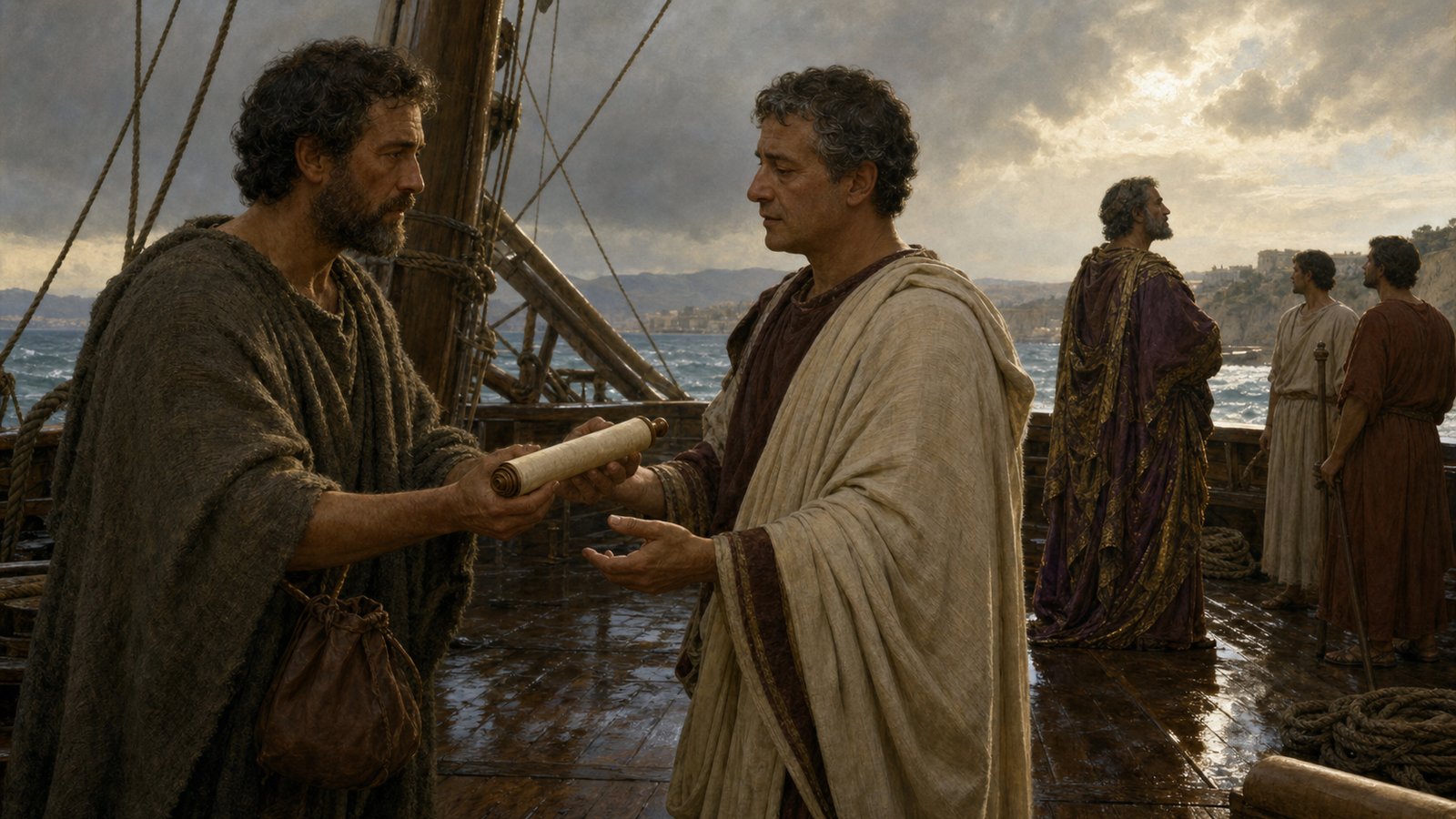
Gellius waited until the ship was approaching Brundisium and both sea and sky were calm. He asked privately and without mockery. The teacher’s manner changed with the audience. He answered quietly and courteously, then told Gellius that reading would make the explanation easier to believe and remember.
From a small bag he produced the fifth book of Epictetus’s Discourses. That physical action is the hinge of the story. The rich passenger had displayed abundant baggage; the philosopher carried a compact book. One traveler used possessions as scenery for a taunt, while the other opened a portable archive of argument after the danger had passed.
Gellius says the collection had been arranged by Arrian and that its teaching agreed with Zeno and Chrysippus. The fifth book he names has not survived as part of the four books known today, which makes his scene more than decorative. It records a reader handling a portion of Epictetus that later readers know through this excerpt.
The episode therefore resembles the story in which a load of wood revealed Protagoras’s intelligence before formal philosophy, but its movement runs in the opposite direction. Protagoras’s arrangement makes thought visible through labor. The Stoic’s pale face seems to hide thought until a book supplies the missing distinction.
First Impressions Arrived Before Permission
The passage Gellius read begins with what the philosophers called appearances or impressions. On the first presentation of an object or event, the mind is struck toward a perception. These initial movements do not wait for permission. They are not summoned by the will and cannot be dismissed before they occur.
A crash from a falling structure, thunder from the sky or sudden news of danger can therefore disturb even a wise person. The mind may shrink. The body may blanch. The surprise runs ahead of the slower powers that compare, judge and choose. In the storm, the black cloud and flooding hull were not propositions calmly submitted for debate.
The teaching then separates the first impression from assent. Assent is the mind’s confirmation that an appearance should be treated as true in the form it initially presents itself. The foolish person, in this account, does more than receive the image of terror. He endorses it, repeats its verdict and lets it settle into judgment.
The wise person receives the blow too. What differs is the next movement. He does not confirm that the first terrifying appearance must rule him. He can reject the enlargement that makes every alarm absolute. His body’s pallor is not a chosen doctrine; his later assent or refusal is where discipline begins.
The Ship Tested Sequence, Not Fearlessness
This distinction does not make danger imaginary. The ship was filling with water, the passengers were pumping and the weather remained violent after dawn. Stoic analysis did not ask anyone to pretend that broken rigging or a flooded hold could not kill them. It asked what part of the response belonged to nature and what part became a judgment.
Gellius’s observation is unusually exact because he records both sides. The teacher looked much like everyone else in colour and expression, but he did not lament or cry out. The evidence does not prove perfect wisdom, and Gellius never names the man as a sage. It does show why a first physical reaction alone could not settle the case.
The same care with sequence appears in Gellius’s memory of refusing to force an uncertain legal judgment. In that courtroom story, pressure to decide is not the same as knowledge. On the ship, pressure to react is not the same as assent. Both episodes pause between what arrives and what a person is willing to affirm.
By the time the teacher explains, the voyage has moved from Cassiopa’s departure through a flooded night to the approach to Brundisium. Reason returns in calm conditions, but it is not invented after the fact. The little book gives language to the restraint Gellius had already seen: no denial of the shock, no need to celebrate it, and no surrender of conduct to it.
Gellius says he recorded the teaching so that readers would not call a person foolish or weak merely for fearing briefly or turning white. Human weakness, in his formulation, can produce an immediate yielding without producing a belief that every frightening appearance is exactly what it seems.
That purpose saves the story from becoming either ridicule or hero worship. The wealthy passenger is wrong because he demands a body without reflexes. A sentimental retelling would be wrong in the other direction if it claimed that every reaction is beyond judgment. Gellius preserves the interval between impact and endorsement.
The interval is small enough to miss from across a wet deck. It can exist between a pale face and a cry, between a frightening image and the sentence “this must master me,” or between dawn and the calmer approach to harbor. The philosopher’s work happens there, after sensation but before assent hardens.
The storm exposed no magical immunity. It exposed a sequence. Water entered the ship; fear reached the body; colour left the face; reason had not yet spoken. When the sea calmed, the teacher opened his bag and showed Gellius why the first three events did not dictate the fourth.
Sources
Aulus Gellius, Attic Nights 19.1.