
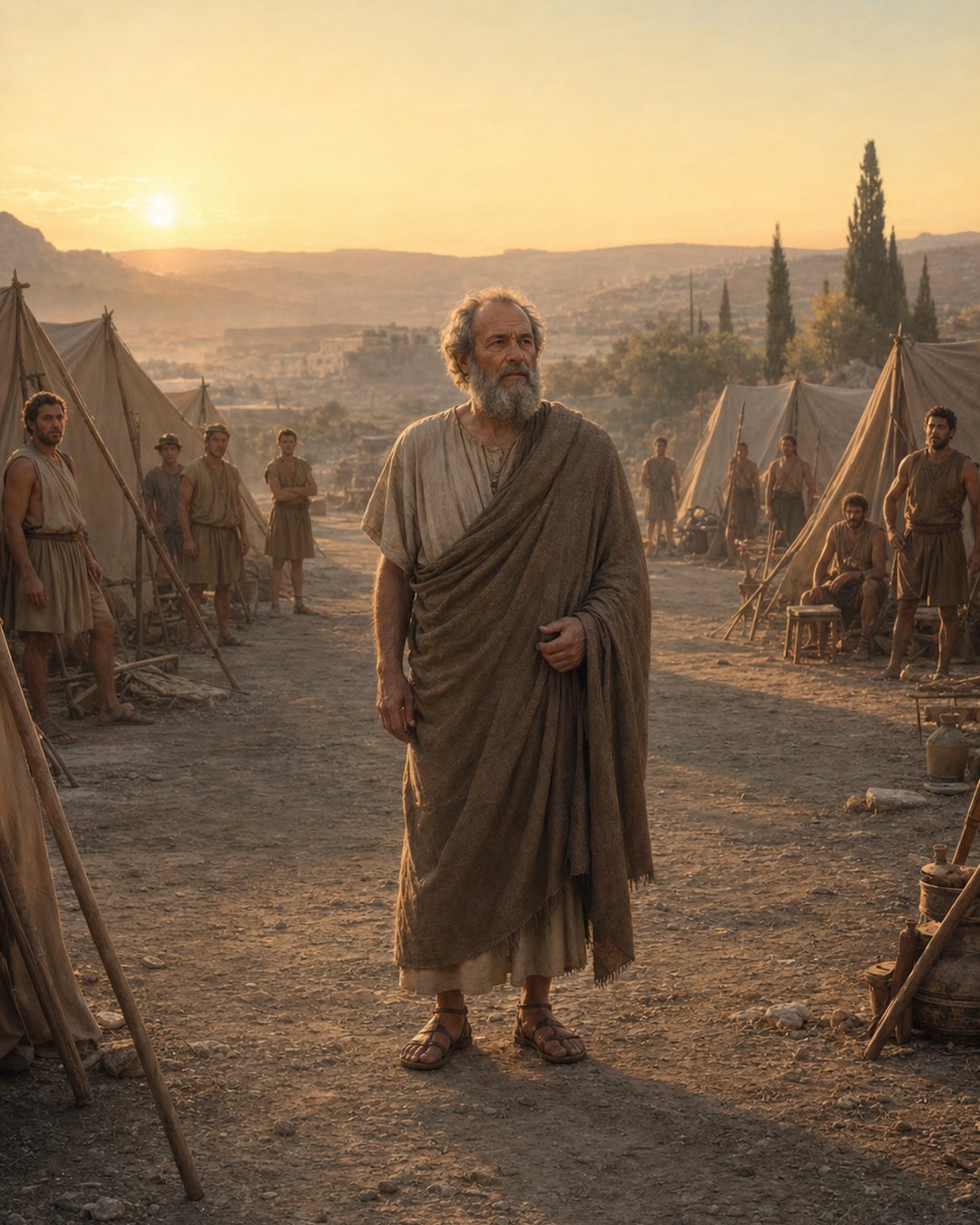
At midday the soldiers began pointing him out. Socrates had been standing in the same place since dawn, absorbed in a problem that had refused to yield. Hours passed, the camp moved through its routines, and still he did not leave. By evening, curiosity had become an overnight watch.
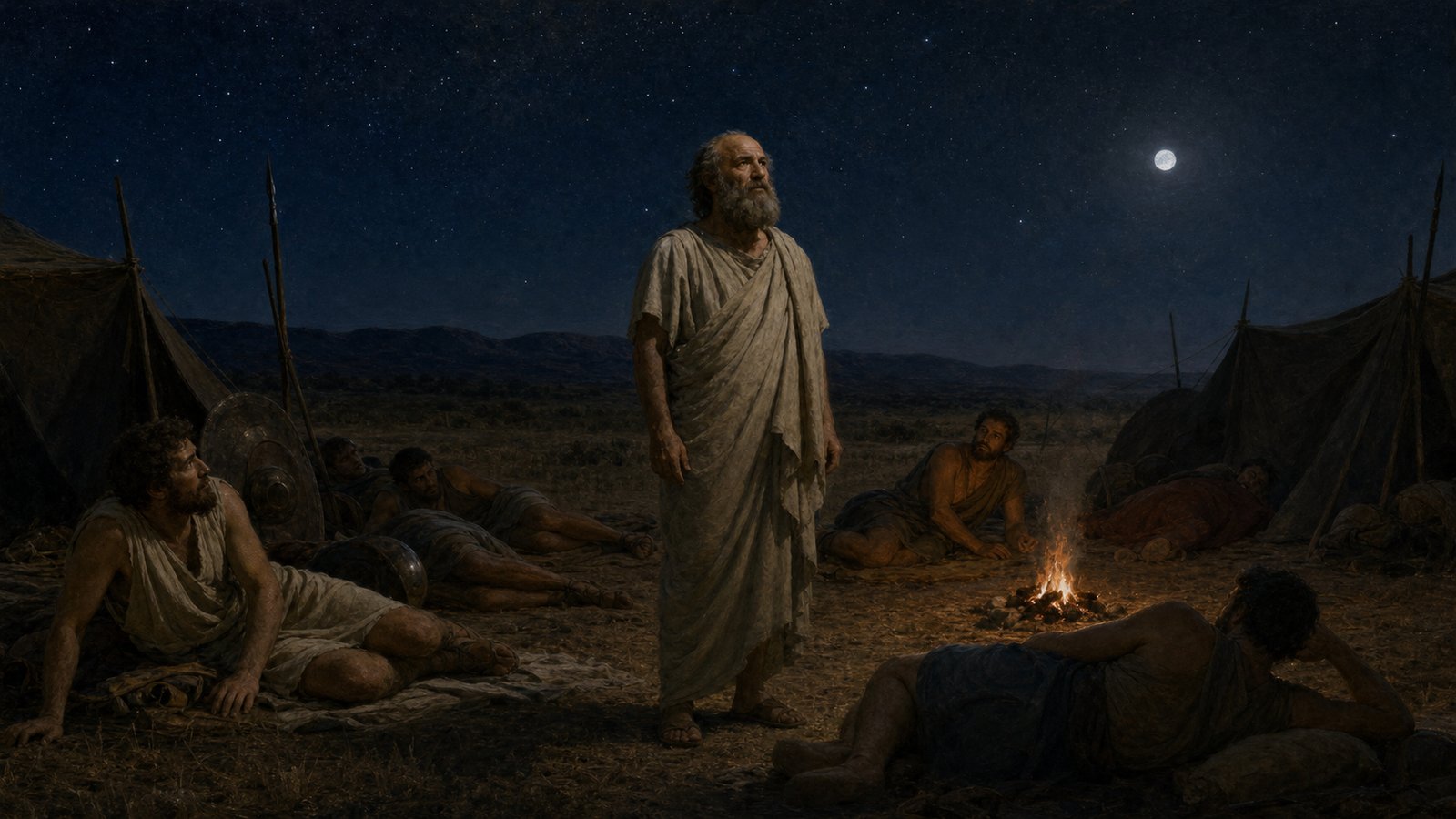
Some Ionian soldiers finished supper, carried mattresses and rugs outside, and lay down in the summer air. Plato’s Symposium says they wanted to discover whether Socrates would remain upright all night. He did. Only when dawn returned and the sun rose did he offer a prayer to the sun and walk away.
The scene survived because it made thought measurable. Nobody could see the problem Socrates was considering, but everyone could count the changing light, the meals and the hours. Aulus Gellius later retold the feat in a chapter on physical endurance and temperance. Between Plato and Gellius, a moment of concentration became a portrait of a philosopher whose mind did not escape the body so much as demand extraordinary steadiness from it.
A difficult problem stopped the camp’s ordinary clock
Plato gives the story to Alcibiades, who places it during military service at Potidaea. Socrates became immersed in a problem at dawn. When the matter proved difficult, he did not abandon it or pace away. He remained where he was and continued considering it.
The first half of the day passed before the event became communal. By midday, the men around him had noticed. They told one another in wonder that Socrates had been standing in study since dawn. Their reaction supplies the scale. This was not a familiar pause that happened to last a little longer than expected. It was strange enough to interrupt camp conversation.
A military camp offers an especially sharp setting for immobility. Men, supplies and duties move according to demands larger than one person’s private schedule. Against that circulation, Socrates held one position. Plato does not describe a platform, audience or announced trial. The spectacle formed because ordinary activity continued around a man who did not.
The archive’s story of Protagoras arranging a load of firewood with one short rope also lets manual conduct reveal a future philosopher. There, intelligent movement catches Democritus’s eye. At Potidaea, the absence of movement makes thought visible to a whole group.
The soldiers turned observation into an overnight test
Evening could have ended the curiosity. It was summer, however, and some of the Ionians chose to sleep outside in the cool after supper. They brought their mattresses and rugs with a specific purpose: to see whether Socrates would continue standing through the night.
The detail prevents the episode from floating into a vague claim that he stood “for a long time.” Food had been eaten. Bedding had been carried out. Witnesses settled down and waited. Their own bodies changed position for sleep while the subject of their experiment remained upright.
Plato’s wording gives the soldiers no instrument beyond attention. They did not measure a pulse, tie Socrates in place or assign shifts. They created a vigil around his vigil. The passing night supplied duration, and their presence supplied witnesses who could say that he had not quietly left when the camp slept.
This was curiosity rather than command. Socrates had not ordered them to watch, and they had not required him to perform. Their decision turned a private act into evidence. By placing rugs in the open, they made themselves part of the story’s mechanism: the camp could remember not only that Socrates stood, but that others waited to test how long he would do it.
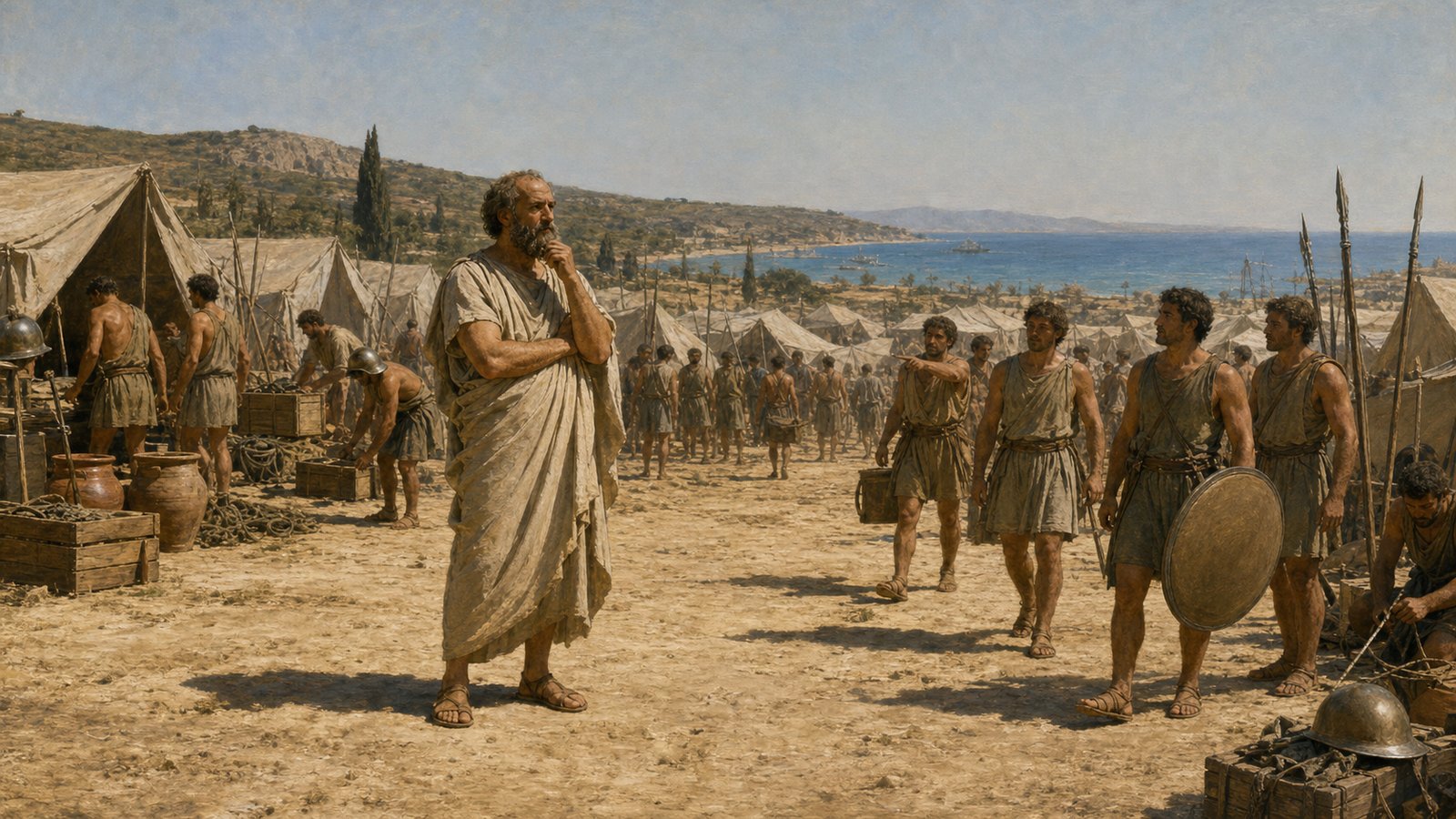
Sunrise ended the feat without a speech
Socrates remained until dawn came and the sun rose. He then offered a prayer to the sun and walked away. There is no triumphant explanation of the problem, no announcement that the exercise had succeeded and no recorded demand for applause. The movement resumes after an act directed beyond the watching soldiers.
The return of sunrise closes a complete visible cycle. Plato’s account begins with Socrates becoming absorbed at dawn and ends after the next dawn. Midday, supper, summer bedding, night and sunrise divide the span into scenes that witnesses could recognize. The narrative does not depend on a later conversion into an approximate number of hours.
The prayer also keeps the ending from looking like the collapse of a self-imposed stunt. Socrates does not simply stagger away when he can endure no more. He acknowledges the sun and departs. Whatever the unresolved philosophical problem may have been, the story’s public action reaches a deliberate conclusion.
Alcibiades immediately moves from this episode to Socrates’ conduct in battle. That sequence matters. Standing at dawn is not isolated from military endurance; it prepares the listener to hear about steadiness under danger. The camp had watched one kind of refusal to abandon a position before Alcibiades described another.
Gellius recast concentration as bodily preparation
Centuries later, Aulus Gellius introduced Socrates’ fixed stance among voluntary tasks and exercises for strengthening the body against unforeseen demands. His language makes the physical interpretation explicit. The point is not only that a philosopher became lost in thought. Socrates trained a capacity that could be called upon when chance required endurance.
Gellius intensifies the image. Socrates stands from early dawn to the next sunrise, open-eyed and motionless, his face and gaze fixed on one spot. He seems, in Gellius’s comparison, as if mind and soul had withdrawn from the body. Yet the chapter’s heading and frame insist on the body’s achievement. Withdrawal of attention from discomfort does not make the flesh disappear; it leaves the flesh holding the pose.
Favorinus, whose discussion Gellius cites, supplied the line that Socrates often stood from sun to sun more rigidly than tree trunks. The comparison trades a moving human being for rooted wood. Its force comes from impossibility: a tree is expected to remain fixed, but a soldier and philosopher is not.
This interpretation resembles the training logic in Cicero’s physical work on a harsh and weak voice. Neither story treats intellectual public life as detached from bodily capacity. Breath, stance, fatigue and repetition set limits that practice tried to alter.
Temperance widened one day into a lifetime
Gellius follows the standing exercise with a broader claim about Socrates’ habits. His temperance, the writer says, was so great that he kept his health through almost all his life. The chapter links exceptional duration in one pose with repeated restraint across years.
He then makes a claim modern readers should preserve as an ancient report rather than convert into medical proof. Gellius says Socrates was unaffected by the plague at the beginning of the Peloponnesian War and attributes this to temperate, abstemious habits. The source cannot establish that restraint protected anyone from infection. It does show how Gellius understood bodily discipline: a stable way of life prepared a person for hazards that could not be predicted.
That framing changes the standing episode. If read only as a marvel, it risks becoming an ancient endurance record. In Gellius’s sequence, it is an extreme instance of a durable practice. The fixed day and night reveal a capacity supposedly built through repeated moderation rather than produced for a single audience.
Plato’s soldiers and Gellius’s readers therefore receive different versions of the same lesson. The soldiers watch time accumulate around one silent figure. Gellius classifies the figure under exercise, fortitude and temperance. One account preserves the scene’s social mechanics; the other names the virtue it was meant to demonstrate.
What survives most vividly is the watchers’ decision to bring bedding. They could not enter Socrates’ thought, so they tested its grip by waiting beside him. Dawn returned, the sun rose, and at last the fixed body moved. Philosophy had occupied a whole cycle of camp time without needing a lecture to announce itself.
Sources
Plato, Symposium, 220c–d; Aulus Gellius, Attic Nights, 2.1; Favorinus, fragment reported by Gellius.