
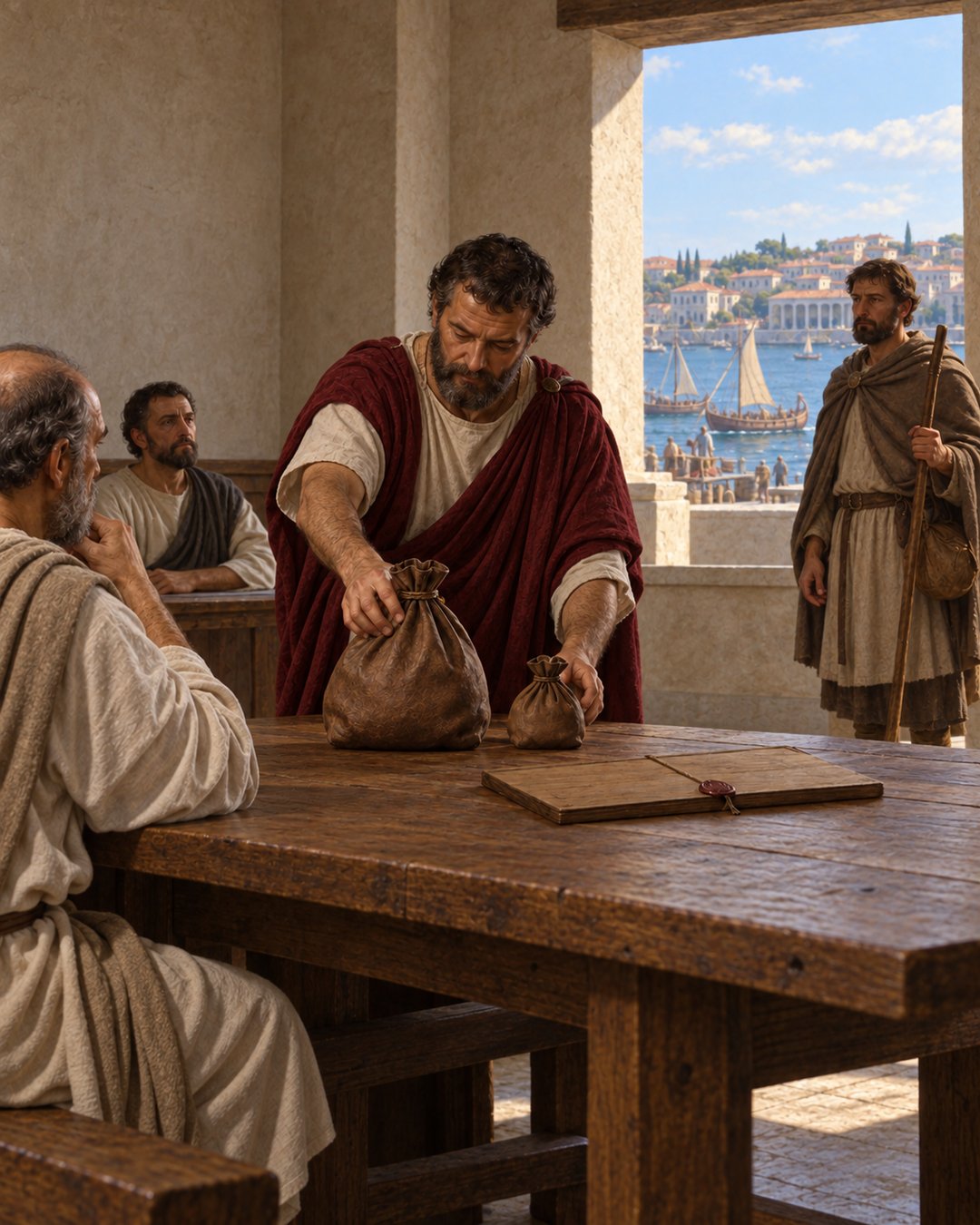
Byzantium paid 12,000 sesterces each year to send Trajan a greeting.
The city spent another 3,000 on an envoy who travelled to salute the governor of Moesia.
Pliny the Younger found both costs in the accounts, then asked whether the officials needed the visitors—or only the message they carried.
The Audit Found Ceremony among the Largest Expenses
Pliny’s report appears in book ten of his letters, the collection preserving his correspondence with Emperor Trajan while he governed Bithynia and Pontus. Its opening is not a meditation on etiquette. He tells Trajan that he has been examining the expenditures of the community of Byzantium and that the sums brought to his attention were very large.
That setting determines the angle of the exchange. Pliny did not discover a secret payment or accuse an envoy of theft. He found an established civic practice whose repetition had made honour expensive.
Every year Byzantium sent an envoy to greet the emperor. The representative carried a psephisma, a formal resolution of the city. Pliny records an allowance of 12,000 sesterces for the mission.
The surviving letter does not itemize lodging, transport, attendants or gifts. It gives one total attached to the envoy and his annual task. Inventing a detailed travel budget would make the record appear fuller than it is. What can be said securely is that personal delivery cost the city 12,000 sesterces every year.
Pliny treated this expense as unusually large in the context of the accounts he was reviewing. Yet the greeting also represented a public obligation. Byzantium was not merely purchasing a journey; it was displaying its relationship with imperial power through an authorized civic messenger.
The problem was therefore political as well as financial. Cutting the line in the budget risked making thrift look like disrespect. Preserving it without examination made ceremony immune to the audit applied elsewhere.
Pliny’s provincial work repeatedly joined documents to action. when his wife needed urgent travel, he used an imperial permit first and reported that exceptional decision to Trajan afterward. At Byzantium, he again asked how a written authorization and a physical journey should relate, but this time his purpose was to remove travel rather than enable it.
A Decree Could Travel without Its Envoy
Pliny separated the elements of the annual mission. The civic decree mattered because it embodied the city’s formal voice. The envoy mattered because custom had assigned him to carry that voice into the emperor’s presence.
His proposal kept the first and removed the second. The envoy would be held back, while the psephisma itself would be sent.
Pliny explained the advantage in two parts. The city’s expense would be reduced. At the same time, the public duty would still be fulfilled. He did not describe the greeting as worthless. He argued that the document could perform its essential work without the body that traditionally accompanied it.
This was an administrative redesign hidden inside a small economy. Representation no longer required a representative standing in front of Trajan each year. A resolution produced by the civic community could arrive as sufficient evidence of respect.
The change also shifted what the emperor was being asked to recognize. Under the old practice, Byzantium displayed loyalty through the cost and trouble of sending a person. Under Pliny’s proposal, loyalty resided in the authorized message. The saving became possible only if Trajan agreed not to measure honour by visible expenditure.
Pliny did not assume that agreement. He closed the report by asking Trajan to write back, either confirming the judgment or correcting an error. The governor could identify waste, but the recipient of the honour had to decide whether the cheaper form still counted.
That request protected more than Pliny’s authority. A city could safely stop an imperial embassy only when the emperor had made clear that its absence would not be interpreted as neglect.
A Second Greeting Added 3,000 Sesterces
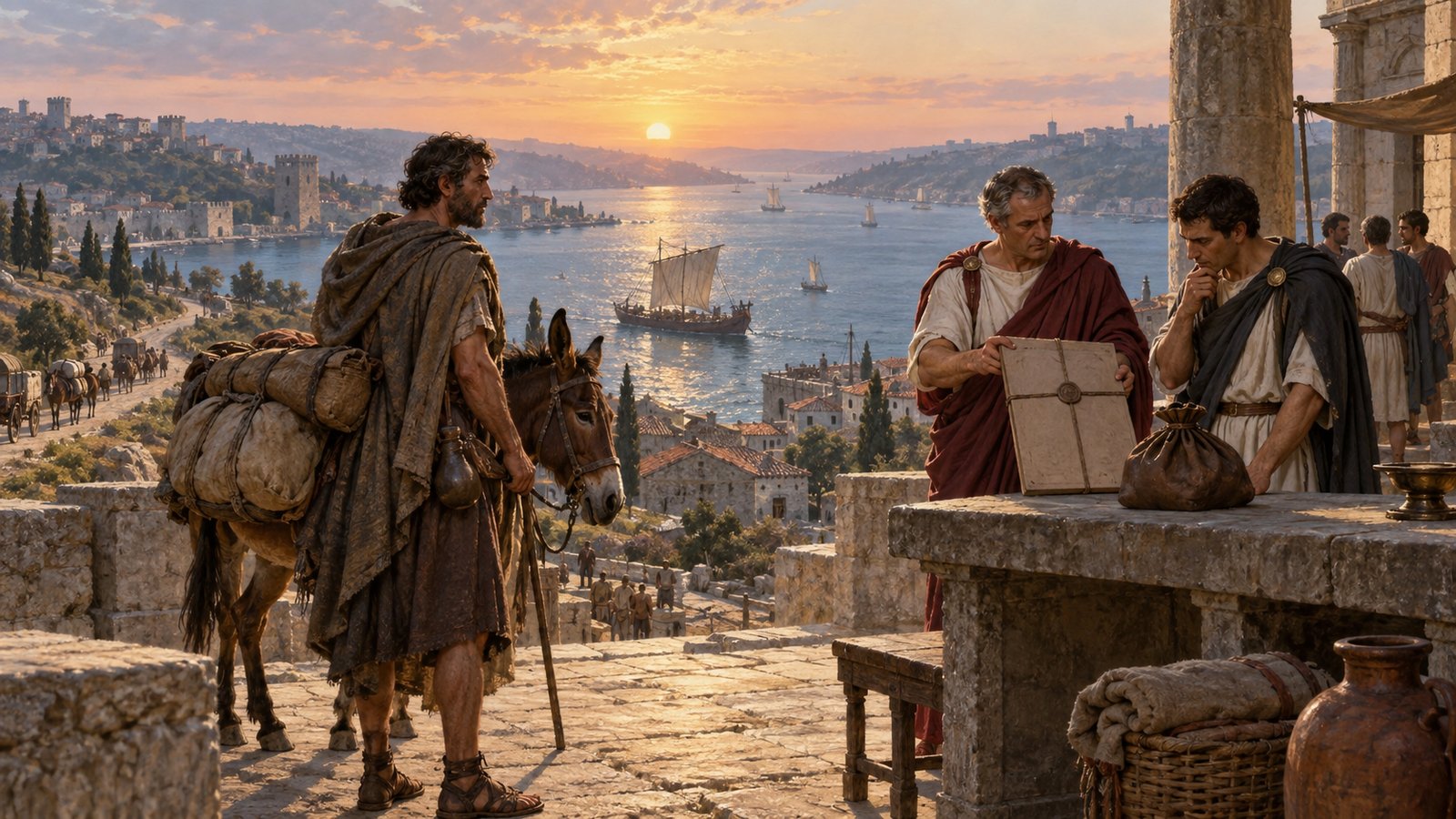
The emperor was not the only official receiving an annual salutation. Pliny found another 3,000 sesterces assigned as travel money for an envoy who went to greet the governor of Moesia on the city’s behalf.
The second journey is revealing because it points toward a hierarchy of ceremonial relationships. Byzantium acknowledged the distant emperor, but it also maintained a formal courtesy toward a nearer provincial commander. Each relationship had acquired its own recurring messenger and allowance.
Pliny proposed cutting the Moesian expense in future. His letter does not say that he would replace this visit with the same decree sent to Trajan. Nor does it preserve the governor’s opinion. Pliny simply identifies the annual travel payment and states that he thought it should be removed.
Combined, the recorded allowances came to 15,000 sesterces each year. The arithmetic makes the reform visible, but it should not be mistaken for the city’s total ceremonial budget. The letters identify only these two missions, not every delegation Byzantium sent or every cost of its political life.
The two amounts also carried different symbolic weight. The larger mission addressed the emperor with a civic decree. The smaller saluted the governor of Moesia. Pliny grouped them because both placed repeat travel inside the public accounts, not because the offices or ceremonies were identical.
His method was consistent: isolate what the journey accomplished, ask whether that result required personal attendance, and cut the travel cost if authority would accept another form.
Roman municipal overspending could take far more spectacular forms. at Nicaea, Pliny confronted a theatre that had consumed ten million sesterces while remaining cracked and unfinished. Byzantium’s greetings were smaller, but recurrence gave them a different danger. A ceremonial payment needed no collapsing wall to continue; custom itself renewed it.
Trajan Confirmed the Cheaper Form of Respect
Trajan’s reply is brief and decisive. He told Pliny that he had acted correctly in removing the expenses of the embassies.
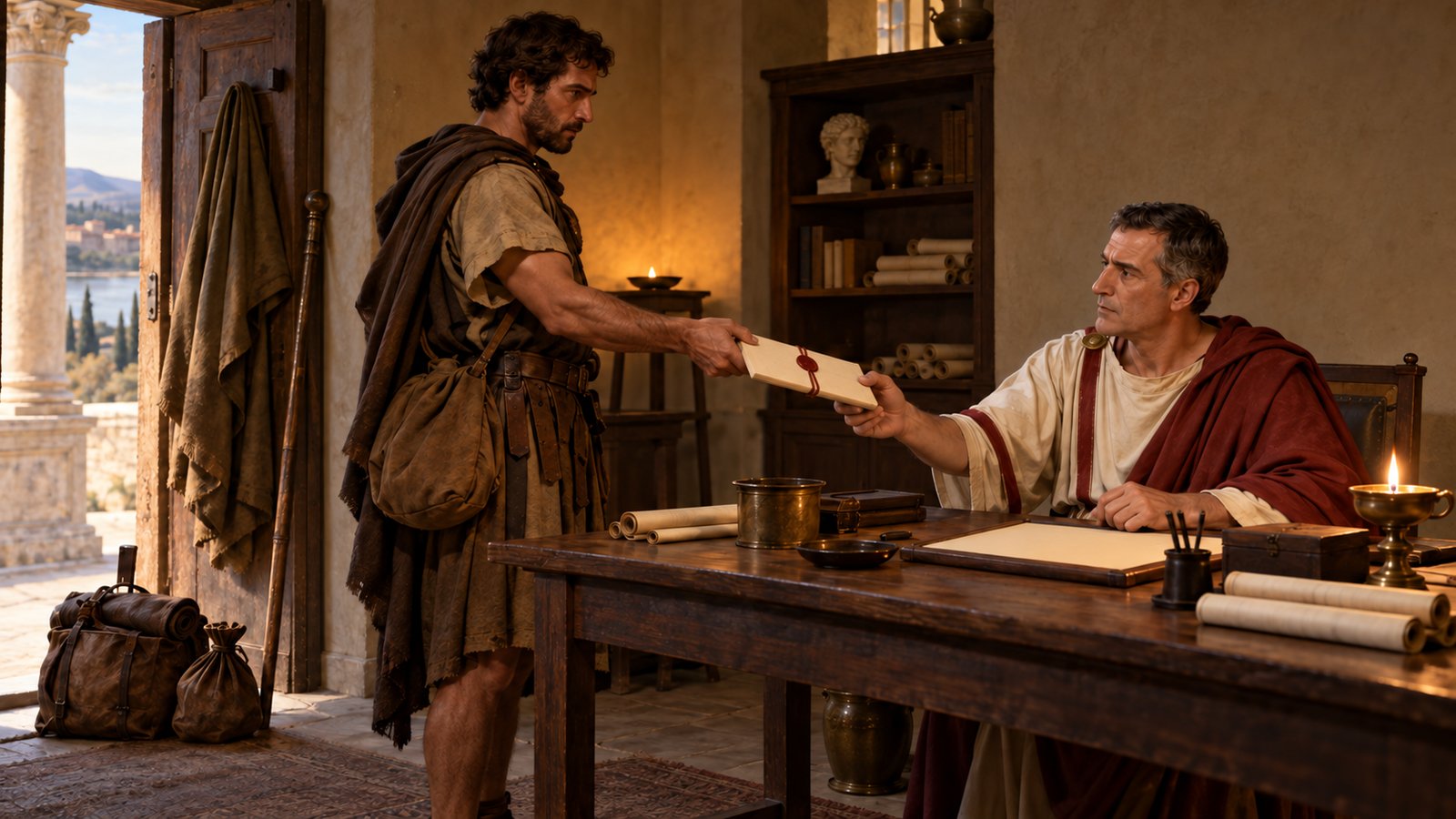
For the imperial greeting, Trajan accepted the document as adequate. The Byzantines could discharge their duty to him by sending their decrees. The emperor’s answer supplied the permission on which Pliny’s saving depended: no annual visitor was required to prove that the city had remembered him.
Trajan also addressed the likely social consequence of canceling the second mission. He expected the governor of Moesia to pardon the Byzantines if they ceased to greet him in such an expensive fashion.
The wording acknowledges that an official might notice the missing envoy. Forgiveness was relevant because ceremony created expectations, and removing a costly courtesy could be read as a slight even when the purpose was economy.
Trajan resolved that risk from above. His response made imperial frugality a model for the subordinate official. If the emperor accepted a decree without a delegation, the neighbouring governor should not demand that Byzantium spend 3,000 sesterces to preserve his annual salutation.
The exchange therefore moved in both directions through the hierarchy. Pliny carried the city’s accounts upward and proposed reductions. Trajan sent downward a new interpretation of duty, one that separated respect from the cost of staging it in person.
Nothing in the two letters says that all embassies were abolished or that face-to-face representation ceased to matter. The decision concerned these recurring greetings. Extraordinary petitions, disputes and negotiations could still give a city strong reasons to send people rather than documents.
The Saving Worked by Changing What Counted as Presence
The annual envoys existed because government was personal as well as documentary. Cities addressed emperors and governors through bodies, journeys and formal encounters. Those practices made political relationships visible, but visibility consumed public money.
Pliny’s intervention did not attack the relationship. It compressed its annual expression. The decree still originated with Byzantium, still travelled beyond the city and still reached imperial administration. What disappeared was the funded human escort whose presence had once completed the gesture.
That substitution mattered because a message and a messenger were not normally interchangeable in every circumstance. A person could answer questions, observe reception, cultivate contacts and represent status through bearing and ceremony. The letters do not claim those functions had no value. They show Trajan deciding they were unnecessary for a routine salutation repeated each year.
The reform also depended on trust in the civic document. A psephisma was not a casual note from an individual. It represented an act of the community. Once accepted as the city’s sufficient voice, it could cross the distance with less expense than an official delegation.
Byzantium’s saving was consequently more than a canceled itinerary. It was a ruling about evidence: the decree itself proved that the duty had been performed.
Pliny’s audit exposed a familiar administrative problem. An institution can preserve the object of a practice long after confusing that object with the procedure inherited to achieve it. Byzantium owed recognition. Over time, recognition had become inseparable from two funded journeys.
Trajan pulled them apart. The city could honour the emperor through the decree and stop financing the annual trip. It could end the Moesian salutation without turning economy into disobedience.
The most important saving was not the single sum removed from one year’s ledger. It was the removal of automatic renewal. Once a sealed civic decision could stand in for a travelling delegation, the same 15,000 sesterces no longer had to be spent merely because the calendar had turned.
Two greetings survived. Two journeys did not.
Sources
Pliny the Younger, Letters, book ten, letters 43–44.