
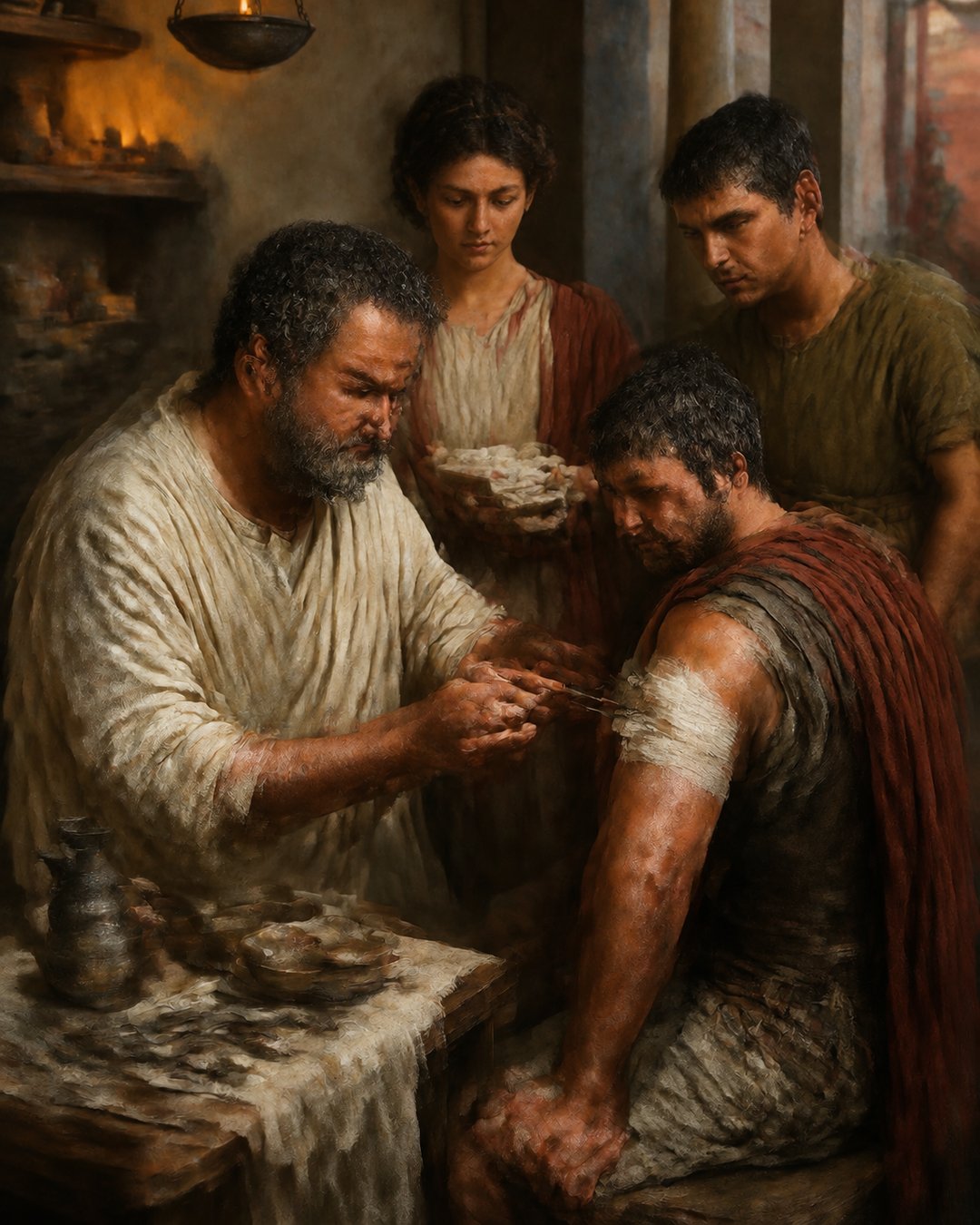
An embedded weapon presented a Roman surgeon with a problem of direction. Pull it back through the wound it had already made, and its edge or barbs might tear tissue again. Push it onward to a new opening, and the surgeon deliberately created another wound. Celsus does not hide that choice behind a heroic operation. He begins with distance, depth, shape and the structures lying along either route.
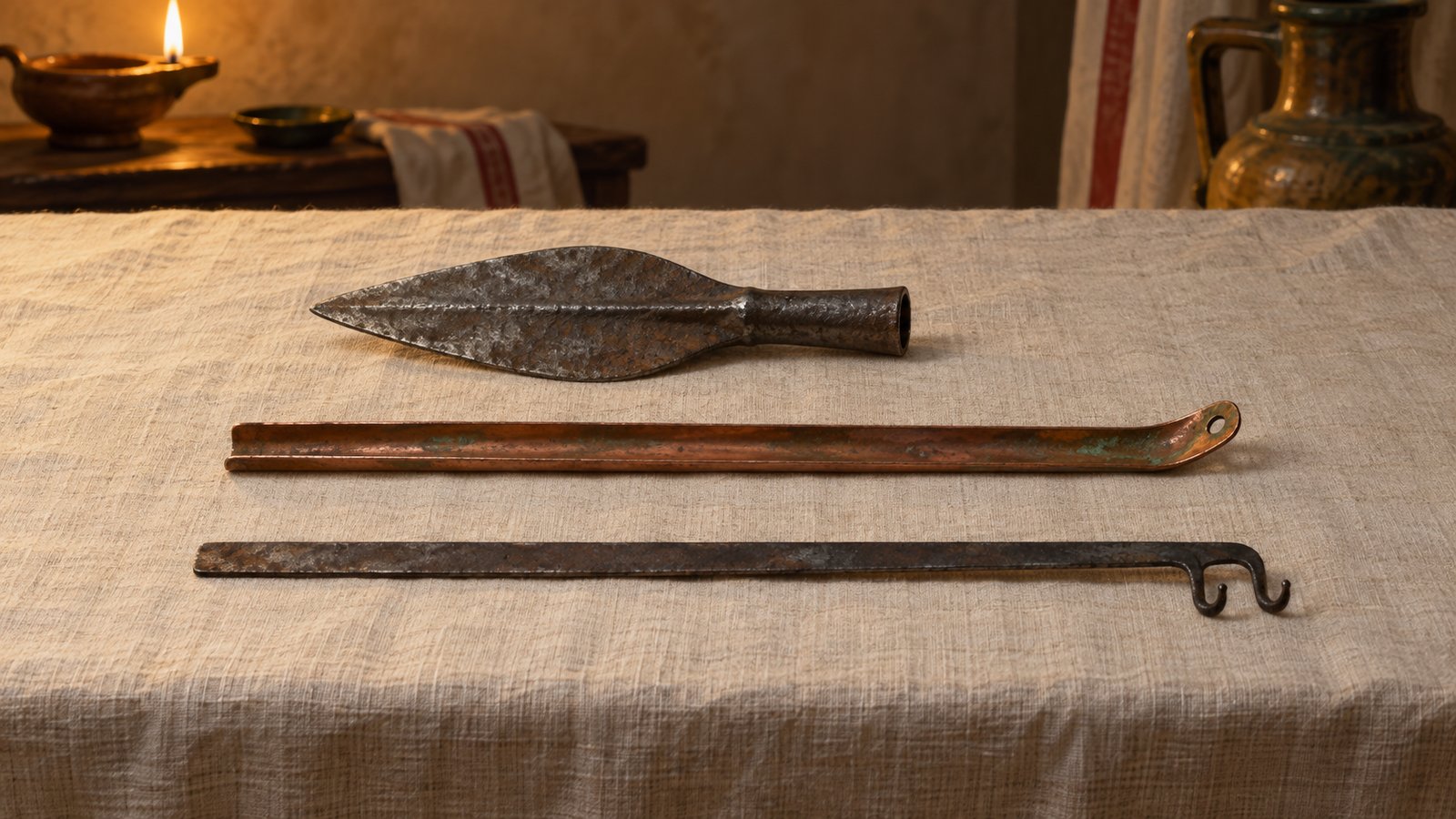
His most striking answer was reserved for a broad head that could not sensibly be pushed through. The instrument known as the Dioclean cyathiscus used two metal blades. One formed a groove beneath the embedded point and caught it in a hole. The other locked over the guide with two small hooks. Together they turned a loose cutting edge into something controlled enough to travel back through the entry wound.
The device is memorable, but the logic surrounding it is more revealing. Celsus’s chapter moves from general rules to arrows, broad weapons and other retained objects. The instrument appears only after he has decided that a counter-opening would cause too much damage. Roman surgery here is not simply a list of tools. It is a sequence of choices about which injury the body can least afford.
A Wound Presented Two Directions
Celsus opens his treatment of embedded missiles by separating shape from position. A point may be troublesome because of the way it is made, because of how deeply it has entered, or because of what lies between it and a possible exit. Before naming a special instrument, he asks which route is shorter and safer.
The entry wound already offers a path. If the missile sits near the surface and has not crossed the line of major blood vessels or sinews, Celsus sees no better course than drawing it back the way it came. Yet the fact that a route exists does not mean it is ready. He instructs the operator to enlarge the wound with a scalpel so the object does not lacerate the edges during removal and provoke more inflammation.
The opposite route is a counter-opening made near the point. When the point lies closer to the far side than to the entry, or when backward travel would cross important vessels and sinews, cutting down onto it can reduce the distance of extraction. In a large limb, Celsus adds, a through wound can be dressed at both ends. This is a clinical calculation, not a universal preference for pushing an object onward.
Whichever direction is selected, space matters. A new opening should not fit so tightly around the missile that the object scrapes it as it passes. Veins, large sinews and arteries seen during the incision are to be caught with a blunt hook and held away from the scalpel. The operation is therefore built around exposure and protection: make enough room to see, identify what must not be cut, then move the foreign body without letting it become a blade again.
This attention to the operator’s hand belongs beside the broader Roman insistence that surgery began with trained touch. Instruments extended judgment; they did not replace it. Celsus’s route choice had to be made from the wound in front of the surgeon, not from the name of the weapon alone.
Arrows Changed the Geometry
Arrows receive their own rules because Celsus treats them as unusually able to penetrate deeply. Force and a sharp point carry them inward, while barbs complicate any attempted return. A point designed to resist escape in flight remains mechanically hostile after it stops moving.
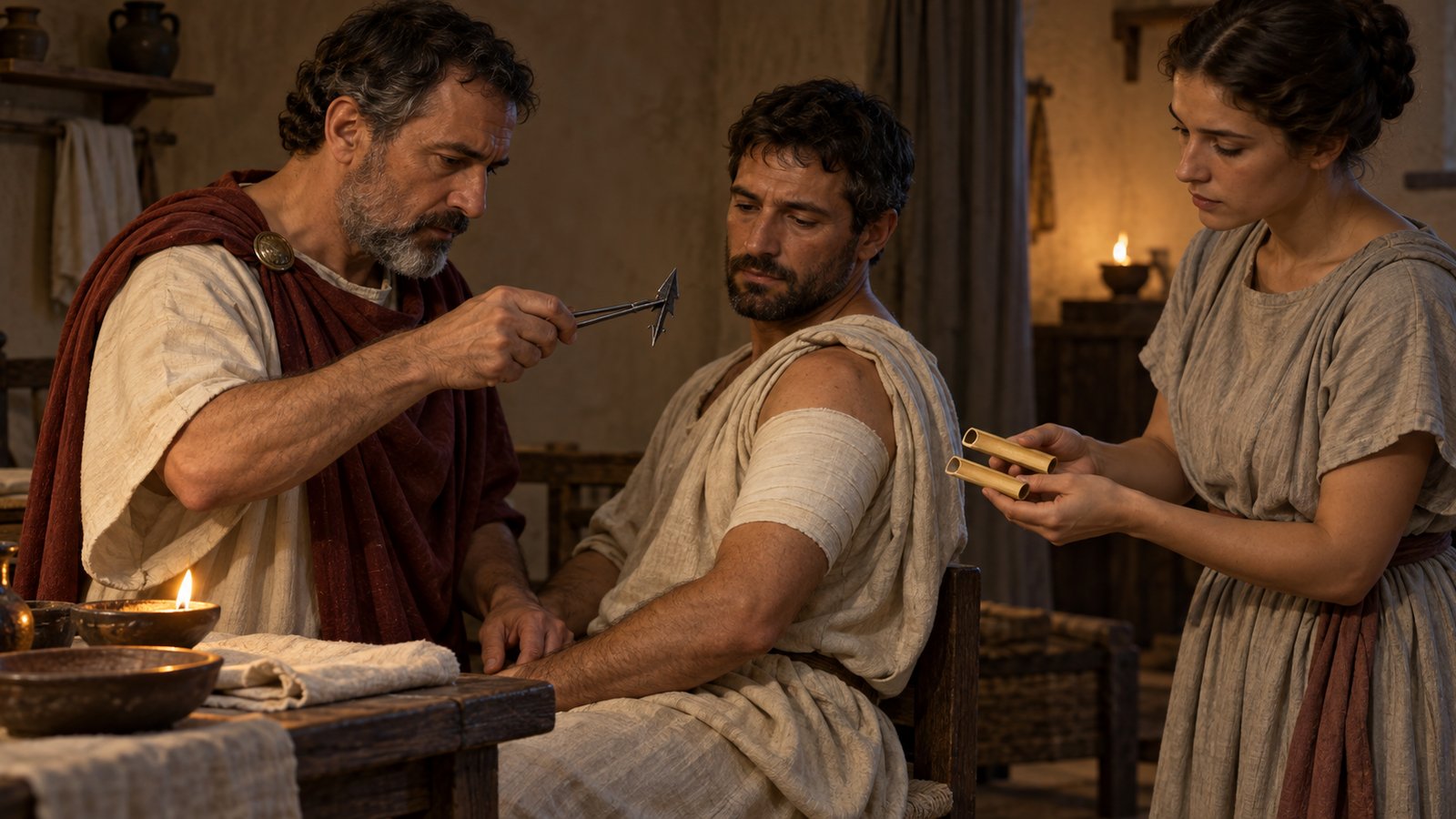
For that reason, Celsus often favors a counter-opening for a barbed arrow. Pushing the head through the shorter remaining distance can do less damage than dragging the barbs backward across tissue they passed smoothly in the other direction. If the wooden shaft remains attached, it can be used to advance the point until the operator grasps it at the new opening. If the shaft has broken away, fingers or forceps take the exposed head.
Backward extraction is still possible, but it requires altering the obstacle. When short, fine barbs become visible, the surgeon can nip them off with forceps. Larger, resistant barbs call for a different shield: split reed pens placed over them so the projecting edges do not rake the wound on the way out. The humble reed and the metal forceps solve the same problem by different means—either remove the tooth or cover it.
Celsus’s account never promises a painless or risk-free procedure. Every option accepts some cutting, pressure or manipulation. What changes is where that damage occurs and whether the dangerous edge remains exposed. His instructions reduce a violent object to a set of surfaces, directions and distances that can be managed one step at a time.
The difference between surviving an injury and controlling its aftermath appears elsewhere in Roman memory. The story of Marius presenting one leg to a surgeon’s knife turns endurance into biography. Celsus offers another register: no audience, no boast, just a practical map of tissues and a rule for stopping the treatment from repeating the wound.
A Broad Head Ruled Out the Counter-Opening
The arrow rules do not carry over automatically to every missile. Celsus next considers a broad weapon embedded in the body. Forcing that large head onward would require a second opening broad enough to receive it. The forward route may be shorter, but the new wound would be too large to justify the advantage.
This is the point at which the Dioclean device enters. Its purpose is not to pull every arrow or spearhead. It answers a specific contradiction: the object should come back through the entry wound, yet its broad point must not remain free to cut the tissues along that return path.
Celsus credits the design to Diocles, an earlier Greek physician whom he places among the great medical authorities. The attribution reminds us that the Roman medical text preserves knowledge with a longer Mediterranean history. Celsus is transmitting a named solution and explaining its construction closely enough that a reader can follow how the pieces interact.
The material could be iron or copper. More important than the metal were the different profiles of the two blades. One had raised sides, making it a narrow groove, and an upturned end pierced by a hole. The other ended in a pair of hooks turned downward. Neither half makes sense as a generic probe. Their shapes anticipate an exact sequence around the trapped point.
The Point Became a Guided Passenger
First the grooved blade passed along the weapon and underneath it. The operator advanced it until it reached the point, then rotated the blade enough for that point to enter the perforation at the upturned end. The sharp tip was no longer wandering freely; it had been seated in a metal opening.
The second blade then came into play. Its downward hooks were fitted with the fingers over the raised end of the first blade. The pair enclosed and stabilized the relationship between guide and weapon. When the surgeon withdrew the assembly, the cyathiscus and the broad head moved together.
The construction did not make the weapon smaller. Instead, it changed what met the wound during withdrawal. The grooved guide presented a controlled surface around the point, while the hooked partner prevented the arrangement from separating. The surgeon could use the original wound without letting the missile’s tip choose its own return line.
It is tempting to celebrate the object as a surprisingly modern gadget, but that comparison flattens what the passage actually gives us. Celsus records no case report, survival rate or painless success. What he provides is a mechanical rationale. The broad head makes a second opening unacceptable; the two blades make backward travel more controllable.
That restraint is part of the evidence. Roman medicine could describe a sophisticated instrument in exact physical stages while remaining frank about the dangers of incision, inflammation, vessels, sinews and tearing. The ingenuity lies not in pretending the injury disappears. It lies in recognizing that extraction itself can become a second injury—and shaping metal so the dangerous point is carried rather than merely pulled.
Sources
Aulus Cornelius Celsus, De Medicina 7.5.1–3.