
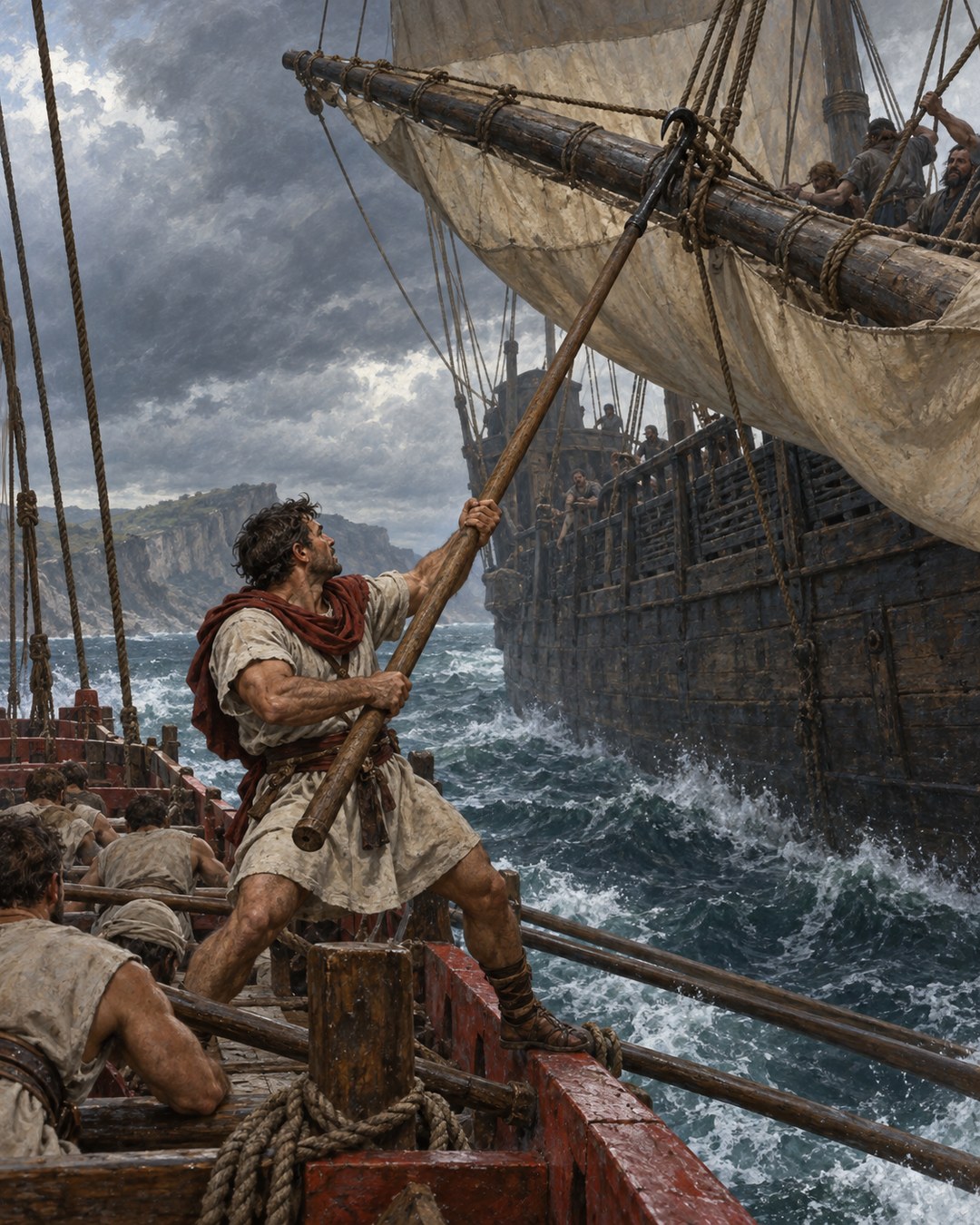
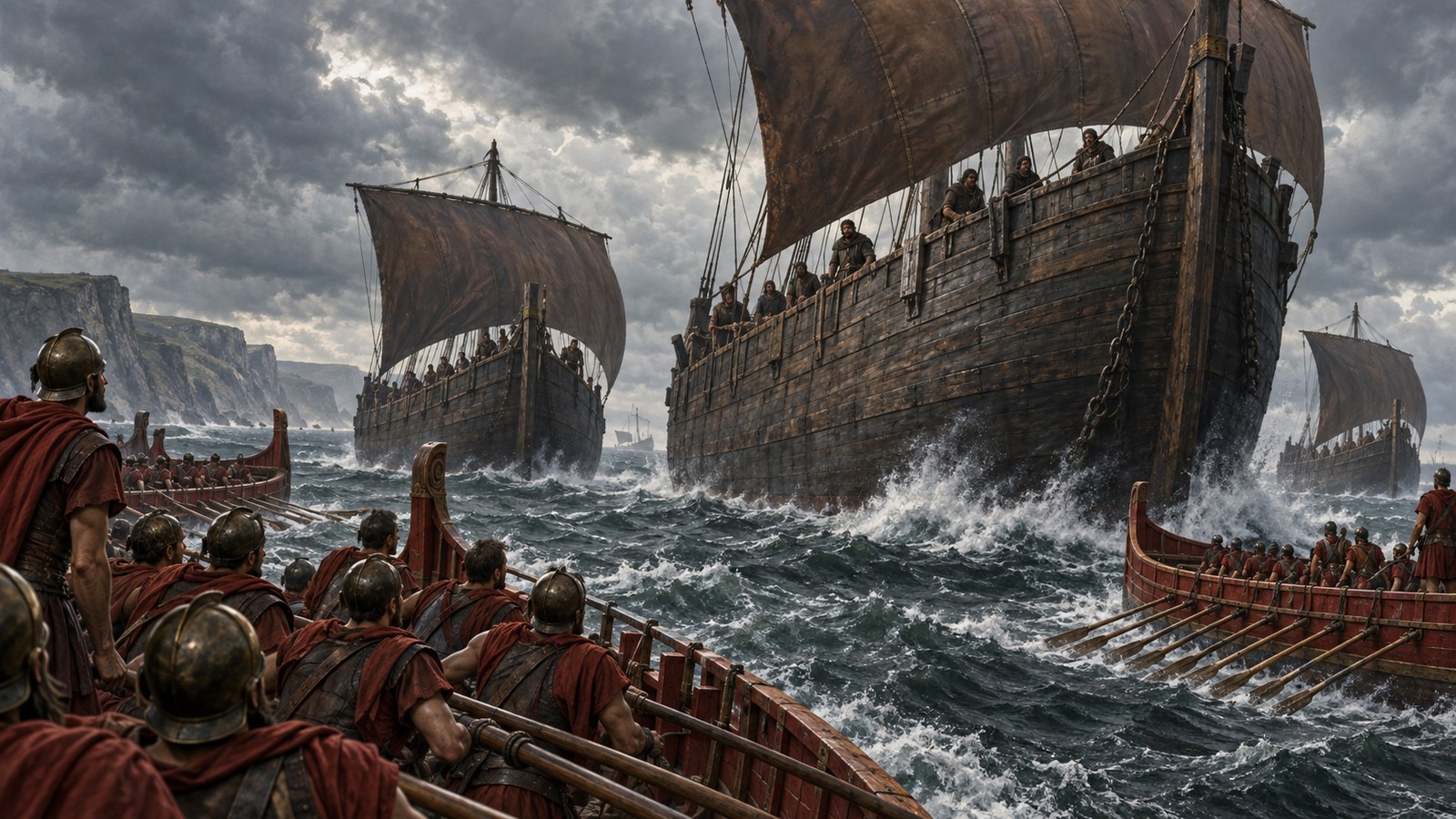
The Roman fleet faced 220 ships whose decks rose above its own. Their hulls were oak, their crossbeams massive, their anchor cables iron chain and their sails made from hides or dressed leather. Caesar says a Roman ram could not hurt them. Even towers added to the lower Roman vessels failed to erase the height from which Venetic missiles fell.
Decimus Brutus and his officers did not solve that problem by finding a stronger ram. Their useful weapon was narrower: a sharpened iron hook fixed to a long pole. A crew caught the ropes holding a yard to its mast, rowed ahead while the hook held and tore the rigging apart. The spar and sail collapsed. Two or three Roman ships could then close on the disabled vessel and send soldiers aboard.
The device did not make the Venetic construction weak. It found the connection on which that strength depended. Thick oak could survive impact, but an ocean-going sailing ship without working yards had become a high wooden platform waiting for enemies who still possessed oars.
The Veneti Built for Tides the Romans Did Not Know
Caesar introduces the opposing fleet by explaining its environment. The Venetic vessels had flatter bottoms than Roman ships, which suited shoals and the retreat of the tide. Their bows and sterns stood high to meet large waves and the violence of Atlantic weather.
The structure matched that exposure. Caesar says the hulls were entirely oak. Crossbeams a foot thick were fastened with iron bolts as thick as a man’s thumb. Anchors hung from chains rather than ropes. For sails, the builders used skins and thin dressed leather, whether because flax was scarce, because they did not know its use, or because ordinary canvas seemed unable to bear the storms and weight their vessels encountered.
We should hear self-justification in Caesar’s catalogue. He was explaining why his fleet did not simply overwhelm a coastal people. Yet the list remains valuable because each feature belongs to a coherent vessel: shallow-water access below, storm resistance above, massive joinery through the hull and rigging intended for a sail-driven ship.
The contrast with Mediterranean hull-first shipbuilding is not a ladder from crude to advanced. Different waters rewarded different choices. Caesar’s Romans brought warships organized around rowing crews, speed and close combat. The Veneti brought tall sailing vessels shaped by tides, harbours and an exposed coast.
Those choices dictated the battle. A weapon designed to punch a hole near the waterline had to reach a thick oak hull. A marine throwing upward had less force than a defender throwing down. Before Rome could use its familiar advantages, it had to change what kind of object the enemy ship was.
Rams and Towers Both Met the Same Height
The Venetic fleet emerged fully prepared from harbour. Caesar gives the number as 220 ships. Decimus Brutus commanded the Romans, while military tribunes and centurions had individual vessels assigned to them. Caesar admits that they did not initially know what to do or what plan of battle to adopt.
The usual answers had already failed conceptually. They recognized that the beak of a Roman ship could not damage the heavy opponent. They raised towers, but the Venetic sterns still overtopped them. Weapons launched from the Roman side therefore travelled from an inferior position, while missiles descending from the high decks struck harder.
This was not the problem the famous boarding bridge called the corvus had addressed generations earlier. A bridge seeks to impose infantry combat by spanning the gap between ships. Brutus’s crews first had to remove the enemy’s ability to choose and maintain that gap.
Caesar also placed the action under unusually visible scrutiny. He and the land army occupied hills and higher ground overlooking the sea. A brave act could not easily remain unnoticed. The fleet fought not only beneath Venetic decks but beneath the gaze of its own command and comrades.
The pressure helps explain why a simple-looking tool mattered. The Romans did not have time to rebuild every ship in the enemy style. They needed a device that crews could use from the vessels already afloat, against one accessible part of a taller structure.
A Long Pole Reached the Ship’s Moving Parts
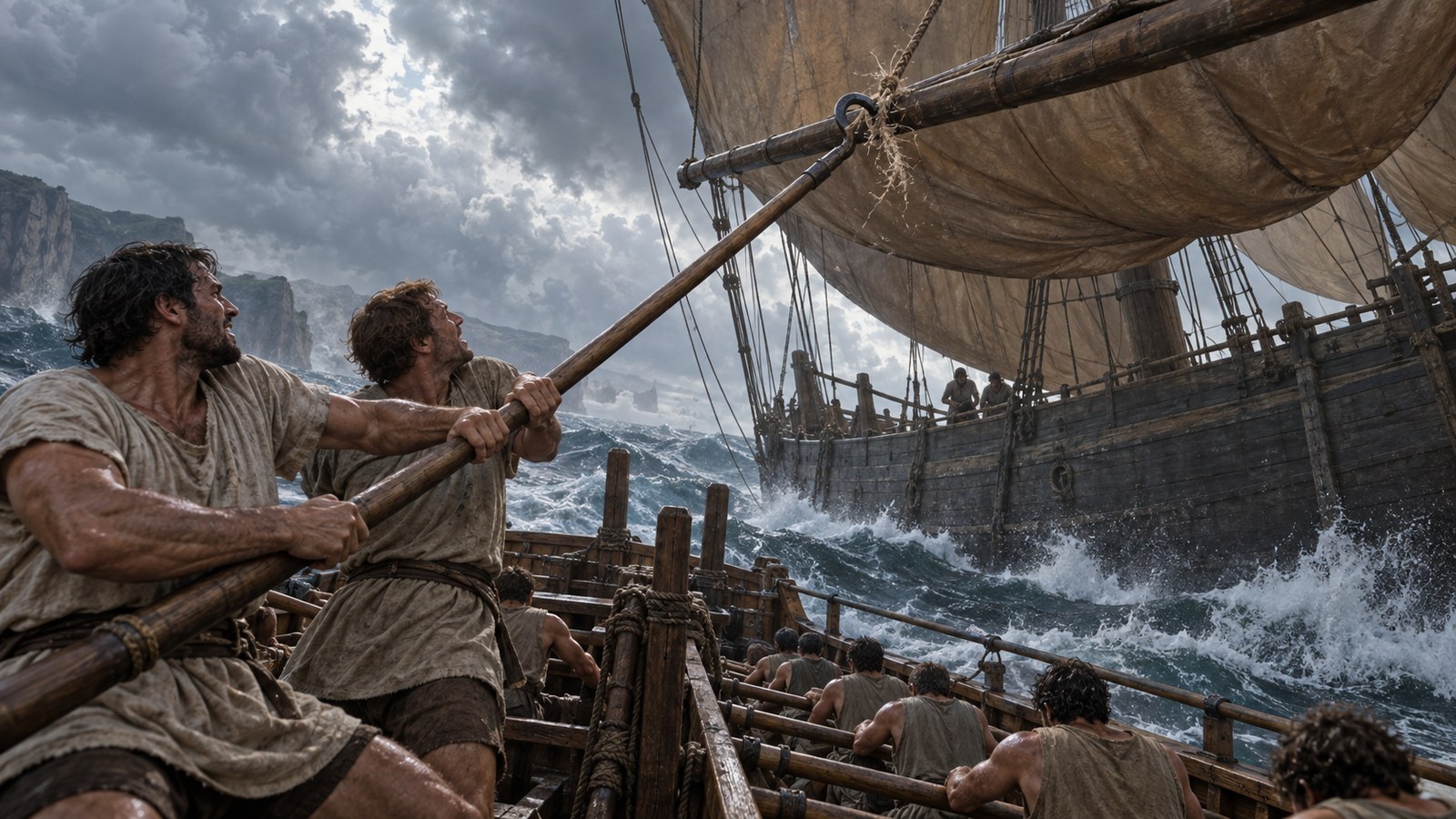
Caesar compares the sharpened hooks to the hooked tools used against walls. Fixed to long shafts, they extended a sailor’s reach into the rigging. The target was precise: the ropes fastening the horizontal yards to the masts.
A hook alone did not cut those ropes by magic. The sequence joined hand tool and propulsion. Sailors caught a line and drew it in. Rowers then drove the Roman vessel forward. With the hook holding at one point and the galley’s momentum pulling at another, the rope broke.
The yard necessarily fell when its support was severed. With it went the ordered surface of the sail. A mast could remain upright, the oak sides intact and the iron anchor chain aboard, yet the vessel’s working identity had changed. Caesar says the Venetic ships placed their whole hope in sails and rigging; removing them took away the use of the ships in one moment.
The claim is rhetorical—people remained on deck and a hull still floated—but tactically exact. The Veneti’s advantages depended on movement under sail. Once stationary, their height no longer kept Roman marines away. It only gave those marines something difficult to climb after several galleys had surrounded one target.
The article’s mechanism therefore lies between materials rather than within one object. Iron hook meets rope; oar-driven momentum strains the connection; gravity takes the yard; infantry closes the result. No single element explains victory without the others.
Two or Three Galleys Closed Around Each Disabled Hull
After the spars came down, Caesar shifts the contest from ship design to personal combat. Roman soldiers pressed to board. Individual Venetic vessels were surrounded by two or three Roman ships, multiplying the points from which attackers could approach.
Once several ships had been taken, the surviving Veneti tried to flee. Their vessels turned toward the direction in which the wind carried them. At that moment the weather supplied a brutal second reversal: a sudden calm settled over the water.
For oared Roman galleys, calm did not mean immobility. For a fleet whose usefulness Caesar had just located in sails and rigging, it removed the escape that intact ships still possessed. The Romans pursued and captured opponents one by one.
Caesar dates the duration by daylight, saying the struggle continued from about the fourth hour until sunset. Only a very small number of the entire fleet reached shore when night intervened. His next chapter turns a naval defeat into the political collapse of Venetic resistance: their young men and leading councillors had been concentrated there, and their communities depended on ships for contact with one another.
That consequence reminds us that 220 is not only a spectacle. The fleet was connective infrastructure for a coastal coalition. Losing it meant losing fighters, transport and the ability to use difficult harbours as a strategic network.
The Winning Target Was a Relationship
Battle stories often make invention sound independent of circumstance: someone produces a clever weapon, and superior intelligence defeats brute mass. Caesar’s account is more interesting. The hook succeeds because Roman officers first recognize exactly why their other tools are mismatched.
The Venetic ships resist impact because of oak and heavy framing. They dominate missile exchange because of height. They traverse their coast through a design adapted to shoals, tides and storms. Those are real advantages, not decorations waiting for Roman ingenuity to expose them as foolish.
The vulnerability appears because the same ships require a functioning relationship among rope, yard, mast, sail and wind. Brutus’s crews do not destroy all five. They interrupt the rope that keeps the system ordered. Oars let them apply force even when their opponents’ movement begins to fail.
Then chance enlarges the opening. The sudden calm does not invent the Roman method, because several vessels had already been captured. Nor do the hooks make weather irrelevant. Tool, crew coordination, boarding strength and windlessness accumulate until almost no Venetic ship escapes before night.
Caesar wrote as the commander whose campaign the victory advanced, so his neat tactical explanation serves his own reputation. Read critically, it still preserves a remarkable piece of mechanical thinking. Rome’s answer to the tallest and strongest object on the water was not to strike its thickest timber harder. It was to reach upward, catch the line carrying its mobility and pull.
Sources
Julius Caesar, Gallic War 3.13–15.