
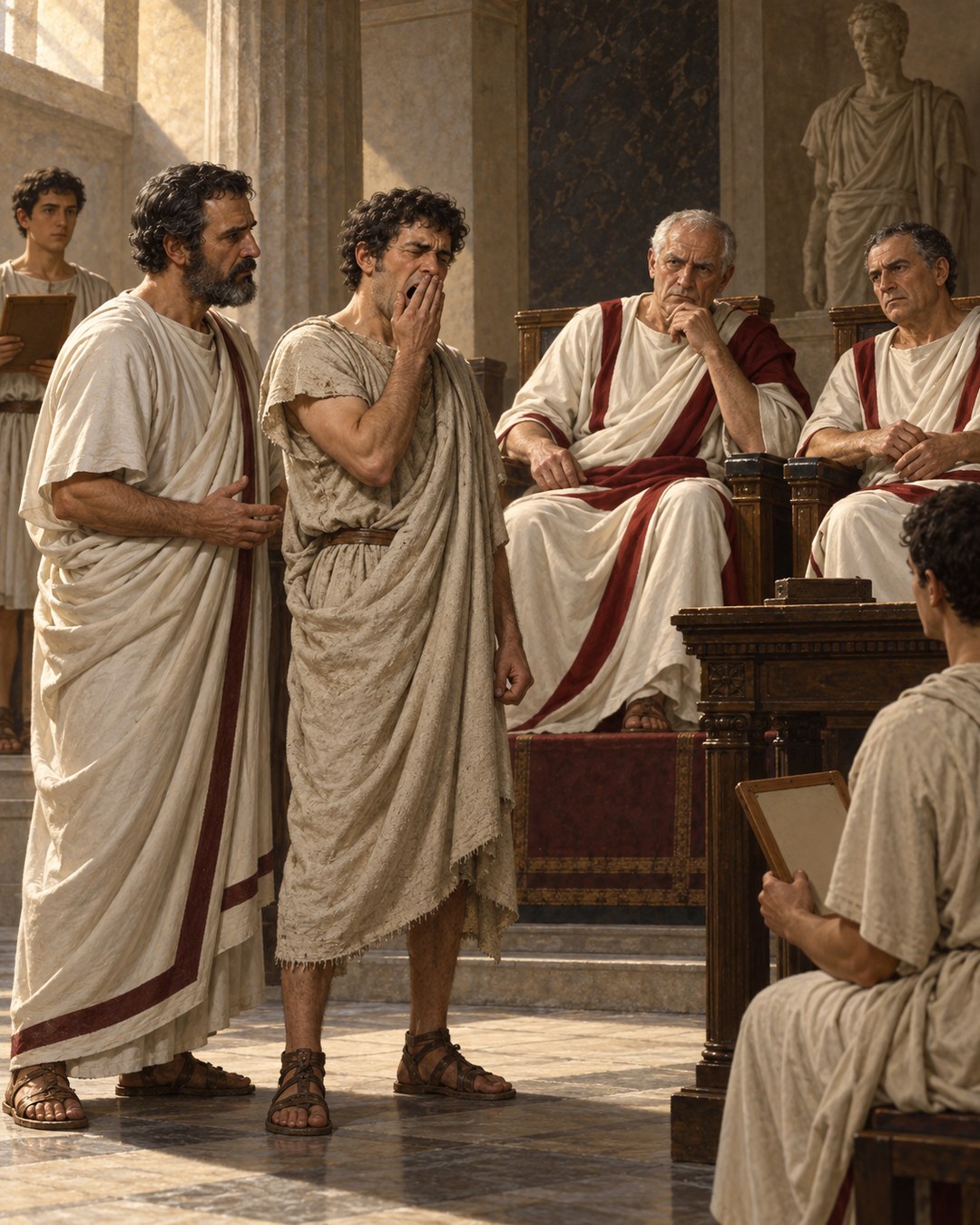
The room did not need a written charge. A Roman citizen stood before the censors with a friend beside him as advocate. Then, clearly and loudly, he yawned.
In Aulus Gellius’s account, the officials almost converted that instant into a judgment on the whole man. They read the open mouth and broken attention as signs of a wandering, trivial mind and undisguised indifference. A penalty was already taking shape when the citizen swore that the yawn had forced itself upon him despite his resistance. He suffered, he said, from a recurring tendency called oscedo.
The explanation worked. The censors excused him. Gellius places the reprieve beside a harsher scene in which another man turned the customary oath about his wife into a joke and lost status for it. Together, the anecdotes show neither random fussiness nor a tidy statute against yawning. They show officials deciding what a small performance revealed about intention, respect and self-command.
An Oath Left No Room for a Comic Aside
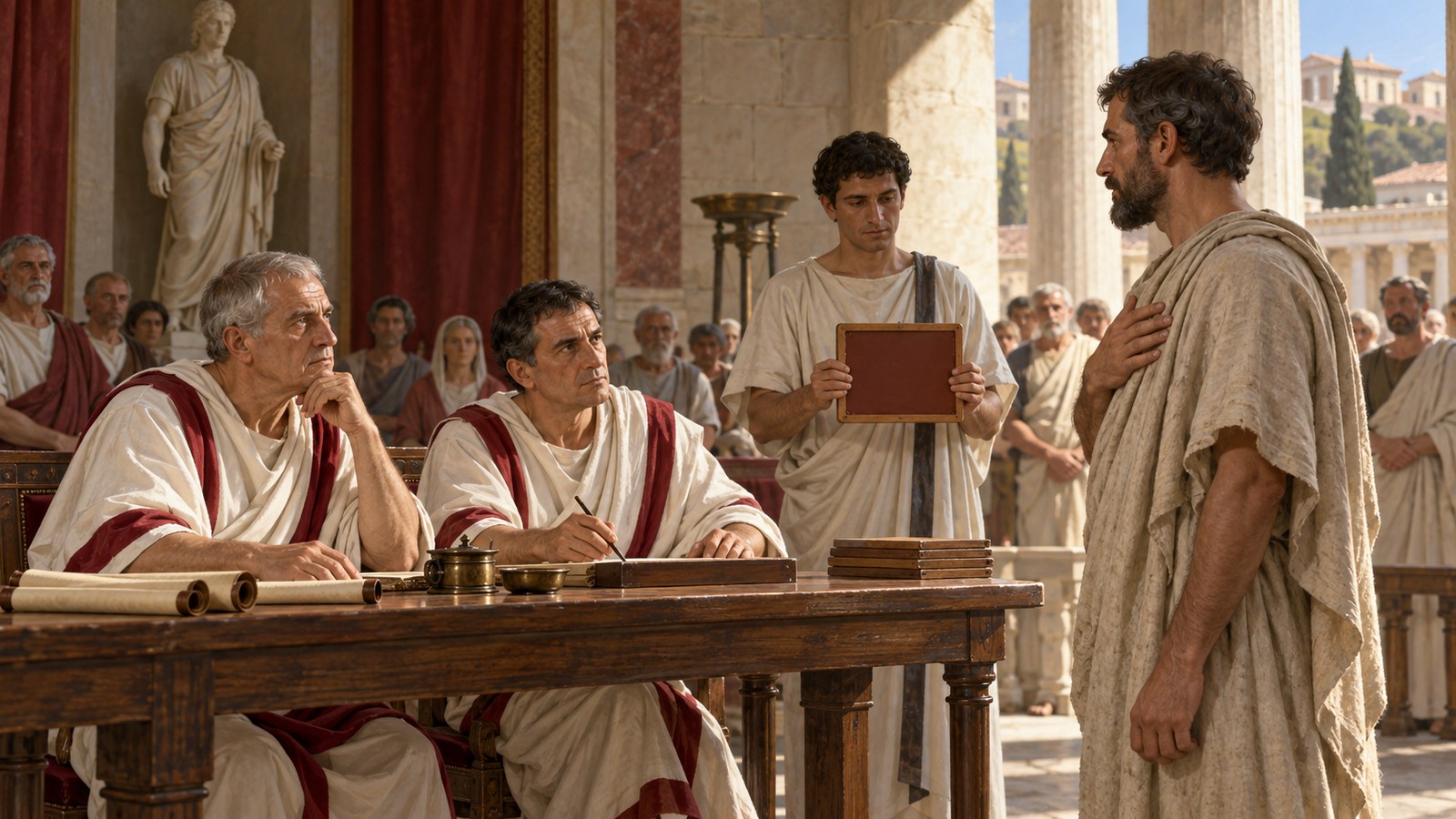
Gellius begins with a formula. A censor asked a man whether, to the best of his knowledge and belief, he had a wife. The question belonged to an established oath, so its wording was not an invitation to improve the occasion with wit.
The respondent was exactly the wrong person to leave near an opening. Gellius describes him as a sarcastic joker, excessively inclined to buffoonery. He replied that he did indeed have a wife, but not—by Heaven—one such as he could desire.
On another day, among friends, the answer might have earned laughter. Before a censor administering a civic oath, it changed the tone of the proceeding. The official reduced the joker to commoner status and entered the reason as a scurrilous joke made in his presence.
The punishment was not about whether the marriage was happy. It followed from treating a formal inquiry as material for performance. The citizen knew the expected shape of the answer and inserted a public complaint for effect. Gellius therefore gives the censor something more than an unfortunate phrase: he gives him timing, audience and a reputation for making sport of serious moments.
This is why a broad account of how censors made reputation countable becomes sharper when we watch an interview unfold. The office did not only classify property. It forced Roman standing through encounters in which a reply, an excuse and a visible manner could become evidence.
The Yawn Looked Like a Moral Choice
The second citizen said nothing clever. His body interrupted for him. He had been brought before the censors, and a friend accompanied him as advocate. While he stood there, he yawned so plainly and noisily that the gesture could not be ignored.
Gellius reports the officials’ first interpretation in unusually psychological terms. They took the yawn as an indication that the man’s mind wandered, that he was frivolous and that he displayed indifference without attempting to hide it. The physical act seemed to supply a character portrait.
That reading depended on the setting. A yawn at home is fatigue. A yawn during formal review can look like contempt because other people control the time, questions and consequences. The citizen’s body appeared to say that the proceeding did not deserve sustained attention.
Modern readers should resist turning this into a universal Roman rule that yawning was illegal. Gellius preserves a story of censorial severity. He does not quote a law naming the act, provide a tariff of penalties or claim that every involuntary yawn produced demotion. The officials moved from an observable act to an inference about the person before them.
That inference was severe because rank carried an expectation of visible discipline. An elite citizen could not ask the public to separate his standing from his conduct whenever he entered a civic arena. The review tested whether appearance and claimed worth agreed.
One Sworn Explanation Changed the Meaning
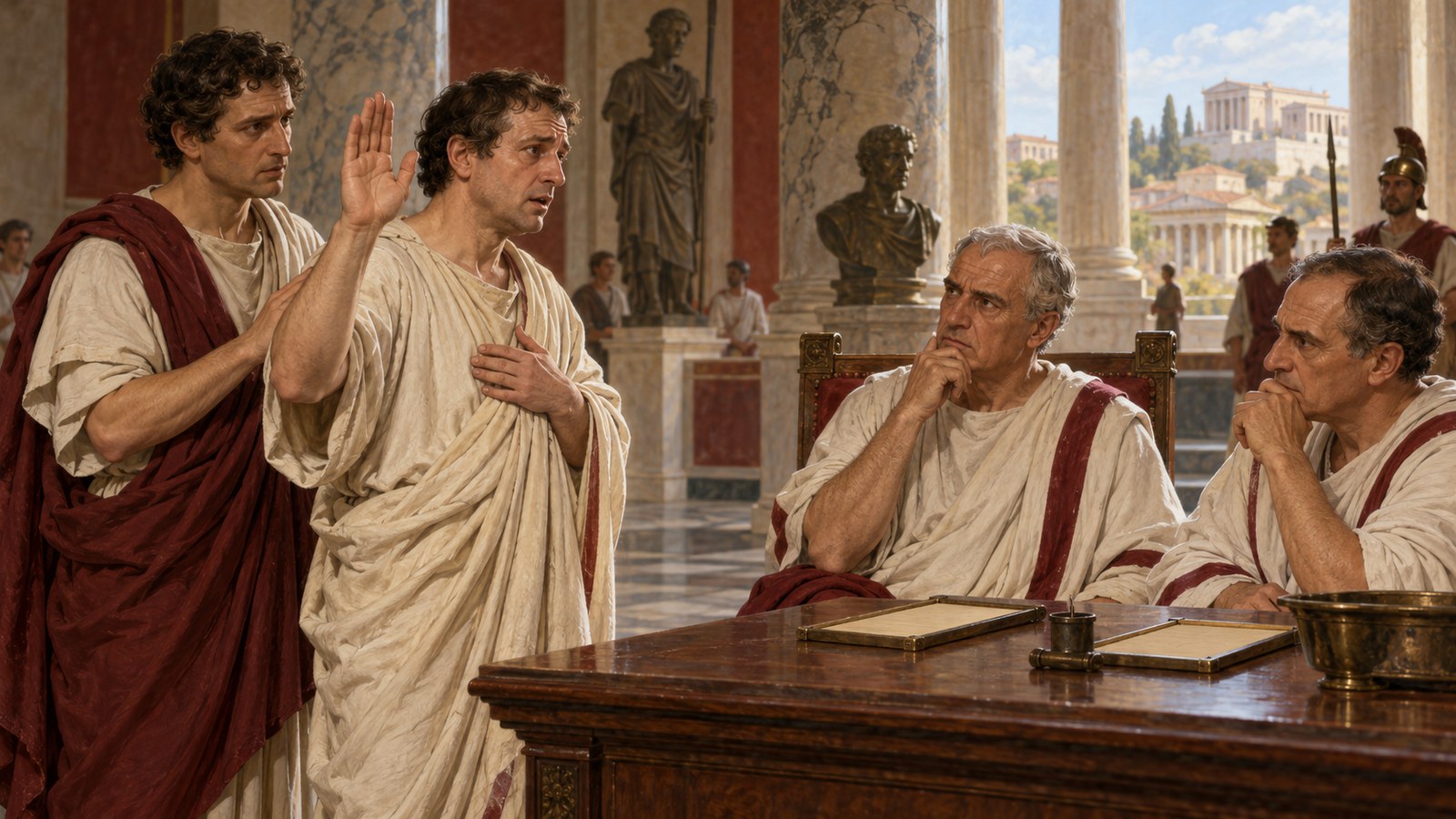
The citizen did not deny that everyone had seen and heard him. He changed the explanation. He swore that the yawn had overcome him against his will, even though he tried to resist it. He also named a recurring tendency to yawn: oscedo.
The oath matters as much as the diagnosis. The officials had treated the gesture as voluntary display. His sworn account recast it as a condition suffered despite attempted control. What had looked like open indifference became a failure of the body to obey.
Gellius says the penalty had already been determined, or was at least on the verge of determination, when this defence succeeded. The censors did not need to pretend that the yawn had never occurred. They withdrew the moral interpretation that made it punishable.
The paired stories now divide cleanly. The joke was intentional, verbal and fitted the speaker’s known appetite for sarcasm. The yawn was conspicuous but, after testimony, accepted as involuntary. Severity did not prevent revision. In fact, the contrast only works because the same demanding institution could distinguish a chosen performance from an unavoidable symptom.
A recent case in the archive, the well-fed rider with the neglected horse, shows censors comparing the condition of a man and his mount and then judging his flippant explanation. The yawn episode turns the mechanism inward: the body itself creates the suspicious evidence, and an oath must separate illness from insolence.
Scipio Used Tiny Scenes to Argue for Old Standards
Gellius does not present the anecdotes as transcripts rescued directly from a censor’s desk. He identifies a path of transmission. Publius Scipio Africanus, the son of Paulus whom we call Scipio Aemilianus, included the first two stories in a speech he delivered as censor. The speech urged the people to follow ancestral customs.
That setting explains why the examples are so compact. A comic answer receives a recorded rebuke. A loud yawn nearly receives one, then a sworn explanation changes the result. Each scene asks listeners to imagine how public authority should read ordinary conduct.
The anecdotes also let Scipio praise strictness without presenting it as blind. The joking husband supplies the cautionary example: verbal cleverness cannot dissolve the seriousness of an oath. The afflicted yawner supplies a limit: an official must still listen when apparent disrespect has another cause.
We should not assume every detail belongs to the earliest history of the censorship exactly as Gellius’s second-century text tells it. The stories reached him through speeches and learned compilations. Their survival reveals what later Roman readers thought censorial authority was for. It made civic reputation visible by examining moments that other courts might have considered too small.
A yawn nearly became a sentence because the censors were judging more than the air leaving a man’s lungs. They were judging the meaning of his presence before them. It ceased to be a punishable sign only when his oath persuaded them that the body, not the citizen’s contempt, had interrupted the review.
Sources
Aulus Gellius, Attic Nights 4.20.