
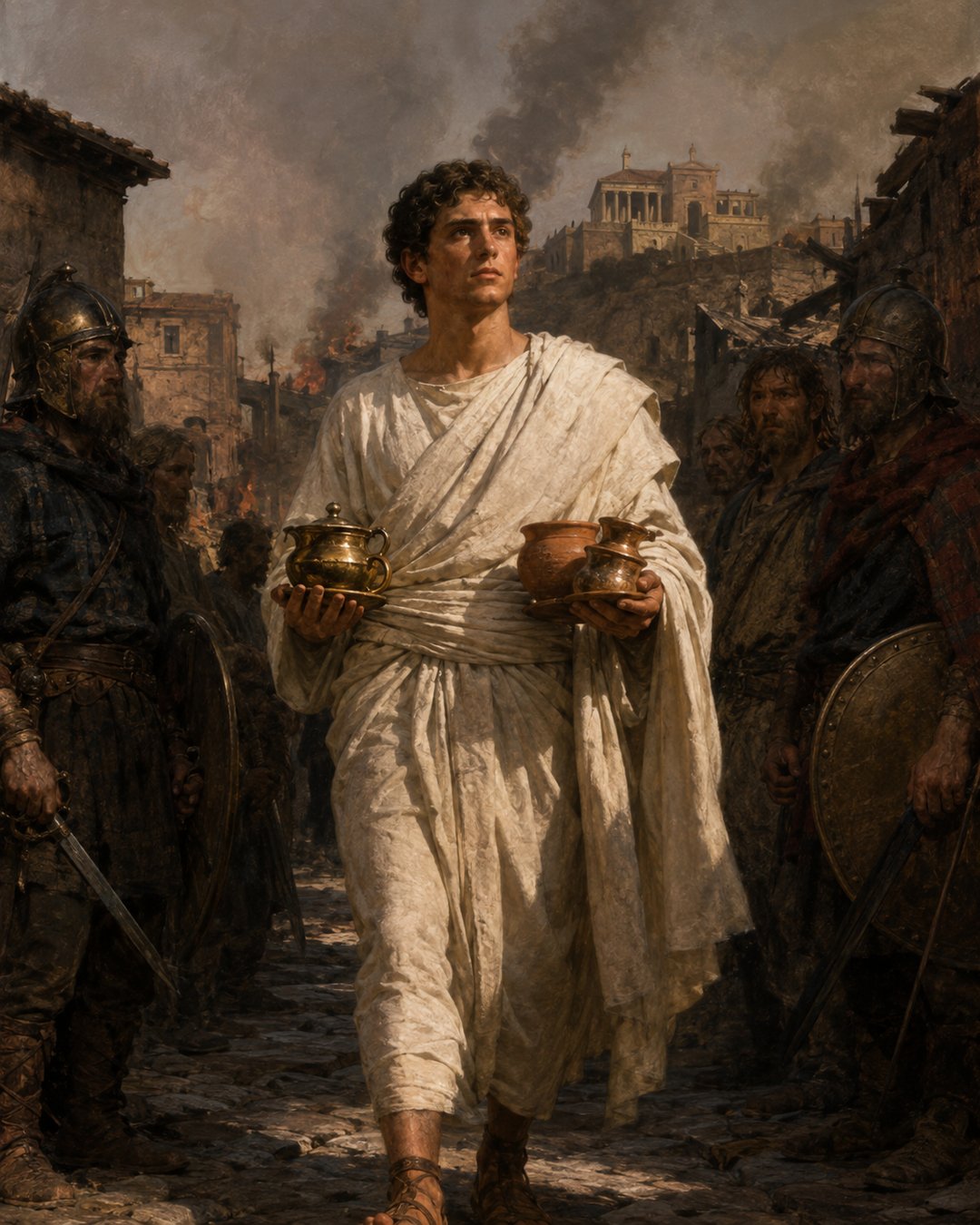
Rome below the Capitol was full of enemy movement, smoke and ruined houses. The defenders on the height could hear cries, the crackle of flames and buildings falling in the city they could no longer control. Gallic posts watched the exits so that nobody inside the blockade could slip away.
Gaius Fabius Dorso did not wait for darkness. In Livy’s account, the young man arranged his garment in the Gabine cincture, took sacred utensils in his hands and descended from the Capitol. His destination was the Quirinal Hill, where the Fabian family had a sacrifice due at a stated time.
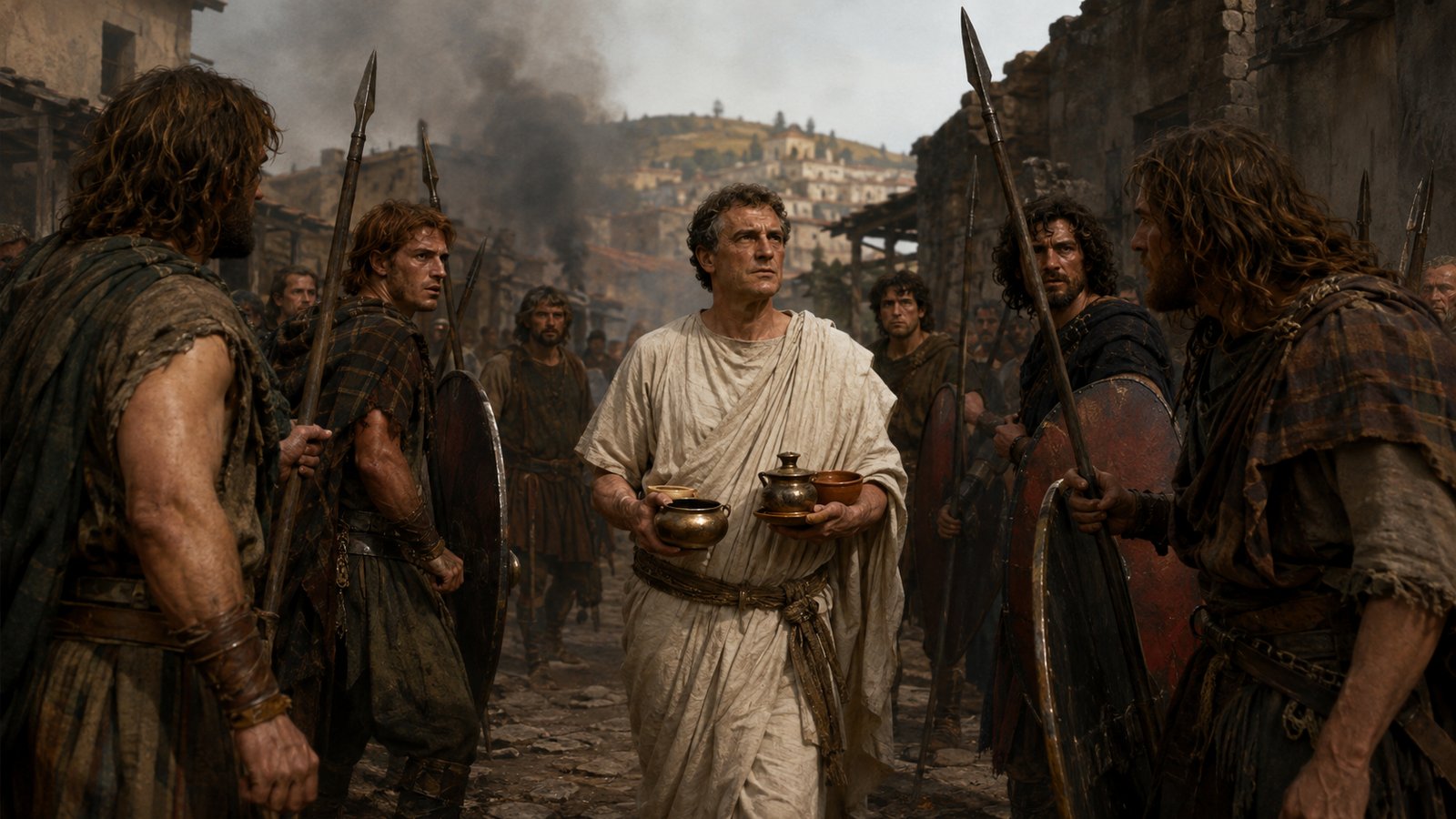
Calls and threats did not turn him back. Dorso passed through the enemy position, completed the rite and returned by the same exposed route with the same steady expression and pace. Livy leaves the Gauls’ restraint open to two readings: they were stunned by the audacity, or religious respect stopped them.
The story is not a neutral record of everything that happened during Rome’s capture. It is a tightly shaped episode in Livy’s narrative. Its power comes from four requirements remaining joined under siege: the proper time, the family responsible, the place on the Quirinal and the visible equipment of ritual.
The Capitol Held the Survivors, Not the Whole City
Livy begins the crisis with a division of Rome. After the defeat at the Allia, many survivors made for Veii. Those who returned to Rome discovered that the city did not contain enough fighting men to defend its full circuit.
The decision was to contract. Men of military age, leading senators, wives and children withdrew into the citadel and onto the Capitol. Arms and grain were collected there. The height became a fortified remainder of the community while much of the lower city was left outside its protection.
Religious continuity received its own emergency plan. Livy says the flamen Quirinalis and the Vestal priestesses were to carry the sacred property of the state away from killing and fire. Worship was not to be interrupted while anyone remained who could continue it.
That is the essential background to Dorso’s walk. The Roman response did not treat religion as decoration to be resumed once military safety returned. People, food, weapons and sacred objects all had to be sorted under pressure. Some rites could travel with their custodians. The Fabian sacrifice, as Livy presents it, remained tied to its appointed hill and time.
Elsewhere in Roman ritual, the body of an officiant could become part of the rule itself. The restrictions gathered around Jupiter’s priest and the knots he could not wear show how clothing, posture and daily conduct could carry religious meaning. Dorso’s Gabine cincture similarly made his purpose visible before he said anything.
The Gauls Turned Assault into Blockade
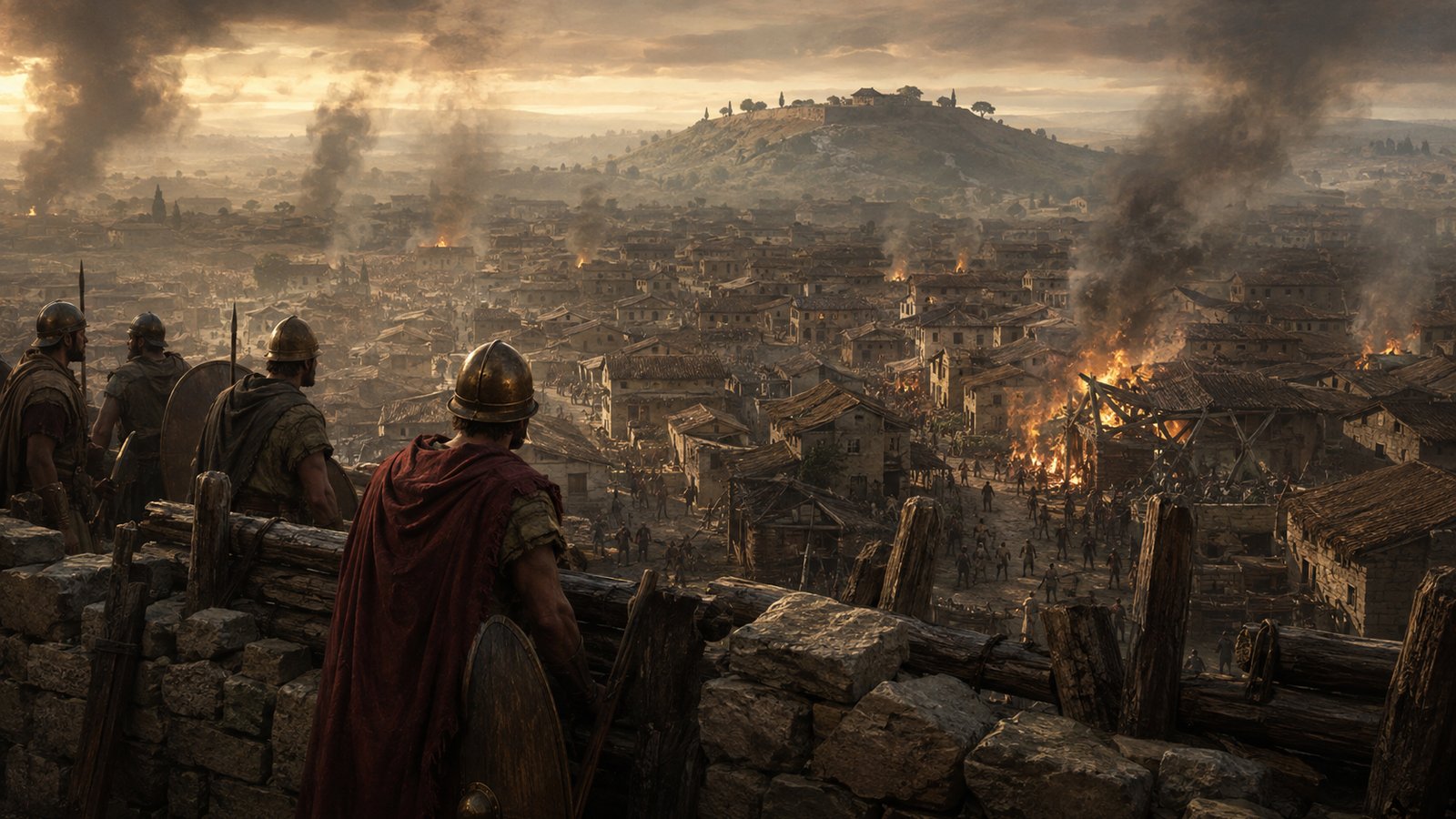
The lower city did not remain an empty corridor. Livy describes the Gauls entering through the open Colline Gate, looking toward temples and toward the one height that still showed signs of armed resistance. Houses were plundered and burned after the leading men who remained below were killed.
From the citadel, Romans watched successive shocks unfold. Their position preserved them, but it also forced them to see and hear the city’s destruction. The separation between defended height and occupied streets was therefore physical and emotional: safety consisted of being trapped above what they had lost.
The Gauls tried to erase that safety with a direct assault. They advanced from the Forum and climbed toward the defenders. The Romans waited until the slope increased their advantage, then charged downhill and drove the attackers back.
After this failure, the siege changed form. One part of the Gallic force ranged through neighboring territory for supplies while another maintained the blockade. By the time Dorso appears, Livy calls the siege slow and the situation generally quiet. Quiet did not mean open passage. The guards were specifically intent on preventing anyone from getting through their posts.
This matters because Dorso’s success was not simply a walk across abandoned ground. Livy stages it after force had failed and containment had become policy. The street between Capitol and Quirinal belonged to an occupation system whose ordinary purpose was to stop exactly the movement he attempted.
A Family Calendar Refused to Move
Livy gives no recipe for the Fabian sacrifice and does not name its divine recipient in this passage. He tells us what his scene requires: the rite belonged to the Fabian family, recurred at stated times and had to be performed on the Quirinal Hill.
Those details prevent us from turning the episode into a generic act of courage. Dorso was not carrying sacred objects merely to save them. He was moving toward an obligation whose timing and location had already been fixed. Completing it elsewhere, later or without its visible apparatus would not create the same story.
The distinction also separates this family rite from the emergency removal of state sacred property. Livy places both responses within the same crisis. Some custodians carry religion out of danger so observance can survive. Dorso carries ritual through danger because this observance belongs at a specific point in the city.
Roman accounts repeatedly make correctness a collective task rather than a private feeling. In the prayer protected by four separate attendants, wording, prompting, silence and music are divided among people so a mistake does not break the ceremony. Here the safeguards are different, but the logic is comparable: right person, right appearance, right objects, right place and right time have to meet.
Livy says Dorso wore the Gabine cincture, a ritual arrangement of the toga, and held the utensils openly. Concealment would have reduced his chance of being recognized for what he was doing. Visibility made him vulnerable, yet it also allowed every watcher to read the passage as ceremonial rather than as an escape attempt.
Dorso’s Route Made Ritual Public
The journey has two halves. Dorso first descends from the defended Capitol and passes outward through the enemy position. He reaches the Quirinal, performs the solemn rites properly, then turns back toward the same guards.
A one-way escape could have been explained as flight. The return removes that interpretation inside Livy’s design. Dorso does not use the rite as cover to leave the besieged community. He walks back into danger and rejoins his companions on the Capitol after the obligation is complete.
Livy emphasizes continuity in his movement: the same way, the same firm countenance and the same gait. Those repetitions make composure observable. We are not told Dorso felt no fear. We are told what his body communicated to people watching him cross an armed boundary.
The sacred utensils matter for the same reason. They occupy his hands and announce a purpose. His clothing and objects transform the route into a procession stripped down to one officiant. An occupied city becomes the ceremonial space between a family’s refuge and its ritual destination.
Even Livy’s language of confidence remains attached to observance. Dorso trusts that the gods favor someone who has not neglected their worship despite the threat of death. The account does not say the sacrifice broke the siege, harmed the Gauls or guaranteed Rome’s recovery. Its immediate outcome is narrower: the rite is done and the worshipper returns.
Livy Leaves the Enemy’s Motive Open
Why did armed guards let him pass? Livy refuses to choose a single answer. The Gauls may have been astonished by a display of boldness outside their expectations. Or religious considerations may have moved them, since, he adds, their people were not indifferent to such matters.
The uncertainty improves the scene. If the guards simply vanished, there would be no confrontation. If Dorso defeated them, the story would become a combat anecdote. Instead, both sides remain present while the expected action—seizure or killing—does not occur.
Dorso’s ritual appearance may have made the action legible, but Livy does not give us a guard’s testimony or a negotiated safe conduct. We should not invent one. He offers literary alternatives from the Roman side of the tradition, and both preserve the same image: military control pauses in front of behavior it cannot easily classify.
The episode sits beside another risky crossing in the same chapter. Pontius Cominius later floats down the Tiber on cork, climbs an unguarded part of the rock and carries political instructions between Veii and the Capitol. His movement depends on concealment and neglected terrain. Dorso’s depends on being seen.
That contrast explains why the sacrifice survived as more than a detail of the siege. Cominius penetrates the blockade because the enemy does not notice his route. Dorso crosses the watched route while looking exactly like the obligation he intends to fulfill. In Livy’s Rome, continuity can require hiding a messenger—and, on another day, refusing to hide a ritual at all.
Sources
Livy, History of Rome 5.39, 5.41–43, 5.46.