
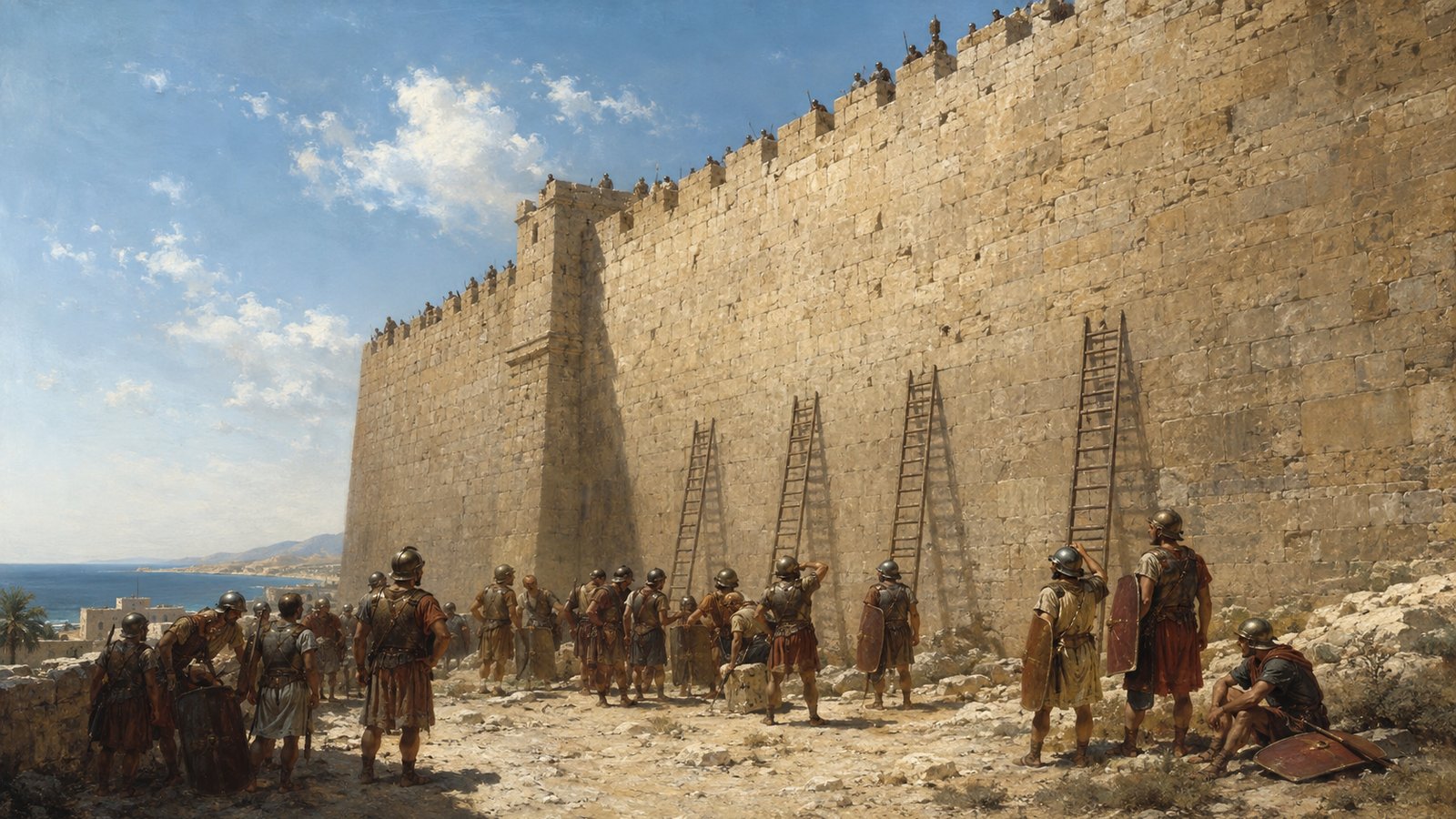
The ladders bent under too many men. Some did not reach the top of New Carthage’s wall at all; the longer ones flexed, broke and dropped their climbers. Those who reached the highest rungs found themselves exposed and unable to step onto the battlement.
Then the Roman signal sounded for retreat. To the defenders, the first assault appeared to confirm the city’s geometry. The wall was too high, a formal siege would take time, and relief might arrive before Scipio could build his way inside.
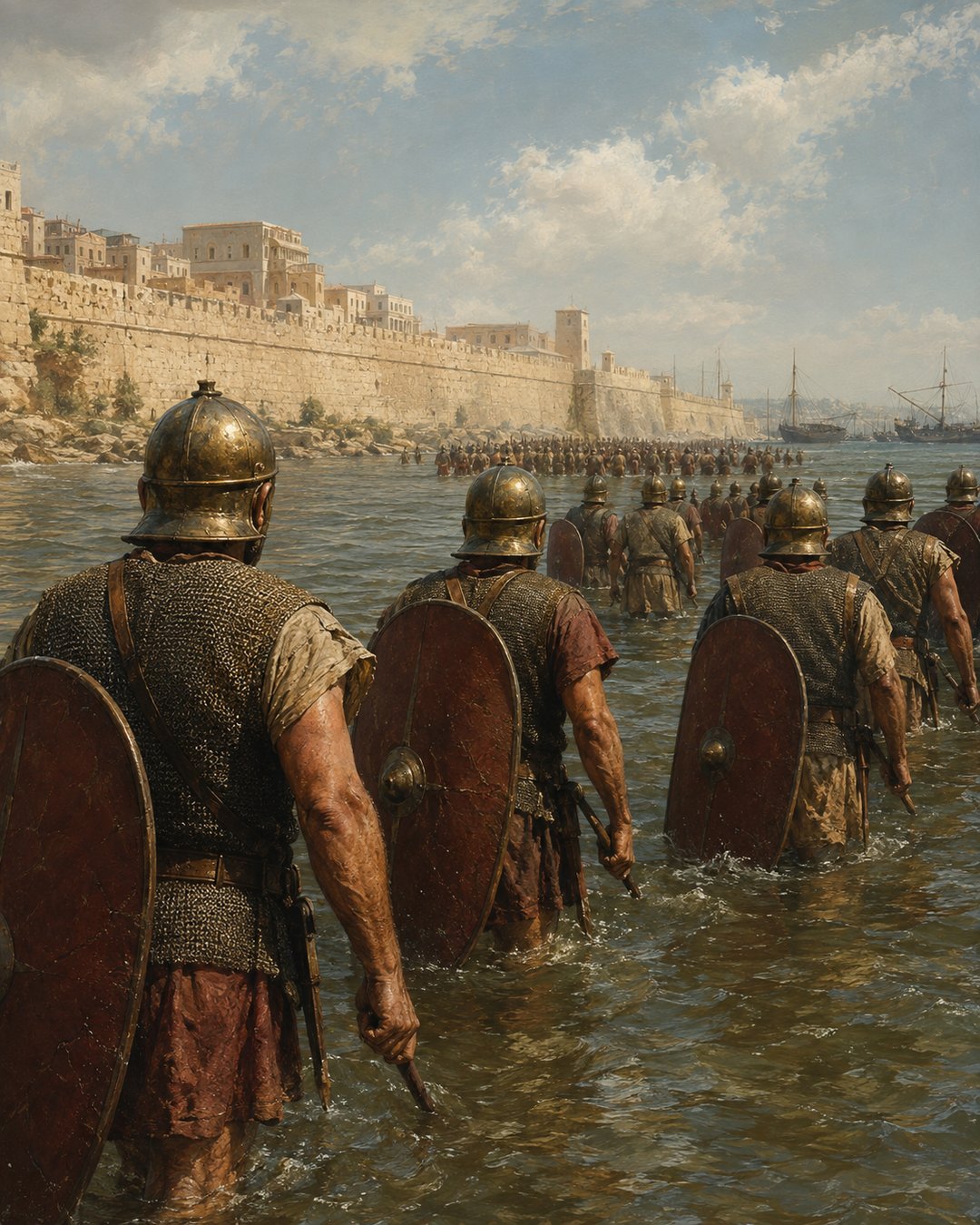
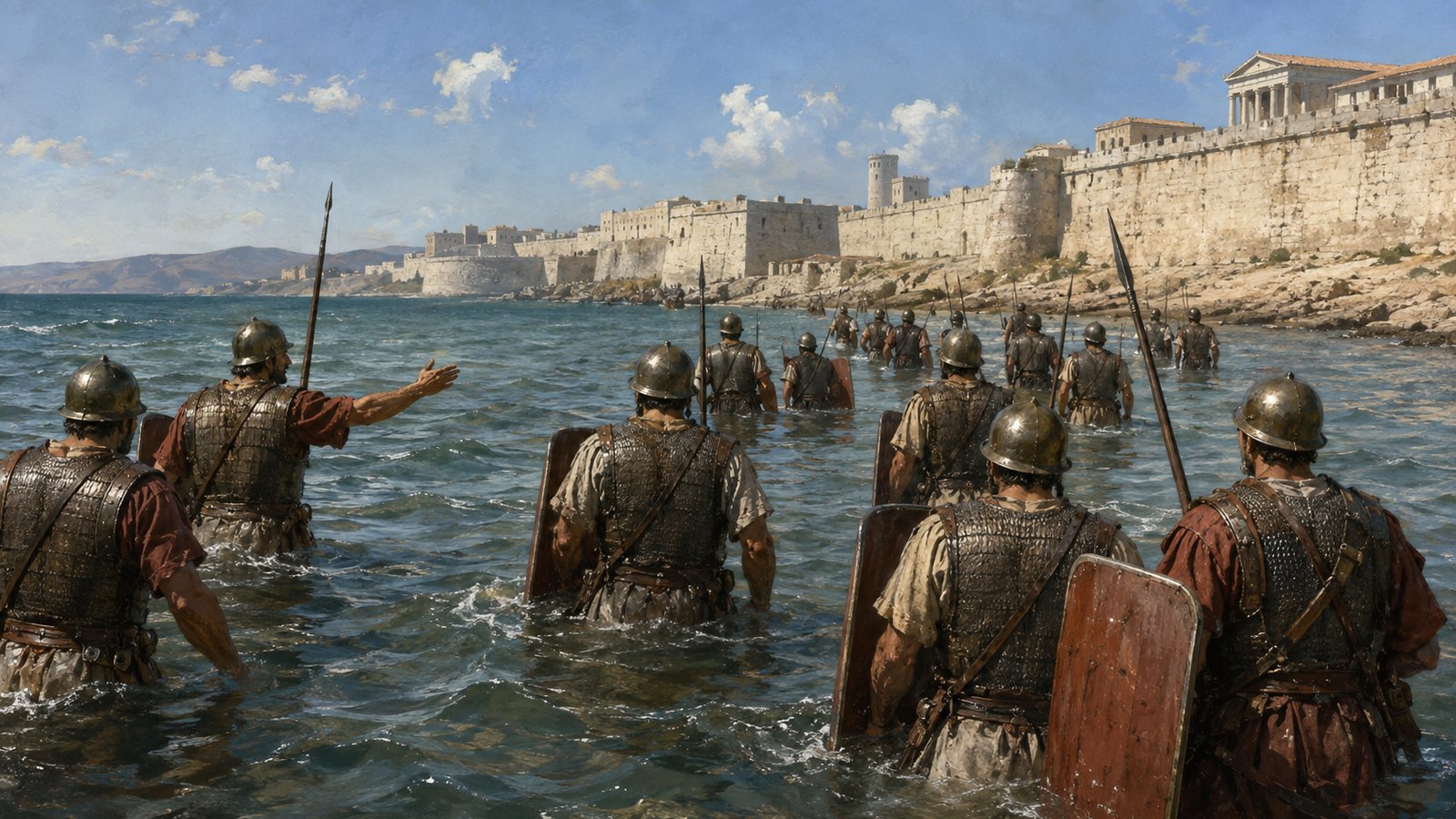
At about midday, 500 Romans moved in another direction. They entered the shallow lagoon west of the city, where ebb water and a northerly wind were working together. In some places the water reached their waists. In others it rose only to their knees.
Livy’s account of New Carthage is often remembered as a feat of bold command. Its sharper lesson concerns information. Defenders watched the obvious danger at the ladders. Fishermen had taught Scipio that the lagoon itself changed, and that the barrier trusted as a wall could become a road.
The City Stored More Than One Army Could Lose
Scipio crossed the Ebro with 25,000 infantry and 2,500 cavalry, leaving Marcus Silanus north of the river with a smaller force. His officers urged him to strike the nearest Carthaginian army. He refused because attacking one risked drawing all three enemy forces together.
New Carthage offered a different target. Livy describes it as rich in its own resources and crowded with the machinery of Carthaginian power in Spain: war stores, arms, money and hostages taken from communities across the peninsula.
The harbour could hold a very large fleet and gave access toward Africa. Capturing one city promised to deprive the enemy of an arsenal, treasury, base and political leverage at once. Scipio was not choosing a fortress instead of an army. He was choosing the place that helped those armies continue.
Secrecy matched the concentration of value. Only Gaius Laelius knew the intended march. His fleet moved around the coast at a pace calculated to meet the army. Seven days after the Romans left the Ebro, ships and troops appeared at New Carthage together.
This coordination resembles the timed information problem in the torch system that converted positions into distant letters. The devices differ, but both stories turn success on separate bodies arriving or acting as one plan requires.
A Quarter-Mile Neck Focused Every Watching Eye
Livy pauses before the assault to make the terrain legible. New Carthage stood on a promontory. Sea enclosed it on the east and south. To the west lay a shallow sheet of water whose depth changed with the tide. A neck of land about a quarter mile long joined the city to the mainland.
The narrow neck created an obvious front. Scipio placed his camp opposite the north side and protected its rear with a double rampart. The city’s defenders could expect the main pressure to arrive across the firm ground where a formed army and its ladders could approach.
Water simplified the defensive map. A wall backed by a lagoon did not look like the urgent sector when Roman troops stood visibly before the landward gate. The Carthaginians treated the terrain itself as fortification and therefore spent fewer people on built defenses there.
The first assault reinforced that choice. Roman soldiers attacked by land while ships threatened the sea-facing side. Noise, missiles and bodies gathered attention wherever the danger could be seen.
Livy says Scipio observed the walls from Mercury’s Hill and sent ladders forward. The attack was not a token distraction in his narrative. Men tried hard to scale the masonry, and its failure was real enough to raise the defenders’ confidence.
The Wall Defeated the Ladders Before the Defenders Did
Livy makes the wall itself the strongest defender. Very few ladders were tall enough. Length solved one problem while creating another: the longest structures were weaker and increasingly difficult to stabilize.
At the top of a crowded ladder, the leading soldier could not step safely onto the wall, while the men behind continued to climb. Their combined weight broke some ladders. Others held, but their height made climbers dizzy and sent them falling.
No reconstruction should pretend Livy gives every measurement or ladder design. His mechanism is clear without them. The Roman approach concentrated bodies on long, narrow structures whose load increased precisely where the transition onto the wall became hardest.
The retreat signal seemed to prove that New Carthage could not be taken quickly by storm. Defenders expected that proper siege works would take long enough for help to arrive. Their confidence came from surviving the method they had prepared to defeat.
Scipio immediately ordered fresh troops to continue the ladder attack. The renewed pressure held attention on the visible wall and exhausted the people defending it. Meanwhile, his most important route began where no one had prepared to see an assault.
Fishermen Turned Tidal Habit into Military Intelligence
The decisive information came from fishermen of Tarraco. They crossed the waters in light skiffs and knew that when their boats grounded, people could wade ashore through the shallows at low water.
That knowledge was practical and repeated. A coastline viewed once from a command post could look sealed by water. People who worked it knew where depth changed, when hulls touched bottom and which apparent lake became passable under particular conditions.
When word arrived that the tide was ebbing, Scipio took about 500 men toward the lagoon. Livy adds a second force: a strong northerly wind had risen and was driving water seaward in the same direction as the falling tide.
The combination reduced the lagoon to a human scale. Waist depth slowed movement and burdened clothing and equipment. Knee depth still resisted every step. Yet neither required ships, bridges or siege towers. Five hundred men could remain a formed attacking body while crossing a space defenders had removed from their tactical map.
Livy says Scipio had established the opportunity through careful investigation and reasoning. Scipio publicly described the change as direct help from the gods. The difference matters. Private method made use of local knowledge and observation; public language turned fortunate timing into confidence.
The episode can be set beside Scipio’s repeated camp-building exercises. In both, he asks soldiers to make difficult collective movement dependable. Here, however, the route could not be rehearsed daily. Timing, water and secrecy had to align once.
Five Hundred Men Entered Where Nobody Was Watching
On the lagoon side, Livy says, there were no additional fortifications and no outposts or pickets. The defenders trusted the water and ground. Most eyes and ears were fixed on the struggle at the main wall.
The 500 found the crossing and the ascent to the wall easy relative to the direct assault. They entered without opposition, then moved quickly toward the gate around which the main fighting had gathered.
Livy describes a city so absorbed by the attack in front that no one understood what had happened behind them until missiles came from the rear. The surprise was not only that Romans had crossed water. It was that a zone categorized as safe had ceased to receive attention.
With pressure now coming from both sides, the gate was battered inward and cleared so Roman ranks could pass through. Other troops climbed the walls. Mago withdrew toward the citadel and eventually surrendered after the city’s internal positions collapsed.
The account should not turn capture into a bloodless puzzle. Livy records slaughter after the entry. The tactical elegance of the lagoon crossing delivered armed men into a populated city. Intelligence changed the route; it did not remove the violence at its end.
New Carthage fell because several systems met at one neglected edge. Laelius brought the fleet on time. The land assault fixed defenders at the obvious wall. Fishermen supplied environmental knowledge. Tide and wind lowered the water. Five hundred soldiers converted that short interval into an entry.
The strongest assumption in the defense was not that stone could never be climbed. The failed ladders showed everyone that climbing remained possible, dangerous and visible. The fatal assumption was that the lagoon did not need watchers at all.
Sources
Livy, History of Rome 26.42, 26.45–46.