
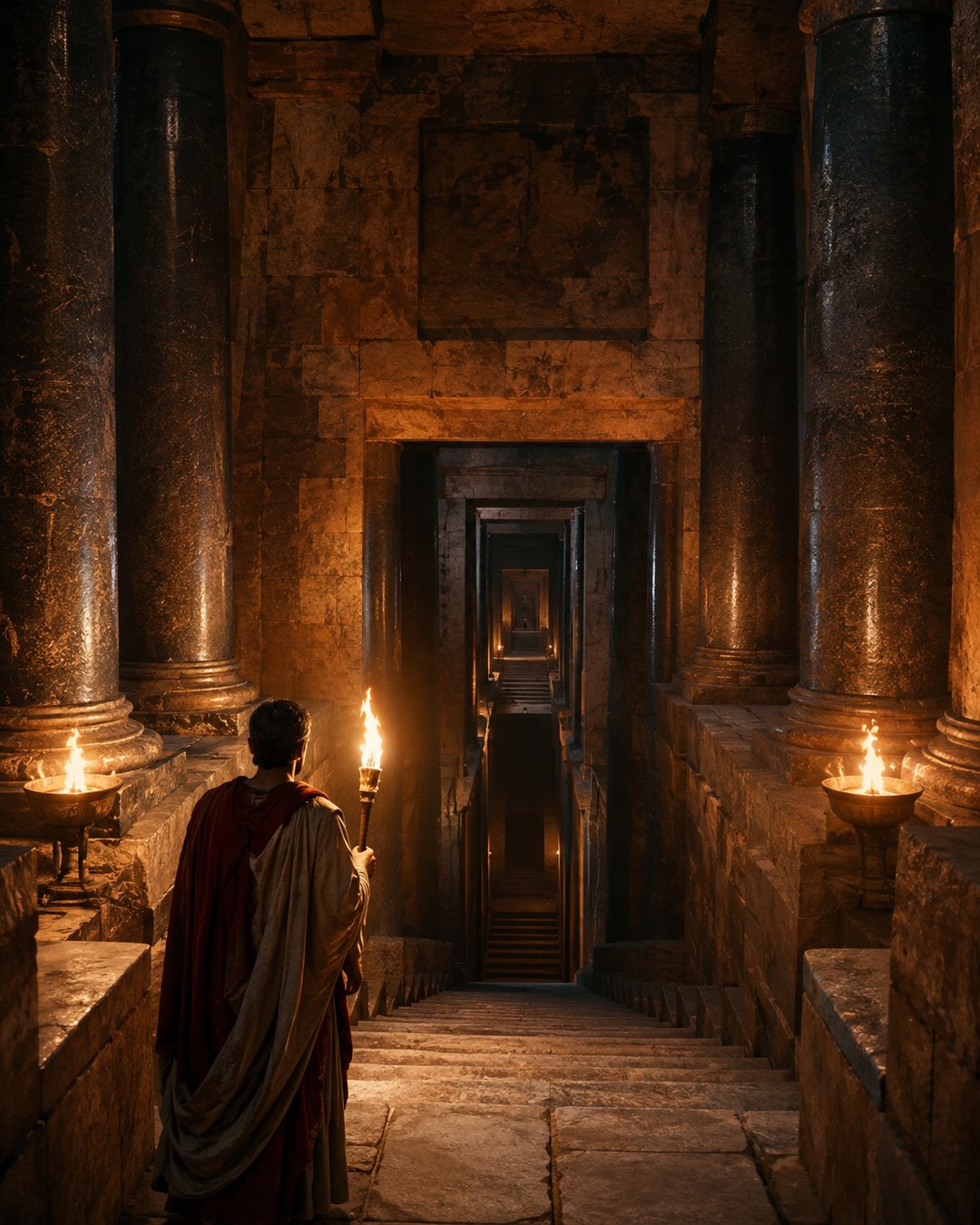
The door opened, and the building answered like thunder. Beyond it, most of the route had to be crossed in darkness. A visitor who kept moving through the galleries could discover that the architecture had delivered him back to the place where he began.
This is the Egyptian Labyrinth as Pliny the Elder asks his Roman readers to imagine it. His account in Natural History 36.19 piles scale upon scale—palaces, shrines, columns and underground chambers—but its most memorable details are physical experiences. Feet climb steeply, descend ninety steps, hesitate at crossings and continue where sight no longer helps.
Pliny calls labyrinths among the most stupendous works made by human labor. Yet size alone does not explain his fascination. The building seems to control the visitor’s route, vision and hearing. Monumentality becomes the experience of surrendering orientation inside stone.
His report is not a modern survey, and its chronology and measurements cannot be accepted without question. Pliny openly preserves rival traditions and repeats marvels. Read carefully, however, the chapter shows what an ancient author thought made architecture overwhelming: not simply how much material it contained, but what that material made a body feel.
Competing Histories Made the Entrance Uncertain
Pliny locates the first labyrinth in Egypt’s Heracleopolite nome. One tradition, he says, assigned it to King Petesuchis or Tithoes and placed its construction 3,600 years in the past. Herodotus offered a different account, attributing the whole work to twelve kings, the last of them Psammetichus.
The disagreement continues when Pliny asks why the complex existed. Demoteles called it a palace of King Moteris. Lyceas made it the tomb of Moeris. Many others considered it a building consecrated to the Sun, and Pliny says that opinion prevailed.
Those alternatives are not minor labels. Palace, tomb and sanctuary imply different occupants, ceremonies and routes. Before Pliny’s reader enters the structure, its purpose is already unstable. The monument resists a single explanation just as its corridors resist a single direct path.
Pliny also places Egypt first in a family of four labyrinths. Crete came second, Lemnos third and Italy fourth. He insists that Daedalus modeled the Cretan work on Egypt’s, while reproducing only a hundredth part of it. The comparison turns a structure famous in Greek myth into a reduced descendant of something older and larger.
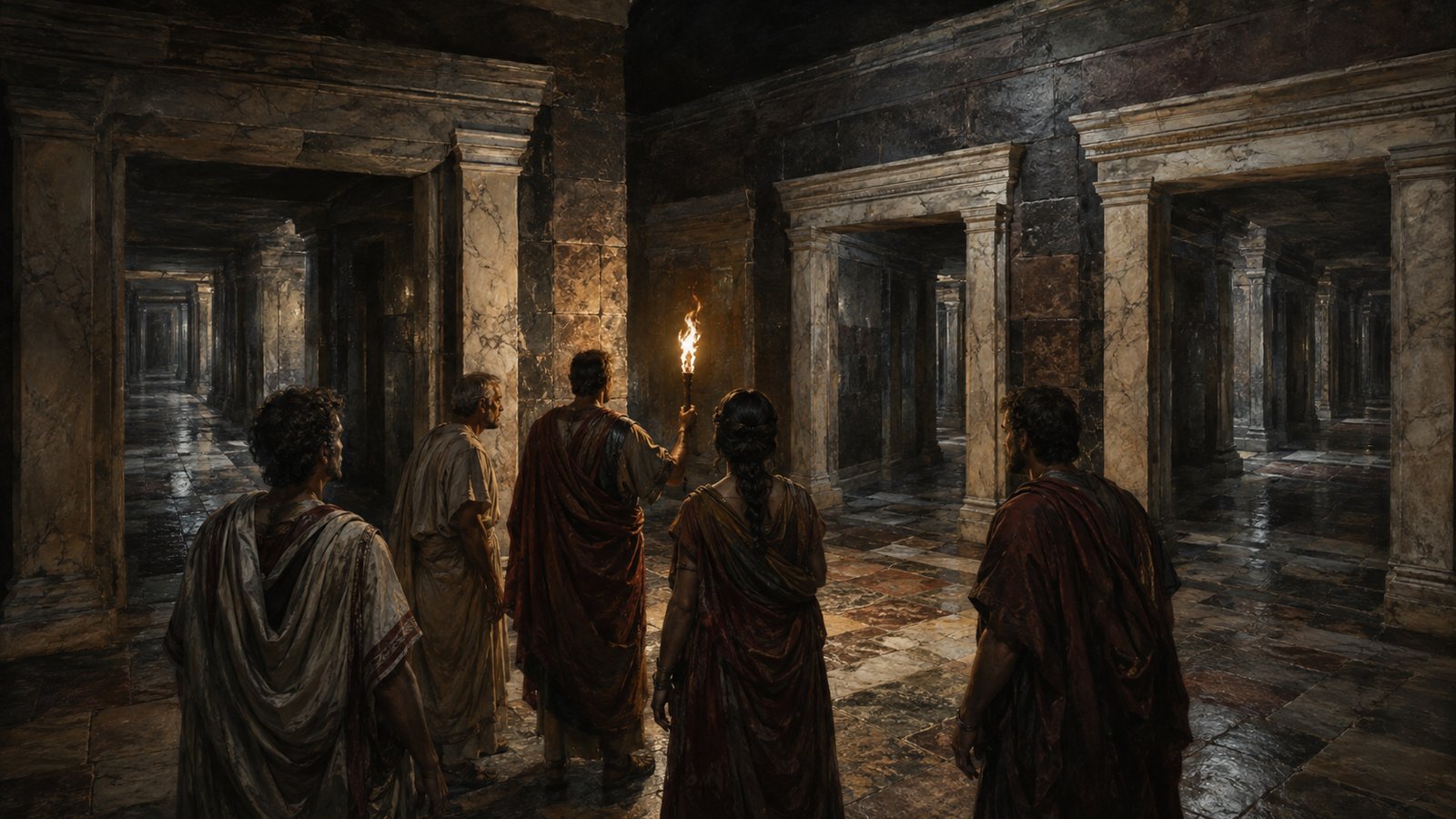
He warns readers not to picture the tidy labyrinth patterns laid in mosaics or the field mazes made for children. His subject is not one narrow path coiled into a decorative puzzle. It is a building of many doors and galleries that repeatedly mislead the person moving through them.
Thirty Palaces Turned a Building into a Territory
The Egyptian complex, Pliny says, was divided into thirty regions or prefectures called nomes, with a vast palace assigned to each. The organization copies the language of territory inside one monumental enclosure. Crossing the building meant passing through an architectural map of Egypt.
Pliny adds temples for all the gods of Egypt, forty statues of Nemesis in forty sacred shrines and numerous pyramids. His figures should be treated as part of his received description rather than a verified inventory. Their effect in the prose is nevertheless clear: every turn seems to lead not to an empty corridor, but to another concentrated claim about religion, kingship or place.
The material palette reinforces difference within unity. Pliny is surprised by Parian marble at the entrance, while the columns elsewhere are syenite. Inside he names porphyry columns, figures of gods, statues of kings and images of monsters. A visitor moved not through one repeated finish, but through shifts of stone, color and subject.
That variety distinguishes the labyrinth from a single-purpose Roman engineering work such as the inverted siphon that carried water down and across a valley. The siphon’s route can be explained by pressure and level. Pliny’s labyrinth accumulates purposes and symbols until the reason for one route becomes difficult to separate from the spectacle around it.
Its polished arched roofs of stone gave the mass a continuous cover. Pliny says the structure had survived ages even though local people, who hated it, had helped to ravage it. Endurance appears almost adversarial: time and human hostility had both worked against the building without wholly erasing it.
Ninety Steps Made Disorientation Vertical
Misleading galleries worked on a horizontal plane, but Pliny’s route also rises and falls. He places banqueting rooms at the summit of steep ascents. Elsewhere, porticoes lead down flights of ninety steps. The visitor’s uncertainty is measured through exertion.
A staircase changes more than elevation. It narrows attention to footing, hides what lies beyond the next landing and makes retreat costly. After a steep climb, a room feels earned; after ninety steps downward, the way back acquires weight. Pliny’s details make the labyrinth difficult to comprehend as a complete plan because the body encounters it one gradient at a time.
He says an exhausted wanderer was certain to arrive at some inextricable crossing. The important word is not only “crossing,” but “exhausted.” Confusion increases after repeated choices, climbs and descents. The building wins by making memory less reliable as fatigue grows.
This differs from the controlled movement imagined for the great columns moved from the Ephesian quarry on their own shafts. There, a difficult object gained a temporary axle and followed a planned road. In the labyrinth, the moving object is the visitor, and the architecture makes the planned road hard to retain.
Outside the walls stood another mass of buildings called the Pteron. Beneath it, excavated passages led toward subterranean palaces. The complex therefore continued beyond the visible enclosure and below the apparent ground line. Even departure from the central maze did not necessarily restore a simple surface map.
Darkness and Thunder Took Sight and Sound
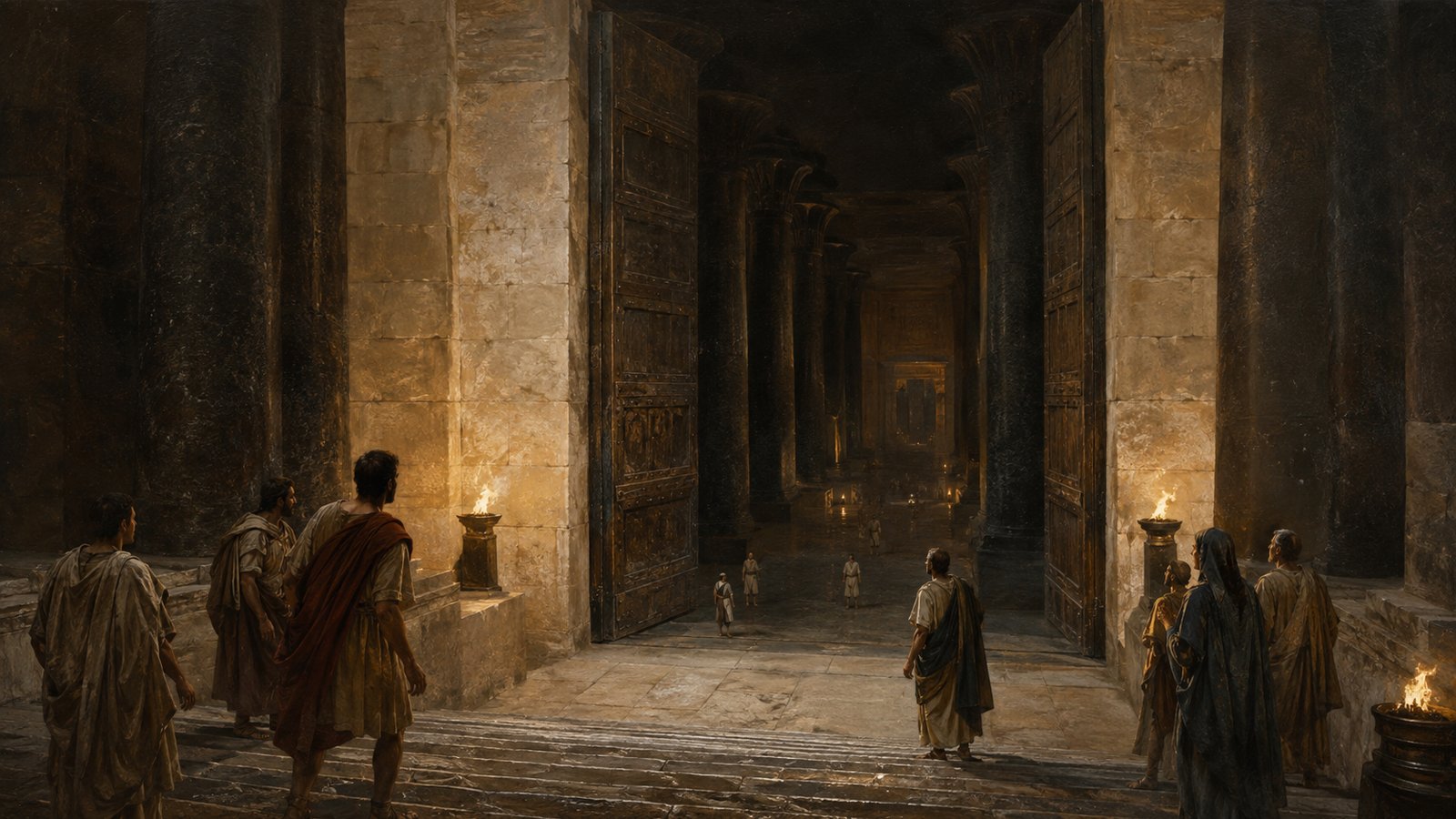
Pliny’s most theatrical claim is that certain palaces were constructed so that opening their doors produced a dreadful reverberation like thunder. He does not provide dimensions or a tested acoustic explanation. He gives an action and a reaction: the hand moves a door, then the interior answers with a sound too large for the gesture.
The effect turns a threshold into an event. A doorway normally promises information about the next room. Here it first announces power through noise. The visitor hears the building before seeing what the opening reveals.
Pliny then says that most of these buildings had to be traversed in total darkness. Taken literally, the statement raises practical questions he does not answer about lamps, guides and who was permitted to pass. As a feature of his description, darkness removes the sense that usually helps architecture become legible.
With sight restricted, polished stone and colored columns cease to offer dependable landmarks. Footfall, echo, touch and remembered turns become more important. Thunder-like doors can unsettle that acoustic map just when a new chamber begins.
This sensory sequence explains why Pliny’s labyrinth is more than an oversized maze. Doors misdirect, stairs tire, crossings divide, darkness withholds and reverberation startles. Each mechanism reduces the visitor’s command of the next decision.
Pliny Preserved Construction beside Wonder
Even while collecting marvels, Pliny includes a construction detail. He names Chaeremon, a eunuch of King Necthebis, as the only person to have made slight repairs, five hundred years before Alexander the Great. During the raising of squared-stone arched roofs, he says, thorn beams boiled in oil served as supports.
The report does not give enough information to reconstruct the centering or prove the treatment. It does reveal the kind of question Pliny brought to a wonder: not only who built it and how astonishing it felt, but what temporary material held permanent stone while it was being assembled.
That contrast matters. The visitor saw polished roofs that appeared immovable. Construction had once depended on perishable timber, preparation and a sequence of support and release. The completed labyrinth concealed the vulnerable stage that made its endurance possible.
Pliny’s chapter moves between those registers without resolving them. It is a catalogue of rival histories, enormous numbers, sensory shocks and one compact workshop memory. The combination is more useful than treating every detail as either sober measurement or fantasy.
For his Roman audience, the Egyptian Labyrinth represented architecture beyond easy mastery. Its history could not be fixed to one builder or purpose. Its plan could not be held securely by a person walking it. Its interiors could remove light and magnify sound. Even its stone roof led back to hidden timber used centuries before.
Ninety steps are the perfect measure for that account. They are precise enough to imagine and too numerous to dismiss as one threshold. By the bottom, the visitor has entered a depth that the eye could not survey from above. Pliny’s monument becomes immense not when he gives its outer dimensions, but when the route makes a human being small.
Sources
Pliny the Elder, Natural History 36.19.