
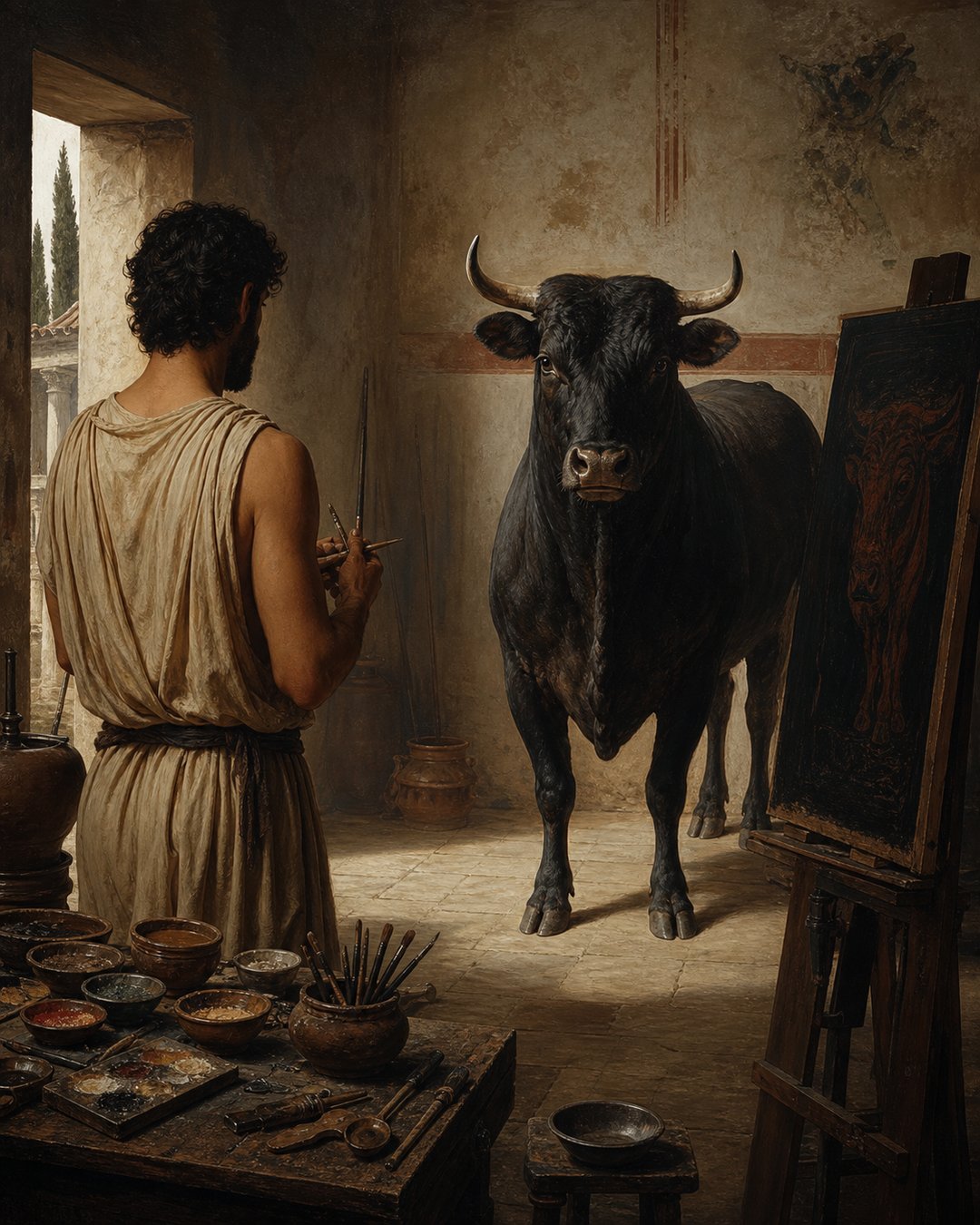
A large black ox faced outward from Pausias’s painting. It did not offer the broad side profile that would make its length easy to describe. Its chest stood before its body, and the painter refused the usual help of white highlights.
Pliny says the animal still appeared long and solid. Pausias made the shadow cast by the black body explain the body itself, building relief with darkness on darkness and setting a unified mass against broken ground.
The painting, a Sacrifice of Oxen, hung in the Portico of Pompey at Rome. By then its visual puzzle had become the kind of achievement other painters imitated. Pliny claims they never matched its success.
Pausias’s biography repeatedly turns on constraints. Encaustic was called slow, so he made a one-day picture. Flowers multiplied colors, so he competed with a garland maker. A ceiling changed the viewer’s angle. A front-facing black ox withheld the easiest signs of depth. His reputation grew from choosing problems that made technique visible.
A Wall Repair Exposed the Limit of His Training
Pausias came from Sicyon, a city Pliny treats as a long-standing home of painting. His father Bryetes first taught him, and Pamphilus—the instructor of Apelles—later trained him in encaustic work.
Encaustic bound color with wax and demanded control over heat, tools and working time. Pausias became distinguished in that branch, but skill did not transfer equally to every surface.
At Thespiae, he retouched walls under repair that Polygnotus had painted earlier. The comparison went against him. Pliny explains the result bluntly: this kind of wall painting was outside Pausias’s line.
The failure matters because ancient artist biographies often flatten careers into uninterrupted genius. Here a public comparison preserves mismatch. A painter known for wax panels could be judged inferior when asked to enter another artist’s monumental wall.
Pausias did not answer by becoming a copy of Polygnotus. The works that secured his name moved toward other formats and other constraints: ceilings, small pictures, flower colors and eventually a large animal whose orientation challenged familiar solutions.
One Day Answered the Charge That Wax Was Slow
Pliny says Pausias painted many small pictures, especially portraits of children. Rivals offered an ungenerous explanation. The slow process of encaustic, they suggested, confined him to small scale.
Pausias turned the criticism into a timed performance. He completed a child’s portrait in a single day. The work was called the Hemeresios, preserving its one-day making in its identity.
Speed here was not merely workshop efficiency. It became evidence displayed to competitors and patrons. A finished picture could not show every hour of labor, so the name carried the feat forward.
The episode resembles Protogenes finding painted foam after throwing a sponge, but the engines differ. Protogenes’s story turns frustration and accident into effect. Pausias deliberately set a deadline to refute a claim about his medium.
Neither anecdote provides a neutral stopwatch. Pliny tells exemplary stories about artistic ingenuity. Their value lies in what contemporaries thought worth remembering: not only the image, but the difficulty under which the image appeared.
Ceilings created another difficulty. Pliny credits Pausias with first painting them and says arched roofs had not previously been decorated this way. Looking upward alters proportion, distance and light. The surface forces the painter to anticipate a viewer who cannot stand squarely before it.
Glycera’s Garlands Made Color a Competition
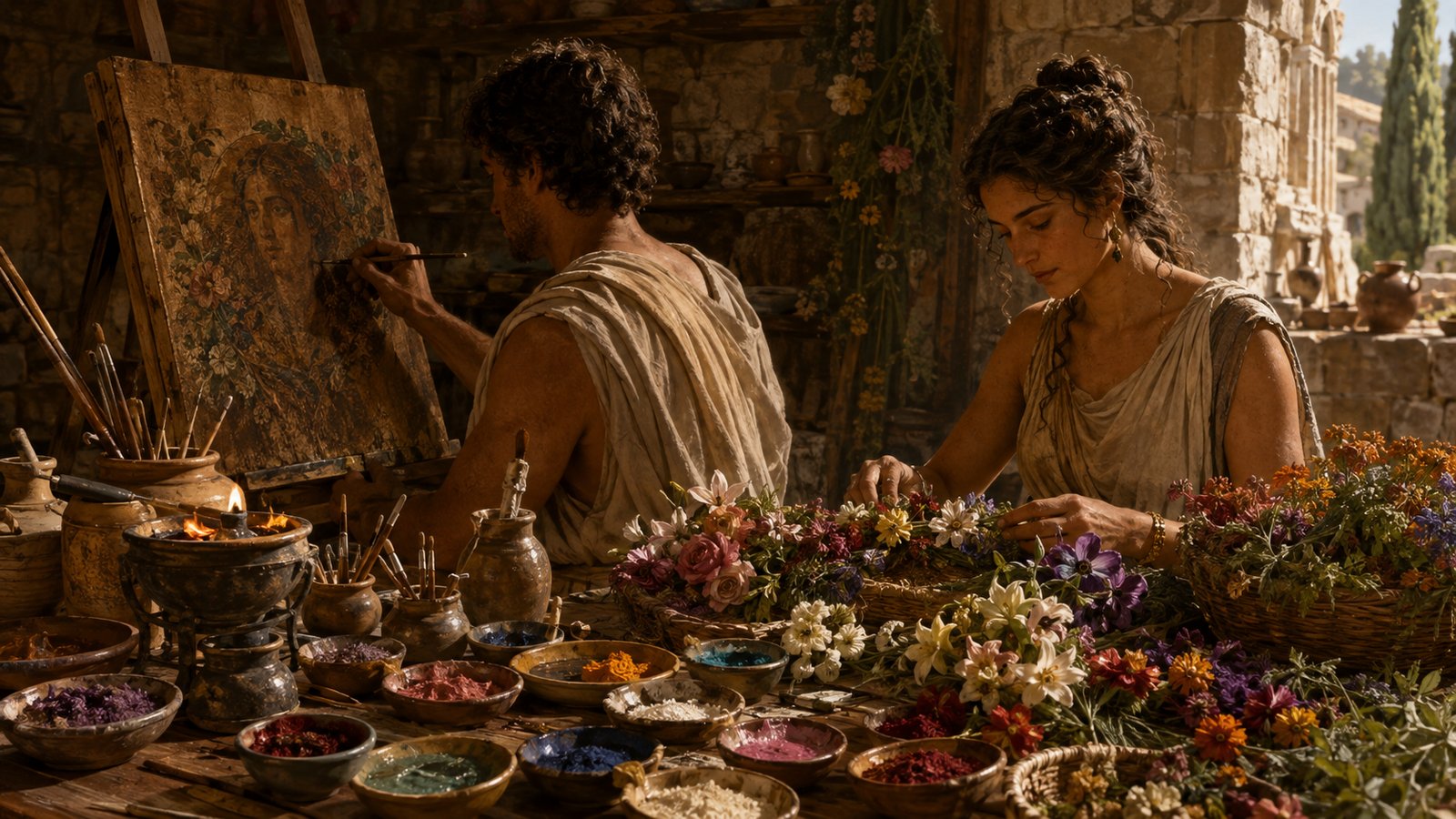
In his youth, Pausias loved Glycera, a fellow citizen who supported herself by selling garlands. Pliny calls her the first inventor of chaplets, language that elevates arrangement itself into an art.
Pausias competed with her skill by reproducing the almost countless tints of flowers in encaustic. The contest joined two makers. Glycera selected living blossoms, balanced their colors and bound them into temporary circles. Pausias translated those decisions into wax color meant to outlast the petals.
He later painted her seated with a garland. The picture circulated under names meaning garland maker or garland seller, keeping her work in the title rather than reducing her to an unnamed model.
A copy reached the high-value art market. Lucius Lucullus bought it in Athens during the Dionysia for two talents. Pliny distinguishes the copy from Pausias’s original, evidence that a celebrated composition could travel through repetition as well as physical relocation.
The flower story expands Pausias beyond the black ox. His challenge was not always mass and depth. Wax had to register small shifts among petals, and the painted arrangement had to compete with a specialist who understood real flowers as material.
That rivalry also warns against treating artistic innovation as solitary inspiration. A seller’s hand taught a painter what range he needed to match. Glycera’s perishable objects shaped the remembered career of a man whose pictures became collectable.
The Ox Made Shadow Carry Length
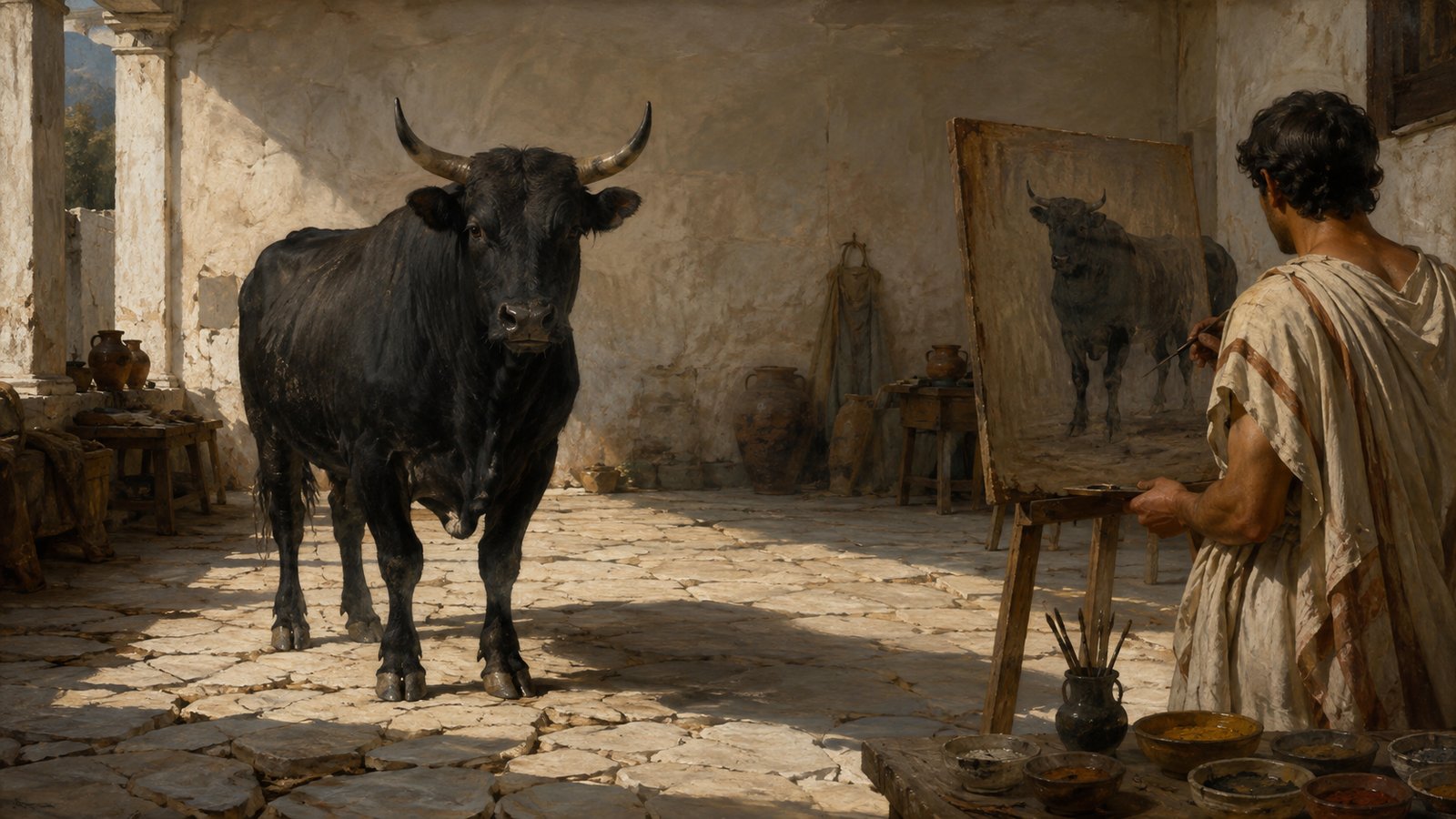
The Sacrifice of Oxen moved Pausias back to large scale. Pliny locates it in Pompey’s portico and singles out one compositional decision: the artist wanted the length of an ox to be understood, but refused to turn the animal sideways.
A side view spreads the body across the picture plane. Head, shoulders, belly and hindquarters occupy a readable sequence. A frontal view compresses those parts behind one another. The very orientation that gives the animal presence makes its length harder to show.
Pausias accepted the compression. Pliny says he conveyed the animal’s great size while keeping it front-facing. The achievement belongs to foreshortening: making a form that recedes from the viewer remain intelligible on a flat surface.
Color added a second constraint. Other painters, Pliny says, used white on parts intended to project and black for areas meant to recede. Pausias painted the entire ox black. He could not model the animal by moving from dark body into convenient pale prominence.
Instead, he used the shadow to reveal the dimensions of the body casting it. A shadow spreading across the ground could state where the hidden bulk extended. It made absence of direct view into indirect measurement.
The black mass also remained unified. Pliny praises relief made with a single color and solidity established against a broken ground. The ox did not need to be divided into conspicuous light patches for the viewer to understand its volume.
This solution can be set beside Timanthes veiling Agamemnon after exhausting visible grief. Timanthes concealed a face so the viewer supplied emotion beyond depiction. Pausias concealed most of an animal’s length behind its front, then supplied spatial evidence through shadow.
Pliny says later artists imitated the improvement without equal success. Whether or not that ranking can be tested, it preserves the ox as a lesson. Technique became portable even when the celebrated panel stayed tied to one name.
Pausias spent his life at Sicyon, but the city’s paintings did not remain there. Pliny says they were auctioned to pay civic debts and transferred to Rome during the aedileship of Scaurus. Art moved not only through admiration and purchase, but through municipal financial pressure.
The Roman portico therefore held more than an image of sacrifice. It held a Sicyonian solution displaced into an imperial city: a black animal, shown from the hardest angle, carrying its unseen length in the darkness it cast.
Across Pausias’s career, constraint was not an obstacle outside the art. It supplied the story by which the art survived. An unfavorable wall comparison clarified his specialty. A taunt about slowness produced a timed portrait. Glycera’s flowers expanded his color. The ox turned orientation and blackness into a public demonstration of depth.
Sources
Pliny the Elder, Natural History 35.40.