
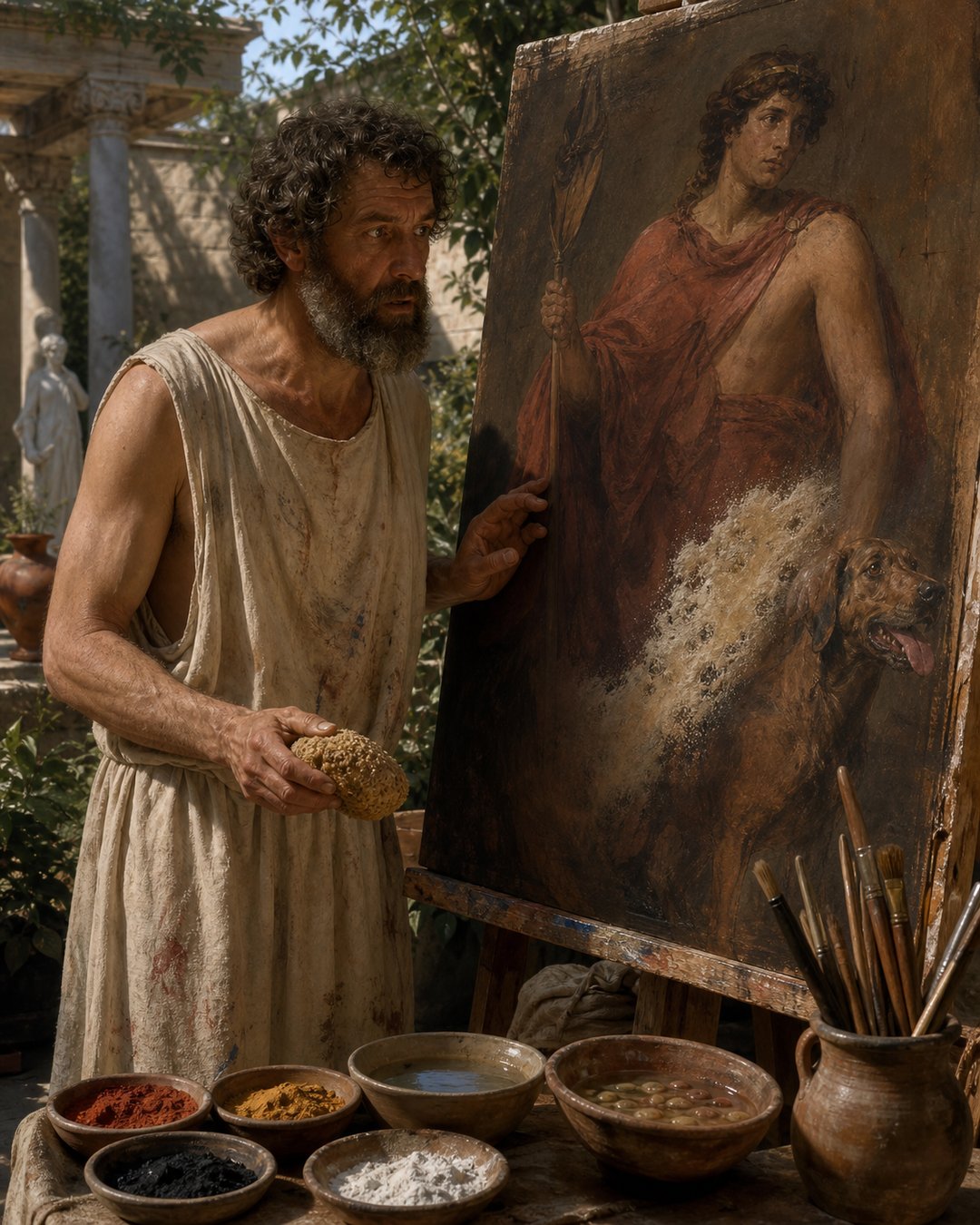
Protogenes approached the painting called the Ialysus as if endurance could be designed. Pliny the Elder says he laid down four coats of paint, leaving three beneath the surface so that age or injury could remove one and reveal another. The painter also disciplined his own appetite, living on soaked lupins while he worked because they answered hunger and thirst without the luxury he feared might blunt his sensitivity.
Then a few flecks of foam on a painted dog defeated him. Every controlled attempt looked too controlled. He removed the passage, tried another brush and produced the same visible artifice. Finally he threw a sponge at the panel. The sponge returned disturbed colours to the surface in an irregular pattern, and the accident made the foam look natural.
Pliny’s anecdote survives because it refuses a simple choice between skill and luck. The sponge could matter only after preparation had made the painting, repeated failure had defined the flaw and Protogenes had trained himself to recognize the effect he wanted. Chance supplied a texture. Judgment decided that the work was finished.
Soaked Lupins and Four Layers Made Painting a Regimen
Pliny introduces Protogenes through beginnings that did not predict later fame. The artist came from Caunus, a community under Rhodian control. He was poor, fiercely committed to his work and consequently slow to produce. One tradition even kept him in ship painting until the age of fifty. Whether that age is exact or part of an exemplary biography, Pliny uses it to make prestige emerge from prolonged manual practice rather than effortless brilliance.
The ship-painter story remained visible in Protogenes’s mature work. At the gateway of Athena’s temple in Athens, he painted celebrated ships called the Paralus and Hammonias, with little battleship drawings in the side pieces. Pliny interprets those small vessels as a record of distance travelled: the summit of public display still carried a miniature reference to the trade from which the artist had risen.
The Ialysus concentrated that discipline into one object. Pliny later knew it as a treasure housed in Rome’s Temple of Peace, but his account keeps returning to what happened before consecration. Protogenes ate soaked lupins while working. The food was humble, moist and practical. It met hunger and thirst together, allowing him to continue without the elaborate meal that his biographical logic treats as a threat to attention.
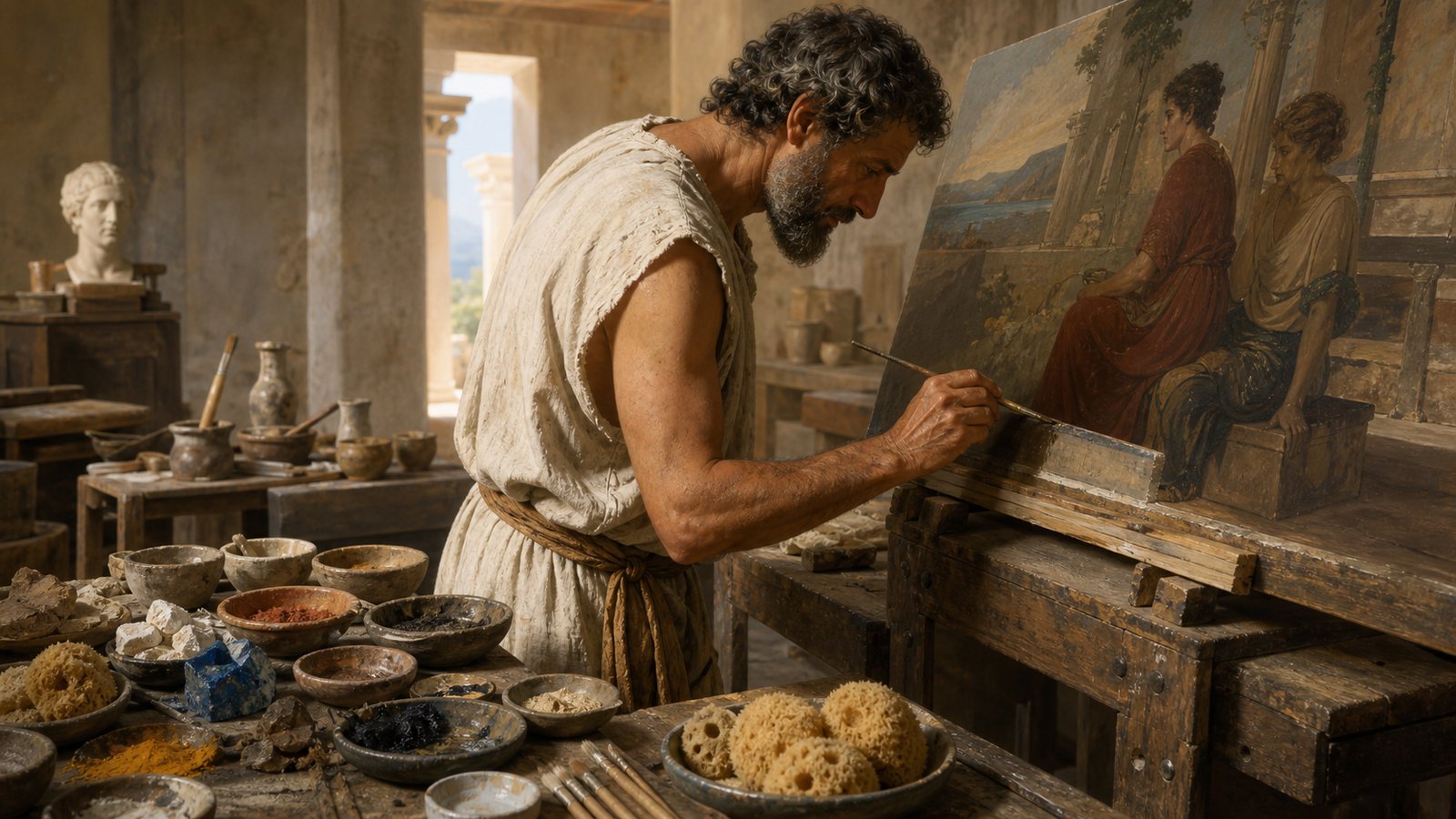
Four coats of paint turned the same concern toward the panel. Pliny imagines the layers as reserves against injury and old age: when the upper surface disappeared, another would show beneath it. The description should not be inflated into a modern conservation manual; the source gives no recipe, drying schedule or complete cross-section. What it does preserve is an ancient claim that the painter planned for wear by repeating his image below the visible face.
This is a different artistic contest from the famous exchange of impossibly fine lines involving Apelles and Protogenes. There, virtuosity becomes narrower and more controlled with each stroke. In the Ialysus, control builds the durable whole but fails at one tiny, unstable detail.
The Dog’s Mouth Looked Painted When It Needed to Look Wet
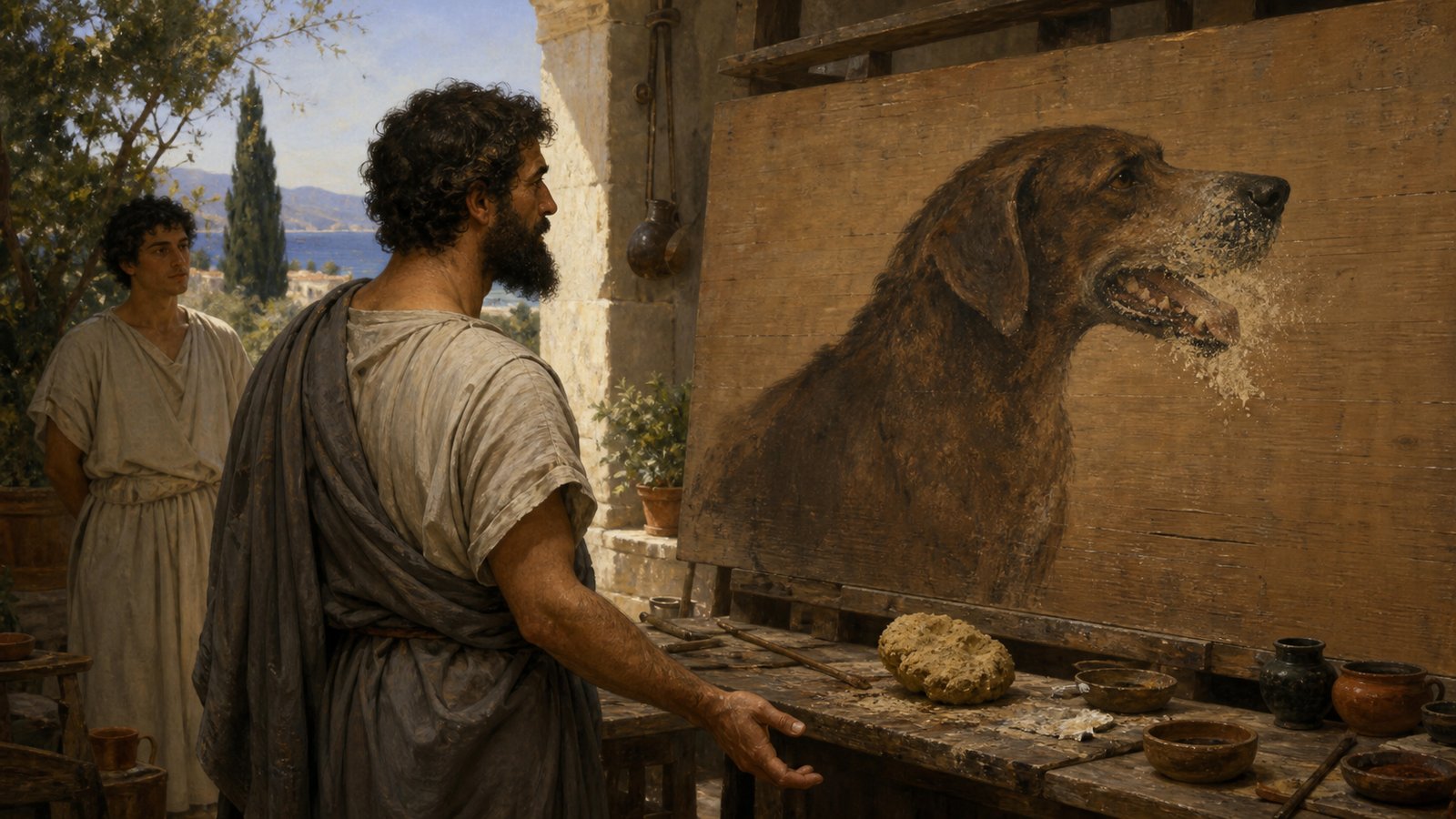
The panel included a dog that Pliny calls marvellously executed. Protogenes was satisfied with almost everything in the animal. The exception was the foam of its panting mouth. This detail had to suggest moisture, bubbles, breath and movement on a dry painted surface. It also occupied the point where a painter’s touch could become too easy to see.
Protogenes’s objection was precise. The foam looked like art rather than the natural product of the mouth. His labor had not failed to make marks; it had made intention too legible. A viewer could perceive the brush arranging pale material instead of seeing a panting dog whose foam seemed to have formed by itself.
He rubbed the passage away and changed brushes. Pliny gives no count, but says the cycle happened several times. Removal was therefore part of making, not evidence that the entire painting had collapsed. Each trial preserved the surrounding success while reopening a small zone where representation had become overworked.
The problem resembles, but does not duplicate, Timanthes hiding a father’s grief beneath a veil. Timanthes made concealment carry what a face could not adequately express. Protogenes wanted no concealment. He needed visible pigment to cease announcing itself as pigment, and every deliberate correction increased the sense of construction.
This is why the dog matters more than a charming studio anecdote. The four-layer system answered time with redundancy. The foam demanded variation without visible pattern. Protogenes could repeat an image to protect it, but he could not repeat a neat brush gesture and obtain the disorder of wet bubbles.
A Thrown Sponge Became Useful Only When the Painter Stopped
Frustration finally changed the tool and the action. Protogenes threw a sponge at the place that offended him. A sea sponge does not touch a surface like a pointed brush. Its many cavities meet pigment unevenly, lifting some colour and depositing some, breaking an edge into clustered marks. Pliny does not offer this physical explanation, but he does identify the result: the sponge restored the disturbed colours in the way the painter’s anxiety had wanted.
The impact was accidental; acceptance was not. Protogenes had spent enough time with the dog to know why the earlier foam failed. When an uncontrolled transfer produced the desired appearance, he could distinguish a useful accident from damage. Had he resumed smoothing every irregularity, he would have erased the quality the sponge introduced.
Pliny sharpens the point by saying that art and good fortune jointly painted the dog. The pairing protects the story from becoming an argument against expertise. Fortune did not choose the panel, construct four layers, place the animal, render its body or diagnose the false foam. Art created the narrow conditions in which fortune could finish one passage.
The tale became repeatable. Nealces, Pliny says, obtained the foam of a horse by following the sponge example. The second use sits differently from the first: once a chance event is remembered, another painter can attempt the procedure deliberately. Accident enters workshop knowledge without becoming a guarantee. A sponge can make an irregular texture, but judgment must still decide whether that texture belongs to this mouth, this animal and this picture.
The episode therefore preserves a subtle model of craft. Discipline controls materials and time. Revision identifies the boundary of failure. Anger interrupts an unproductive loop. Chance opens another possibility. Expertise returns at the final instant to recognize that possibility and leave it alone.
A Painting Survived in Stories of Siege, Risk and Restraint
Pliny extends the Ialysus beyond the studio. He reports that Demetrius Poliorcetes refrained from setting fire to the side of Rhodes where the painting was kept, even though the decision cost an opportunity to take the city. The anecdote cannot be treated as a complete military history. In Pliny’s sequence, it measures the value later attached to a panel made through lupins, layers, failed foam and a sponge.
Protogenes himself appears inside the siege in an even stranger scene. He continued working in a little garden outside the walls, among the forces of Demetrius. Summoned by the king and asked why he felt safe, he replied that Demetrius was at war with the Rhodians, not with the arts. The answer converted confidence in artistic immunity into a direct claim about the boundaries of violence.
Demetrius accepted the distinction in Pliny’s account. Guards protected the painter, and the king visited his work amid attacks on the walls. Another picture from this period, a resting satyr holding flutes, carried a story of being painted with a sword hanging over the artist. Peace inside the image and danger around the workshop made each other visible.
These siege stories do not erase the practical studio story. They enlarge its stakes. Protogenes’s reputation eventually made rulers pause, but Pliny builds that reputation from exacting labor and a willingness to admit that one tiny passage remained wrong. The painter is not heroic because every stroke obeyed him. He is memorable because he saw the difference between persistence and needless interference.
The sponge marks an ending that the brush could not reach. It did not replace the years of practice behind the panel or the repeated layers beneath its surface. It gave irregularity to a place where deliberate order looked false. Protogenes’s decisive act was not throwing it. His decisive act was looking at the accident, understanding what had happened and refusing to paint the foam again.
Sources
Pliny the Elder, Natural History, 35.101–106.