
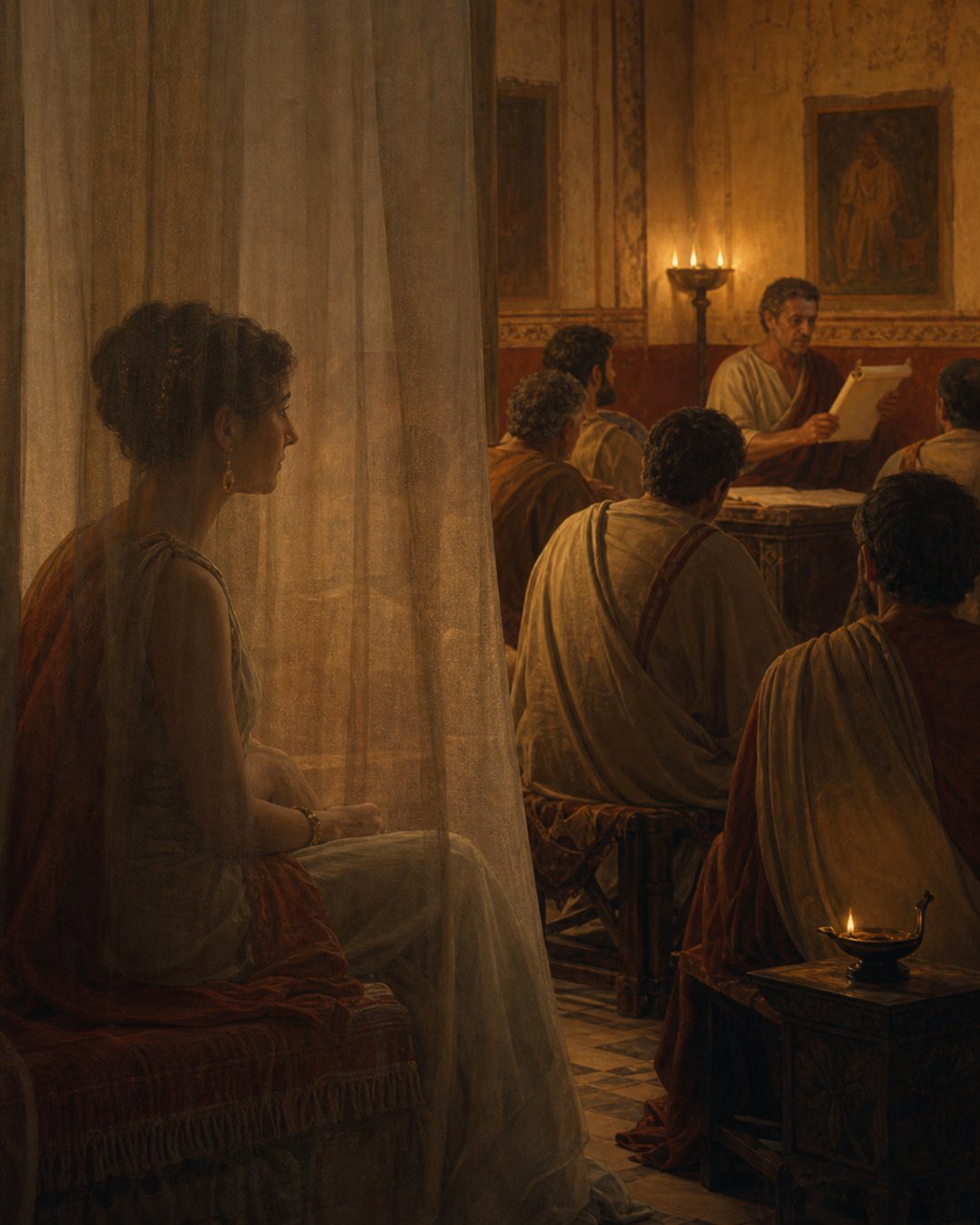
When Pliny the Younger recited his work, his wife Calpurnia sat nearby but out of sight. A curtain screened her from the audience while allowing her to hear what listeners said in her husband’s praise. The arrangement placed her at the edge of a public literary room: hidden from its gaze, close to its judgments.
That curtain was only one part of her listening system. Pliny says she collected his speeches, read them and learned them by heart. When he went to plead cases, relays brought her reports about his reception, the applause and the verdicts. At home she sang his verses and supplied her own music. Public words returned through messengers, memory and melody.
The evidence comes from a husband praising his wife to her aunt, so it cannot be read as a neutral portrait. Pliny selects actions that flatter Calpurnia, himself and the family that joined them. Yet the selected details are unusually concrete. They show literary reputation being received and interpreted through household work that public applause alone could not reveal.
Hispulla’s Household Stood Behind the Marriage
Pliny addressed the letter not to Calpurnia but to Calpurnia Hispulla, her aunt. He begins by praising Hispulla’s conduct within her family: devotion to her brother and care for his daughter after his death. Calpurnia had therefore reached marriage through a household in which an aunt took on responsibilities Pliny associates with a lost father.
This framing matters because Pliny does not describe his wife as an isolated admirer who spontaneously discovered his books. He presents her habits as the result of upbringing. Hispulla’s instruction, example and recommendation connect one generation’s family loyalties with the younger woman’s place in another house.
The compliments are conventional in their moral vocabulary. Calpurnia is sharp-witted, economical and pure; Hispulla’s home is said to have shown her nothing dishonourable. Such claims tell us what an elite Roman husband wanted to praise publicly in a wife and guardian. They do not open an unfiltered window onto Calpurnia’s private thoughts.
But convention gains texture through action. The aunt did not merely preserve a family name. She raised a brother’s daughter, taught her and helped select a husband she already knew. Pliny reminds Hispulla that she had loved his mother like a daughter, shaped his own character when he was a boy and predicted the man he might become. The marriage joined relationships that predated both spouses’ adult roles.
Pliny closes this family circle by saying each spouse competes to thank Hispulla: he because she gave Calpurnia to him, Calpurnia because her aunt gave Pliny to her. The balanced phrase is polished, but it identifies the aunt as an active broker of trust. Husband and wife become the visible pair produced by a longer network of women, parents, guardianship and recommendation.
Speeches Crossed from Court into a Reader’s Memory
Pliny says Calpurnia developed a taste for study through affection for him. The sentence keeps his own importance at the centre, as praise letters often do. The actions that follow nevertheless belong to her. She gathered his speeches, read them and learned them by heart. A performed legal argument became a portable household text, then an internal possession held in memory.
Collecting speeches required access to copies and sustained attention. Pliny does not say who copied the rolls, how many Calpurnia owned or how accurately she memorized them, so those details must remain open. He does tell Hispulla that Calpurnia’s engagement continued after the public case. The speech did not vanish when the judges left; it acquired another life under domestic reading.
This differs from the reader who followed Pliny through exercise, bath and dinner. That household schedule made another person’s voice serve the author’s appetite for books. In Letter 4.19, Calpurnia chooses Pliny’s own public work, reads it herself and carries it into memory. The direction of attention is reversed.
Her anxiety before a pleading and pleasure afterward also tie reading to uncertain events. A speech on a roll has a fixed sequence; a case in court can succeed, fail or receive a mixed response. Calpurnia wanted information not only about Pliny’s words but about what happened when those words met judges and listeners.
Pliny’s language turns her study into proof of affection, yet memorization can do more than flatter an author. It creates standards for comparison. Someone who knows multiple speeches can hear repeated techniques, changes of tone and claims that receive different outcomes. The source does not record Calpurnia criticizing a draft, so she should not be invented as an editor. It does establish that she possessed the texts and attention from which informed judgment could grow.

Relays Carried Applause and Verdicts Back from the Forum
Calpurnia did not wait for Pliny’s own version of a courtroom day. He says she had relays of people bring news about the reception he received, the applause he excited and the verdicts he won. The plural matters. Information travelled through repeated human reports rather than a single triumphant summary at dinner.
The letter does not identify the messengers. They may have belonged to the household or to the wider circle surrounding Pliny’s legal career. Their anonymity is a limit, but their function is clear. They connected a woman outside the courtroom sequence with developments inside it, carrying response as the performance unfolded or immediately after it.
Applause and verdict were different kinds of result. Applause measured the room’s audible enthusiasm. A verdict recorded what the judges decided. One could be loud without guaranteeing the other. By naming both, Pliny reveals that reputation had several moving parts: delivery, audience reaction and formal outcome.
Calpurnia’s relay system is especially revealing because Pliny offers it as emotion made practical. Anxiety became a demand for updates. Pleasure followed the completed pleading. Between those states lay organized movement by other people, each carrying fragments of an event from a public institution into a private residence.
Roman elite authors often make achievement look individual: one advocate rises, speaks and wins. Letter 4.19 briefly exposes the listeners and carriers around that figure. Pliny still claims the applause, but Calpurnia gathers its evidence. Her household receives the public career in installments and makes it part of the marriage’s daily emotional rhythm.
The Curtain Hid a Listener Without Silencing Her
The recitation scene brought Calpurnia physically close to literary reception. She sat near Pliny but behind a curtain. Pliny emphasizes that her ears eagerly absorbed praise. The barrier managed visibility, not sound. It let her occupy the event without becoming part of the audience’s visible social display.
From that position she heard more than the author’s prepared text. She also heard what people said about him. The curtain may even have changed the quality of what reached her: listeners who could not see the wife nearby had less reason to direct comments toward her. The letter does not state that this produced candour, so it remains a possibility rather than a claim. What is explicit is that she listened to audience judgment from concealment.
Calpurnia then carried verse into another medium. Pliny says she sang his poems and set them to music without a teacher. His sentimental explanation is that love instructed her. Beneath that compliment lies a concrete transformation: written meter became breath, pitch and rhythm in a domestic performance.
Her singing offers a useful contrast with Sulpicia’s six surviving poems. Sulpicia’s voice reaches us through words attributed to her; Calpurnia appears through her husband’s account and performs his verses. The difference warns against turning Pliny’s praise into direct autobiography. Calpurnia is active in the letter, but Pliny controls the surviving frame.
That frame also explains his confidence in lasting happiness. He says Calpurnia loves his reputation rather than youth or appearance, qualities subject to age. This is self-flattery presented as marital stability: the public identity he has built becomes the supposedly durable object of affection. Calpurnia’s listening practices are recruited as evidence that she values the right version of him.
Even so, the concrete practices exceed the moral Pliny draws from them. A woman collects speeches, memorizes legal prose, demands independent reports, listens through an architectural screen and invents melodies for verse. These are acts of reception, organization and reinterpretation. They show how a public career continued after the speaker left the forum or recitation room.
The curtain is therefore not the symbol of a wholly private Calpurnia. It marks a managed boundary she repeatedly crossed by sound, text and messenger. Pliny stood before the room and received its applause. Calpurnia, hidden at its edge, measured what the room did, carried the result home and gave the words another voice.

Sources
Pliny the Younger, Letters, 4.19.