
Pliny the Elder admired Rome’s sewers as structures that seemed able to survive everything the city threw at them. Floodwater battered their floors and walls. The Tiber could drive water backward through their channels. Buildings collapsed overhead, fires shook the streets and earthquakes disturbed the ground, yet the masonry endured. He claimed that the channels had remained nearly impregnable for seven hundred years.
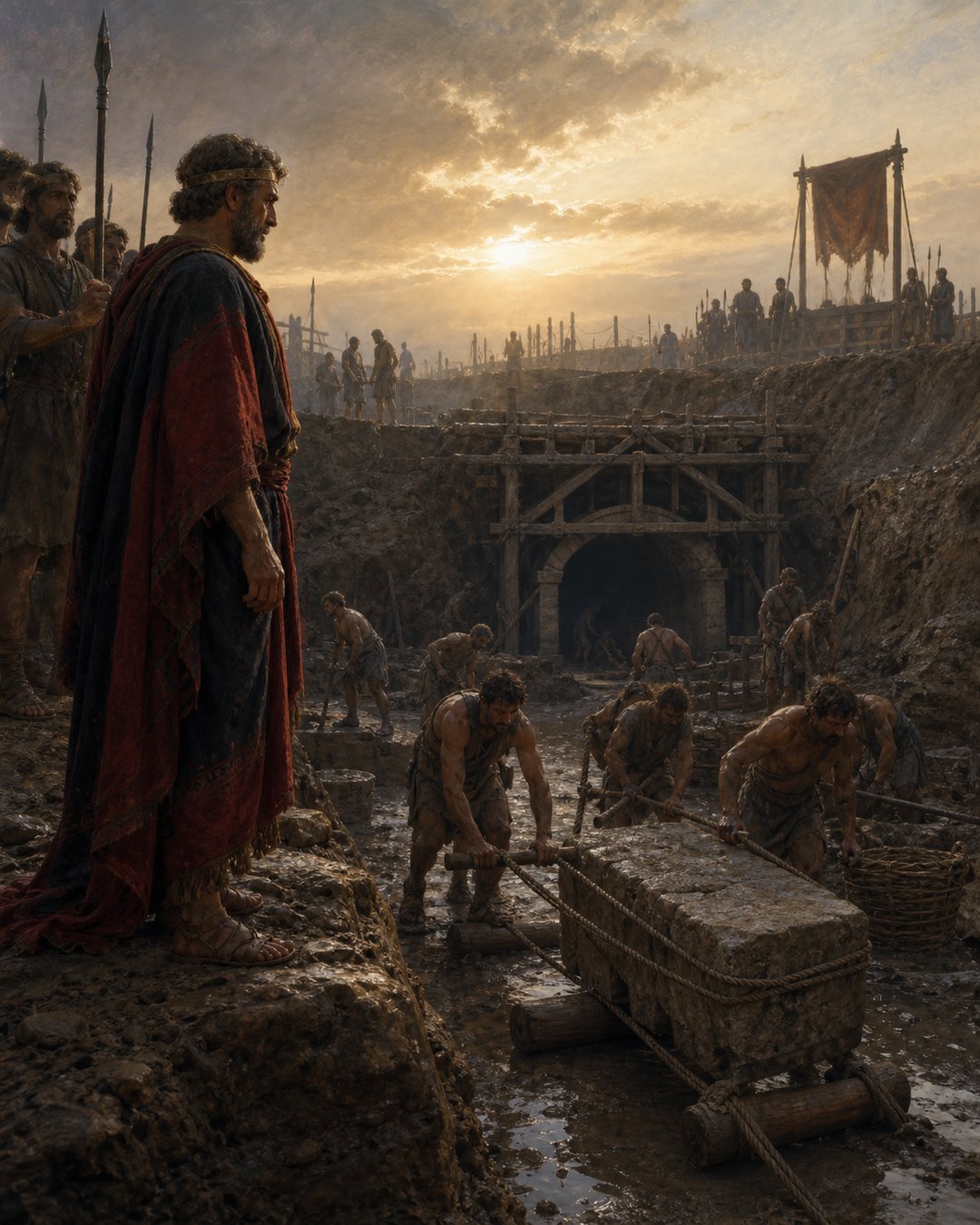
Then his account changes direction. The marvel beneath Rome acquires a human cost. Tarquinius Priscus, Pliny says, put common citizens to work on the tunnels. The labor became so exhausting that people tried to escape it through death. The king answered by having their bodies crucified and exposed, turning what happened after death into a threat against the living.
This is not a neutral construction record. It is one author’s compressed and morally charged memory of the regal past. Yet its placement matters. Pliny sets coercion beside engineering durability, forcing admiration for the finished structure to pass through a story about who was compelled to build it and how far royal power claimed to reach.
Seven Rivers Tested the Work Beneath a Hanging City
Pliny begins with scale. Among the Agger, the substructures of the Capitol and other works admired by older Romans, he calls the city sewers the most noteworthy achievement. Hills had been tunnelled, he writes, leaving Rome like a hanging city. During Marcus Agrippa’s aedileship, men could even travel in boats below the streets.
The description presents a second urban landscape beneath the visible one. Above were roads, houses and monuments. Below, channels received moving water and carried it through engineered space. The image of boats is not merely decorative praise. It makes the underground volume measurable through a human action: a person could enter it and move where daylight did not reach.
Water supplied the severest test. Pliny imagines seven rivers joining one channel and rushing down like mountain torrents. Rain added force. The streams struck the bottoms and sides of the sewers while the Tiber could push back in the opposite direction. Two bodies of water then met head on inside the tunnels, and the fabric resisted their collision.
Pressure also came from the city above. Massive stones were dragged through the streets. Buildings fell through accident or fire. Earth tremors moved the ground. Pliny’s list accumulates assaults so that endurance feels almost animate: the drains are battered repeatedly but refuse to yield.
This physical achievement remains important. the Cloaca Maxima’s role in making Rome less fragile explains why drainage could support the public spaces later generations remembered. Pliny’s darker passage adds another question. If the completed tunnels protected the city from water and collapse, what had protected the people ordered to excavate them?
Intensity and Duration Made the Labor Impossible to Escape
Pliny signals that his labor story came from the edge of the historical tradition. He says the best-known historians had overlooked it. That admission does not prove every detail; it tells us how he wants the reader to receive the episode—as a neglected truth capable of disturbing a familiar monument.
Tarquinius used the common people as laborers. Pliny gives no roster, wage table, work schedule or precise division of tasks. He does not identify the dead or calculate how many people entered the tunnels. Those absences prevent the anecdote from becoming a statistical account. Its vocabulary instead emphasizes two dimensions of toil: intensity and duration.
The distinction matters. A brief burst of heavy work can break bodies through force. Prolonged work can exhaust through repetition and the apparent absence of an ending. Pliny says it became uncertain which quality of the project was more remarkable. The same sentence that magnifies the public work also magnifies the pressure placed on those beneath it.
He claims that citizens responded through collective suicide. The wording is sweeping and should not be inflated into a number the source never gives. It nevertheless makes refusal unmistakable. Death appears not as an incidental accident of construction but as the only exit laborers believed the king could not close.
That imagined exit exposes the political character of the worksite. A tunnel is an engineering object, but the ability to command bodies into it is a form of rule. Stone could be hauled, fitted and tested only while people continued to obey. When exhaustion interrupted that obedience, Tarquinius did not reduce the labor in Pliny’s story. He widened punishment.
The King Extended Punishment Beyond the Laborer’s Death
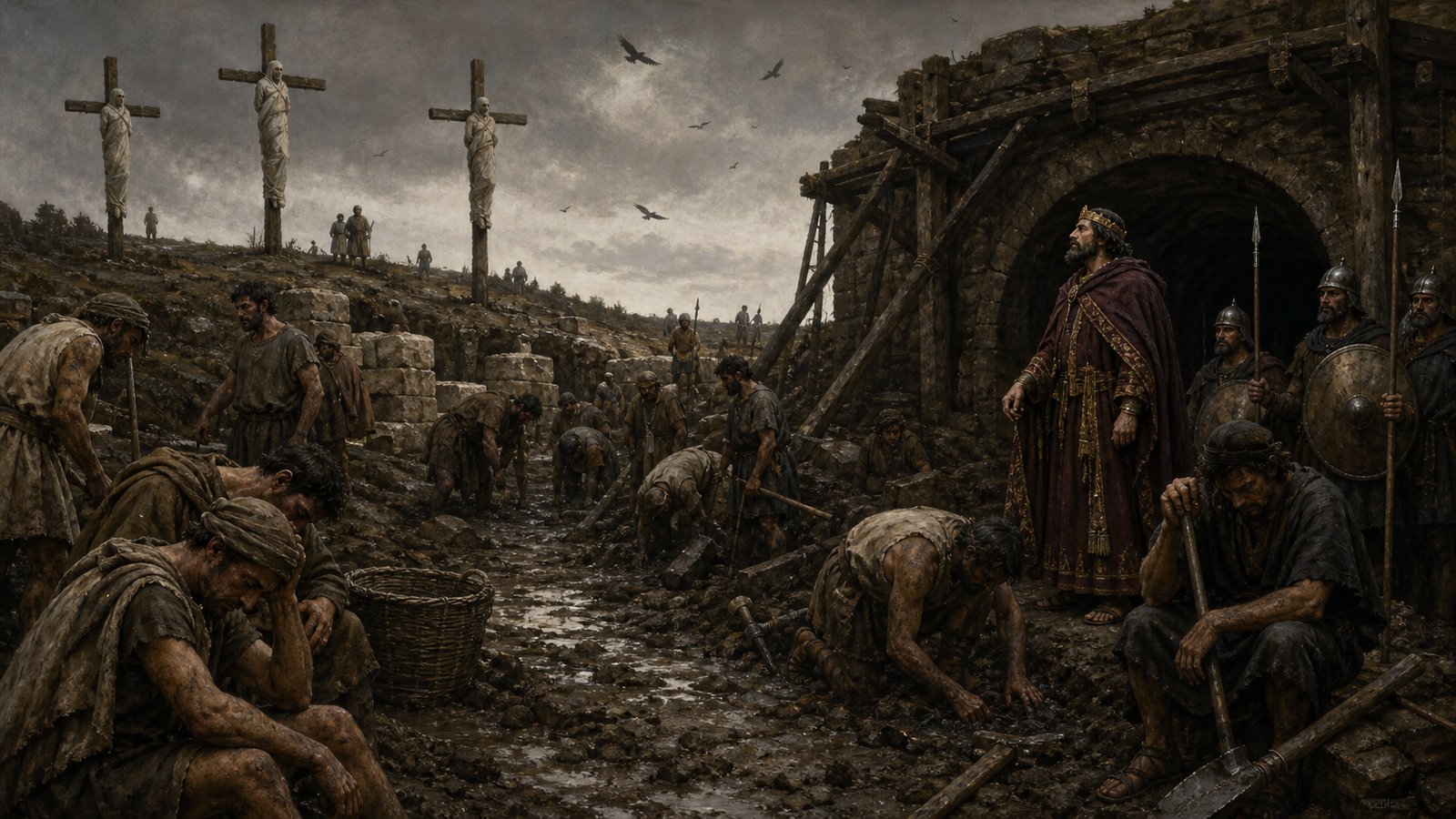
Tarquinius ordered that the bodies of those who had died by their own hands be crucified. Their fellow citizens had to see them. Pliny adds that beasts and birds of prey tore at the exposed remains. The penalty therefore acted on several things at once: the corpse, its visibility, the expectations of burial and the memory carried by survivors.
The violence was posthumous, but its target was alive. A dead laborer could no longer be driven back into the tunnel. The displayed body addressed everyone still capable of choosing. It announced that death would not place a person beyond the king’s control and that escape from toil would be followed by public degradation.
Pliny identifies shame as the mechanism. He generalizes it as a characteristically Roman force that had rescued desperate battlefield situations. Here he turns that familiar moral language inside out. Shame does not rally free soldiers against an enemy. It disciplines exhausted citizens for a king’s building project.
His explanation depends on an apparent contradiction: the living were ashamed of a disgrace they could experience only when dead. Pliny calls this an illusion, but an effective one. People imagined the gaze of neighbors continuing after their own awareness had ended. Royal punishment borrowed that imagined future audience and made it present at the worksite.
The episode belongs beside other Roman stories in which power is revealed at the boundary of the body. At Vedius Pollio’s pool, a broken crystal cup placed an enslaved man’s life inside a master’s performance of punishment. Tarquinius’s warning operates on a different scale, but both narratives make an audience part of coercion. Terror must be seen to govern anyone beyond its immediate victim.
A Hay Wagon Measured Both the Tunnel and Its Price
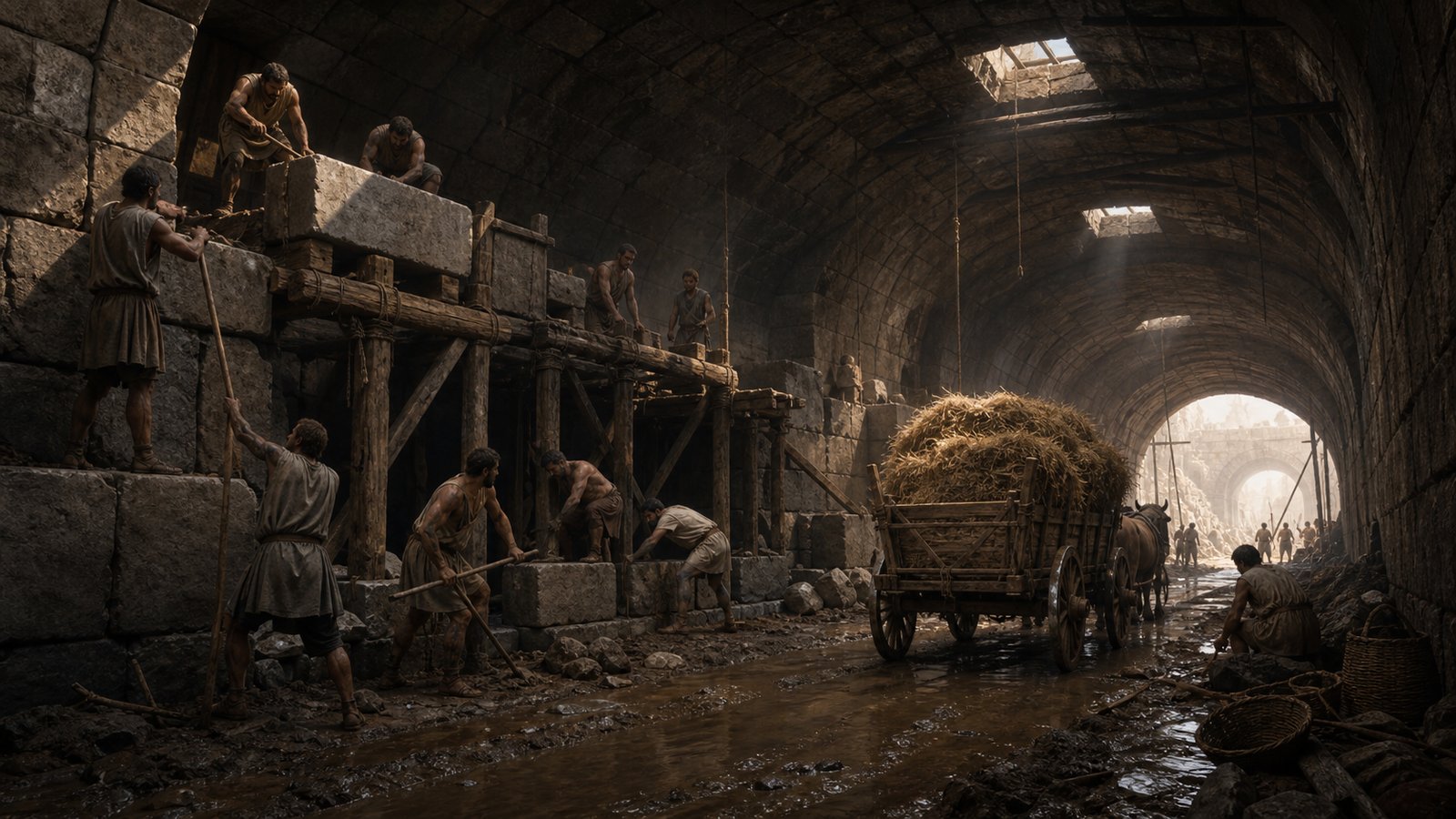
Pliny closes the episode with another physical measure. The tunnels, he says, were large enough for a wagon fully loaded with hay. A loaded wagon supplies width, height and practical bulk without giving an abstract dimension. The reader can picture axles, wheels and a high mass of fodder passing through stone beneath the city.
Placed after the crucified bodies, the wagon carries two meanings. It confirms the magnitude of construction, but it also clarifies why the labor could have seemed endless. A passage able to admit that load was not a narrow household drain. Excavating and lining it required space on a scale Pliny expected his audience to find astonishing.
The hay does not redeem the king’s remedy. Nor does the story ask readers to dismiss the sewer because its labor was coercive. Pliny preserves both reactions in tension. The channels withstand floods and collapsing buildings; their scale deserves wonder. The means attributed to Tarquinius deserve horror.
That tension is the reason the anecdote remains more useful than an uncomplicated celebration of Roman infrastructure. Monuments often reach later viewers without the noise of their worksites. Finished stone conceals commands, fatigue and refusal. Pliny briefly reverses that process. He makes the tunnel visible, then makes the threatened laborer visible beside it.
Rome’s underground durability becomes inseparable from a claim about sovereignty. Tarquinius could order citizens into the earth, but exhaustion produced a refusal his normal command could not answer. His response was to claim the corpse, publicize its exposure and use anticipated shame to close death as an escape.
The result is a disturbing political technology attached to an engineering one. Stone controlled water. Display controlled people. The sewer survived because its fabric resisted physical pressure; in Pliny’s account, construction continued because royal punishment placed social pressure beyond the boundary of life itself.
Sources
Pliny the Elder, Natural History, 36.104–108.