
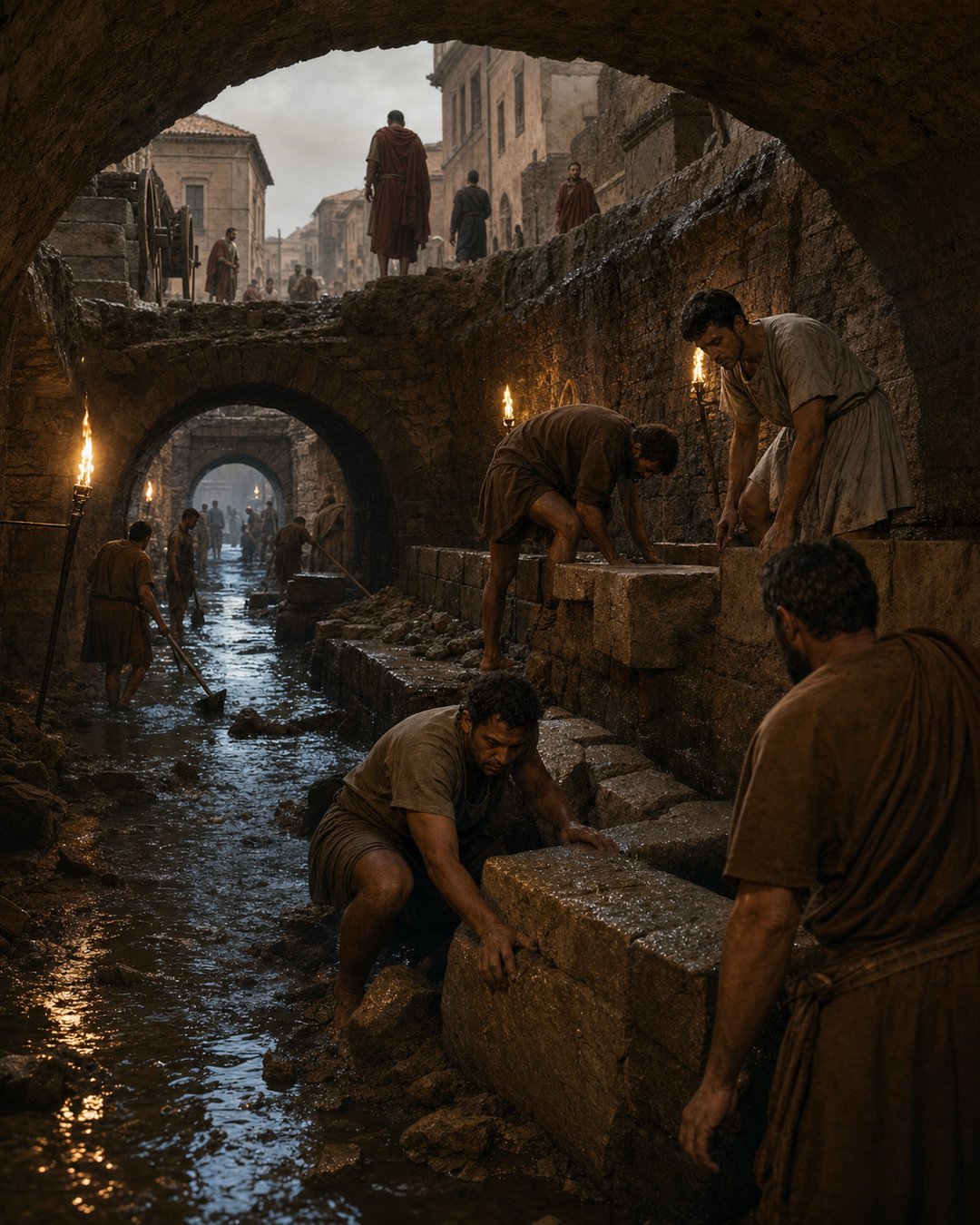
Rome’s grand center depended on a dirty solution. Before marble monuments, law courts, temples, speeches, and processions could feel permanent, water and waste had to go somewhere. The Cloaca Maxima mattered because it made urban life less fragile.
Drainage is easy to underestimate because it works best when it disappears. A crowd notices a triumphal arch. It rarely thanks the channel that keeps rainwater, mud, and filth from turning civic space into a swamp. Rome needed both.
The Forum began as a drainage problem
The valley that became the Roman Forum was low ground between hills. Ancient tradition placed major drainage works in the regal period, when Rome was still becoming a city capable of using its center as a civic stage. Before politics could gather there, water had to be controlled.
That physical fact changes how the Forum looks in memory. It was not simply chosen and decorated. It had to be made usable through practical labor, stone, channels, and repeated maintenance.
Sewers made monuments possible
A sewer does not compete with a temple for beauty, but it can decide whether the temple’s surroundings remain passable. Drainage protected paving, markets, approaches, and public buildings from ordinary water as well as dramatic storms.
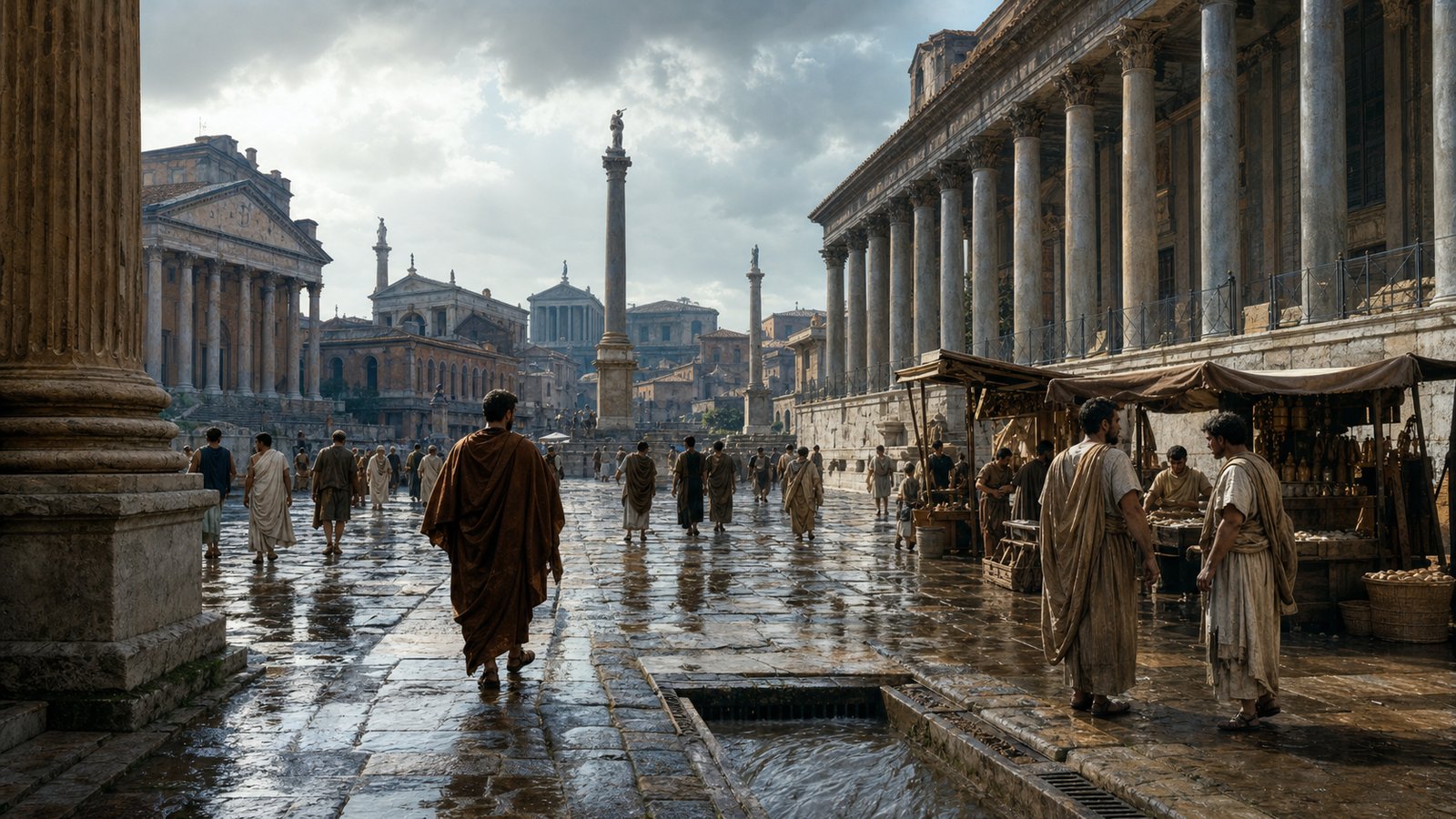
Imagine rain falling on a crowded civic center. Without channels, the same space that hosted speeches and lawsuits could become mud, smell, and obstruction. The Cloaca Maxima helped keep public life from dissolving into the ground beneath it.
The work was ancient enough to become legendary
Livy connects early drainage with Rome’s kings, and later writers treated the sewers as astonishing survivals. Whether every tradition preserves exact engineering history is less important than the memory it reveals: Romans knew that their city rested on old practical works.
Pliny’s admiration for the sewers shows that Romans could see infrastructure as a wonder. The impressive thing was not decoration. It was endurance under the pressure of an enormous city.
Water management was civic order
Roman water infrastructure is often remembered through aqueducts, but drainage completed the story. Bringing water in is only half of urban life. Water also has to leave, carrying waste, runoff, and risk away from dense streets.
That movement made daily order possible. Shops could open, crowds could gather, officials could meet, and ceremonies could proceed because the city had ways to manage what bodies, weather, and animals produced.
Maintenance kept the invisible visible
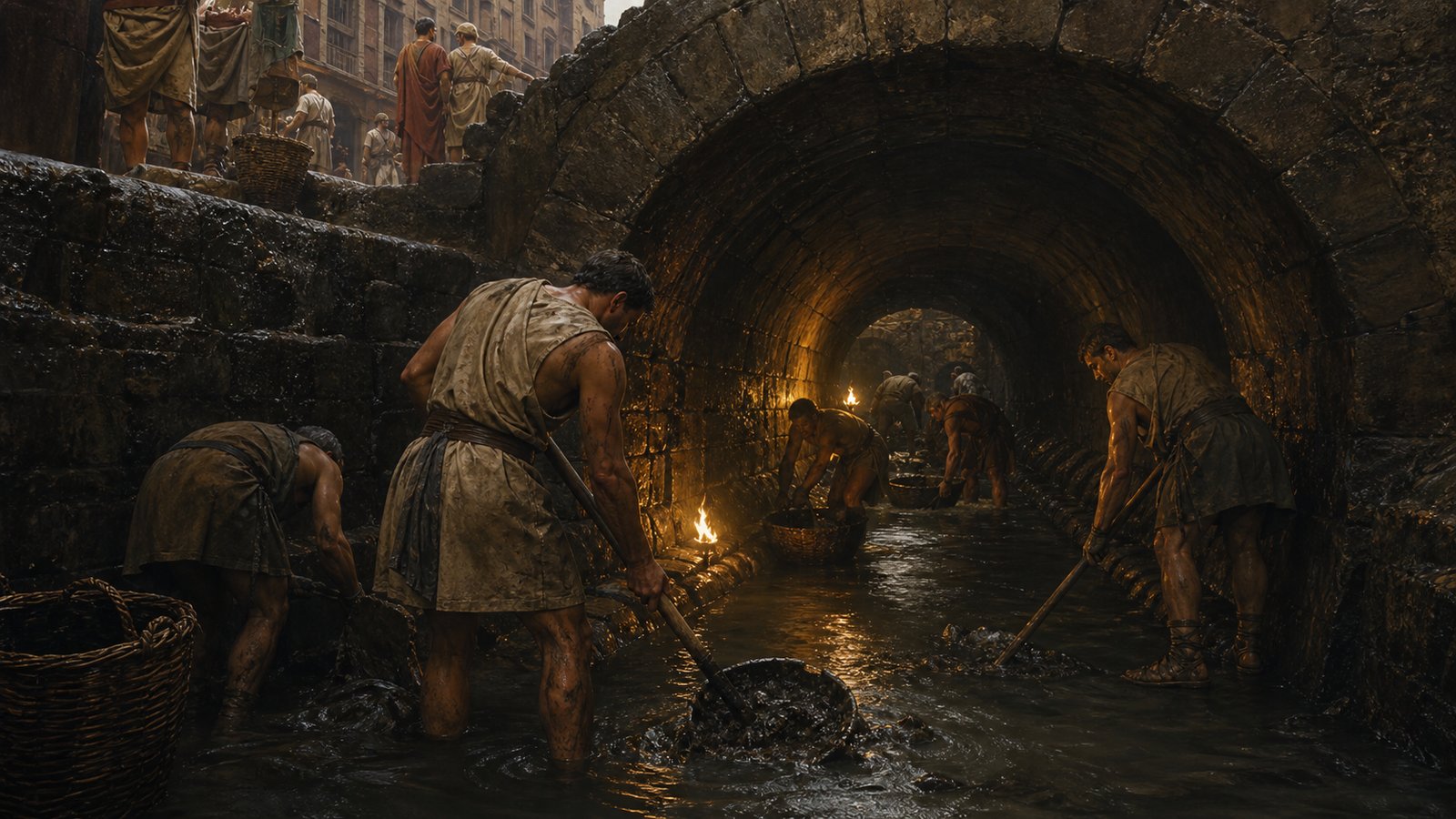
A drain is never finished in the same way a statue is finished. It can clog, crack, flood, stink, or be overloaded. Its usefulness depends on inspection and repair. The Cloaca Maxima therefore points to the workers and administrators who kept Rome functioning below eye level.
Those people rarely dominate the story, but the city depended on them. Urban greatness requires someone to clear the channel after everyone else has walked across the clean paving.
The dirty work protected public confidence
The Cloaca Maxima did not make Rome safe from every disease, flood, or failure. It did make the city less fragile by giving water and waste a managed path. That practical reliability helped public spaces feel durable.
This is why the great drain belongs in the story of Roman power. It turned a vulnerable valley into usable civic ground and helped make Rome’s public center seem more permanent than nature would have allowed.
The sensory details matter. Wet stone, torch smoke, stagnant smell, scraping tools, baskets of debris, and the sound of water moving beneath the street all belonged to the hidden city. Roman order was not only seen in marble; it was heard and smelled underground.
The drain also shows that urban civilization is a fight against accumulation. Water accumulates, waste accumulates, silt accumulates, and crowds create pressure. A city survives by moving those accumulations away before they become crisis.
That is why practical engineering could become politically meaningful. A ruler who built or repaired drainage was not merely solving a technical problem. He was protecting the stage on which public authority appeared.
The Cloaca Maxima’s fame also warns us against separating infrastructure from memory. Romans remembered old drains because they knew the city would be weaker without them. Their endurance became part of Rome’s own story about toughness and continuity.
There is a humble drama in that endurance. Stone arches under the city carried what polite public life preferred not to see. The cleaner the Forum looked, the more successfully the hidden system was doing unpleasant work.
Drainage also helped connect the hills and low ground into one urban organism. The city was not a set of monuments standing apart. It was a connected body of slopes, streets, channels, buildings, and flows.
If aqueducts made Rome abundant, drains made abundance survivable. Water for baths, fountains, houses, and streets had consequences. The more water entered the city, the more important exit routes became.
The great sewer therefore belongs with roads, warehouses, and aqueducts as part of Rome’s practical imagination. These systems made power repeatable by making daily life less likely to collapse under ordinary pressure.
The work was not glamorous, and that is precisely why it is revealing. Rome’s survival depended on systems that did not need applause to matter. The drain protected the conditions under which applause could happen elsewhere.
A city that cannot manage water cannot reliably manage crowds, markets, or ceremony. The Cloaca Maxima helped Rome solve that problem early and visibly enough that later generations treated the solution as one of the city’s marvels.
The drain also reveals a Roman willingness to think at city scale. A household might sweep its threshold, but a public sewer dealt with shared consequences that no single house could solve. It was collective infrastructure for collective vulnerability.
Because the Forum became the place where Rome represented itself, its drainage carried symbolic weight even when no one mentioned it. The cleaner and firmer the public center felt, the easier it became to imagine Rome as stable, ancient, and chosen for greatness.
That stability was manufactured. It required stonecutters, laborers, administrators, and later repair crews whose names mostly disappeared. The Cloaca Maxima preserves their achievement indirectly: every usable street above the water channel testified that hidden work could hold a public world together.
The lesson is not that Rome was hygienic in a modern sense. It is that Romans understood the practical danger of unmanaged water and waste. They met that danger with durable masonry, civic memory, and maintenance, making the city less fragile one channel at a time.
The most important detail is that this protection was ordinary. It did not require a festival to prove its value. Every storm that drained, every route that stayed passable, and every public errand completed after rain repeated the same quiet argument: Rome’s greatness rested on systems people were not supposed to notice.
Sources & Further Reading
- Encyclopaedia Britannica, Cloaca Maxima
- Livy, History of Rome, Book 1
- LacusCurtius, Cloaca Maxima
- LacusCurtius, Roman Forum
- Pliny the Elder, Natural History, 36
- Smith Dictionary, Cloaca
- World History Encyclopedia, Roman Sanitation
- Frontinus, Aqueducts of Rome
- Oxford Classical Dictionary, Roman sanitation