
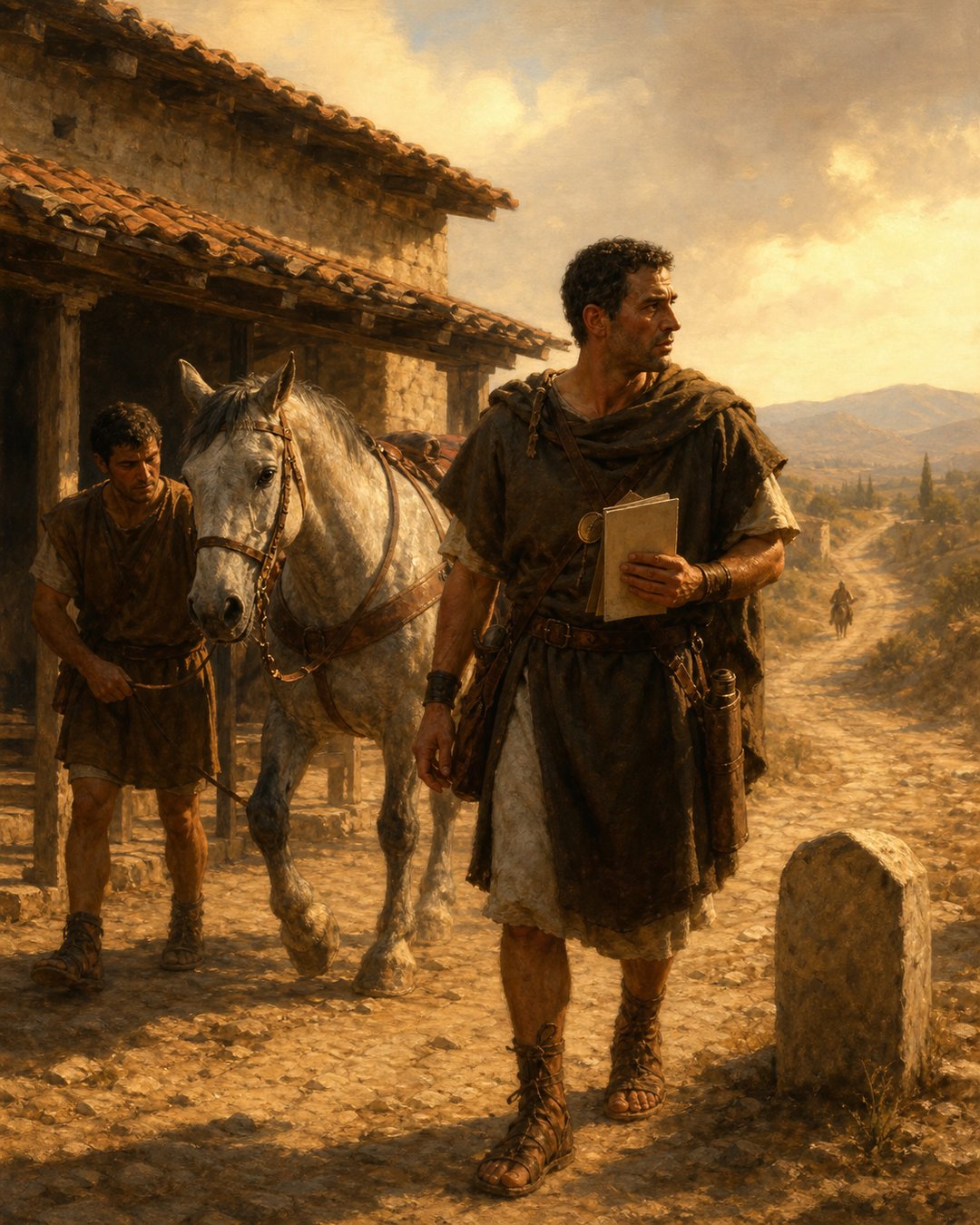
An imperial order still needed hooves. However grand the emperor looked on coins, his commands had to cross mud, mountains, rivers, bad weather, tired animals, and local suspicion before they became action in a province. The cursus publicus made that movement more dependable.
Roman couriers mattered because they turned distance into an administrative routine. The service was not simply a fast messenger story. It was a network of roads, relay stations, permits, horses, vehicles, clerks, and obligations that made the empire feel reachable from the center.
Empire had to travel before it could govern
A Roman order did not become real when it was written. It became real when someone delivered it to the right official, camp, city, or governor. That gap between decision and arrival was one of the central problems of ruling a large empire.
The cursus publicus narrowed the gap. It gave government communication a privileged route through the same physical world that slowed everyone else: distance, fatigue, weather, and the need for fresh animals.
Relay stations made speed repeatable
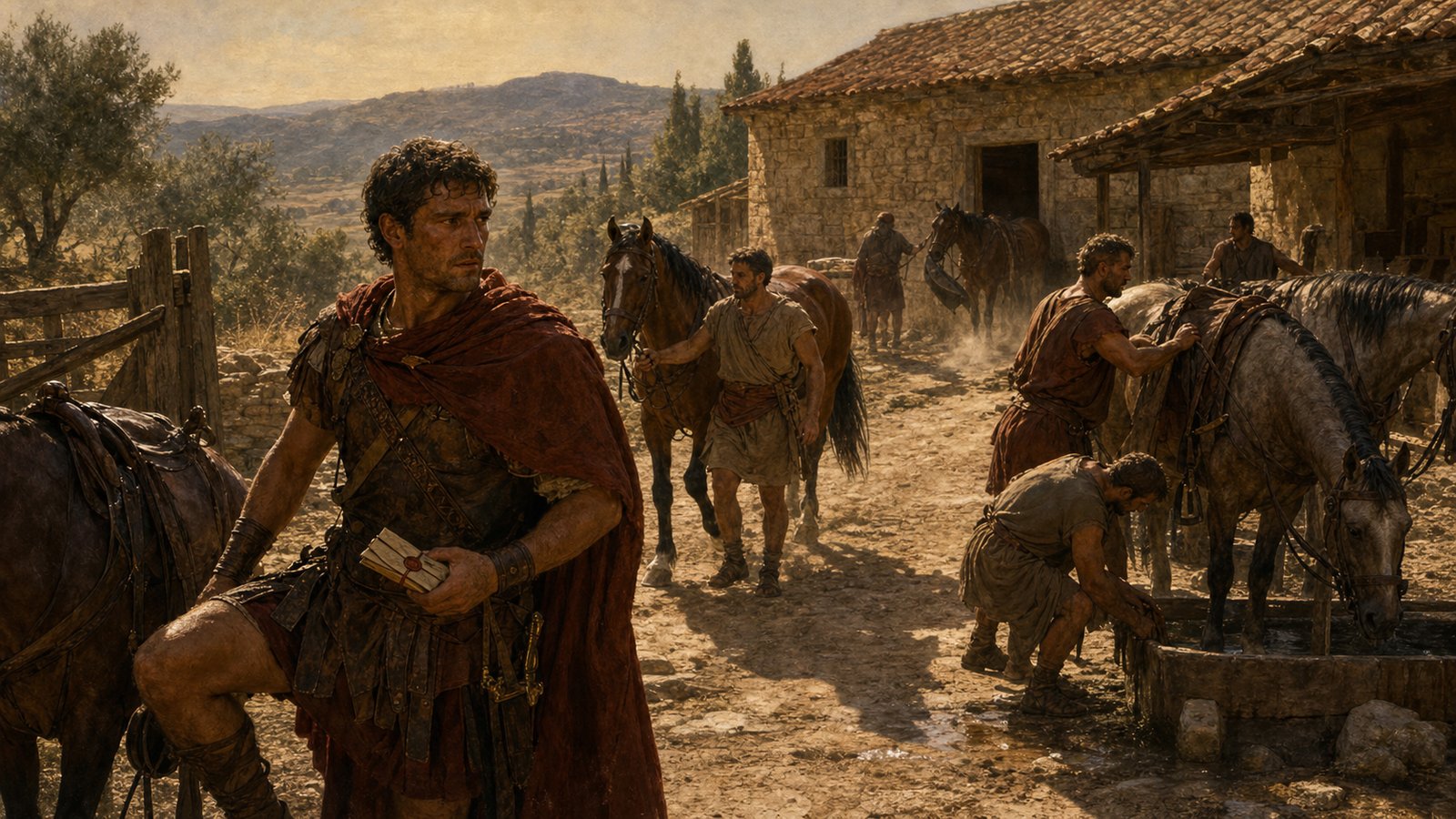
Mansiones and mutationes gave official travelers places to stop, rest, change horses, and continue. The genius of the system was not one heroic rider galloping forever. It was repetition. Each stage reduced the journey to a manageable segment.
Picture a courier arriving with road dust on his cloak while a groom brings forward a fresh horse. A tablet is checked, a permit is recognized, an animal is exchanged, and the message moves again. The scene is practical, but it is also political.
Authorization made movement official
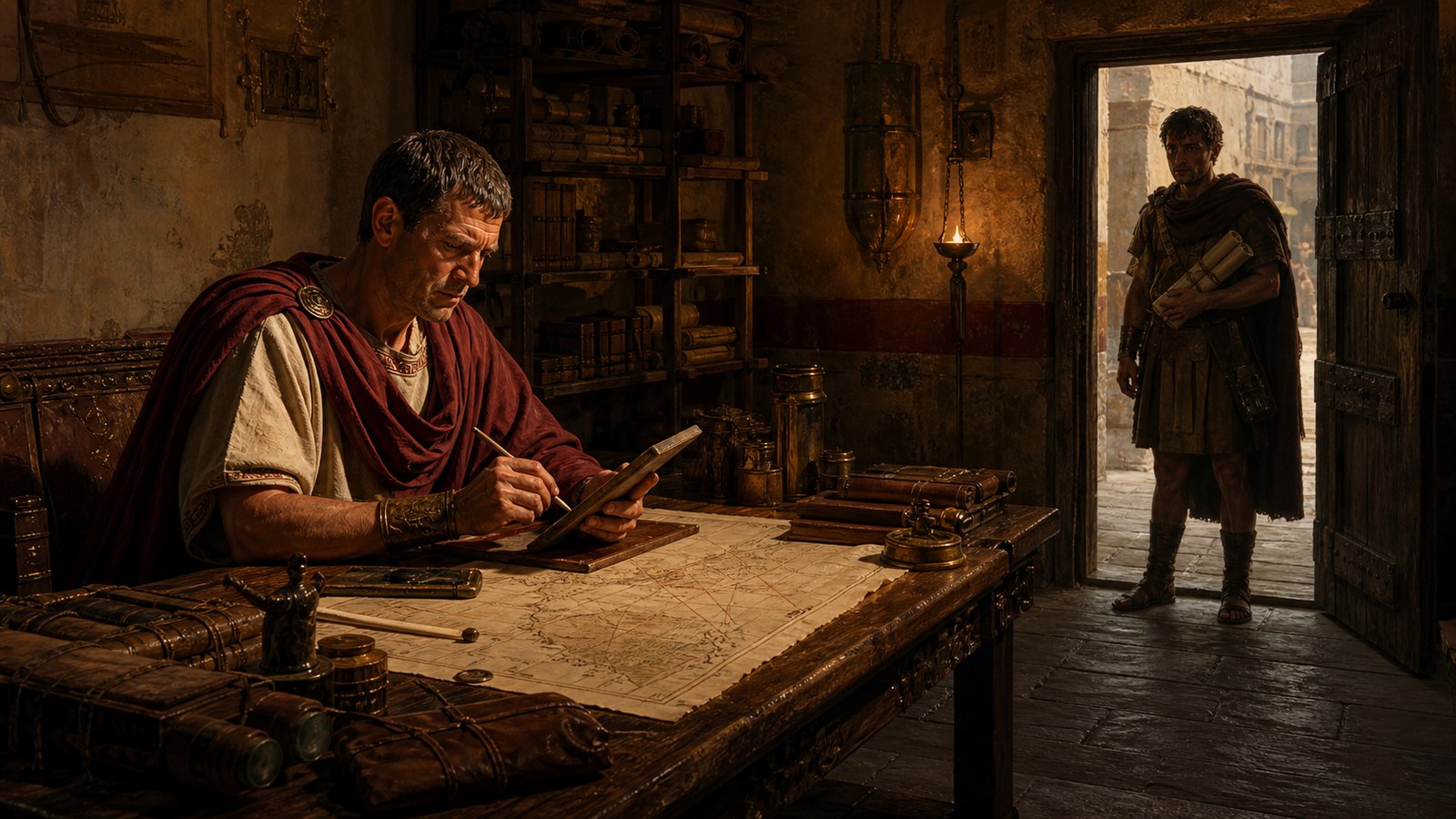
The imperial post was not an open convenience for anyone who wanted speed. Authorization mattered because access to animals, vehicles, and lodging carried cost. A permit separated official movement from private desire.
That distinction protected the system in theory, though abuses were common enough to require regulation. Every official traveler consumed local resources. The post made imperial power mobile, but it also made the burden of empire visible in villages and roadside stations.
Roads turned geography into procedure
Roman roads did not remove distance, but they made distance more predictable. Milestones, stations, bridges, paving, and known routes allowed messages to be planned rather than merely hoped for. Administration could imagine movement in stages.
This changed how power felt. A governor knew that news from the center could arrive. A commander knew orders could be sent. A city knew that appeals, reports, and commands did not vanish into empty space.
Augustus understood the value of reports
Suetonius says Augustus arranged a system for dispatches, first through young men placed at short intervals and later through vehicles, so reports could be brought more effectively. The detail is easy to miss, but it shows an emperor thinking about information as infrastructure.
Augustus did not only need loyalty. He needed news, answers, and instructions to move. An empire without communication becomes a collection of guesses.
The courier carried more than a message
A courier on the road carried the expectation that Rome could still reach the edge. He represented a chain of authority stretching from palace or office to station, horse, clerk, road, and recipient.
This is why Roman couriers made imperial orders move. They did not make distance disappear. They made distance governable enough that orders could travel with a recognizable official rhythm.
The system also reminds us that infrastructure is social before it is impressive. A road without animals, stations, documents, and people is only a surface. The cursus publicus joined those pieces into a working habit.
That habit could be resented. Supplying animals or vehicles to official travelers placed demands on communities. A courier’s arrival might bring honor, urgency, expense, or all three at once. Imperial speed was paid for somewhere along the road.
The material details made authority tangible. A sealed tablet, a travel warrant, a tired horse, a stable yard, a milestone, and a clerk’s check all belonged to the same chain. None was symbolic alone; each helped the message continue.
The post also helped Rome manage uncertainty. A slow empire can still govern if slowness is expected and organized. The danger is not only delay, but unpredictability. Relay systems turned delay into a timetable of sorts.
For soldiers, the movement of orders could decide where units marched, when supplies shifted, or how quickly a crisis became known. For governors, the same system carried reports, petitions, appointments, and reprimands. The courier stood between decision and consequence.
The service reveals a quieter side of Roman power. We often imagine emperors in triumph, generals in battle, or senators in debate. Yet many imperial decisions depended on anonymous riders, grooms, station managers, and scribes doing repetitive work.
The network could never be perfectly smooth. Animals failed, roads broke, officials abused privilege, and weather ignored imperial ambition. Still, the existence of a regulated service shows how seriously Rome took the problem of movement.
A message’s authority also depended on trust. The recipient had to believe the document came through a recognized channel. The road, permit, seal, and courier together helped establish that trust before the words were even read.
That trust made remote government possible. A province could be far away and still be connected to a decision made elsewhere. The connection was not mystical. It was hoofbeats, station yards, permissions, and repeated labor.
The cursus publicus therefore belongs beside roads and armies in the story of empire. It made command travel, made information return, and made the enormous Roman world feel administratively smaller than geography alone allowed.
A provincial recipient may have cared less about imperial theory than about the object placed before him. The tablets had arrived, the seal was present, and the courier could name the route by which he came. That concrete chain made a distant decision harder to dismiss as rumor.
The relay station was therefore a small theater of empire. Horses breathed in the yard, a groom checked harness, a clerk recognized the authorization, and a rider prepared to continue. In those ordinary motions, Rome converted command into movement again and again.
For a ruler, such repetition was priceless. The empire could tolerate slow news better than blind news, and it could tolerate distance better when distance had known stopping places. Couriers did not make Roman government omnipotent. They made it less likely to be trapped by geography.
The courier also made hierarchy practical. A governor might be powerful inside his province, but the arrival of an authorized messenger reminded everyone that provincial command belonged inside a larger chain. The road brought the emperor into the room without requiring the emperor to appear.
That was the deeper achievement. Rome did not need every order to be instant; it needed orders and reports to move often enough, formally enough, and visibly enough that officials planned around them. The cursus publicus made imperial presence a repeated logistical fact.
Sources & Further Reading
- Smith Dictionary, Cursus Publicus
- Smith Dictionary, Mansio
- Encyclopaedia Britannica, Roman road system
- Suetonius, Augustus, 49
- Cassius Dio, Roman History, 54
- The Theodosian Code, public post excerpts
- Smith Dictionary, Milliarium
- Cambridge Core, Roman imperial administration
- Oxford Classical Dictionary, cursus publicus