
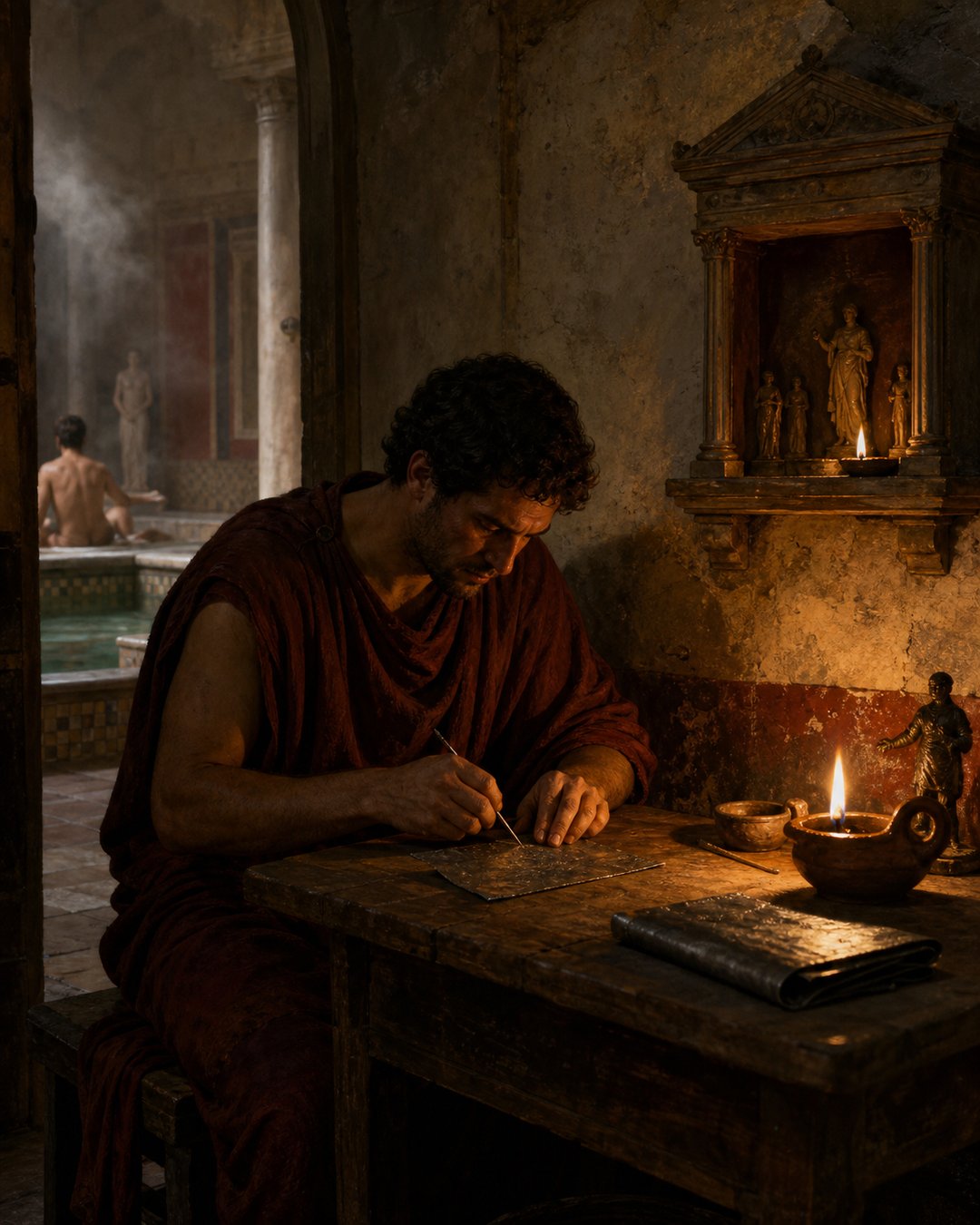
A Roman curse tablet could be small enough to hide in one hand. A name was scratched into lead, the sheet was folded or pierced, and the object was placed where ordinary sight would not follow: a spring, a grave, a sanctuary, a drain, or some other charged edge between human anger and divine attention.
These tablets reveal Roman private fear because they preserve anxiety at a scale official histories rarely notice. Not fear of empire collapsing, but fear of a stolen cloak, a cheating rival, a court case, a lover, a thief, a neighbor, or a body that might not obey. Lead made worry durable.
The object was small, but the emotion was not
Defixiones were usually thin lead sheets inscribed with requests to bind, punish, expose, or damage a named person. Their modest size is part of their power. They look like scraps, yet they carry concentrated emotion: resentment, helplessness, suspicion, and the desire for hidden enforcement.
The choice of lead helped the spell feel physical. Lead is heavy, dull, foldable, and cold. A scratched sheet could be bent shut like a secret. The person making the curse turned speech into an object, then placed that object where a god, spirit, or dead power might find it.
Bath shows the everyday scale of fear
The Roman Baths at Bath preserve a remarkable group of tablets thrown into the sacred spring of Sulis Minerva. Many are not grand political curses. They complain about stolen ordinary things: cloaks, tunics, rings, coins, gloves, and other losses that made daily life feel violated.
That ordinariness matters. A stolen cloak was not just an inconvenience if clothing was costly and public reputation mattered. A person who could not recover property through ordinary means could ask a goddess to make the thief suffer, confess, or lose peace until justice appeared.
Hidden places made hidden anger possible
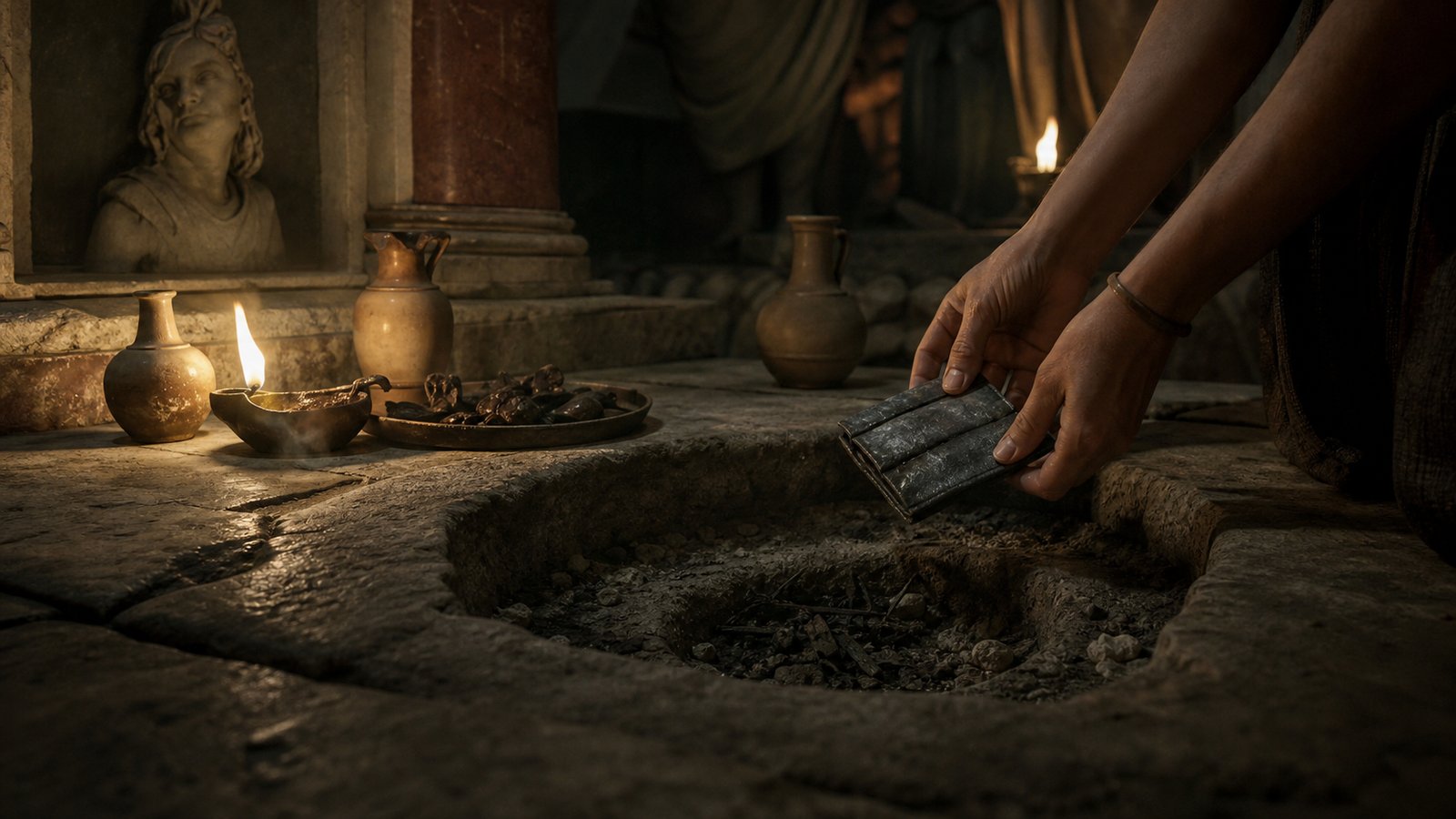
Curse tablets were often deposited in places that felt charged: graves, springs, wells, sanctuaries, and liminal corners. The location gave the writing a second audience. The tablet was not meant only for the human target. It was meant for a power that could act where normal pressure failed.
Picture the gesture at night: a hand near lamplight, a stylus biting into soft metal, the sheet folded, the small weight dropped into dark water. The sound would be brief. The hope behind it could last much longer.
The names make fear personal
Many tablets name people, property, rivals, or body parts with uncomfortable directness. That specificity makes them different from abstract superstition. They are not vague proof that Romans believed in magic. They are records of people trying to solve particular problems through supernatural leverage.
A Bath curse by Docilianus over a stolen hooded cloak is powerful because the grievance is so concrete. The tablet does not ask us to imagine generic anxiety. It gives us a person, an object, and a desire for divine punishment attached to a loss.
Magic filled gaps in ordinary justice
Curse tablets do not mean Romans ignored courts, patrons, neighbors, or officials. They show what people did when those routes felt insufficient, unavailable, slow, embarrassing, or uncertain. Magic could operate beside social and legal life, not simply outside it.
The tablet offered a private procedure. There was no need to win a public argument before scratching a name into lead. A person could make a claim, assign guilt, and recruit divine force in secret. That secrecy was part of the appeal.
The tablets make the voiceless audible
Elite authors often described Rome from the top: emperors, generals, senators, laws, wars, and public rituals. Curse tablets preserve a different register. They let us hear people who were angry about theft, rivalry, humiliation, and vulnerability.
This is why curse tablets matter historically. They are not charming curiosities. They show how fear moved through ordinary Roman life and how people tried to control it when visible power felt too weak. The empire was full of roads and laws, but private dread still found its way into folded lead.
Pliny’s remarks about magic show that Roman concern over spells and hidden forces was not confined to one province or class. Whether he mocked, feared, or cataloged such practices, the very discussion shows a society alert to invisible harm.
The tablets also reveal a moral imagination. Many petitioners did not describe themselves as villains. They presented themselves as wronged people asking a deity to restore balance. A curse could feel, to its maker, like justice by other means.
That does not make the practice gentle. Some tablets sought pain, paralysis, failure, or humiliation. Private fear could turn cruel when it found a sacred mechanism. The lead sheet compressed grievance until it became a wish for another person’s suffering.
The Bath material is especially revealing because water carried the messages away while preserving them for archaeology. What disappeared from human view survived in the spring. A secret object became a public source many centuries later.
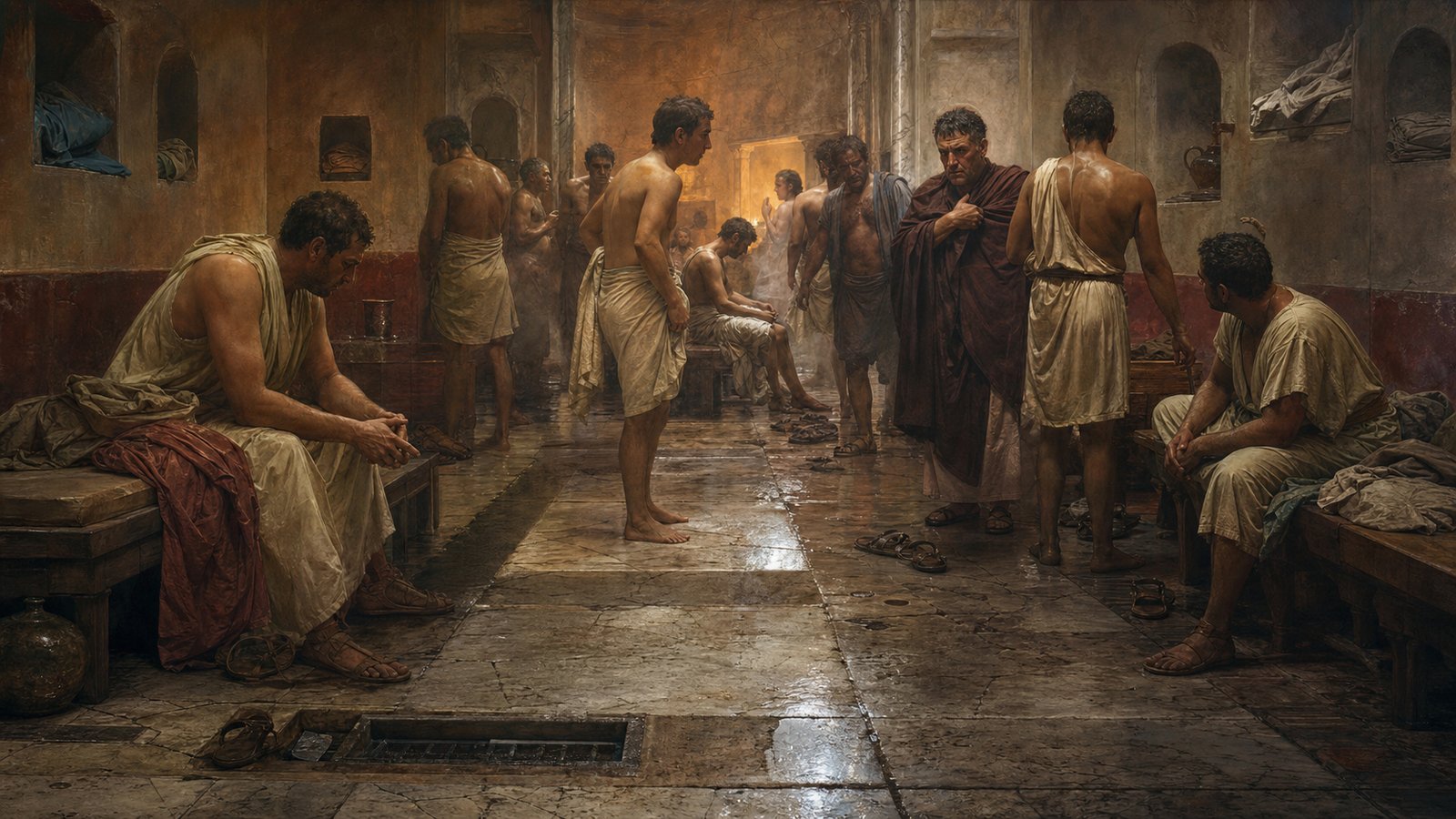
There is also a social geography here. Baths, sanctuaries, roads, and markets brought strangers together. Such places created opportunity, but also theft, suspicion, competition, and embarrassment. Curse tablets grew in exactly those cracks between contact and trust.
A person writing a tablet might not know the thief. That uncertainty sharpened fear. The text could ask the deity to identify the guilty, punish whoever had done it, or force restitution. Magic became a way to act when knowledge was incomplete.
The small details are the strongest evidence: a cloak, a glove, a ring, coins, a named rival, a body part, a spring. These are not decorative facts. They show that Roman anxiety had texture. People feared loss in forms they could touch.
The tablet’s silence also matters. Once folded and deposited, it stopped being conversation. It became waiting. The maker had done something, but the result belonged to hidden powers. That waiting may have been the emotional point: a feeling that fear had been handed over.
Roman curse tablets therefore complicate any picture of a purely rational administrative empire. The same world that built aqueducts and legal formulas also scratched anger into lead and dropped it into sacred water. Practical order and magical hope lived side by side.
The most human lesson is not that Romans were strange. It is that fear often seeks a mechanism. When public mechanisms fail or feel too weak, people invent private ones. In Roman Britain, a folded strip of lead could become that private machine.
The handwriting also matters. Some tablets are neat, some awkward, some formulaic, and some intensely personal. That variety suggests a practice used by different kinds of people, not a single official class of ritual specialists. Anxiety found scribes, formulas, shortcuts, and borrowed language.
A curse tablet was therefore both intimate and social. Someone had to know where to place it, what words might work, which deity or spirit to address, and how to make the object disappear into the right place. Private fear moved through shared habits before it became hidden lead.
That mixture is what makes the evidence so valuable. The tablets show people living inside Roman systems while still reaching beyond them. They used names, property claims, and accusations that sound almost legal, then handed those claims to powers no magistrate could cross-examine.
Sources & Further Reading
- Oxford Classical Dictionary, Defixiones
- Johns Hopkins Archaeological Museum, Curse Tablets
- Roman Baths, Curse Tablets
- The Roman Inscriptions of Britain, RIB 306
- The Roman Inscriptions of Britain, Uley tablets
- British Museum, Curse tablets
- Pliny the Elder, Natural History, 28