
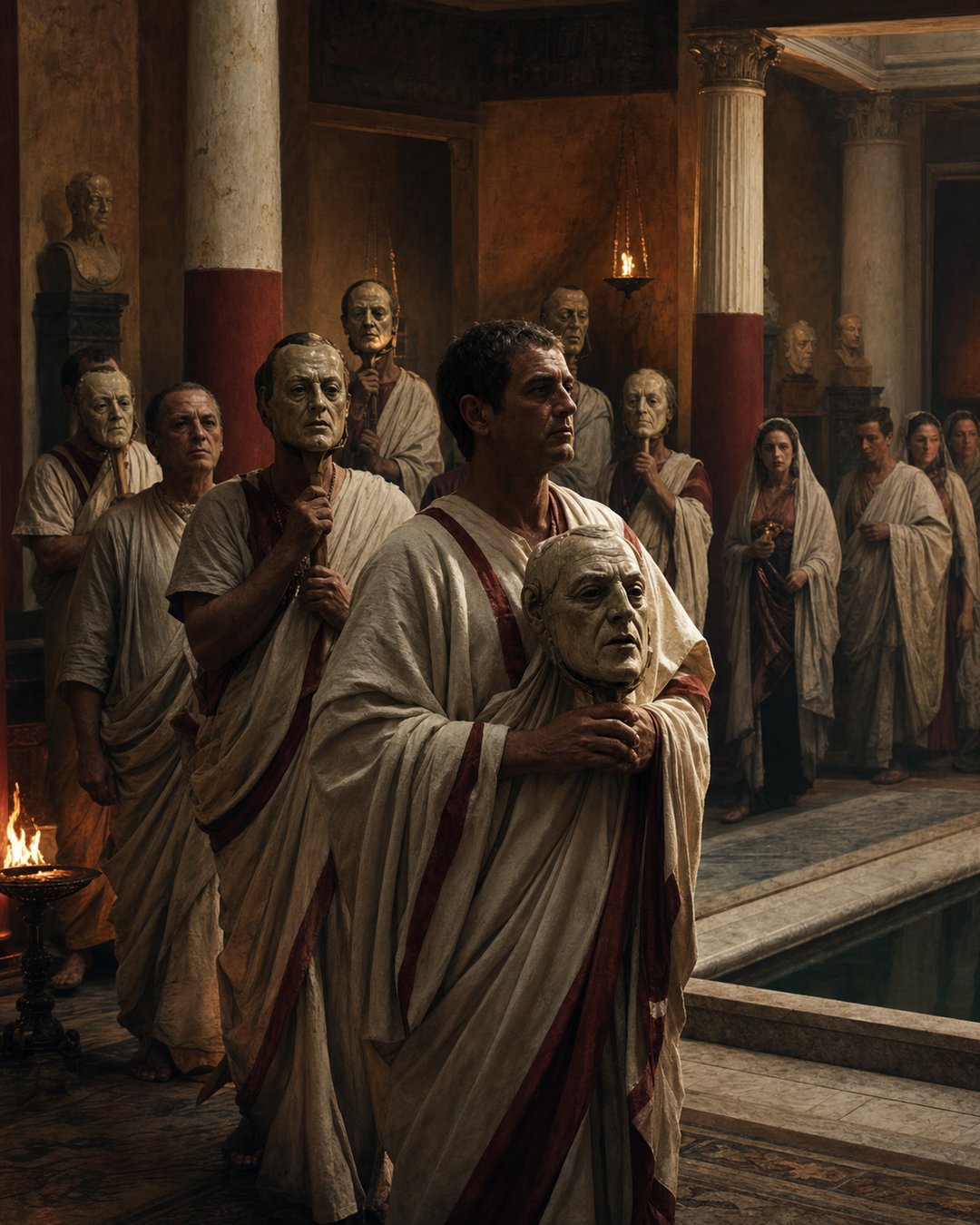
A Roman noble funeral could make the dead appear to walk again. Masks came out of storage, actors put on the faces and clothing of ancestors, and a family’s past moved through the city as if it still had business with the living. Memory did not stay private. It entered the street.
This is why Roman ancestor masks made memory political. The imagines were not only sentimental keepsakes. They joined household pride, public office, and civic ambition into one visible performance. A family could show Rome what it had been, and by doing so suggest what it still deserved to be.
The mask turned ancestry into evidence
The Roman imagines were ancestral portrait masks or images associated with elite families. They mattered because they made descent visible. A claim about ancestors could be doubted, forgotten, or ignored; a row of faces in the atrium gave the claim a physical form.
Polybius gives the most vivid ancient description. At funerals, people resembling the dead ancestors wore the masks and appeared in garments matching the offices those ancestors had held. The mask therefore did more than preserve a face. It brought office, rank, and memory into the same scene.
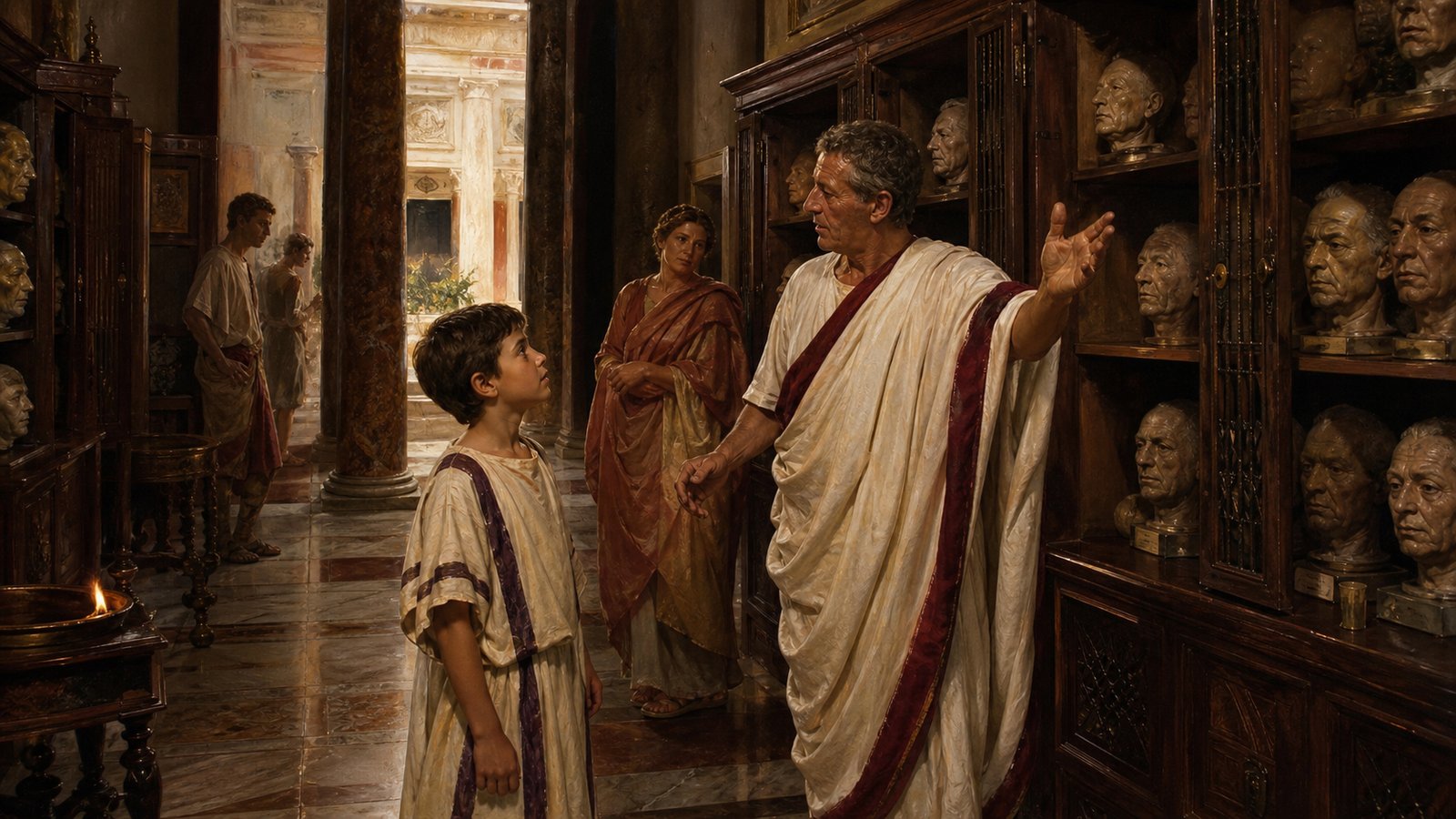
The atrium was not a private museum
Elite ancestral memory often lived in the house, but the Roman house was not sealed away from public life. The atrium received visitors, clients, allies, petitioners, and political dependents. A display of ancestors in that space taught guests what kind of family they had entered.
This domestic setting made the politics subtler. A visitor did not need a campaign speech to understand the message. Faces, names, offices, and stories arranged around the household created a genealogy of authority. The family’s past watched the present conversation.
A funeral made the archive move
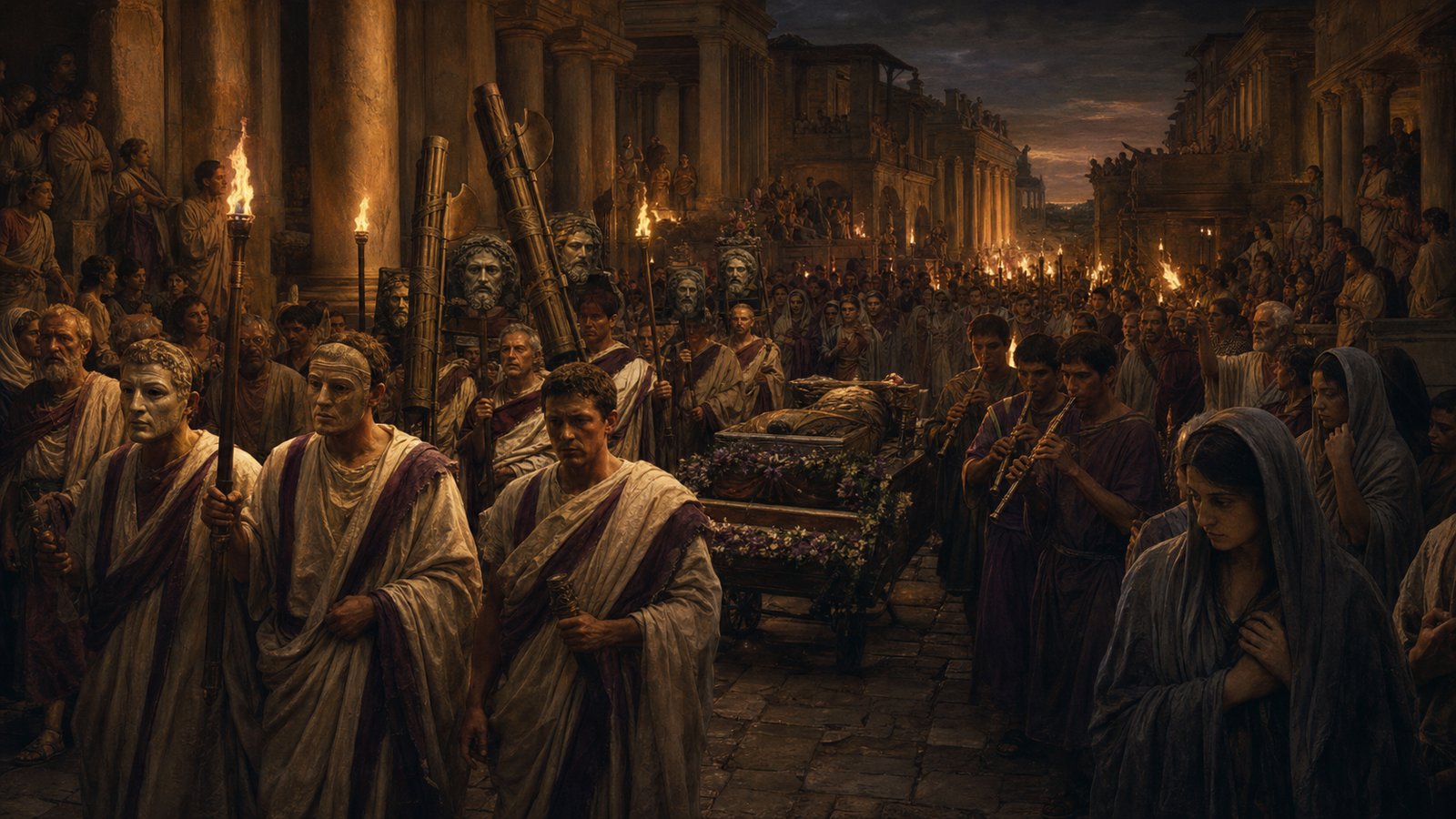
The strongest moment came during the public funeral. The masks left the cupboard and entered procession. Polybius describes ancestors seeming to be present again, dressed according to their highest offices. The dead became a moving archive of magistracies and victories.
Imagine the sensory force of it: wax faces in torchlight, purple-bordered garments, mourners pressing along the route, lictors and musicians, and a young heir seeing his family’s reputation carried through the crowd. The past was not being remembered quietly. It was being staged.
Memory taught ambition
Polybius says the spectacle stirred young men toward virtue and public achievement. That sentence reveals the political function. Ancestor masks did not only celebrate what had already happened. They trained the next generation to treat office and glory as an inherited obligation.
The pressure could be powerful. A son or nephew did not merely inherit property. He inherited watchers. The masks implied that the living had to answer to the dead, and that the public would measure them against earlier magistrates in the same line.
The face was also a social filter
Not every Roman family could use ancestry in the same way. The strongest ancestral displays belonged to aristocratic houses whose members had held high office. That made memory unequal. Some families could turn the past into a public credential more easily than others.
A new man could win office and honor, but old families possessed a theater of legitimacy ready at home. Their ancestors had faces, costumes, offices, and funeral roles. The mask helped turn social memory into a kind of political capital.
The dead could still compete
Ancestor masks remind us that Roman politics was not only speeches, laws, and battles. It was also reputation across generations. The dead competed through the living, and the living borrowed power from the dead. A funeral could become a campaign of memory without naming itself as one.
This is why the masks were more than art. They made Roman memory public, ranked, and persuasive. In a city obsessed with office, honor, and example, the face of an ancestor could become an argument about who belonged near power next.
Pliny’s discussion of ancestral portraits shows that Romans themselves thought about faces as carriers of memory. A likeness could preserve more than appearance. It could preserve a moral claim about the household: these people served, governed, fought, spoke, and deserved to be remembered.
The material choice mattered too. Wax is intimate and fragile. It can take an impression of a face, but it can also melt, crack, and darken. That fragility made the careful preservation of masks feel like a duty. A family had to maintain the objects that maintained its memory.
The funeral procession also changed the city’s spectators into witnesses. Ordinary Romans might not know every ancestral story, but they could read costume, office, number, and choreography. The more ancestors a family could display, the more crowded its argument became.
There is a quiet violence in that abundance. Political culture often pretends that merit speaks for itself, but Rome knew how loudly lineage could speak. The masks amplified some voices before a living candidate ever opened his mouth.
The images did not guarantee success. A foolish heir could disgrace a noble line, and a talented outsider could rise. But aristocratic memory gave certain families a head start in the imagination. It made their presence in public life seem less like ambition and more like continuation.
That is why the atrium and the funeral route belong together. One stored the family’s claim; the other released it into public movement. The household and the city were connected by faces that had outlived their owners.
The most revealing detail in Polybius is not merely that masks were worn. It is that the wearers imitated rank through clothing and official signs. Rome did not remember ancestors as isolated personalities. It remembered them through offices, honors, and service to the state.
So the ancestor mask was never only about grief. It was grief organized by status. It told mourners whom to praise, young relatives whom to imitate, clients whom to follow, and rivals whom they were up against.
A modern viewer may see something eerie in actors wearing dead faces. Romans saw a civic lesson. The dead were not gone from politics if their names, offices, and images could still discipline the living.
The result was a city where memory had a body. It could be carried, dressed, displayed, and watched. The ancestor mask made the past visible enough to argue with, admire, fear, or use.
The practice also explains why Roman memory could feel so crowded. A living politician was rarely alone on stage. Behind him stood offices won by fathers, grandfathers, uncles, and distant relatives, each one available as a precedent when the family needed authority.
That crowding could comfort supporters and irritate rivals. It made politics feel like a contest among houses as well as among individuals. The masks did not cast votes, but they helped shape the atmosphere in which votes, favors, marriages, alliances, and grudges were understood.
The strongest political message was continuity. A family could point to old faces and say, in effect, that service to Rome had already been proven in this bloodline. Whether the claim was fair mattered less than whether the city had learned to read it. The masks taught Rome to see lineage as visible public evidence.
Sources & Further Reading
- Polybius, Histories, 6.53
- Polybius, Histories, 6.54
- Smith Dictionary, Imagines
- Metropolitan Museum of Art, Roman Portrait Sculpture
- Pliny the Elder, Natural History, 35
- World History Encyclopedia, Roman Funerals
- Oxford Reference, Atrium