
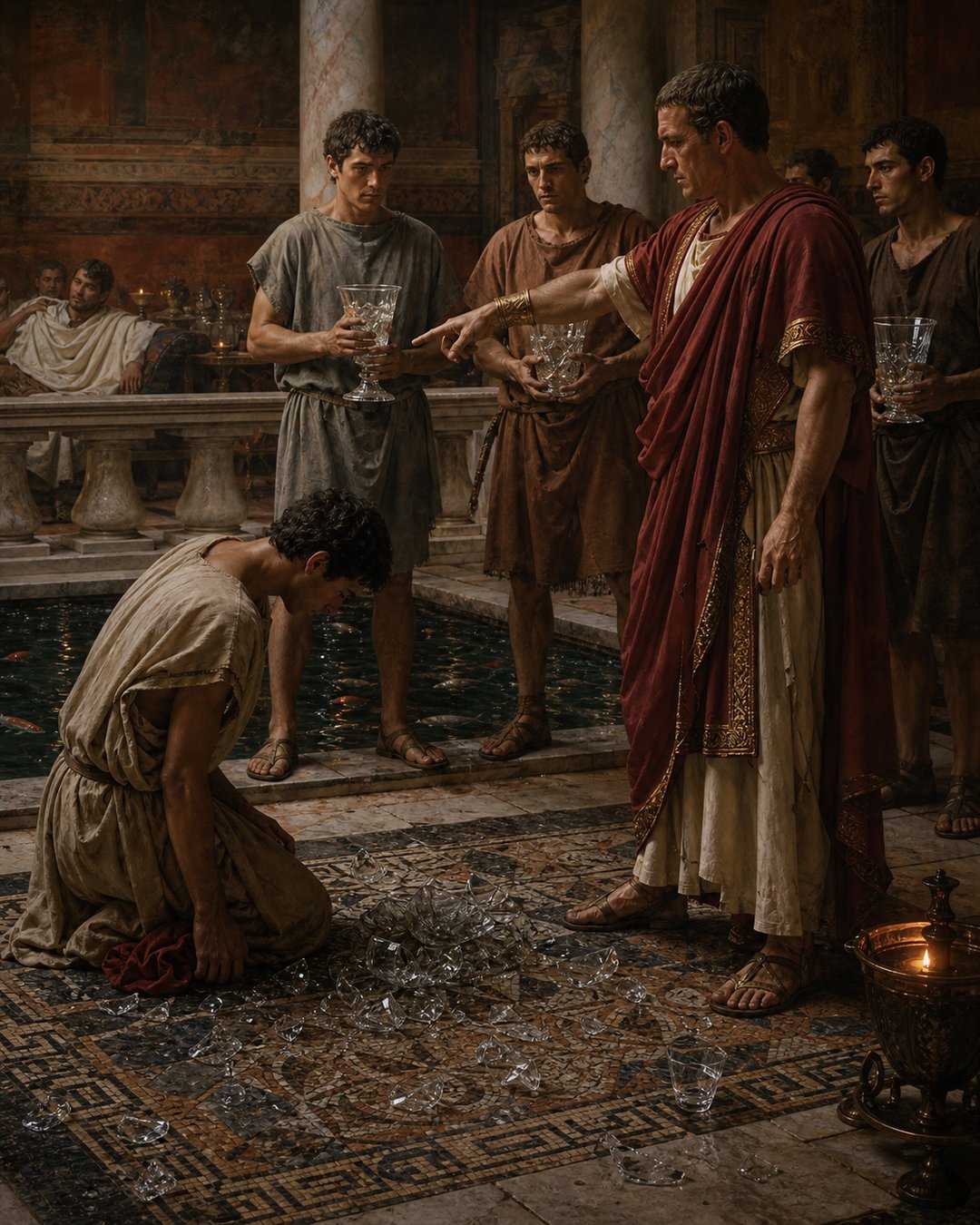
A crystal goblet broke during dinner. Its owner, Vedius Pollio, did not ask what the vessel had cost or whether the damage was accidental. He ordered the enslaved cup-bearer taken to a pool of large muraenae, fish kept for a death that would turn punishment into spectacle.
One guest changed the result. Augustus was at the table. The cup-bearer escaped the hands of the men seizing him, reached the emperor’s feet and asked at least to die in some other way. What followed was not a private lecture on kindness. Augustus ordered Pollio’s other crystal vessels brought out and broken.
Seneca, Cassius Dio and Pliny the Elder preserve versions of the episode. Each writes with a purpose and at a distance from the dinner, so their details cannot be treated like a transcript. Together they show why the story endured: expensive glass, a fish pool, an enslaved person’s body and imperial authority collided in one dining room.
The Cup-Bearer Asked for a Different Death
Seneca places the scene in his discussion of anger. Vedius Pollio was dining with Augustus when one of his slaves broke a crystal goblet. Pollio ordered an unusual execution: the young man was to be thrown alive to the large muraenae in his tank.
The victim’s request is the hardest detail in Seneca’s account. He did not initially ask to escape death altogether. He reached Caesar’s feet and begged not to be eaten. The limited plea makes the imbalance of the room physical. Pollio owned the vessel, the pool and the person; the cup-bearer tried to secure only the manner of his death.
Cassius Dio gives the servant a household role, calling him Pollio’s cup-bearer. A cup-bearer stood close to the expensive objects and to the diners who used them. That proximity made service visible, but it also placed one person beside fragile wealth whose loss an owner could treat as an insult.
The broken goblet mattered because crystal carried elite value. It was not merely a container for wine. In this scene it became a test of how completely Pollio could translate ownership into punishment. The more extravagant the object, the more extravagant he made the proposed response.
A related material history survives in the story Romans told about an allegedly unbreakable glass vessel. There too an emperor, a remarkable cup and the danger attached to luxury meet, but Pollio’s dinner turns the object’s fragility against an enslaved attendant.
Augustus Broke the Scale of Pollio’s Anger
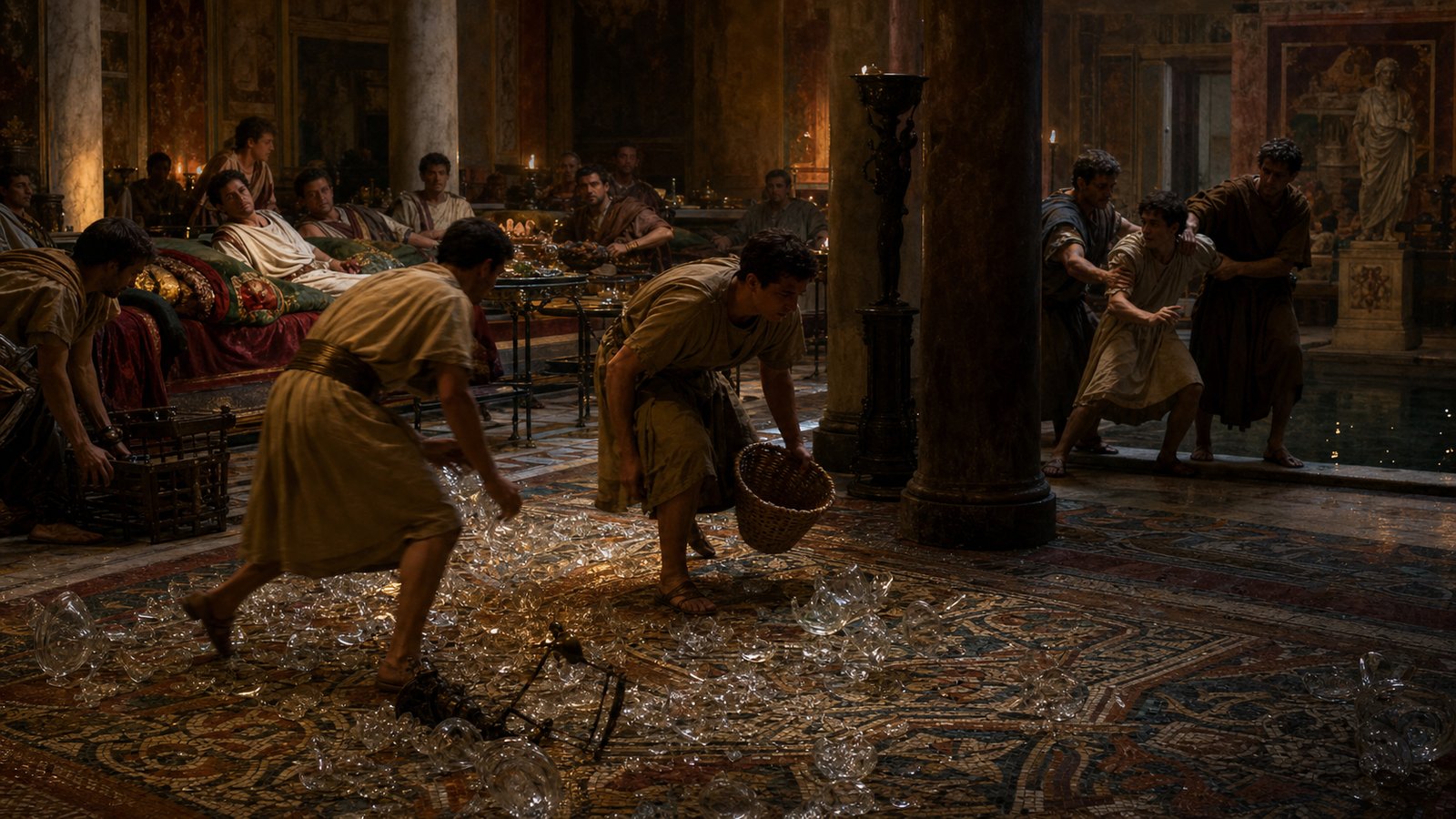
In Dio’s version, Augustus first tried persuasion. Pollio refused. The emperor then asked for all the other drinking vessels of the same kind, along with other valuable vessels, as if he intended to use them. Once they appeared, he ordered them smashed.
The action changed the arithmetic. Pollio had treated one broken cup as a loss requiring a human death. Augustus multiplied the broken objects until that logic could no longer be applied to the servant alone. Pollio could hardly punish one cup-bearer for something the emperor had just done on a much larger scale.
Seneca says Augustus also ordered the tank filled in and the enslaved man released. His point is about stopping another man’s anger from a position of superior power. The intervention succeeded because the guest was not socially dependent on the host. Augustus could destroy Pollio’s tableware and make the order stand.
This was rescue, but it was also command. The cup-bearer’s safety depended on a stronger master entering the scene. No court heard the case, and no general rule emerged in the accounts. The same hierarchy that made imperial intervention effective also shows how little protection an enslaved household worker could claim alone.
Formal freedom could be made visible through public procedure, as in Rome’s ceremonies of manumission. Pollio’s cup-bearer reached a different kind of threshold. The sources make one imperial interruption decisive without telling us what legal status or later life followed.
The Fish Pool Made Cruelty into Display
Pliny identifies Vedius Pollio as an equestrian and a friend of Augustus. In his account of muraenae, he says Pollio threw condemned slaves into fish preserves because the animals tore a body apart in a particularly complete way. Pliny does not present the pool as an ordinary method of Roman punishment.
That distinction matters. A rich household might contain decorative water, stocked fish and expensive dining equipment. Pollio joined those forms of luxury to a threat. The pool advertised that he could maintain unusual animals and decide which bodies entered their water.
The English word “lamprey” is often used in retelling, although the ancient muraena is commonly identified with the Mediterranean moray. Keeping the ancient term in view prevents a modern zoological label from becoming the point. Seneca’s emphasis falls on a death designed to be unheard-of and horrifying.
The proposed execution also made dinner unstable. Hospitality ordinarily displayed control through courses, vessels, servants and conversation. Pollio’s order exposed the violence supporting that polished surface. A slip of glass could move a servant from pouring wine to the edge of a fish tank.
Seneca asks whether a person’s insides should be torn apart because a cup was broken. His rhetorical question binds object and body together without pretending their values were comparable. The force comes from the fact that Pollio behaved as though the vessel deserved the greater protection.
Pollio’s Wealth Outlived Him, but His House Did Not
Dio records Pollio’s death in 15 BC. He describes a man of equestrian rank, descended from freedpeople, remembered not for public achievements but for wealth and cruelty. The judgment is Dio’s, written centuries later, yet it explains how the dinner became the organizing memory of Pollio’s life.
Pollio left Augustus a large share of his estate and Pausilypon, his property between Neapolis and Puteoli. He wanted a beautiful public work erected there. The bequest shows continued proximity to imperial power even after the dining-room humiliation.
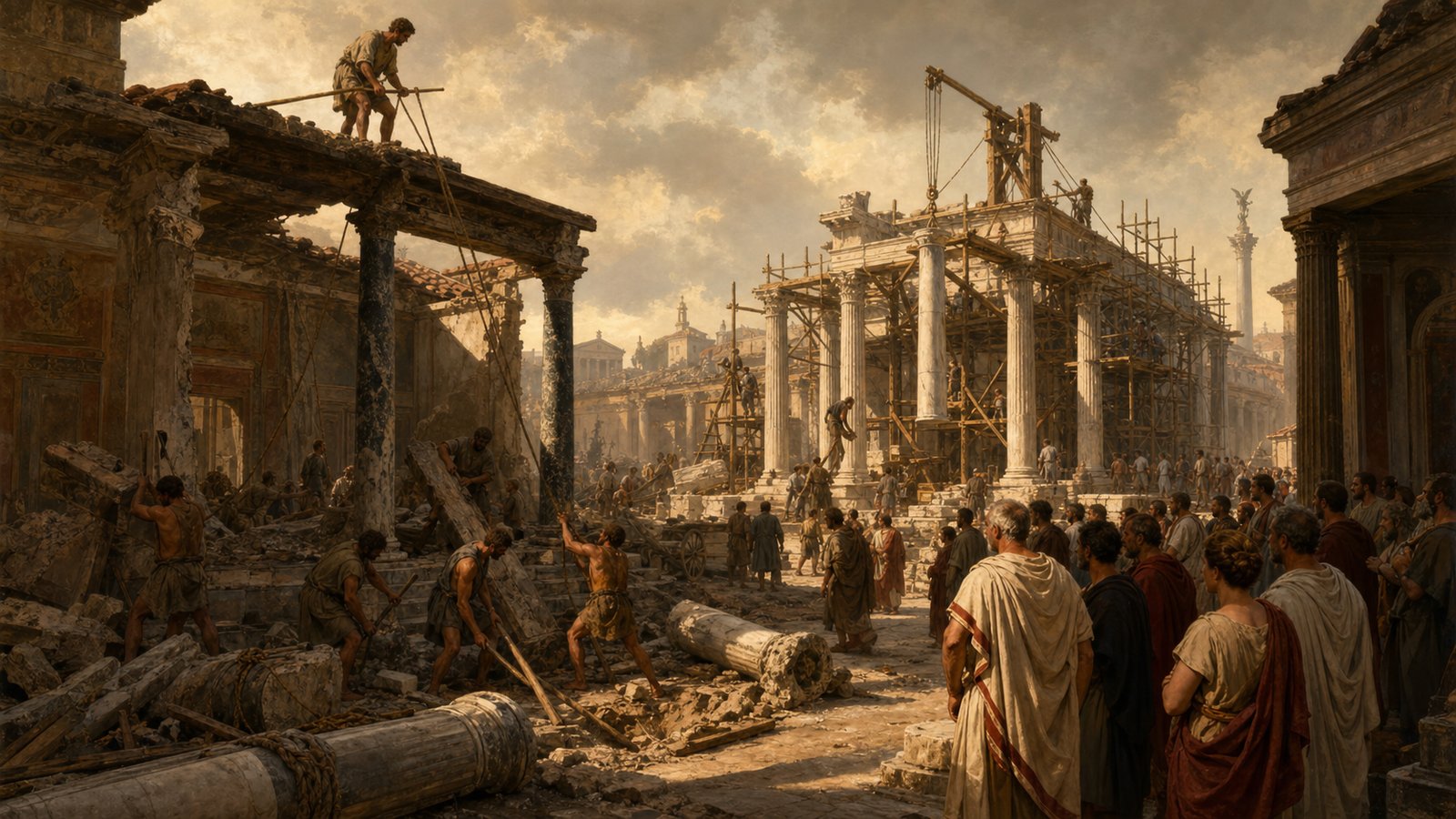
Augustus accepted the property but treated Pollio’s Roman monument differently. Dio says he razed Pollio’s house, officially to prepare another structure but really so Pollio would have no memorial in the city. The Portico of Livia rose on the site.
The sequence cannot be reduced to modern moral reform. Augustus benefited from Pollio’s wealth and controlled the story told by the urban site. Destroying the house simultaneously erased a private landmark and allowed the imperial household to place its own name and public architecture there.
Objects therefore bookend Pollio’s surviving reputation. Crystal vessels were smashed while he lived; his house was demolished after he died. In both cases Augustus used destruction to make authority visible. The enslaved cup-bearer appears only in the first moment, when breaking property became the way to stop a body from being broken.
Three Authors Turned Dinner into a Warning
Seneca uses the scene to teach how superior power can stop anger. Pliny inserts Pollio into natural history as evidence of human cruelty toward other humans through fish. Dio places the episode inside a political biography of wealth, friendship with Augustus and posthumous memory.
Their purposes explain minor differences. Seneca stresses the escape to Caesar’s feet, release, smashed crystal and filled tank. Dio gives a staged exchange in which persuasion fails before Augustus calls for more vessels. Pliny concentrates on the preserves and the method of killing.
Agreement across the accounts does not remove the need for caution. None of the authors supplies the cup-bearer’s name. None records his own voice beyond an appeal shaped by the narrator. Pollio and Augustus remain the named men through whom the story is organized.
Yet the unnamed worker drives every action. His mistake exposes Pollio’s claimed power; his flight puts the question before Augustus; his threatened body makes the value of crystal grotesque. Without him, there is no memorable lesson, only another elite dinner.
The story lasted because the response answered Pollio in his own language of ownership. Augustus did not merely say the cup mattered less than a life. He made the remaining cups disposable, deprived the proposed sentence of its excuse and showed that Pollio’s household command ended where a greater command began.
Sources
Seneca, On Anger 3.40.
Cassius Dio, Roman History 54.23.
Pliny the Elder, Natural History 9.39.