
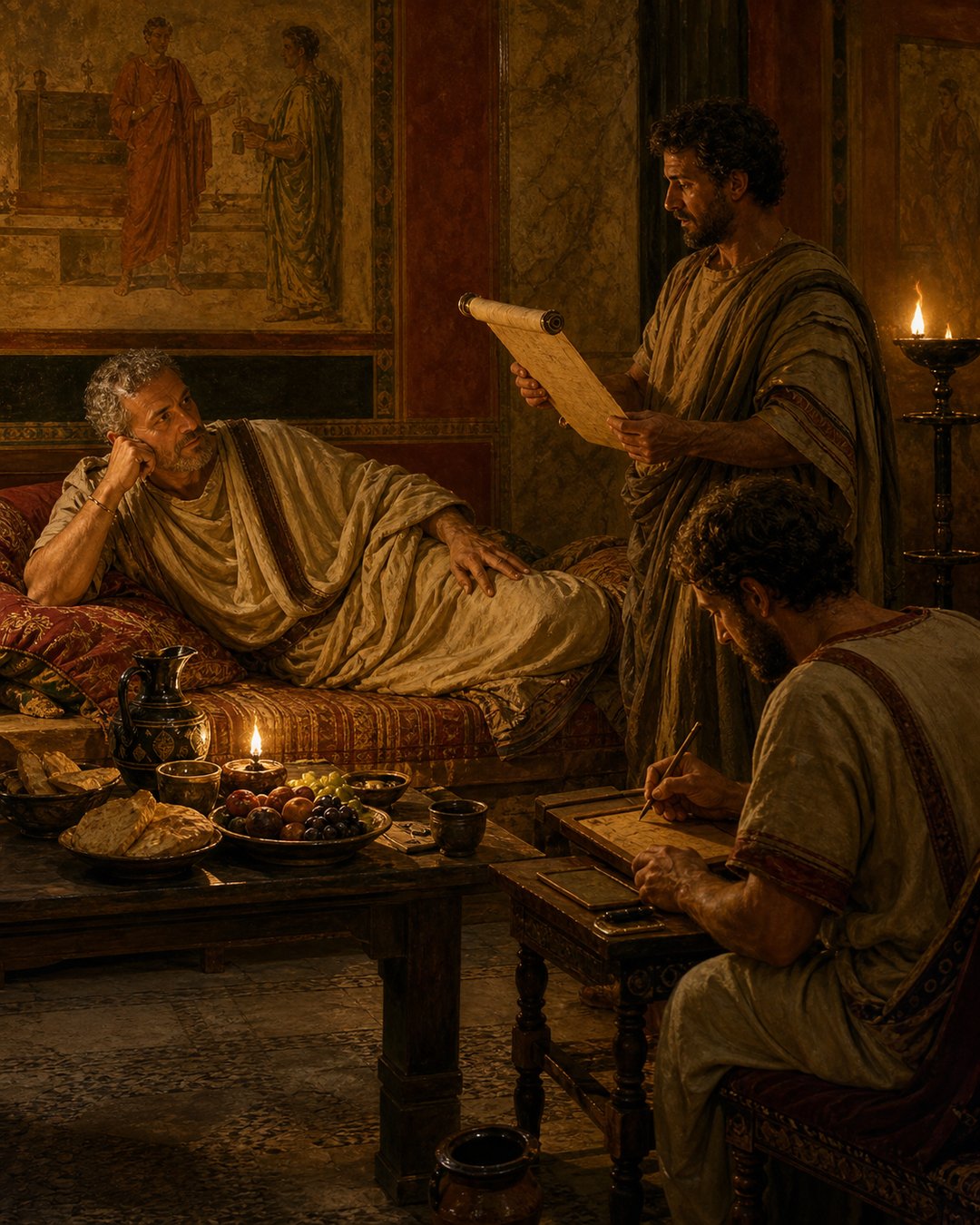
At dinner, a book was read aloud and notes were taken. If the reader mispronounced a word, Pliny the Elder interrupted him. On one occasion, a guest asked why he had not simply let the reader continue. Pliny answered that the correction mattered—and then rebuked the guest for wasting the time in which more than ten lines could have been read.
The scene comes from a letter by Pliny the Younger describing his uncle’s habits and writings. It is affectionate, admiring and sometimes defensive. The younger man wants his correspondent to understand how one life produced a huge body of scholarship. His answer is not a mysterious burst of genius. It is a timetable.
Reading followed the elder Pliny before dawn, through official duties, meals, travel and parts of the bath. Secretaries took dictation. Readers supplied books when his hands or eyes were occupied. Notebooks preserved excerpts in a compressed form. The routine joined personal intensity to the labour of an educated household.
Study Began Before the Emperor’s Working Day
Pliny the Younger says his uncle began working at night. During the reign of Vespasian, he rose before daybreak to visit the emperor, who also used the night for business. After completing the duties assigned to him, Pliny returned home and gave the remaining time to study.
The hour varied with the season. The letter says he started at midnight around the festival of Vulcan, or later at one or two in the morning on other occasions. Those details are not a universal Roman schedule. They describe an exceptional man whose nephew remembered sleep as time borrowed from work.
The imperial visit anchors the routine in office rather than private retreat. Pliny the Elder was not only the author of the Natural History. He served in military and administrative roles and belonged to Vespasian’s working circle. Study had to occupy the hours surrounding public obligation.
The younger Pliny says his uncle could fall asleep quickly and wake just as quickly. After a short sleep, work resumed. He reports that the elder sometimes dozed while a book was being read, then continued taking notes upon waking. The portrait turns physical fatigue into another variable managed inside the schedule.
Readers should keep the letter’s purpose in view. A nephew praising a famous relative selects habits that make the life coherent. We do not possess a neutral time log for every day. Yet the repeated settings—night, meal, bath and carriage—are concrete enough to show the method the family associated with Pliny’s output.
The Bath Interrupted Reading Only at the Moment of Immersion
After a light meal, Pliny sometimes rested in the sun while a book was read aloud. He made notes and extracts. The arrangement combined bodily routine with scholarship: another person supplied the text while Pliny listened and selected material worth preserving.
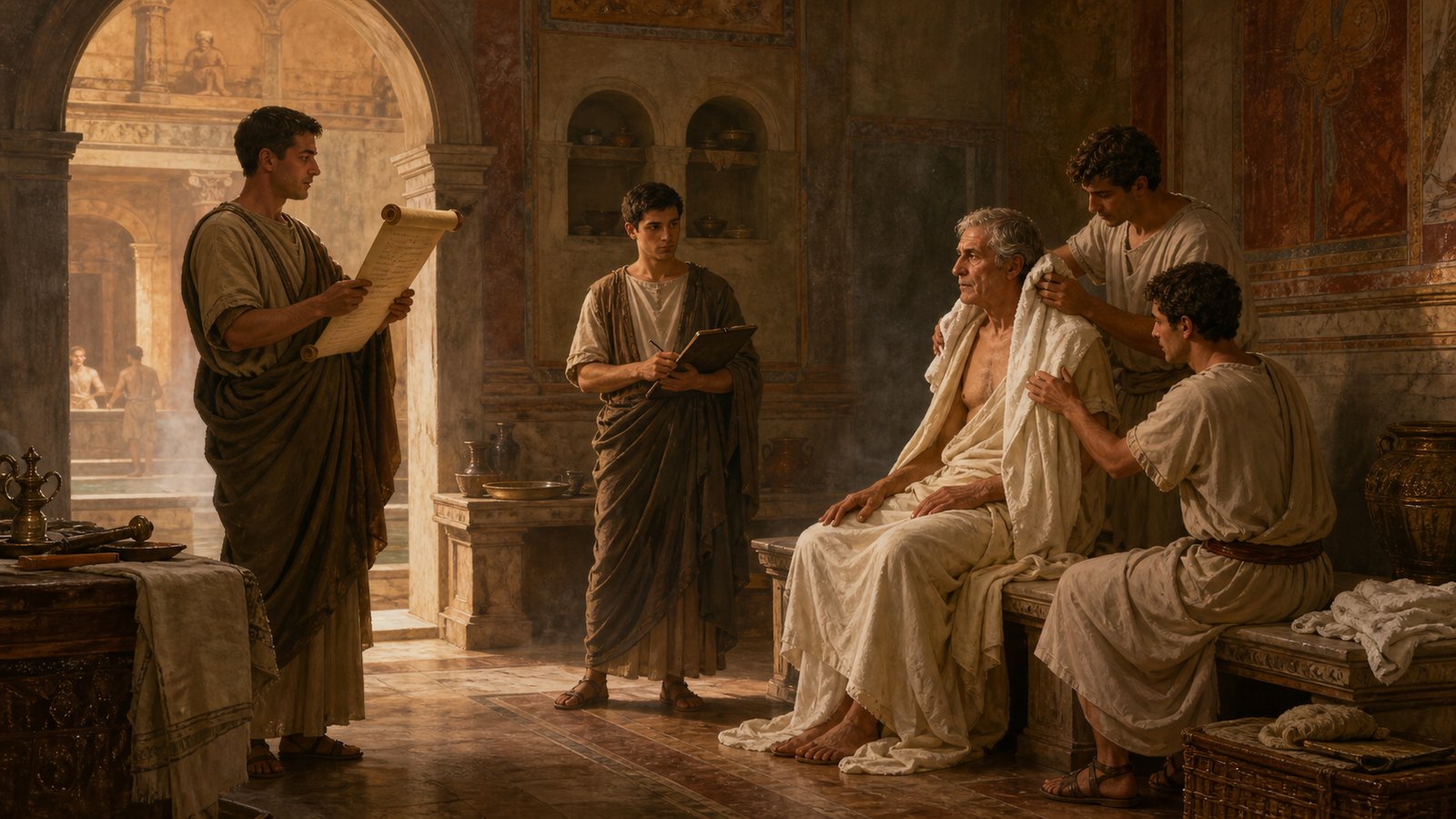
The bath did not end that work. Pliny the Younger says that while his uncle was actually in the bath he did not study, although he could dictate. The distinction is wonderfully precise. Immersion changed what could be done, but it did not necessarily stop production. A secretary could still turn spoken thought into writing.
Once Pliny was being rubbed and dried, he listened to reading again or dictated. The transition from water to clothing became usable time. A reader and secretary had to be ready to match that rhythm, bringing intellectual work into a setting modern readers might imagine as private leisure.
This was not frictionless efficiency. Books had to be obtained and carried. A reader needed literacy, volume and stamina. A secretary needed writing materials and speed. Corrections interrupted the flow. The routine worked because several people coordinated around one man’s attention.
The unequal structure matters. Pliny’s disciplined habits were real, but they were amplified by household workers whose names the letter does not preserve. When the younger Pliny says that his uncle believed all time lost that was not given to study, other people were helping ensure that his meals and bath could count as study at all.
That infrastructure offers a different view from Galen’s loss of irreplaceable books and notes in the fire of AD 192. Galen’s account reveals the vulnerability of a scholarly archive at one catastrophic moment. Pliny’s routine reveals the daily human chain required to create such an archive in the first place.
Ten Lost Lines Made Dinner Conversation Expensive
Dinner was normally light and simple in the nephew’s account, but a book was read and notes were made. The famous exchange over a mispronounced word shows how Pliny valued not merely the total hours of reading but the density of each interval.
A guest named Larcius Macedo asked the reader to repeat a word after Pliny corrected him. Macedo then wondered why the elder had stopped the reading if he had understood it anyway. Pliny asked whether the guest had also understood. When Macedo said yes, Pliny told him that his interruption had cost more than ten lines.
The anecdote is comic because Pliny measures politeness in lost text. Dinner conversation, which elsewhere built friendship and status, becomes an obstacle to throughput. His correction also shows that listening was active. He monitored pronunciation closely enough to stop a reader while simultaneously following the argument and preserving extracts.
The ten-line rebuke should not be converted into a modern productivity metric. Ancient manuscript lines varied, and the nephew offers a remembered quip, not stopwatch data. Its meaning lies in the scale Pliny chose: even a brief social exchange could be translated into text not heard.
The scene also complicates the image of passive consumption. Reading aloud was common in Roman literary culture, but Pliny treated it as an editorial process. He corrected, selected, dictated and reorganized. The reader’s voice freed his hands without surrendering judgment.
Carriages Became Moving Rooms for Dictation
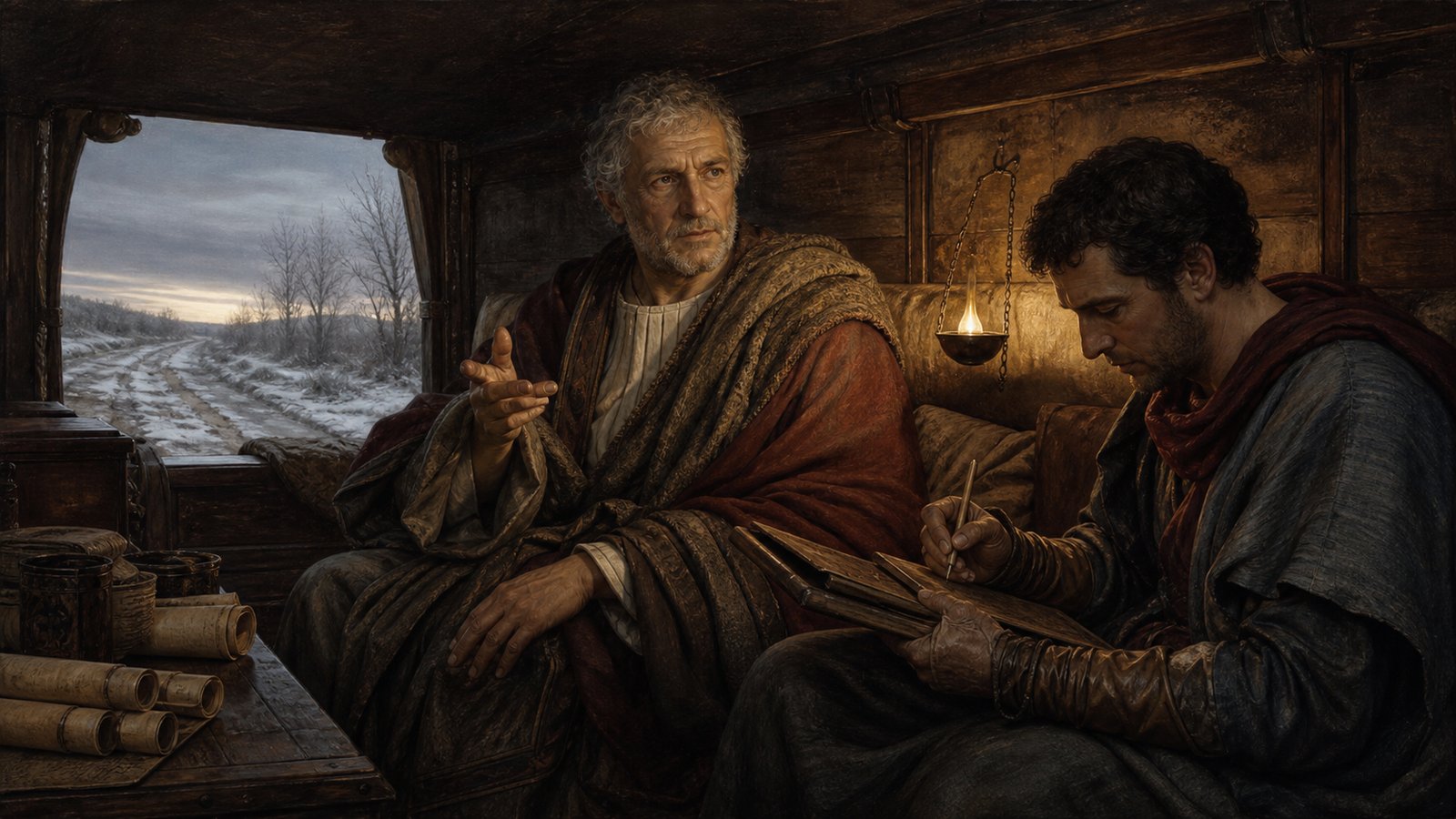
Travel extended the system beyond the house. In Rome, Pliny used a closed carriage so he could work while moving. The younger man says a secretary sat beside him with a book and writing tablets. In winter, the secretary’s hands were protected with long sleeves so cold would not prevent note-taking.
The detail of covered hands makes the scene physical. Roads jolted, weather entered the vehicle, and wax tablets or other writing materials had to remain usable. Pliny’s solution was not to imagine travel as effortless. It was to equip another worker to continue despite the cold.
On longer journeys, the method remained. Pliny read or dictated in the carriage. His nephew recalls being scolded for walking instead of riding because walking surrendered hours that could have been devoted to study. The elder’s system converted distance into a sequence of pages and notes.
Official movement and scholarship therefore reinforced each other. A provincial command or journey did not automatically suspend compilation. Materials and assistants moved with him. The same officer who investigated unfamiliar phenomena could continue building an enormous reference work between destinations.
This rhythm gives context to the day Pliny read the cloud over Vesuvius as both an object of inquiry and a rescue signal. His final voyage was exceptional in danger, but not in the impulse to observe, ask and record. The letter about his habits shows that inquiry had already been organized into the ordinary movement of his life.
Notebooks Preserved What the Reader’s Voice Released
The end product of all this listening was not only memory. Pliny made extracts and notes. His nephew says he left 160 notebooks, written in very small script on both sides. A buyer once offered a large sum for them, but Pliny kept the collection.
The figure belongs to the nephew’s testimony and should be treated as such, but the material detail is persuasive. Writing on both sides and using small script increased capacity. Notes were condensed so that reading completed at dinner or in a carriage could later be recovered and combined.
The notebooks linked spoken performance to authored books. A reader voiced someone else’s text. Pliny selected a fact or argument. A secretary recorded dictation, or Pliny made an extract. Later work could retrieve the item from a dense personal store. Compilation depended on the survival and organization of these intermediate objects.
Pliny the Younger lists works on cavalry, grammar, rhetoric, history and the wars in Germany before the thirty-seven books of the Natural History. The variety makes the routine easier to understand. No single uninterrupted session could gather such material. Repeated capture across years could.
The method carried costs as well as achievements. Sleep was short, leisure was treated with suspicion, and companions were recruited into the schedule. The nephew admired that severity but did not entirely imitate it. He notes that compared with his uncle he felt lazy, despite his own extensive writing and public career.
It is tempting to read the letter as timeless advice about using every minute. That would flatten the Roman household behind it. Pliny’s routine required status, books, servants or freedmen with specialized literacy, access to the emperor and enough authority to make dinner follow his intellectual priorities.
Its historical value is richer than a slogan. The letter opens the workshop behind a famous author. Pages arrived through another person’s voice; ideas left through dictation; cold hands were covered; wet skin was dried while reading resumed; notebooks caught the result in tiny script.
Pliny the Elder did not simply find more hours than everyone else. He built a human system that made different kinds of hours behave like study. The reader at dinner was as essential to that system as the book on the table.
Sources
Pliny the Younger, Letters 3.5.
Attalus translation of Pliny the Younger, Book III.