
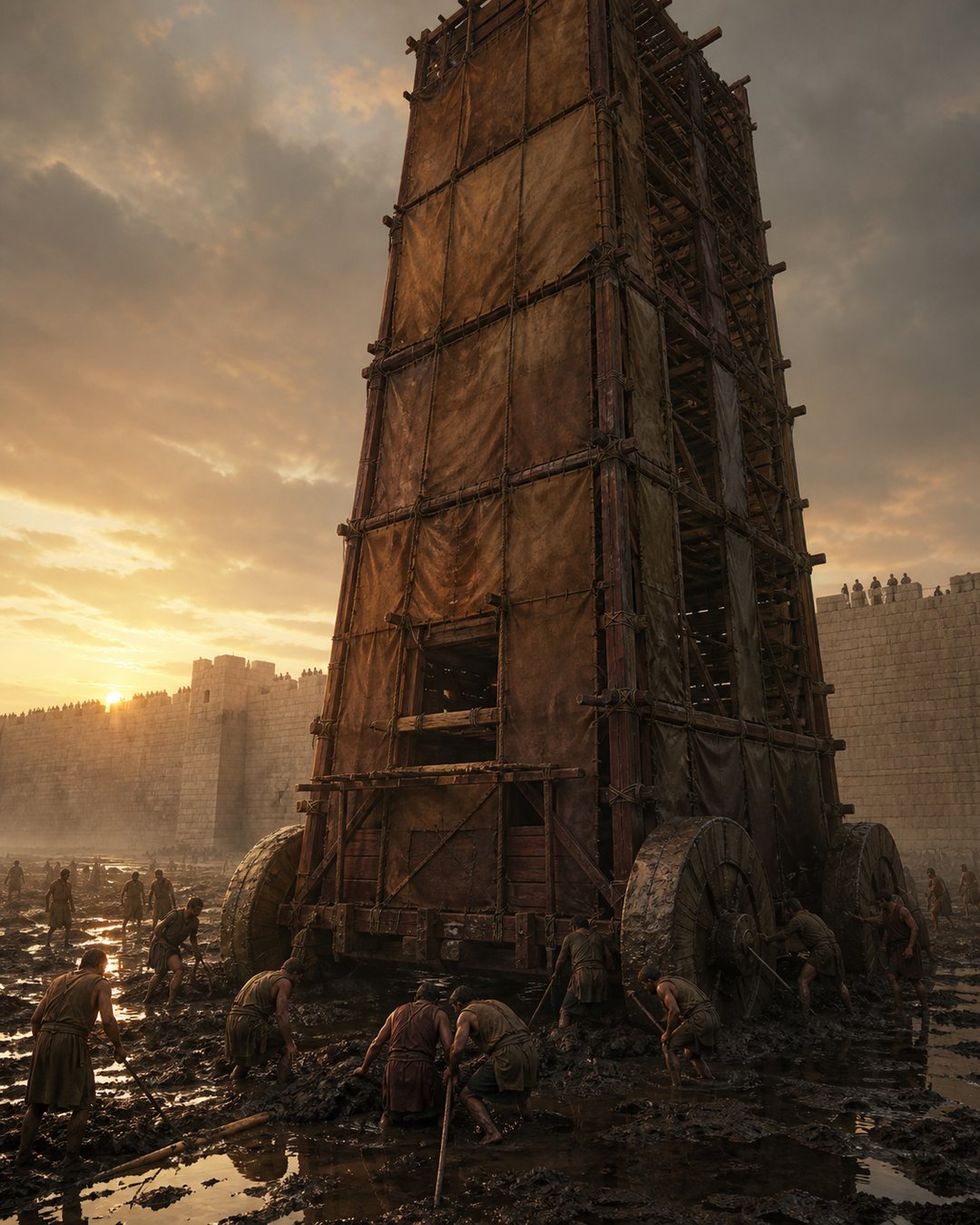
Demetrius Poliorcetes brought Rhodes a siege tower that Vitruvius describes as 135 feet high, 60 feet broad and 360,000 pounds in weight. Hair and rawhide protected its timber frame against a 360-pound stone shot from a ballista. The machine was designed to survive impact, approach the wall and turn mass into access.
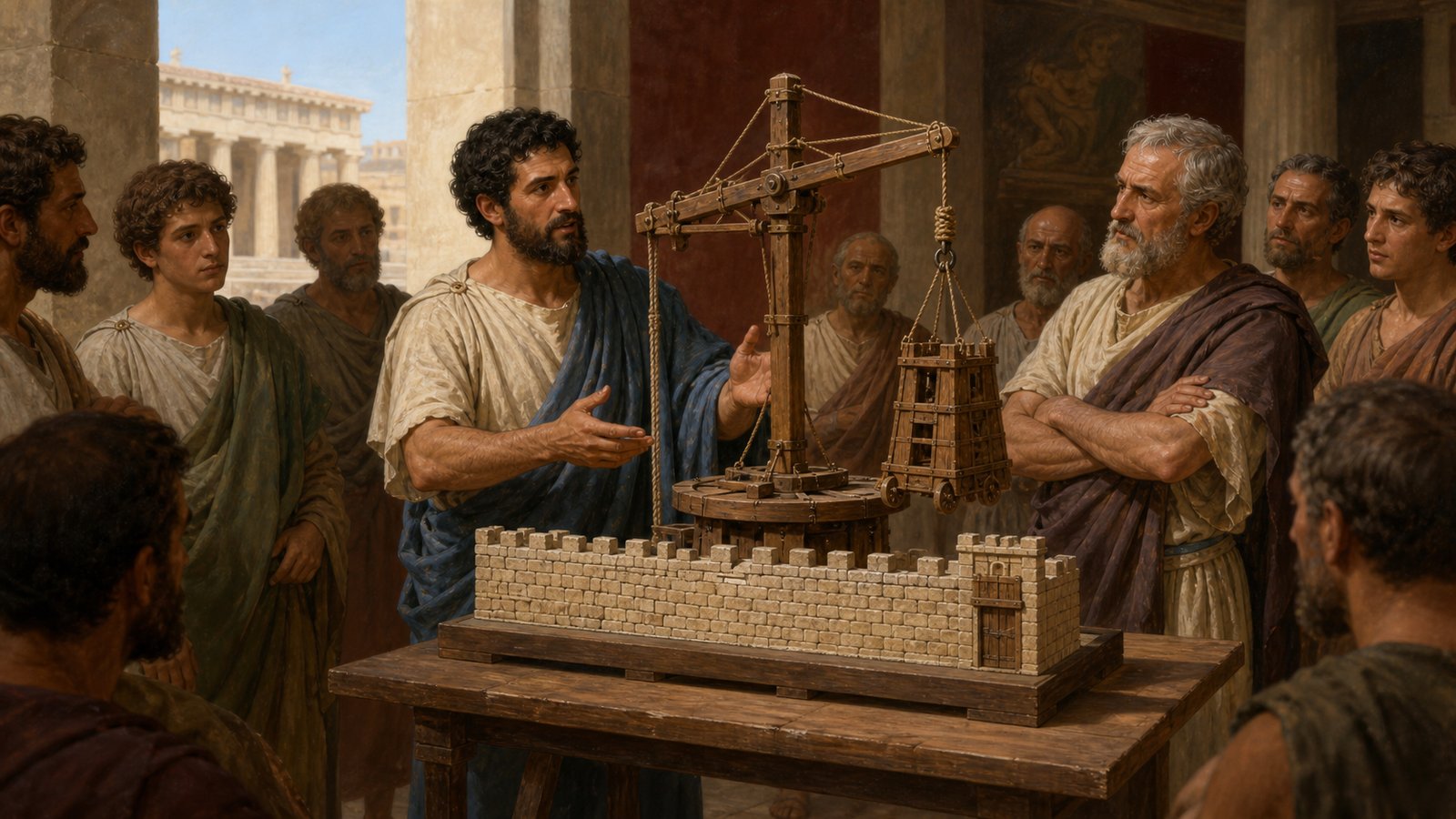
Rhodes had already paid for an answer—or thought it had. Callias of Aradus had displayed a model in which a revolving crane reached over a wall, seized an approaching siege tower and lifted it inside. The demonstration impressed the city so deeply that officials removed the annual honor paid to the local architect Diognetus and transferred it to Callias. When the real tower arrived, Callias admitted that his promise could not be enlarged into a working defense.
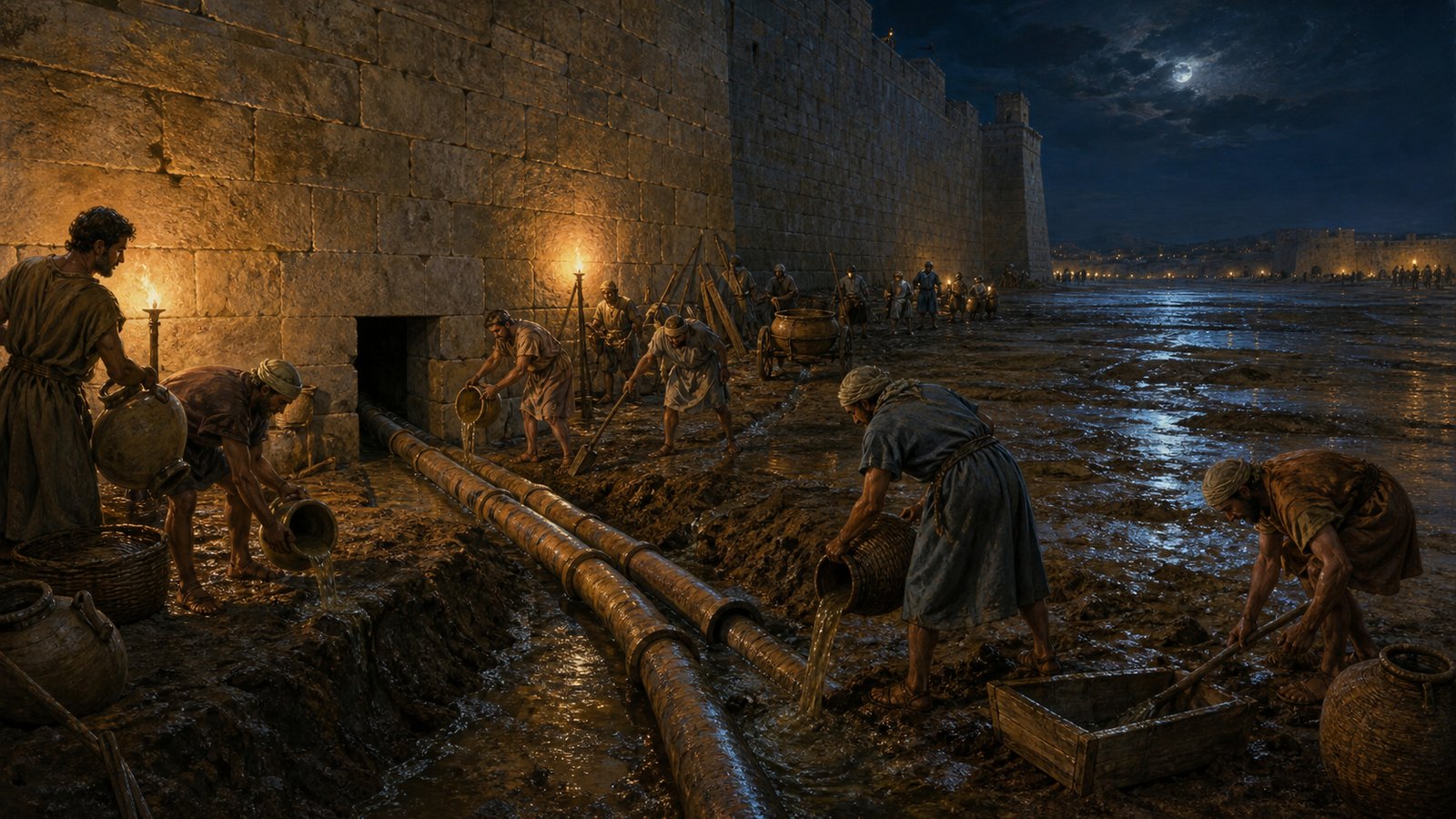
Diognetus did not answer the huge machine with a larger crane. He changed the surface carrying it. During the night, water, excrement and refuse flowed through pipes in the wall and saturated the approach. The next day the helepolis stopped in the swamp before it reached the masonry. It could move neither forward nor backward. In Vitruvius’s account, the tower’s extraordinary weight became the reason a field defeated it.
A Tabletop Victory Replaced the Architect Who Knew the City
Diognetus began the episode inside Rhodian public life, not on a battlefield. The treasury paid him a fixed annual sum as an honor proportioned to his profession. That arrangement recognized architecture as a continuing civic resource. His value did not depend on selling one object; the city retained expertise before a crisis defined what expertise would be needed.
Callias arrived from Aradus with a different kind of authority. He gave a public lecture and showed a model. On it, a miniature wall supported a revolving crane. As a model siege tower approached, the crane caught the machine, raised it and brought it behind the fortification. The sequence was visible, compact and complete. An audience could watch the threat disappear in a few movements.
The Rhodians responded to what the demonstration made easy to judge. Callias had a device, an enemy shape and a satisfying result. Diognetus possessed a title and an existing public payment, but the model offered an apparent proof. Admiration became an administrative decision: the annual grant moved from the resident architect to the visitor.
Vitruvius does not preserve a technical rebuttal from Diognetus at that moment. He lets the city commit itself to the model’s promise. This makes the later siege more than an engineering challenge. Rhodes had to discover that clarity at small scale was not the same as capacity at full scale, and that public confidence could be allocated before the decisive dimensions were known.
The episode differs from Ephesus making an architect’s property answer for his estimate. That rule tried to bind professional confidence to financial consequence. Rhodes instead treated a persuasive demonstration as enough to transfer honor, then learned that the demonstration contained no practical route from model to machine.
The Real Helepolis Turned Enlargement into a Physical Trap
Demetrius’s attack supplied the missing scale. His architect Epimachus built the helepolis at enormous expense and with careful labor. Vitruvius’s measurements are part of the argument: 135 feet vertically, 60 feet across and 360,000 pounds before counting the men and equipment required to operate it. Whatever modern conversions one prefers for Roman measures, the ancient text insists on a structure beyond the neat world of Callias’s model.
The defensive skin added another layer of design. Hair and rawhide strengthened the tower so that it could withstand a ballista stone weighing 360 pounds. The material was chosen around a threat: a heavy projectile striking from the wall. To the attackers, protection meant preserving the timber system long enough for the wheels and crews to close the distance.
Callias was asked to build the crane he had advertised. He said it was impossible. Vitruvius then pauses the story for a lesson in enlargement. An auger can make a hole half an inch, an inch or an inch and a half wide. Asking the same principle to bore a quarter-foot opening becomes impracticable; imagining a half-foot hole by the same method becomes still less credible.
The point is not that models are useless. It is that similarity of appearance does not preserve every force. A crane that lifts a light miniature must carry its own enlarged structure before it touches the enemy tower. Reach, leverage, material strength and supported weight do not increase as conveniently as the audience’s visual impression. The model concealed the burden created by becoming real.
A previous article on Hegetor’s enormous protected battering ram follows ancient writers through weight, wheels, men and shelter. The Rhodian story turns those same advantages against a machine. Once a tower’s mass is committed to a route, the route becomes part of its mechanism whether its builders acknowledge that dependence or not.
Diognetus Designed the Ground Instead of Another Tower
When the attackers approached and enslavement threatened, the Rhodians returned to Diognetus. Vitruvius says they begged him to aid his homeland. At first he refused. Priests then came with free-born young women and men to implore him, and he agreed on one condition: if he captured the enemy machine, it would become his property.
The condition reversed his public humiliation. Callias had received the honor because he promised to bring a tower over the wall. Diognetus would receive the actual tower only if his defense worked. His reward was tied to full-scale performance rather than a miniature result.
He pierced the wall where the machine was expected to approach. The opening was not for a counterweapon. Pipes projected through it. Diognetus ordered water, excrement and refuse gathered from both public and private sources, then discharged outside. The city’s households and civic stores became parts of the plan.
Timing mattered as much as material. The work happened at night, while concealment protected preparation and moisture had time to alter the soil. Water alone softened the route; refuse and excrement made the saturated ground heavier, fouler and less stable. Vitruvius calls the result a swamp. He gives no measured depth or soil profile, so those details should not be invented. The secure outcome is mechanical: the surface no longer carried the tower.
The defense used the wall without waiting for the wall to absorb a blow. Masonry concealed and directed a flow that transformed the open ground beyond it. Pipes, labor, waste, darkness and the predicted line of approach formed a temporary system. No individual component resembled the enemy machine, yet together they acted directly on its wheels and weight.
Diognetus therefore solved a different problem from Callias. Callias asked how to seize a siege tower after it came within reach of a crane. Diognetus asked what the tower required before it could reach anything. The answer was bearing ground. Remove that condition, and the protected height, broad frame and massive construction ceased to be strengths.
An Enemy Monument Finished the Argument About Expertise
On the next day, the helepolis advanced and stopped short of the wall. Vitruvius says it could not move ahead and later could not move backward. The crews had not merely met resistance; the machine had lost the possibility of retreat along the same surface. Its own weight pressed the transport system into the engineered mud.
Demetrius recognized the failure and withdrew with his fleet. Vitruvius compresses the larger war into this result because the anecdote serves the final chapter of his book on machines. He is not writing a complete history of the siege. He is choosing an episode that makes adaptable judgment superior to mechanical catalogues.
The captured tower completed the reversal. Diognetus brought it into the city, displayed it publicly and attached a dedication identifying it as a gift taken from the enemy for the Rhodian people. The object that Callias could not lift over the wall entered Rhodes only after Diognetus had made it useless outside.
Public display also corrected public memory. The earlier lecture had made Callias’s model the most convincing object in the room. Now citizens could stand before the full-size machine and compare promise with outcome. Diognetus’s defense left behind evidence whose scale could not be mistaken.
Vitruvius closes by saying that defense requires wise plans above machines. His story supports that claim through more than cleverness. Diognetus integrated local ground, available materials, civic labor, secrecy, timing and enemy mass. He did not reject engineering for improvisation; he expanded engineering until the battlefield itself became the device.
The unpleasantness of the material was part of its usefulness. Water and city waste were cheap beside a 360,000-pound tower, already present behind the walls and difficult for an attacker to interpret before the advance. Prestige had attached itself first to polished miniature machinery. Survival depended on someone willing to see drainage, mud and refuse as a precise answer to weight.
Rhodes won Vitruvius’s lesson when it stopped trying to match spectacle with spectacle. The tallest structure in the story never touched the wall. Its armor still resisted stones, its frame still rose above the field and its builders’ labor remained inside it. But a machine designed around blows had no defense against the disappearance of firm ground.
Sources
Vitruvius, On Architecture, 10.16.