
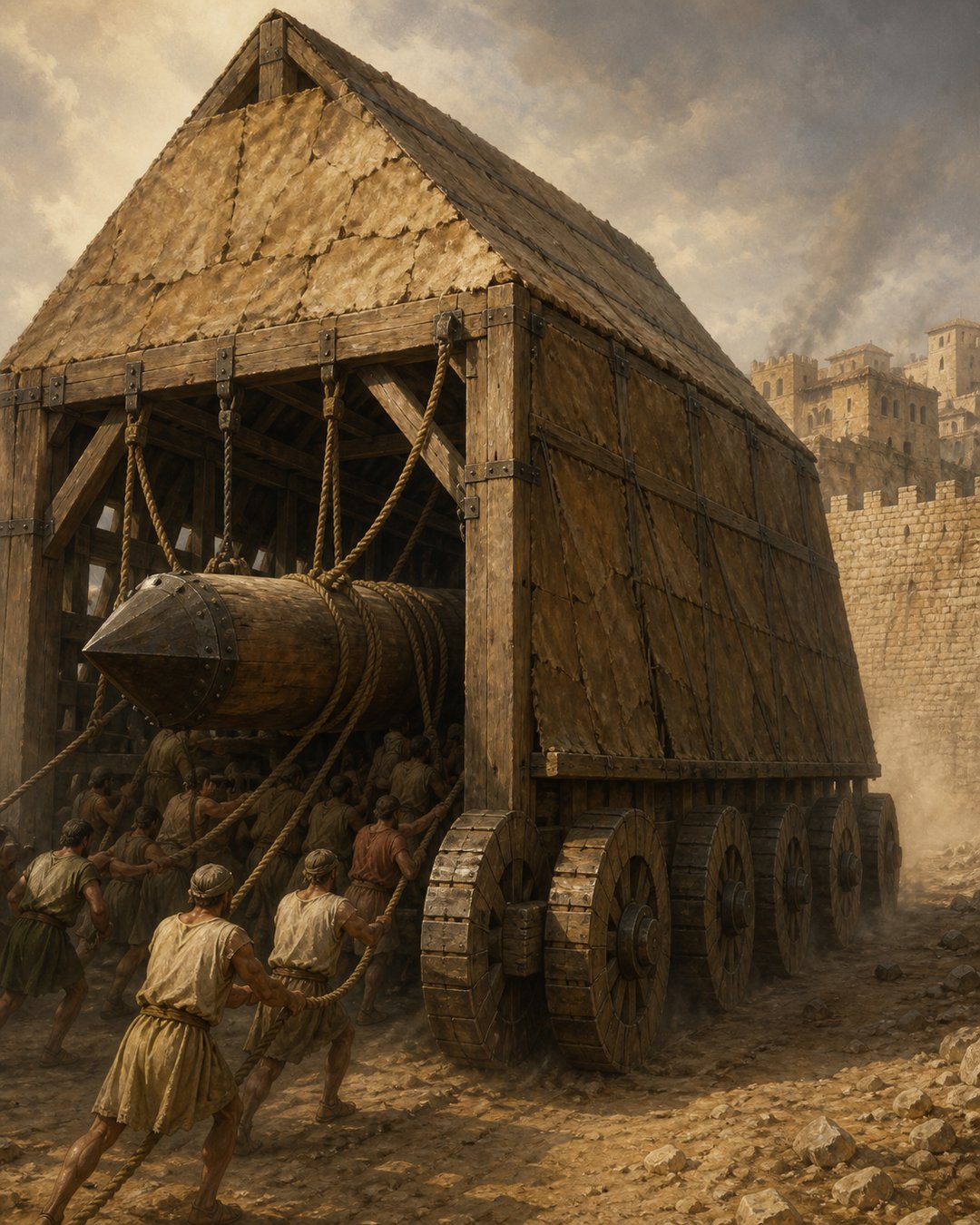
One hundred men stood between four thousand talents of siege machinery and a city wall. Vitruvius says the immense tortoise attributed to Hegetor of Byzantium could roll forward, shift right or left, raise its ram and lower it. Its iron beak did not hang from a simple shed. It worked inside a timber building that moved.
Eight wheels carried the base. Hides and hair-tempered clay guarded the roof against fire. Scorpions and catapults occupied a middle floor, while two observers watched from a protected turret over the ram crew. Axles, ropes and chains held the striking beam so its mass could be aimed rather than merely dragged.
The surviving dimensions are not perfectly stable between translations, and the stated total weight invites caution. Yet the chapter preserves something more useful than a clean reconstruction drawing. It shows how an ancient writer imagined control at extraordinary scale: not through one clever component, but through many specialized layers made to cooperate.
The tortoise was armor before it was a weapon
Vitruvius begins with the outer shell. Board parapets and battlements surrounded the machine. Sloping eaves carried firmly fastened boards and hides, and a coat of clay kneaded with hair was spread above them thickly enough, he says, to prevent fire from injuring the structure.
That covering answered the defender’s easiest reply to a mass of dry timber. A ram approaching a wall invited burning missiles from above. The layered roof did not make the crew invulnerable, but it put sacrificial material between falling fire and the ropes, joinery, men and engines underneath.
He also describes excavating tortoises with triangular fronts. Missiles striking those angled faces would glance aside rather than land squarely on a flat surface. The principle is consistent: survival depended on controlling how force reached the shell before the machine could deliver force of its own.
The enormous Hegetor design belonged to that protected family. Its frame was not wasted bulk around the ram. It created a working enclosure in which crews could move, observe and operate under threat. The weapon’s first task was therefore to keep its own vulnerable system alive long enough to touch the wall.
Eight composite wheels turned a frame into a vehicle
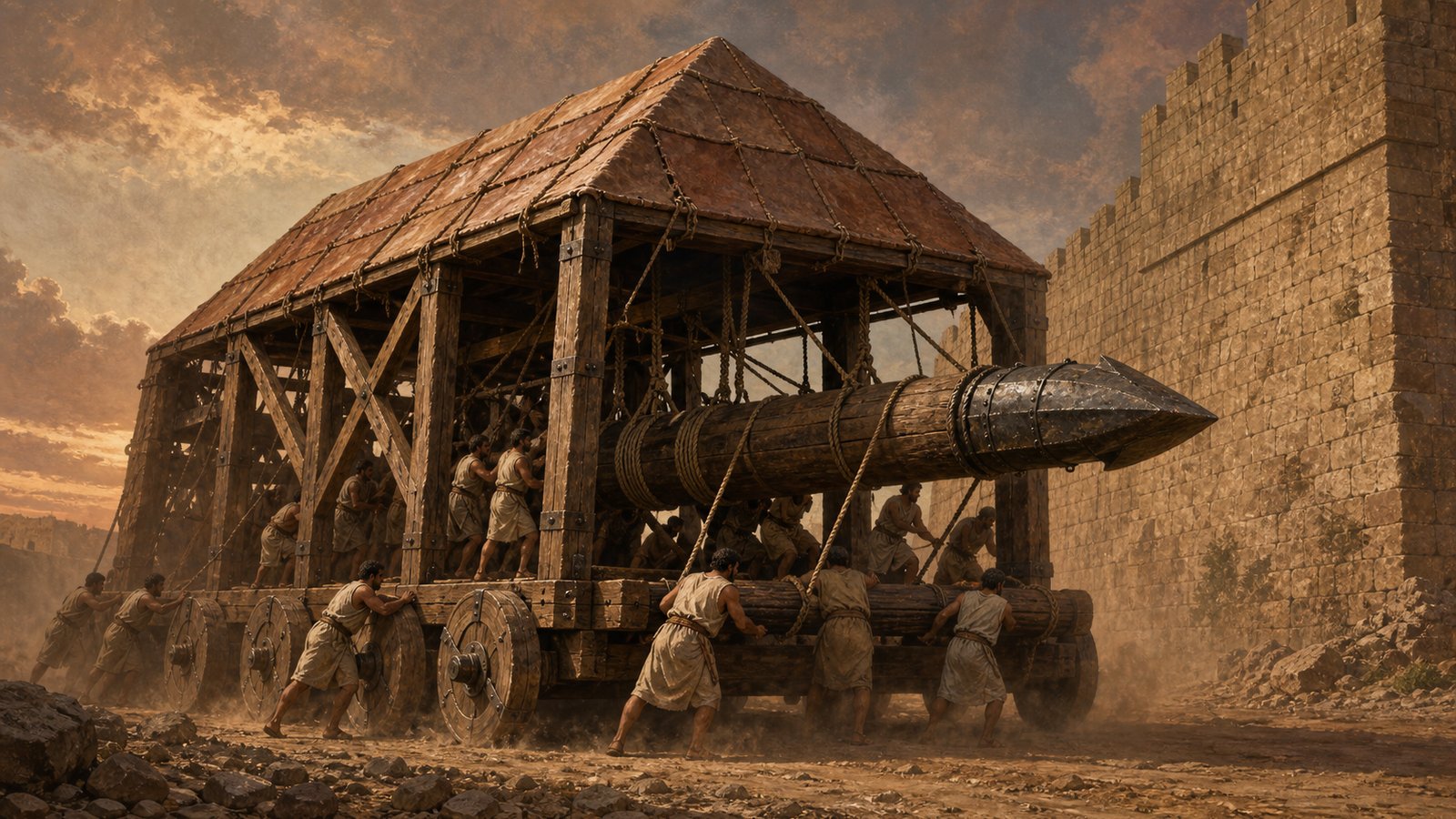
Vitruvius assigns eight wheels to the base. Morgan’s translation makes each wheel six and three-quarter feet high and three feet thick. Three pieces of timber were joined with alternating dovetails and bound with cold-worked iron plates. Even before the superstructure rose, mobility required substantial carpentry and metal reinforcement.
The base dimensions differ sharply between English versions. Morgan gives sixty-three feet by forty-two; Gwilt gives sixty by eighteen. The discrepancy is a warning against presenting one modern outline as certain. Both versions agree on the machine’s exceptional scale, its eight wheels and its dense framework, but not on every number carried through the text.
Above the base, paired corner posts rose thirty-six feet in Morgan’s account. More uprights, crossbeams, rafters, bridging and floors tied the body together. These members had to keep their relationships while the wheels crossed imperfect ground. A static tower can push continuously into its foundations; a moving one has to endure changing loads with every turn.
Vitruvius notes that wheel arrangements could be modified for the nature of the site. That small qualification matters. Siege machines existed in terrain, not only in diagrams. Slope, firmness and access decided whether a giant frame could approach at all. The archive’s Roman crane likewise made power depend on a carefully organized timber frame, but Hegetor’s machine had to carry its frame toward hostile masonry.
A second floor brought missiles inside the ram
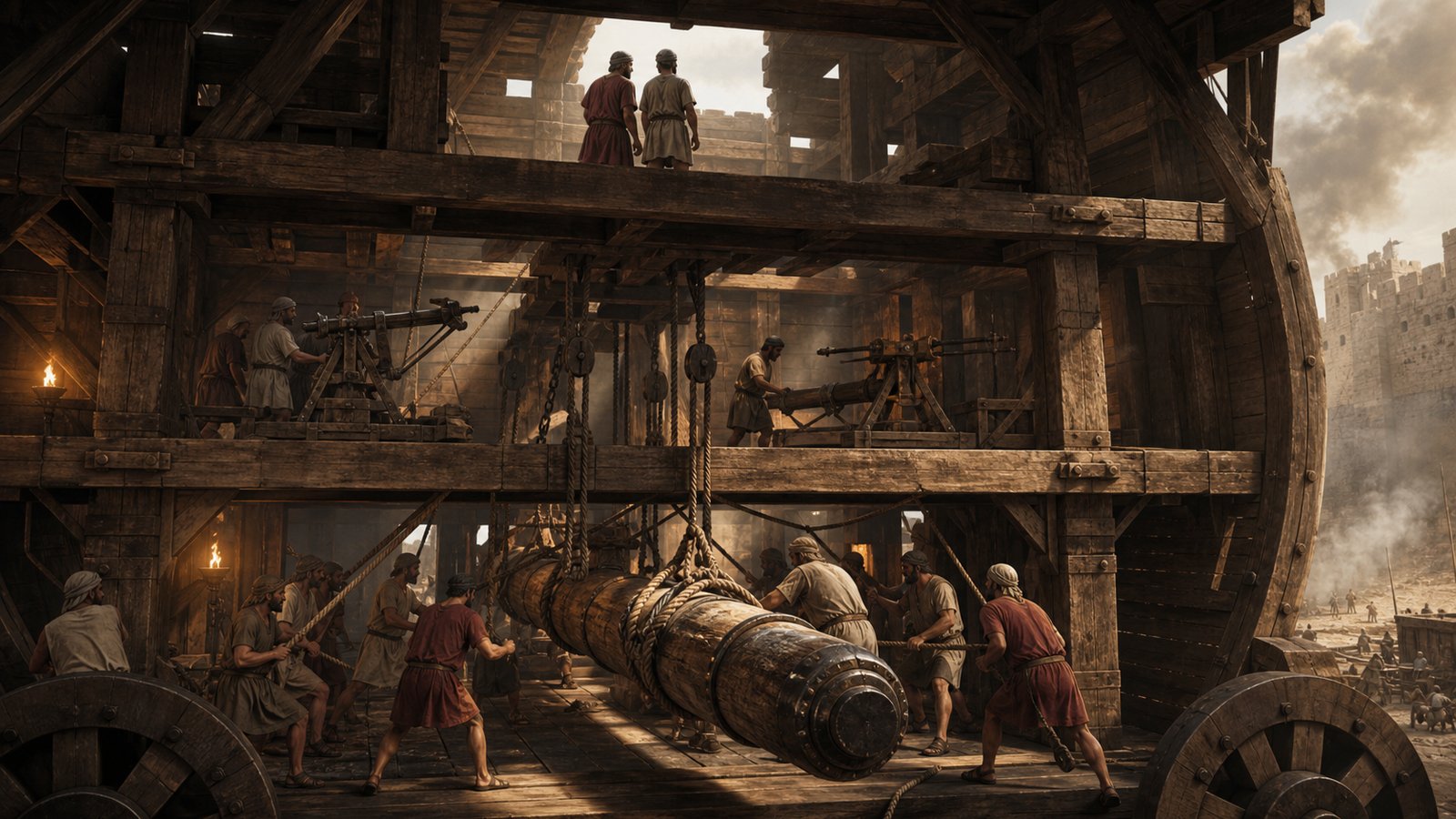
The ram did not consume every interior level. Vitruvius puts scorpions and catapults on a middle floor. Their presence turned the tortoise into a combined platform. While the main beam threatened masonry, projectile engines could answer defenders or suppress positions above the point of impact.
This arrangement multiplied demands on the structure. Artillery needed room, stable support and crews. The ram needed clearance to swing or thrust. Drivers and operators needed routes through the frame. None of those jobs could be allowed to cut the ropes or block the sightlines required by another.
Above the ram crew, a small turret sheltered two soldiers. Their role was to look out and report what the enemy was attempting. The detail places information inside the mechanism. Men working ropes below could not safely expose themselves each time they needed to know where danger or resistance was developing.
Observation therefore became a protected specialty. Two people did not move the beam or extinguish fire; they supplied decisions to those who did. A machine with one hundred operators needed this division of attention. Raw strength without current information could send the next movement toward the wrong point.
Ropes and axles made the long beam aimable
Two framed uprights and their crossbeams held a block fitted with turned axles. Ropes fastened to those axles suspended the ram. The beam could then be controlled within the frame instead of resting as dead weight on the ground.
Its reported length is another unstable figure. Morgan gives one hundred eighty feet; Gwilt gives one hundred six. It would be false precision to choose silently between them. The shared picture is still remarkable: a very long timber tapered toward an iron head and hung from a supporting system built to redirect its movement.
The head carried a hard iron beak like that of a warship. Four iron members, about fifteen feet long, fastened the metal head back along the wood. Long cables ran from head to heel, bound across the beam, and rawhide wrapped the assembly. Iron chains at the suspension ends received their own rawhide covering.
Every layer answered a different failure. The beak concentrated impact. Long iron plates transferred force into timber. Cables helped the beam act together along its length. Hide protected exposed reinforcement. Suspension converted an almost unmanageable object into a mass that a coordinated crew could set in motion.
Vitruvius also describes a projecting walkway fitted with a rough rope net so feet would not slip on the approach to the wall. It is a modest detail beside a four-thousand-talent total, but it reveals the same design logic. A machine fails if its people cannot cross it safely, however impressive the headline dimensions look.
Six directions turned size into controlled reach
Vitruvius says the machine moved in six directions: forward and backward, to the right and left, upward and downward. The wording joins the movement of the vehicle to the aiming range of the suspended beam. The whole frame approached; the ram then shifted within its support.
He claims it could reach a wall about one hundred feet high and sweep not less than one hundred feet from side to side. Those statements belong to an ancient technical description, not a surviving field test. They nevertheless define the ambition of the design. The ram was meant to attack more than one fixed point after laborious placement.
At the end comes the most arresting ratio: one hundred men controlling four thousand talents, glossed in the translations as 480,000 pounds. The figure should not be converted into confidence about every component. It works better as Vitruvius’s summary of scale. A huge load became usable only when wheels, frame, suspension, lookout and crews divided the problem.
The same vulnerability appears from the defender’s side in the floating siege tower broken by a ten-talent stone. Enormous machinery concentrated resources and ingenuity, but it also concentrated risk. One failed support, one fire or one well-placed projectile could undo the coordination that gave the system power.
Hegetor’s tortoise survives as a description of organized motion. Its iron beak gets the dramatic role, yet the beak could do nothing by itself. Carpenters shaped the frame and composite wheels; smiths supplied plates, chains and the head; rope makers created suspension and reinforcement; observers interpreted the wall; operators translated reports into pull and release. The machine’s real achievement was to make all those actions arrive together at one patch of stone.
Sources
Vitruvius, On Architecture, 10.15.