
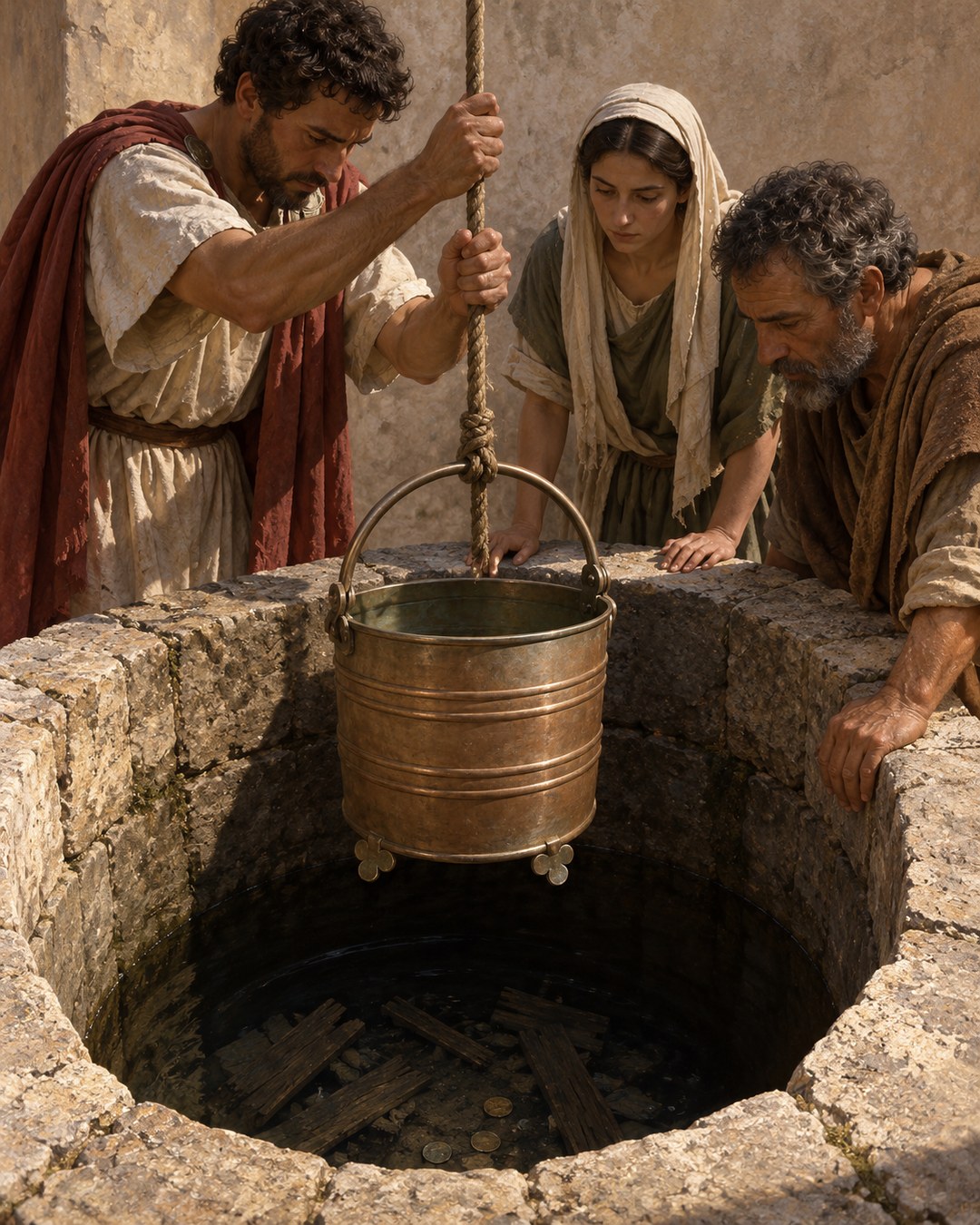
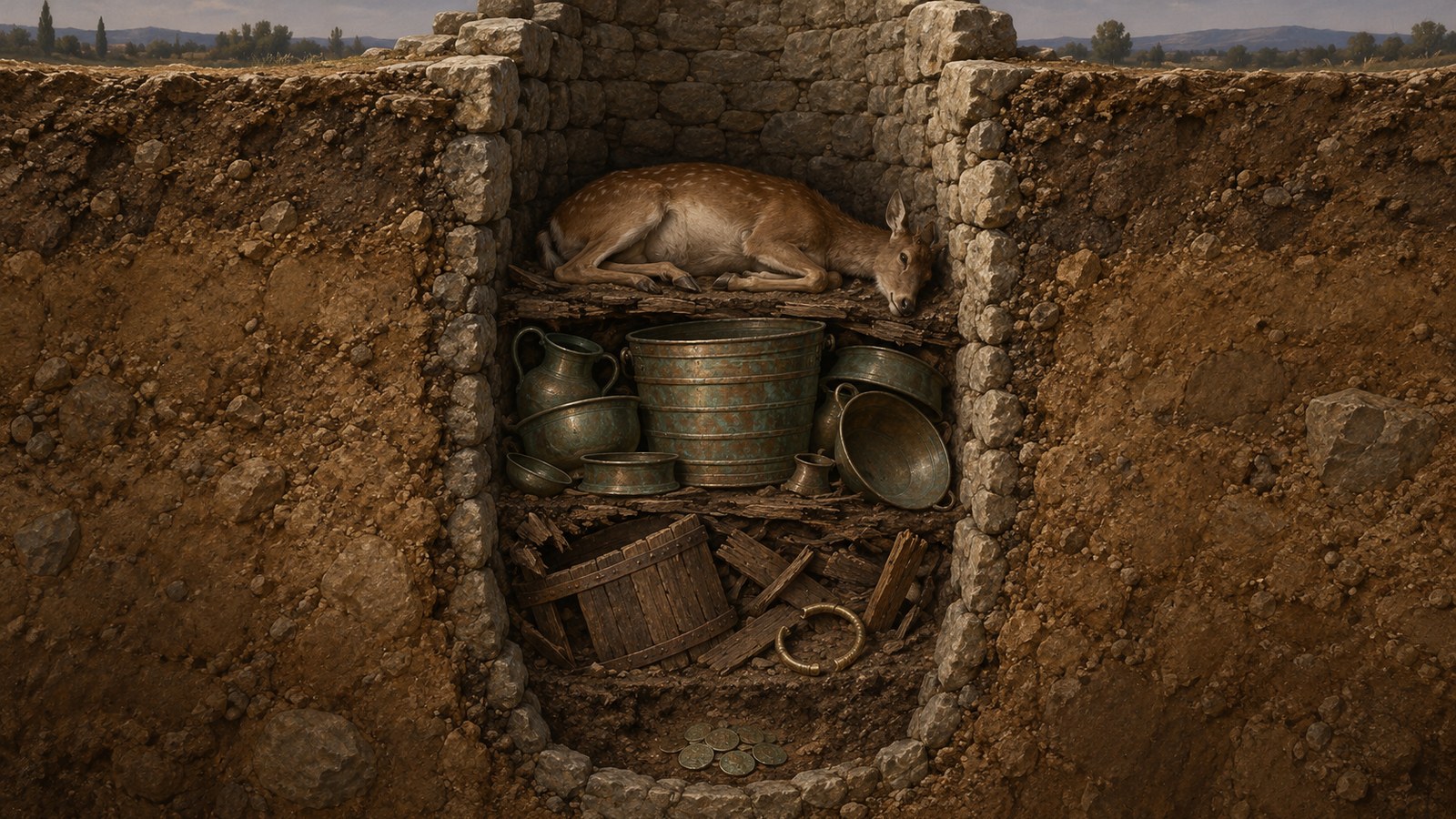
The objects did not enter the Roman well at Drapers’ Gardens as a random collapse. Coins went in first. Broken pieces of the well’s own bucket followed. A woman’s bracelet was deliberately broken and dropped after them. Above that sequence, people stacked 20 high-quality vessels and utensils. A young deer carcass completed the deposit.
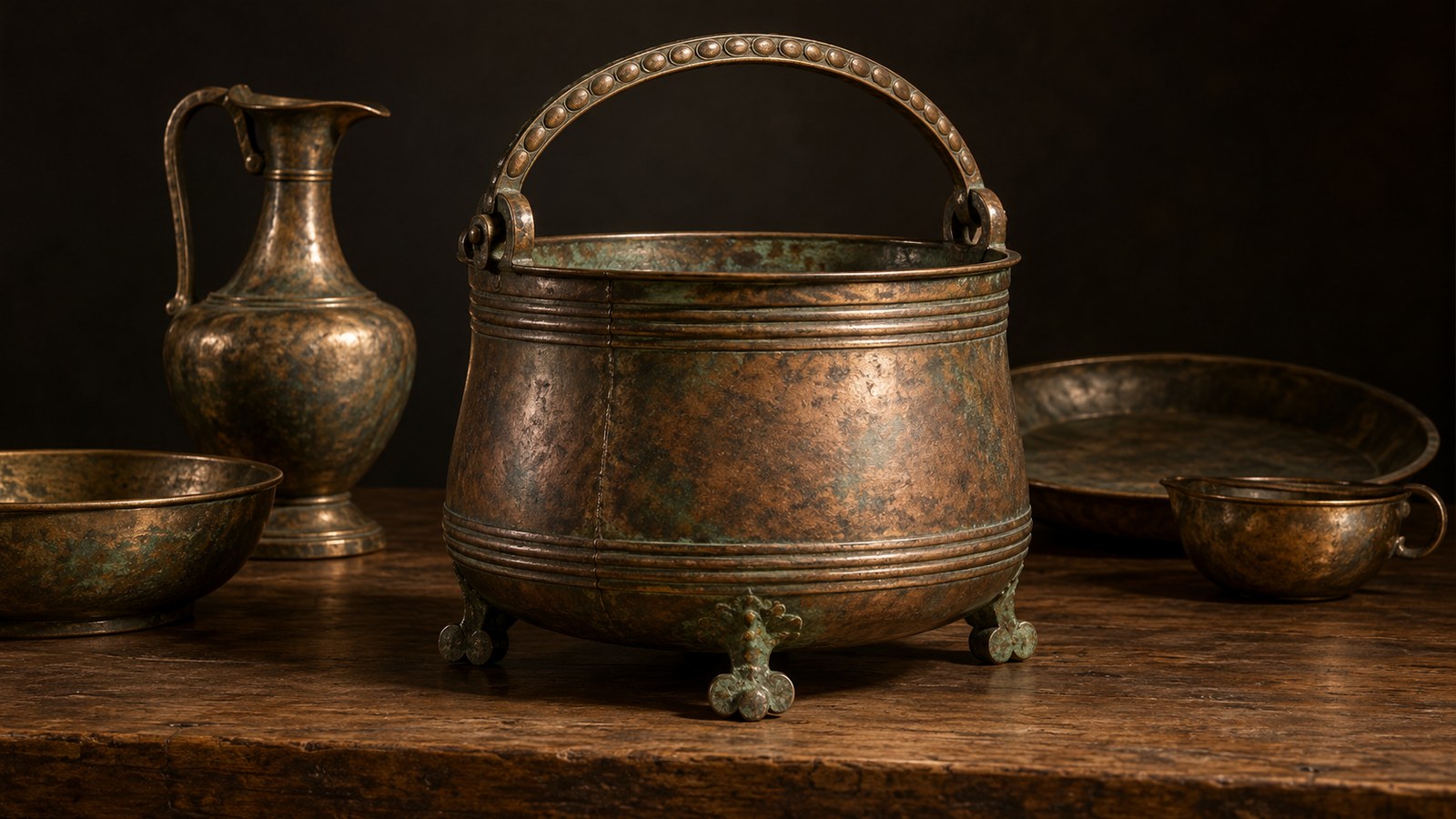
Among the vessels was a copper-alloy wine bucket, 263 millimetres high at its lugs, 290 millimetres across and weighing 2,532 grams. Its ribs, handle fittings, welding line and trefoil feet still describe an object intended to stand, carry and serve. In the late fourth or early fifth century, however, the bucket became part of a different construction: a layered closure inside a well.
The bucket still shows how it was assembled
The vessel’s surface is not mute. Parallel horizontal moulded ribs run around the top and bottom. Near the lower ribs, a welding line shows where the upper part was joined to the lower part. Two rounded lugs on the rim held the handle, and the handle itself carried moulded ovolos. Three trefoil-shaped feet supported the base.
Each feature belongs to a different demand. The join made separate sections into one container. The lugs transferred the load to a moving handle. The feet lifted and steadied the rounded metal body. Decoration followed those practical zones instead of hiding them: ribs marked the upper and lower bands, ovolos animated the handle, and trefoils turned contact with the floor into a repeated form.
The welding line is especially valuable because it interrupts the illusion that a finished vessel emerged whole. It preserves an assembly boundary. The rounded lugs preserve another: bucket and handle had to meet at two load-bearing points. At the base, three attached feet created a stable triangle. The record therefore lets the eye move from manufacture to handling to standing without leaving the physical object.
Three feet also solve a small geometric problem. On an uneven surface, three contact points can define one plane without a fourth foot rocking against it. The catalogue does not claim that Roman makers expressed the problem in those terms, but it does record three trefoil-shaped attachments. Their repeated shape made the engineering decision decorative rather than invisible.
The result was substantial but portable. A mass of 2,532 grams is more than an ornamental shell, while a diameter of 290 millimetres leaves room for serving. The record calls it a wine bucket. Before it went below ground, it belonged to tableware whose form made pouring, carrying and display visible in the same object.
A foreign parallel widens the vessel’s route
The London bucket has a close parallel far from Britain: a similar vessel was found in a fifth-century grave in Nubia, Africa. On that basis, the museum says the Drapers’ Gardens example may have been made in the eastern Mediterranean. “May” matters. The parallel suggests a route and a manufacturing region; it does not prove an individual journey step by step.
Even with that caution, the comparison changes the object’s horizon. A vessel found in a City of London well belongs to a form known from Nubia. Its possible eastern Mediterranean origin makes the bucket part of a material geography larger than the well that finally held it. Roman transport repeatedly made containers carry evidence of routes as well as contents. The pointed jars discussed in the pepper route from Nelcynda solved a different transport problem, but the principle is related: vessel form travelled with the goods and practices it served.
The Nubian parallel is dated to the fifth century, which overlaps the broad end of the London deposit’s horizon. Similarity across those distant contexts does not prove that the two buckets shared an owner, cargo or exact workshop. It does show why the London object is described as unusual for Britain. Its form belongs to a comparison that reaches far beyond an ordinary local well bucket.
Here the route ends in a deliberately arranged deposit. The bucket’s possible long-distance origin did not protect it from removal from circulation. On the contrary, a high-quality and unusual object may have made the assembled set more materially emphatic when the well was closed.
Twenty vessels became one deposit
The wine bucket was not alone. It belonged to a hoard of 20 high-quality vessels and utensils. Coins found with the group place its deposition between AD 375 and the early 400s. The museum describes this as a period when Roman London was declining and gradually being abandoned.
A hoard can tempt a modern reader to imagine hurried concealment, but the order inside this well points in another direction. Coins formed the first layer. Pieces of the ordinary well bucket came next. Then a bracelet was deliberately broken and dropped. The vessels were stacked above those materials rather than scattered through the shaft. Finally, part of a young deer’s carcass was added.
That vertical order is evidence because gravity preserved sequence. The deposit can be read from lower to upper actions. It does not reveal every spoken intention, but it makes a single accidental fall increasingly difficult to sustain. Coins, broken equipment, personal ornament, stacked tableware and animal remains formed stages.
The contrast between broken and intact forms sharpens those stages. Pieces of the well’s working bucket represented equipment already tied to the shaft. The bracelet was deliberately broken before deposition. The high-quality vessels, by contrast, were stacked as a group. The young deer came after them. Different treatments were therefore assigned to different materials within one downward sequence.
Dating comes from coins found with the hoard, not from an exact date stamped on the bucket. The range between AD 375 and the early 400s should remain a range. It anchors the action in late Roman London while leaving open how long the wine bucket had circulated before entering the well.
Closing the well changed the meaning of the feast
The museum interprets the assemblage as a likely ritual deposition, perhaps intended to close the well and bring good luck to the owners before they left London. It also suggests that the vessels may have been used in a final feast before deposition. Both points are interpretations grounded in the layered evidence, not direct transcripts of the event.
That distinction keeps the scene vivid without making it falsely certain. The bucket can be shown as tableware because its form and name support that role. The set can be described as stacked because the excavation recorded it. The bracelet can be called deliberately broken because the record says so. A final feast and a luck-bringing closure remain plausible readings offered by the museum.
There is a useful contrast with the silver table set hidden for eight diners at Pompeii. One assemblage was stored in a chest and preserved by disaster; the Drapers’ Gardens set was arranged in a well through human action. Both preserve tableware as a group, but the grouping mechanisms are different. One arrests preparation. The other appears to conclude use.
The wine bucket therefore carries two endings. It ended its service as a vessel, and it helped mark the end of a place’s service as a well. Its ribs, feet and handle still speak of the table. Its archaeological position speaks of closure. The object becomes most legible when neither life is allowed to erase the other.
The bucket’s measurements make that final movement tangible. Lowering a vessel 290 millimetres across and more than 2.5 kilograms before any contents required intention and control. Stacking it with nineteen other vessels required space and order. The archaeological story is powerful not because the well swallowed an isolated treasure, but because many separately made things were reorganised into one final deposit.
Sources
London Museum, “Wine bucket” collection record.