
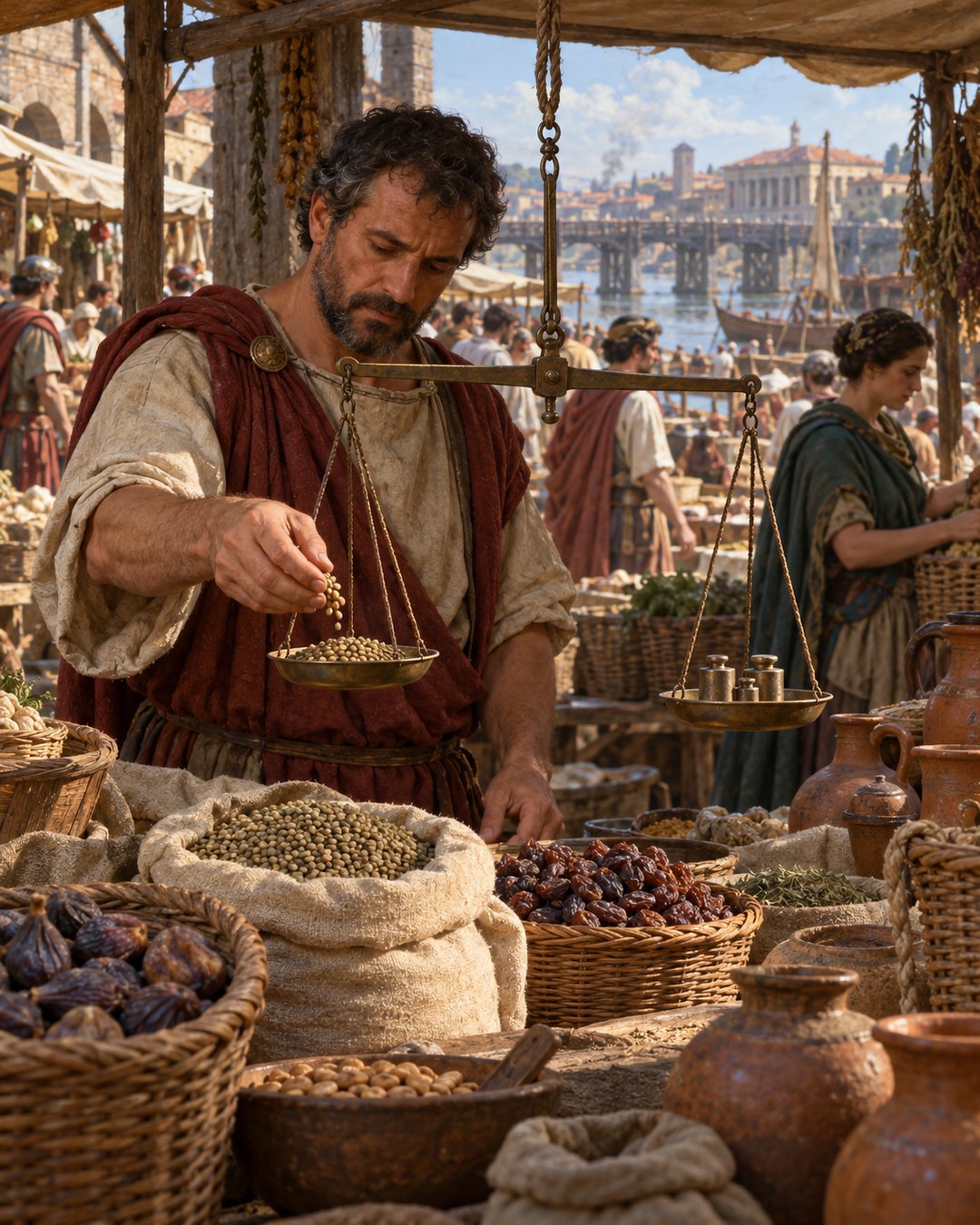
A copper-alloy pan in the London Museum is only 90 millimetres across and 25 millimetres high, but its catalogue gives it an unusually wide field of work. A precise scale could measure ingredients for medicine and make-up in a home, dyes for textile production, or food in a marketplace. The pan belonged to a system in which a quantity had to mean the same thing to people who were doing very different jobs.
The object is not the whole scale. It is the shallow container that received whatever was being weighed. Yet that limited role is exactly what makes it useful evidence. A standard can be proclaimed in law or stamped on a weight, but it becomes real only when material is placed in a pan and a balance is allowed to settle.
The pan turned loose material into a comparable quantity
Powder, pigment, dried ingredients, and pieces of food do not naturally present a neat surface for measurement. They scatter, roll, stain, and vary in shape. A scale pan gathers them into one side of a comparison. Its shallow 90-millimetre bowl defines where the material belongs while the beam compares its load with known weight on the other side.
The museum records the pan as copper alloy and gives its overall height as 25 millimetres. Those dimensions describe a vessel intended for relatively modest quantities, not a container for bulk cargo. Its usefulness lay in controlled portions. A medicine ingredient might be potent in a small amount. A dye mixture could depend on proportion. A market sale needed an agreed quantity before price could be trusted.
Nothing about the pan can guarantee honesty by itself. A balance might be badly made, a weight false, or an operator deceptive. What the pan did was provide a repeatable physical position in which comparison could occur. It made a disputed quantity visible as an action: add material, observe the beam, remove or add more, and stop when balance is reached.
That repeated action joined the object to a larger system. The museum says uniform weights and measures were essential in Roman London. Uniformity did not mean that every task used the same amount. It meant that the relationships among weights could be recognised across transactions and preparations.
One measuring principle crossed the home, workshop, and market
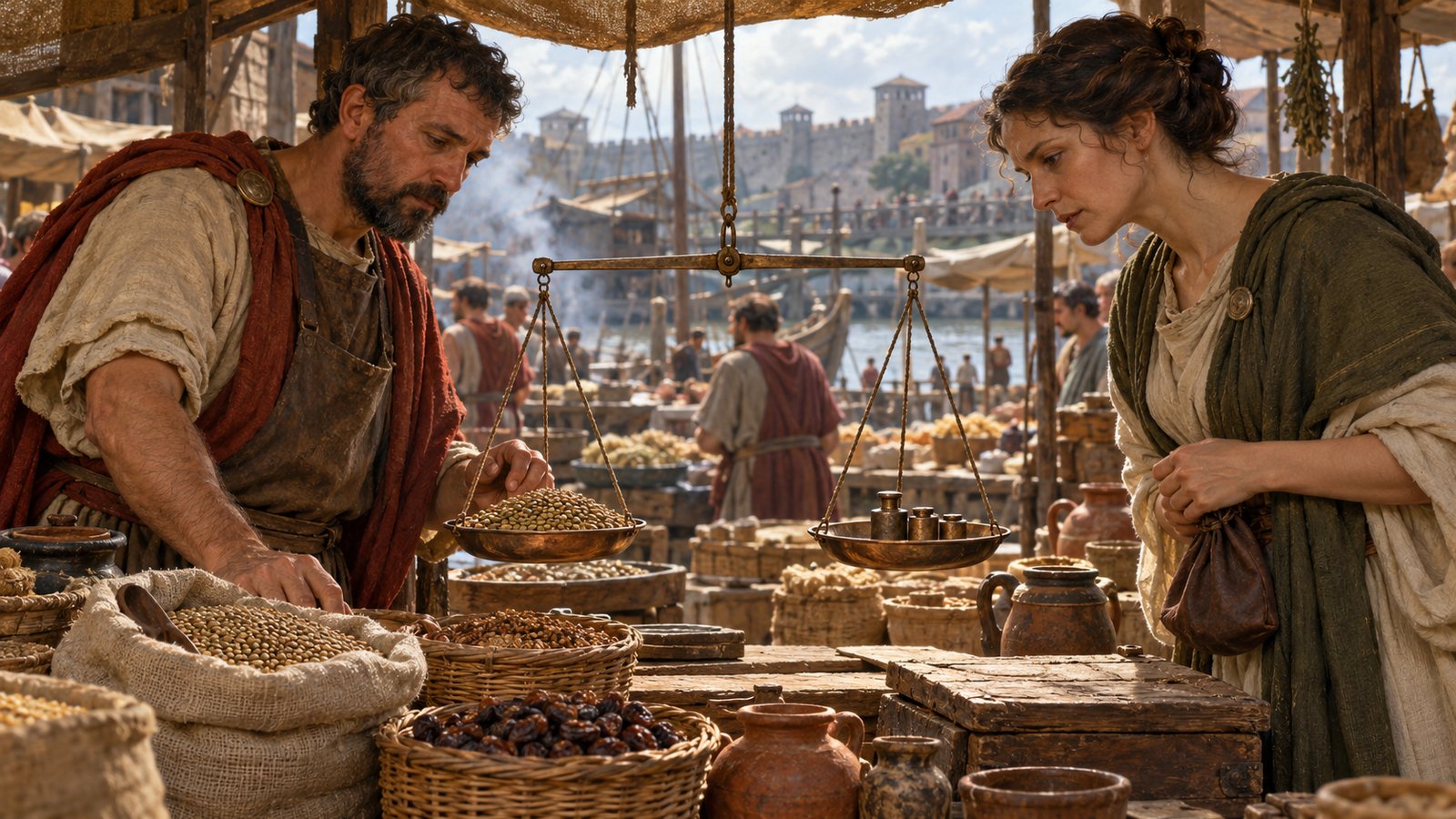
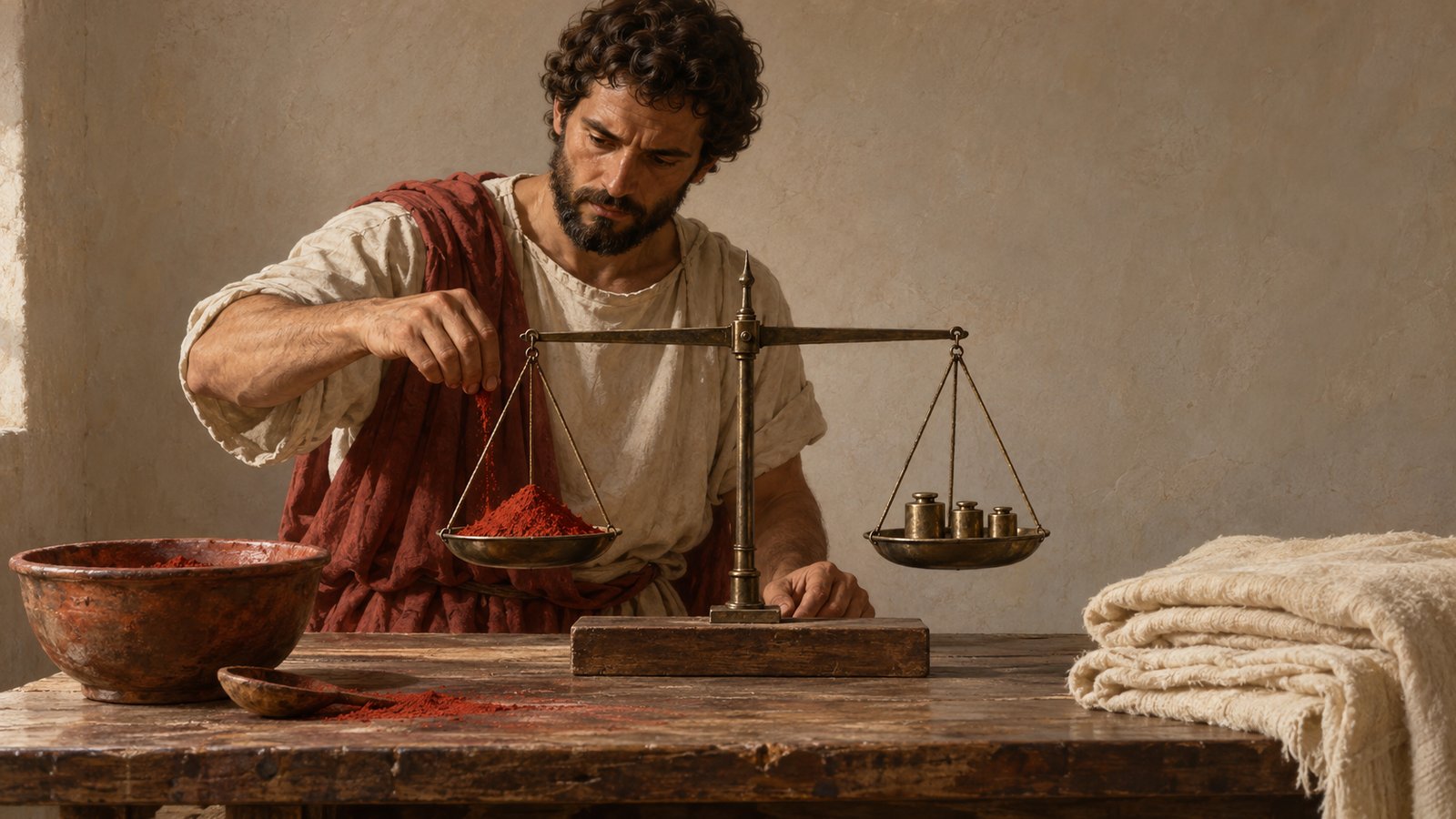
The catalogue’s examples move through three settings. In the home, scales could help prepare medicines and make-up. In textile manufacture, they could measure dyes. In the marketplace, they could weigh food. The substances changed, but the mechanism did not. Each was placed in a pan and compared against a weight through a beam.
This shared mechanism mattered because these activities demanded different kinds of confidence. Medicine asked whether an ingredient was present in the intended proportion. Cosmetics asked whether a mixture could be repeated. Textile dyeing linked measured material to colour and production. Food sales connected quantity to money and public exchange.
The scale pan thus sat between knowledge and trust. The person preparing a mixture needed confidence in the recipe. The customer needed confidence in the sale. A workshop needed enough consistency to turn the same process into a recognisable result. Measurement did not erase skill, but it gave skill a countable framework.
A Lost Eagles article on Roman steelyards follows a different balance design, using a moving weight along an arm. This small pan belongs to the equal-arm tradition rather than that sliding-counterweight mechanism. Comparing them shows that Roman weighing was not one object repeated at every scale. Different devices solved the same central problem: converting an unknown load into a relation with a known standard.
Precision depended on the whole chain, not the bowl alone
The museum calls precise scales necessary for all these purposes. Precision was a property of the assembled practice. The pan had to hold the material without losing it. Its suspension had to let it move freely. The beam had to respond. The comparison weight had to be trusted. The operator had to recognise equilibrium.
This chain makes the surviving pan both important and incomplete. Its 90-millimetre diameter tells us the space available for a load. Its 25-millimetre height shows how shallow that space was. Copper alloy gave it a durable formed body. But the pan cannot reveal the exact beam, cords, weights, or substances used with it in a particular transaction.
That boundary is useful. It prevents a museum object from becoming an invented shop scene. The record offers no named owner, maker, or related event. It dates the piece broadly as Roman. The strongest story therefore comes from the functions the catalogue actually identifies and the mechanics visible in the object type.
The same caution applies to the word “precise.” Precision need not imply modern laboratory decimals. It means that the differences being measured mattered enough to require a responsive instrument and recognised weights. A pan built for comparison offered more control than guessing by sight or by the handful.
The market made standards a public relationship
Food weighing placed the instrument where buyer and seller could both care about the result. The contents of the pan represented one side of a bargain. The standard weight represented the agreed quantity. The beam’s position connected them.
This did not make conflict impossible. It gave conflict an object. A customer could look at the load and the balance rather than rely entirely on a seller’s estimate. An official system of weights and measures could inspect the standards used in such exchanges. The pan was where policy met beans, spice, meat, or another saleable substance.
Another Lost Eagles article on a tariff that priced traffic through Palmyra shows regulation working through written charges. The London pan reveals regulation at a smaller physical scale. Before a price could apply to an amount, the amount had to be produced as something measurable.
The domestic examples broaden that relationship. Medicine and make-up may have been prepared away from a market stall, but their ingredients still depended on proportion. Dye workers likewise converted quantities into colour. A uniform system allowed the same family of weights to travel among settings even when the purpose changed.
A small surviving part reveals a large measuring culture
It is tempting to treat a detached pan as a fragment too ordinary to carry a story. In fact, its ordinariness is the story. Measurement had to happen repeatedly, in kitchens, workshops, treatment spaces, and markets. The pan was a working surface for that repetition.
Its form kept unlike materials inside the same comparison. A pigment and a foodstuff had little in common as substances, but each could become a load. Once placed in the pan, it could be balanced against a recognised weight. That transformation made a standard portable across occupations.
The object also clarifies why uniformity required material equipment. A decree cannot weigh anything. A unit name cannot hold powder. People needed pans, beams, suspensions, and physical weights whose relations made the system operable. Each transaction or preparation recreated the standard in motion.
The museum assigns the record 80 per cent quality and leaves the maker, related people, and findspot unspecified. Those omissions rule out a personal biography. They do not diminish the secure facts: a Roman copper-alloy scale pan, 90 millimetres in diameter and 25 millimetres high, tied by the catalogue to precise weighing across medicine, cosmetics, textile dyeing, and food sales.
That range is the object’s deepest significance. The pan did not belong conceptually to only one trade. It was a shared interface between material and number. Whether the load was a remedy ingredient, cosmetic powder, dye, or food, the procedure asked the same question: how much is here compared with a known amount?
The answer appeared when the balance settled. For a moment, a shallow copper-alloy bowl made a household recipe, a workshop process, or a market bargain commensurable with the wider Roman system. Ninety millimetres of metal carried the practical burden of making quantity public.
Sources
London Museum, “Balance, scale pan” collection record.