
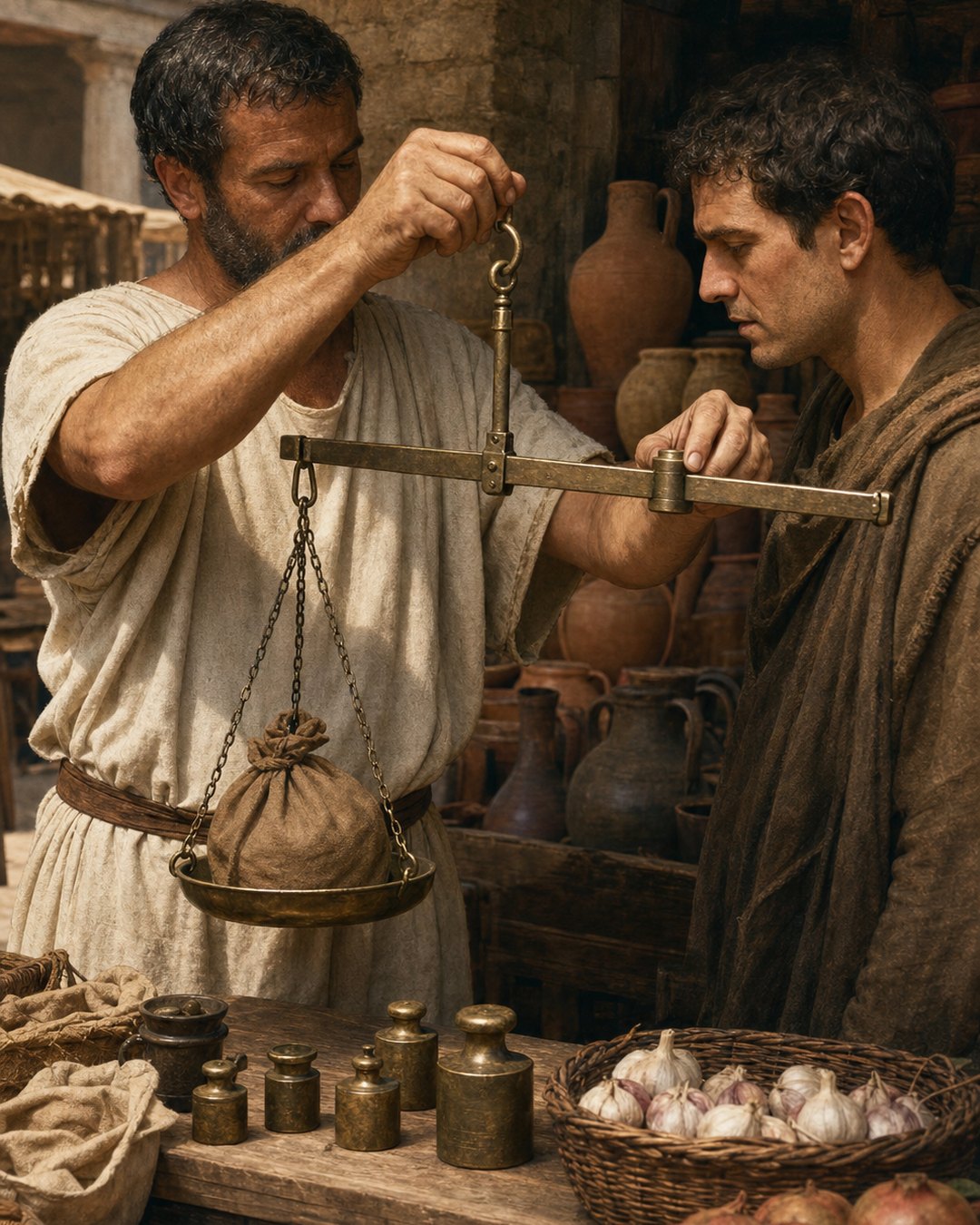
A merchant did not need a row of counterweights equal to every possible load. An unequal beam offered a more compact bargain. Hang the goods close to the fulcrum, place one known counterpoise on the longer arm, and slide it outward until the beam settles. The weight is then read from position. A small piece of bronze can oppose a much heavier basket because leverage depends on distance as well as mass.
Roman steelyards turned that principle into market equipment. Their promise was practical range: one beam, one movable weight and a graduated scale could handle many loads. Their danger was equally practical. A bent beam, false graduation, worn pivot or altered counterpoise could make a neat balance lie. The instrument made weight visible, but only a chain of standards made the visible answer credible to buyer, seller and official.
The short arm carried the goods, not an equal weight
An equal-arm balance places load and standard at similar distances from a central pivot. The steelyard deliberately breaks that symmetry. Goods hang from the short arm, often in a pan or from a hook, while the counterpoise occupies the long arm. Because the load sits close to the fulcrum, the counterweight need not match it pound for pound. The difference in arm length supplies mechanical advantage.
This arrangement made the tool compact without making its reasoning mysterious. Each side tries to rotate the beam around the same point. The load produces one turning moment; the counterpoise produces the other. When the beam reaches its intended balance indication, those moments match. The eye sees stillness, but that stillness represents two opposed products: weight multiplied by distance on each side.
The suspended pan or hook had to belong to the calculation as well. Its own mass formed part of the instrument’s baseline, so changing an attachment without recalibration altered the relation between beam marks and load. A merchant who treated every hanging component as invisible could introduce error before the goods were placed on the short arm.
Sliding distance converted one counterpoise into many answers
The movable weight is the steelyard’s central economy. Close to the fulcrum, it exerts a smaller turning effect. Slide it farther along the long arm and the same mass exerts more. The operator therefore varies distance instead of swapping an entire set of weights. A heavy load drives the counterpoise outward; a lighter one balances nearer the suspension point.
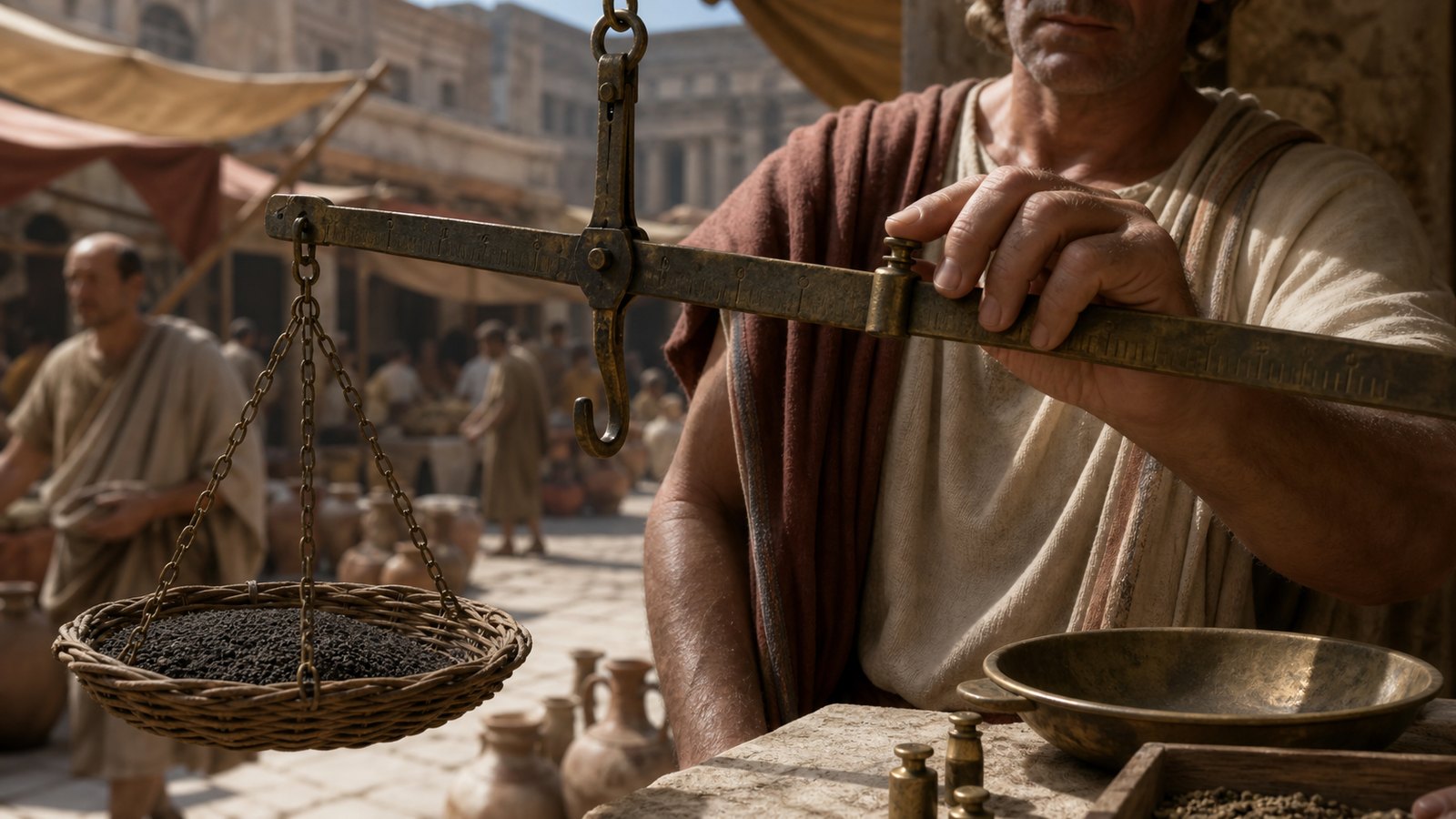
The graduated beam translates position into a reading. Its marks encode the lever’s geometry so the merchant does not calculate moments at every sale. This resembles the way Roman surveyors made spatial relationships operational: a disciplined instrument converts physical alignment into a usable claim. Yet a line on bronze has authority only if it was placed for the correct beam and counterpoise.
The counterpoise’s position turned the long beam into a stored table of results. Each graduation represented a previously established balance condition for that instrument. Reading was fast because geometry had already been encoded into spacing, but that convenience made unauthorized re-marking especially powerful: altered lines could convert systematic fraud into an apparently routine observation.
Different suspension points extended the useful range
Some steelyards provide multiple places from which the beam can be suspended. Changing the fulcrum changes the effective lengths of the arms, allowing another graduated range to become useful. The operator can weigh smaller goods with finer movement on one scale and shift configuration for larger loads. What looks like an extra hook is therefore a mechanical choice about sensitivity and capacity.
The feature also creates room for error. Using the wrong graduation with the selected suspension point produces a plausible but incorrect answer. A practiced merchant had to know which marks belonged to which pivot and ensure the beam hung freely. Portability concentrated several ranges into one object, but it also concentrated the need for correct setup in the hands of the user.
Multiple ranges balanced two competing goals. Closely spaced changes helped distinguish smaller loads, while a stronger leverage arrangement extended capacity. No single setup maximized both sensitivity and range. The extra fulcrum let one object negotiate that trade, as long as the operator deliberately selected the proper suspension point, scale and load attachment together.
A level beam ended negotiation only if witnesses trusted it
At a market stall, weighing was both measurement and performance. Buyer and seller could watch the basket, sliding weight and final balance. The visible sequence reduced reliance on a merchant’s spoken estimate. It belonged naturally beside the tabernae that made exchange part of the street, where many transactions unfolded before neighbors and passers-by.
Visibility did not remove asymmetry of knowledge. An experienced operator understood the beam better than a hurried customer. He knew how friction at the pivot, a hand touching the arm or a sloping suspension affected the result. Fair dealing required the mechanism to move freely and the witnesses to recognize when it had truly settled. The moment of balance was persuasive because it looked independent of either person’s preference.
A witness could test more than the final position. The beam should move when the counterpoise moved and approach balance without sticking. Repeating the weighing or removing and replacing the load exposed some manipulation. Such simple checks did not equal official calibration, but they made the visible mechanism accountable to behavior rather than a single convenient pose.
Standards connected a private tool to public measure
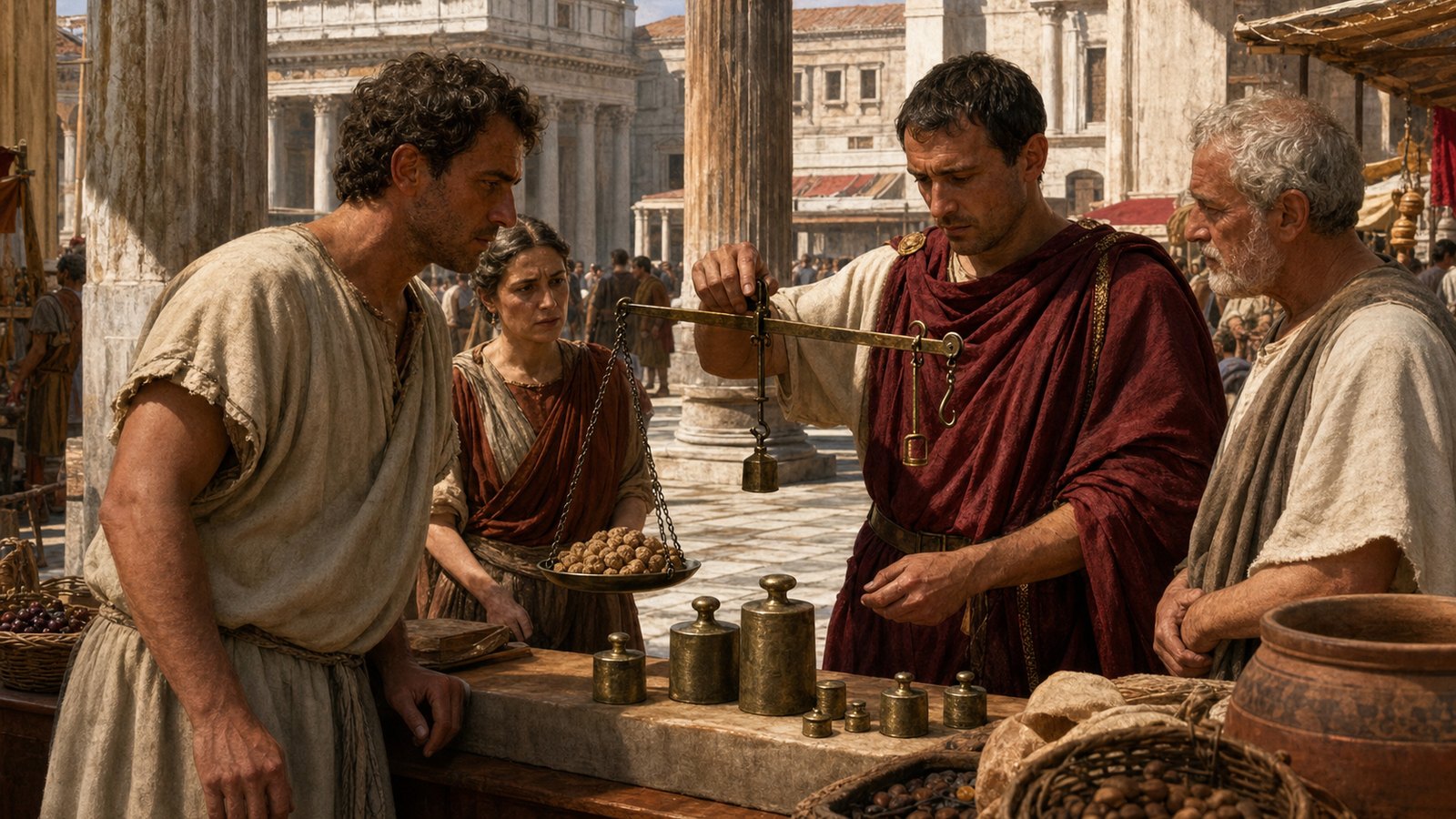
A steelyard could be checked against known weights. This mattered because the Latin libra named both a balance and the Roman pound, joining instrument and unit in ordinary language. A beam’s graduations had to correspond to accepted measures rather than a shopkeeper’s convenient private scale. Standard weights and inspection made separate market tools answer to a shared reference.
The same problem appears with Roman coins. A marked object can circulate widely, but trust depends on more than the mark. Metal can be altered, surfaces can wear and claims can be challenged. For a steelyard, calibration meant testing whether known loads balanced where the beam said they should. Public measure was rebuilt each time that comparison succeeded.
Standard weights also allowed inspectors to compare many private balances without dismantling them. Place a known load on the instrument and its counterpoise should reach the expected graduation. Repeating that test at different points could reveal a bent beam or false spacing that one calibration point missed. Shared measure depended on comparison across the useful range.
Wear attacked the answer at several small points
A balance can fail without dramatic breakage. A worn suspension ring shifts the pivot. A bent beam changes distances. A damaged graduation obscures where the counterweight should stop. Dirt or corrosion adds friction, while an altered counterpoise changes every reading across the scale. Because the instrument multiplies distance, small physical changes can travel into repeated commercial error.
Care therefore belonged to the measurement mechanism. The beam had to hang freely, the load attachment remain sound, the counterpoise retain its mass and the marks stay legible. One sliding weight could measure a Roman market load because lever geometry did most of the work. Trust came from the less visible discipline around it: correct range, clean pivot, sound standards and enough shared understanding to challenge a balance that settled too conveniently.
Care included storage and transport because portability exposed the tool to knocks. The long beam could bend, hooks could wear and a counterpoise could be lost or substituted. Before weighing, an operator needed to see how the unloaded instrument hung and whether movement remained free. A trustworthy answer began before the first basket touched the pan. Rechecking the empty balance after a busy market session could expose a change that no customer noticed during trade. Maintenance preserved not merely a bronze object but the repeated relationship among pivot, arm length, counterpoise and engraved scale.
Sources & Further Reading
- Steelyard balance
- Smith Dictionary, Libra
- Weighing scale