
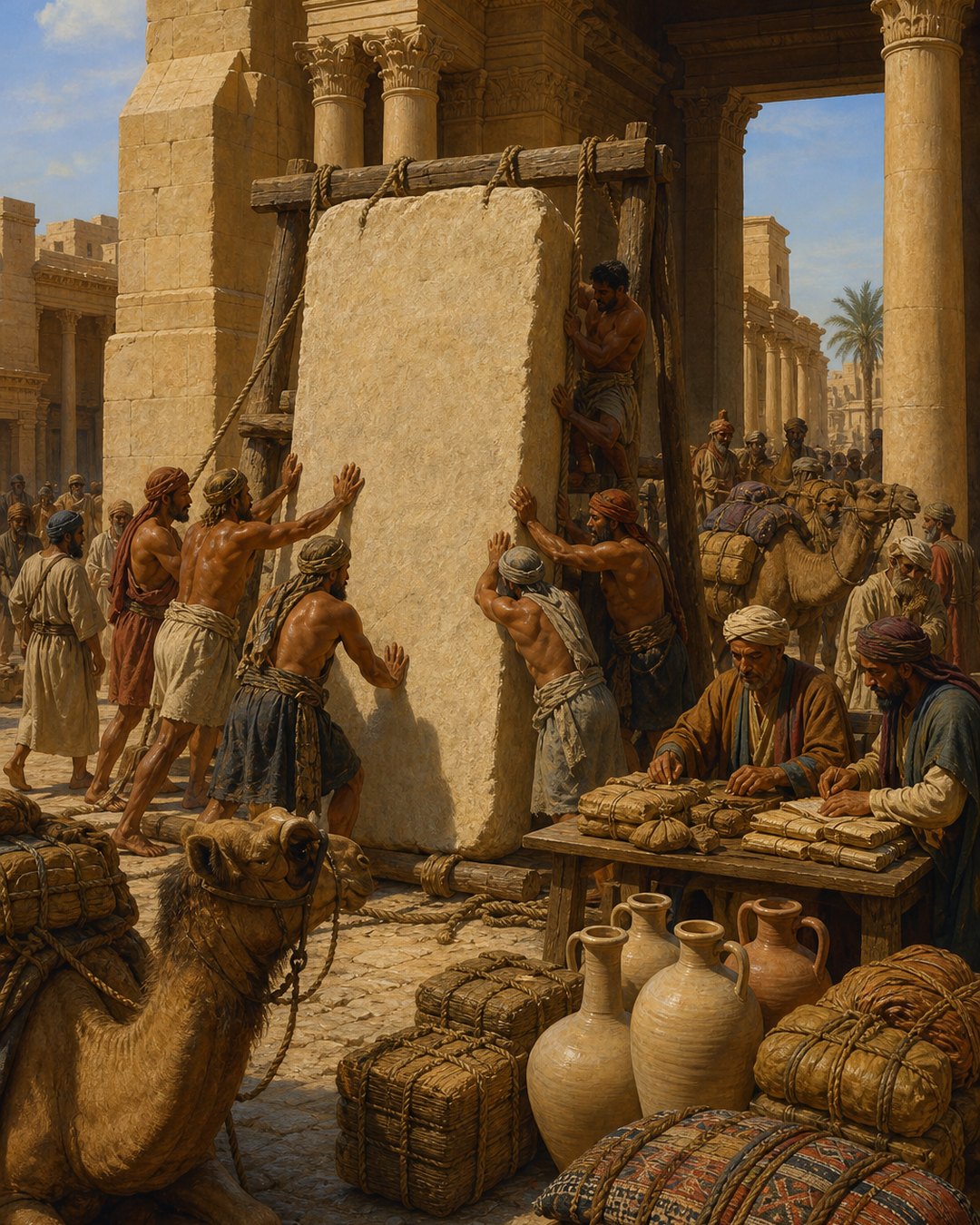
Caravans made Palmyra famous, but camels and silk do not explain how a city benefited from movement. Goods had to enter, services had to be priced, disputes had to be settled and collectors had to know what they could demand. Palmyra put part of that machinery into stone.
The monument now called the Palmyra Tariff is a vast limestone inscription written in Greek and Palmyrene Aramaic. It gathered customs rules for goods and services passing through the city and connected rates to civic administration. The text is not a merchant’s adventure. It is the schedule waiting when the adventure reached a gate.
That distinction makes the tariff unusually valuable. Trade becomes visible not as a line on a map but as repeated encounters: a pack animal counted, a commodity identified, a charge disputed, an official named. Palmyra’s prosperity required caravans, yet it also required a public procedure capable of turning their arrival into predictable municipal revenue.
A Desert Crossroads Needed More Than Distance to Create Wealth
Palmyra stood between Mediterranean markets and routes reaching east through Syria and Mesopotamia. Its position offered opportunity, not automatic profit. A city beside traffic could watch wealth pass through unless it supplied security, storage, market access and rules trusted enough for merchants to stop.
Customs dues captured a portion of that movement. Each charge represented a bargain with consequences. Rates set too high could encourage avoidance or diversion; rates left vague could invite collectors to improvise. A published tariff narrowed both risks by telling traders and officials what the city claimed.
The inscription lists goods and commodities rather than praising commerce in general. That specificity is what lets historians approach the economy. Categories show what officials expected to encounter often enough to regulate. The tariff is an administrative response to recurring traffic, not a literary catalogue assembled for curiosity.
The Muziris cargo loan follows one enormous shipment through credit, risk and valuation across the Indian Ocean. Palmyra’s stone operates at another point in the system. It waited on land, where many separate journeys became a stream of taxable arrivals.
Two Languages Made One Civic Demand Legible
The tariff presents its rules in Greek and Palmyrene Aramaic. That bilingual form was not decorative balance. Greek connected the city to a broad administrative and commercial world under Roman power, while the local Aramaic script belonged to Palmyra’s civic identity and daily elite culture.
Translation made authority travel across audiences, but it did not erase difference. Terms in one language might not map perfectly onto those in the other. Commodity names, offices and measures carried local assumptions. Setting versions beside each other turned those problems into an official equivalence that people could cite.
The stone therefore records more than linguistic diversity. It shows a government doing the work required when trade crossed communities. A rate could not remain an oral understanding known only to one collector. It had to be formulated, translated and fixed strongly enough to outlast the people who negotiated it.
The physical scale reinforced that permanence. This was not a wax memorandum that disappeared when an official left office. Limestone made revision difficult and visibility possible. The city transformed a schedule into part of the built environment, announcing that customs were civic rules rather than a private bargain at each caravan.
Rates Controlled Collectors as Well as Merchants
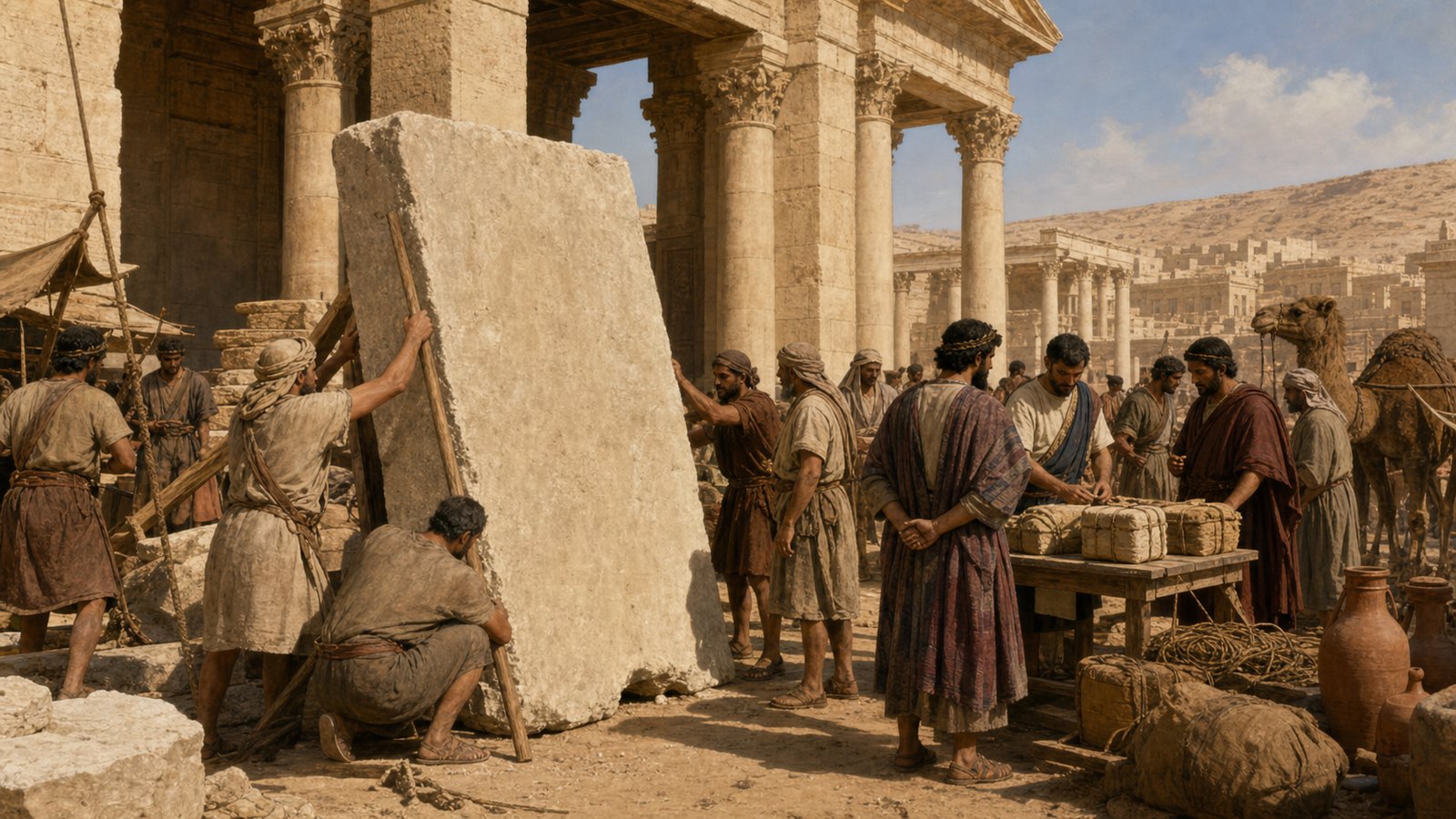
A tariff is often imagined as a burden imposed in one direction. Yet a public rate also constrained the person collecting it. Merchants could compare a demand with the published schedule. Officials could point to authority beyond personal preference. Both sides gained a reference, even if unequal power and literacy still shaped the encounter.
The inscription names people responsible for trade matters. Administration therefore appears beside price. A charge required an office, and an office required accountability within Palmyra’s municipal structure. Revenue did not leap from a camel’s load into a treasury by itself.
This helps explain why the stone matters to political history. Roman rule did not mean that an imperial employee personally priced every service at Palmyra. The city maintained institutions that adapted commerce to local needs while operating inside the wider imperial order. Municipal authority multiplied the practical reach of empire.
Roman steelyards made a market load measurable. The tariff performed a related conversion at civic scale. Once a good could be classified and measured, a rule could translate it into a due. Instruments, categories and officials together made revenue repeatable.
The Stone Preserves a Compilation, Not a Frozen Economy
No tariff can make prices or traffic stop changing. Palmyra’s text drew together decisions that had accumulated over time. That process is visible in the need to clarify rates and responsibilities. The inscription belongs to an economy active enough to create ambiguities that demanded formal settlement.
Older rules could survive beside newer adjustments. A city might retain precedent while resolving a dispute that previous language had not anticipated. Publication gave the result a single monumental form, but the stone should not be mistaken for proof that every charge had been invented on one day.
This layered character makes the tariff more realistic. Commerce generated exceptions. Pack animals arrived with different loads, services varied, and names for goods changed across languages. Administration advanced by defining, comparing and occasionally correcting rather than by designing a perfect system before trade began.
The surviving text also cannot tell us how consistently officials obeyed it. A public schedule creates the possibility of challenge; it does not abolish bribery, influence or error. The strongest claim is mechanical: Palmyra had invested in a rule that merchants and collectors were expected to recognize.
An Excavated Monument Outlived the Traffic It Regulated
Semyon Abamelek-Lazarev discovered the tariff at Palmyra in 1881. In 1901 it was presented by the Ottoman sultan Abdul Hamid II to Tsar Nicholas II. The stone now stands in the Hermitage Museum in Saint Petersburg, far from the routes and offices that gave its clauses practical force.
That removal changed the object again. At Palmyra it had regulated and displayed civic authority. In a museum it became evidence to be copied, edited and compared. Catalogue labels such as PAT 0259 and CIS II 3913 place it inside modern scholarly systems just as its original clauses placed goods inside ancient fiscal categories.
Historian John Matthews called it one of the most important single pieces of evidence for economic life in any part of the Roman Empire. The praise is justified by density, not glamour. The inscription preserves the ordinary decisions without which spectacular long-distance exchange could not reliably benefit a city.
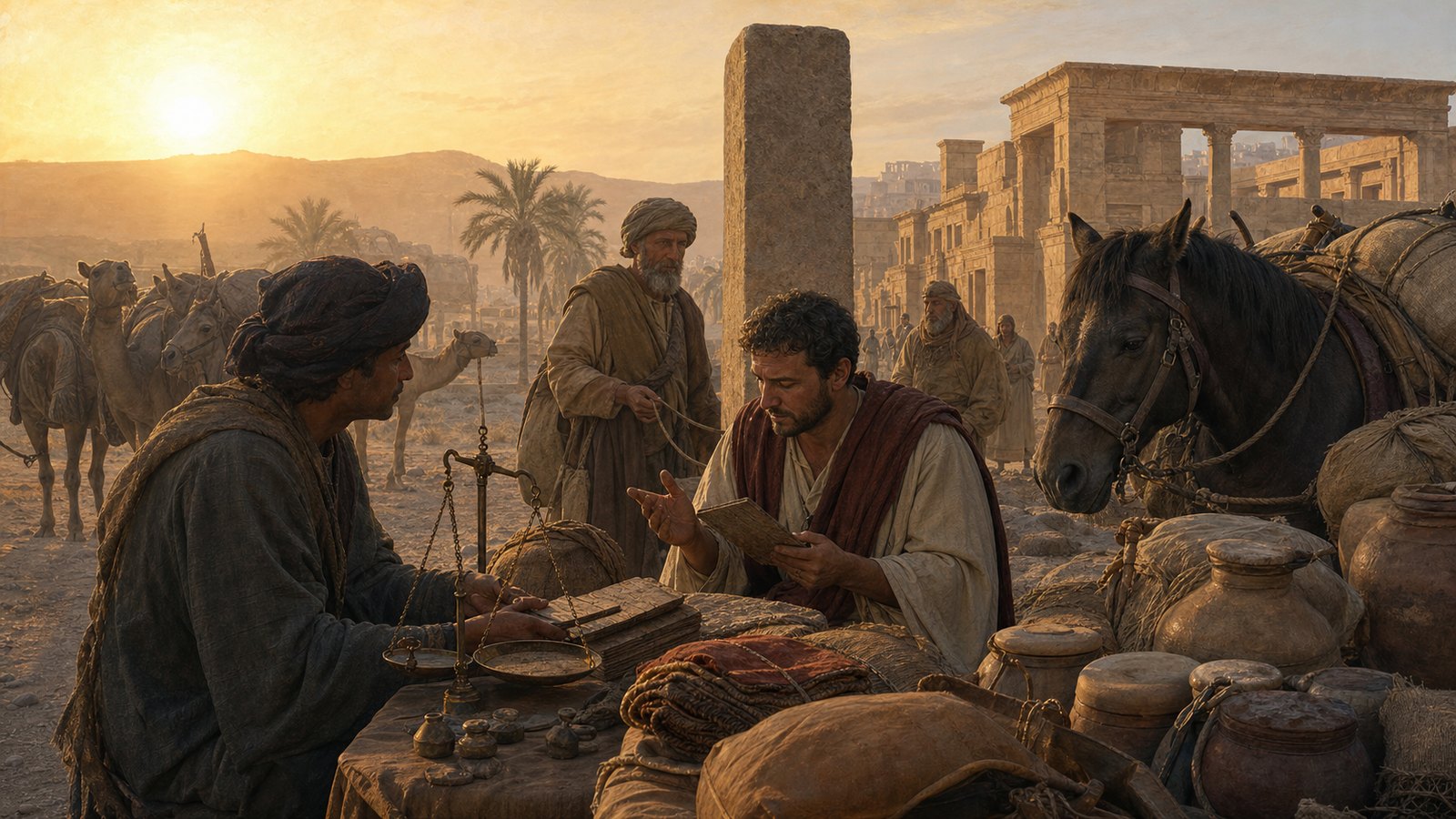
Palmyra’s columns and caravan stories invite visions of wealth arriving from the horizon. The tariff directs attention to the moment after arrival. Someone had to recognize the load, consult a rule, name a charge and account for the money. The desert city’s commercial power was built not only on distance crossed, but on procedures cut deeply enough to remain when the caravans were gone.
Sources
Hermitage Museum, “Palmyra Tariff”; John Matthews, The Journey of Theophanes; Corpus Inscriptionum Semiticarum, CIS II 3913.