
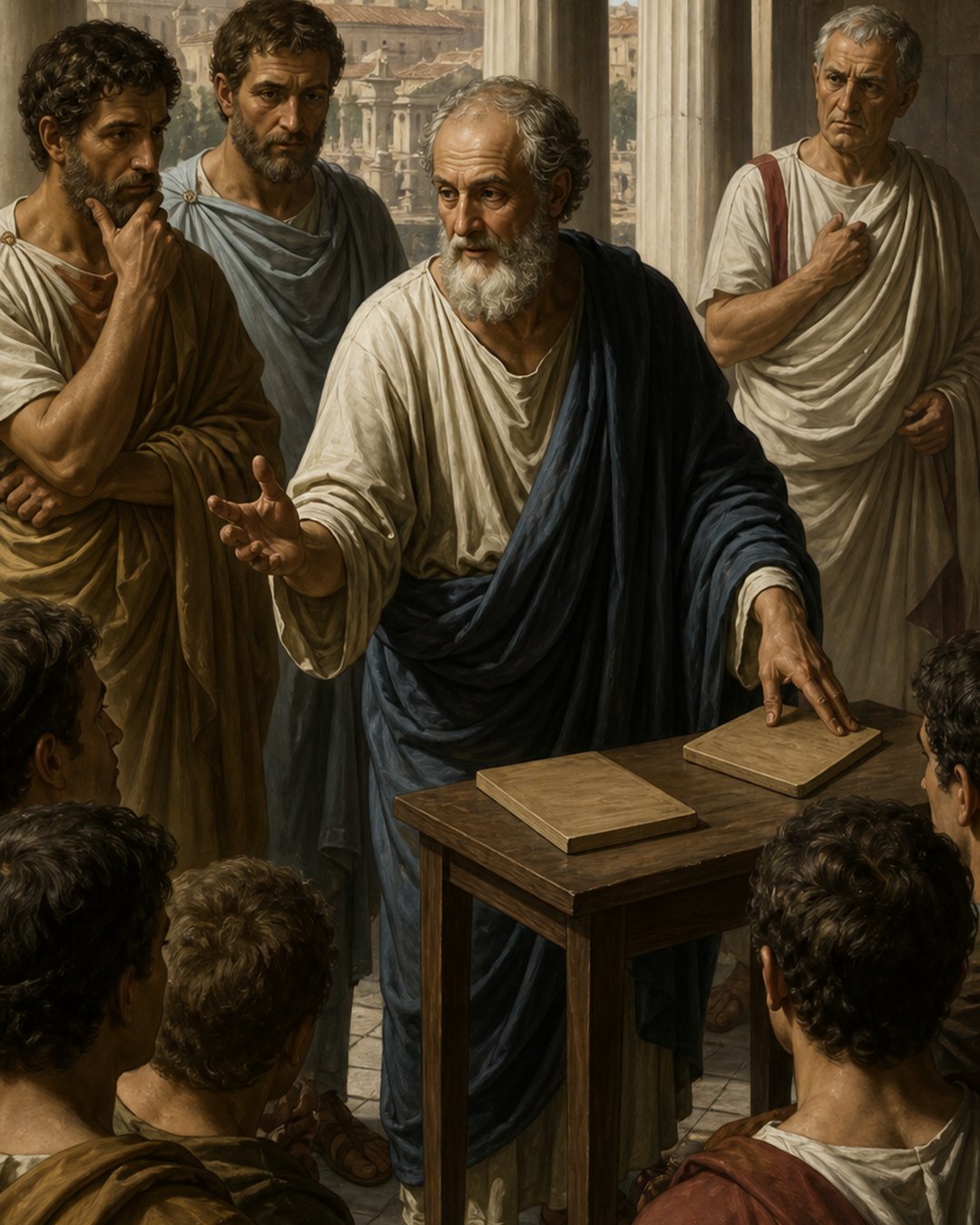
Three philosophers arrived in Rome carrying a problem measured in five hundred talents. Athens had lost a case connected with Oropus and wanted the Senate to reduce or reverse the punishment. Its ambassadors in 155 BC were not routine envoys: Carneades led the Academy, Diogenes represented the Stoics, and Critolaus headed Aristotle’s Peripatetic school.
Roman youth crowded around them. Plutarch describes Carneades as the most electrifying, an orator whose arguments seemed to sweep through the city. Later tradition sharpened the episode into two performances. On one day he defended justice; on the next he argued against the case he had just made.
The paired speeches are famous and uncertain. Modern scholarship warns that all surviving accounts are later and that even the lectures’ precise form has been questioned. The uncertainty is not an obstacle to the story’s importance. It reveals what Romans remembered as dangerous: a method capable of constructing conviction, reversing it and exposing how much public certainty depended on argument.
A Five-Hundred-Talent Judgment Brought Philosophy to the Senate
The embassy began in litigation, not a lecture tour. According to Plutarch, people from Oropus brought a complaint against Athens. The Athenians allowed the case to proceed by default, Sicyonian judges imposed a fine of five hundred talents, and the condemned city sought Roman intervention.
That sum made persuasion urgent. Athens could appeal to its cultural prestige, but prestige worked best through people who embodied it. Sending the heads of three major schools gave the petition intellectual weight and ensured attention beyond the Senate chamber. Diplomacy and public performance reinforced one another.
Carneades, Diogenes and Critolaus did not represent one doctrine. Their schools disputed central questions about knowledge, ethics and nature. Together, however, they offered Rome a concentrated display of Greek authority. The delegation’s diversity made it harder to dismiss as one partisan faction.
Pompey’s need for a procedural handbook shows how even powerful Romans could stumble over the Senate’s working rules. The Athenian philosophers faced a different procedural problem: how to make a foreign city’s failed case compelling enough for Roman senators to reopen its consequences.
Carneades Made Reversal Look Like a Method, Not a Defeat
Carneades belonged to the skeptical Academy. He did not simply announce that nothing could be believed and walk away. His practice tested claims by drawing out their commitments, showing conflicts and arguing from more than one side. A conclusion had to survive pressure rather than borrow authority from confidence alone.
The justice speeches, if the later tradition preserves their outline, were a public demonstration of that method. A first argument could make justice appear natural, necessary or wise. A second could expose self-interest beneath legal claims and ask whether states followed justice when power offered advantage.
Reversal was not a confession that the first day had been fraudulent. It showed that persuasive speech and secure knowledge were not identical. Listeners who felt certain after one performance had to confront an equally capable challenge from the same voice. Carneades made the audience experience its own instability.
The Stanford Encyclopedia notes that every part of the celebrated two-day episode has drawn scholarly doubt. No transcript lets us reconstruct the exact order of examples. Cicero’s later discussion may preserve traces of arguments associated with Carneades, but that relationship is disputed. The honest claim is therefore about tradition and method, not verbatim sentences.
Young Romans Heard Possibility Where Cato Heard Civic Risk
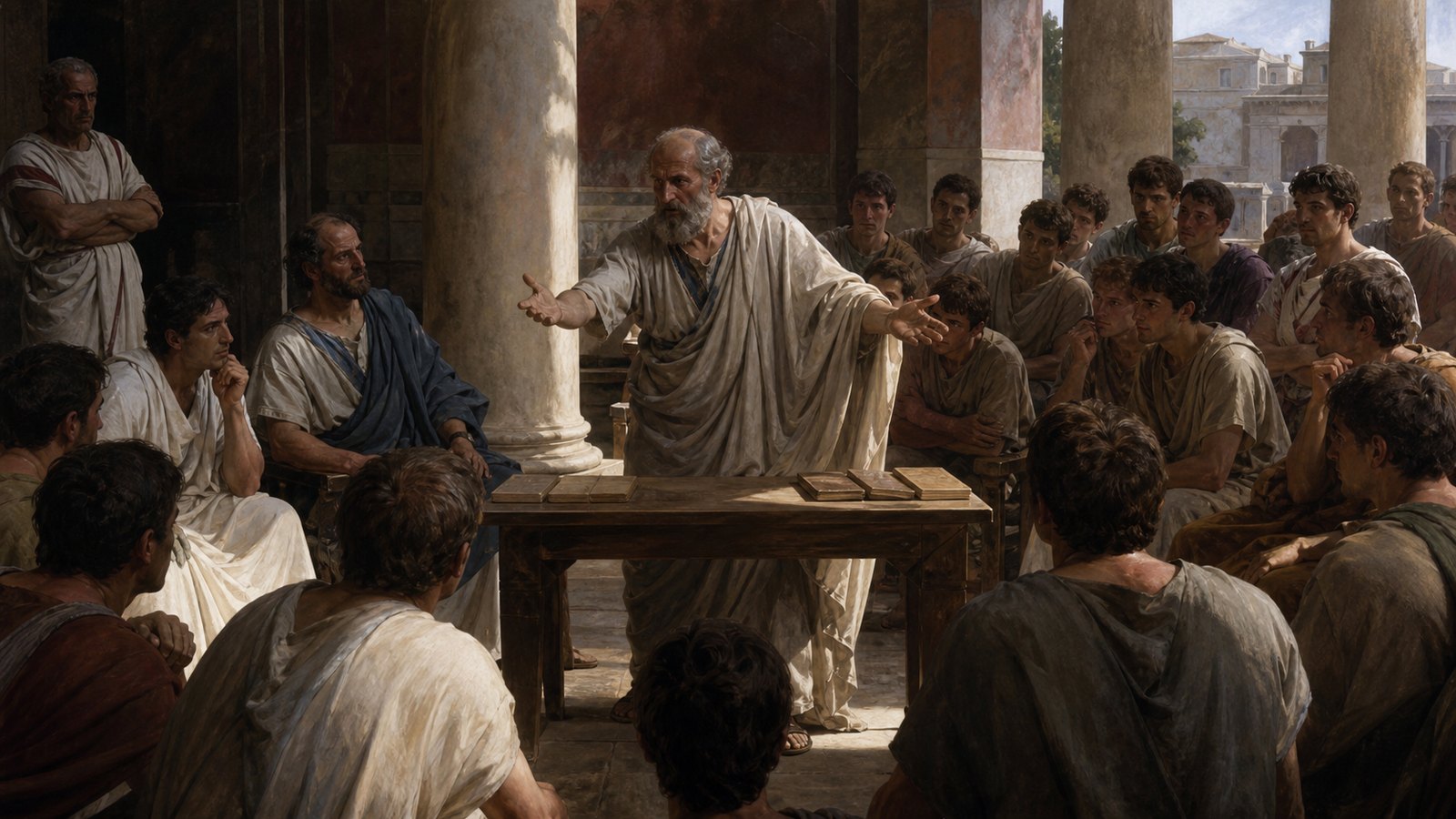
Plutarch says studious young men became devoted listeners. Carneades’ fame and verbal force filled Rome with praise. For Romans already attracted to Greek education, the ambassadors offered philosophy at its most alive: not a distant book but face-to-face combat between arguments.
Cato the Elder read the enthusiasm differently. In Plutarch’s portrayal, he feared a style of reasoning that could detach talented young Romans from laws and magistrates. The complaint was not that Carneades lacked skill. His skill was precisely the danger. A speaker who could prevail on opposite sides might train judgment, but he might also weaken inherited obedience.
Cato urged the Senate to settle the Athenian request and let the philosophers return to Greek schools. That response joined diplomacy to cultural policing. Rome could decide the fine, benefit from Greek expertise and still limit how long the intellectual spectacle occupied its youth.
Cato’s history written for his son reveals that his resistance to Greek influence did not mean indifference to education. He cared intensely about who formed Roman judgment and through which examples. Carneades represented a rival teacher whose lesson began by making certainty answerable to technique.
The Embassy Turned Skepticism into Political Leverage
The philosophers’ public success cannot be separated from the petition. Crowds and reputation created an atmosphere around a legal request that might otherwise have remained technical. Athens used the cultural capital of its schools to make a financial judgment into a Roman event.
That does not mean Carneades argued against justice merely to help Athens evade payment. The surviving evidence cannot securely assign every philosophical move to diplomatic calculation. Yet the setting gave abstract questions immediate pressure. What is justice between cities? Does a strong power enforce another court’s verdict, revise it or reward a famous ally?
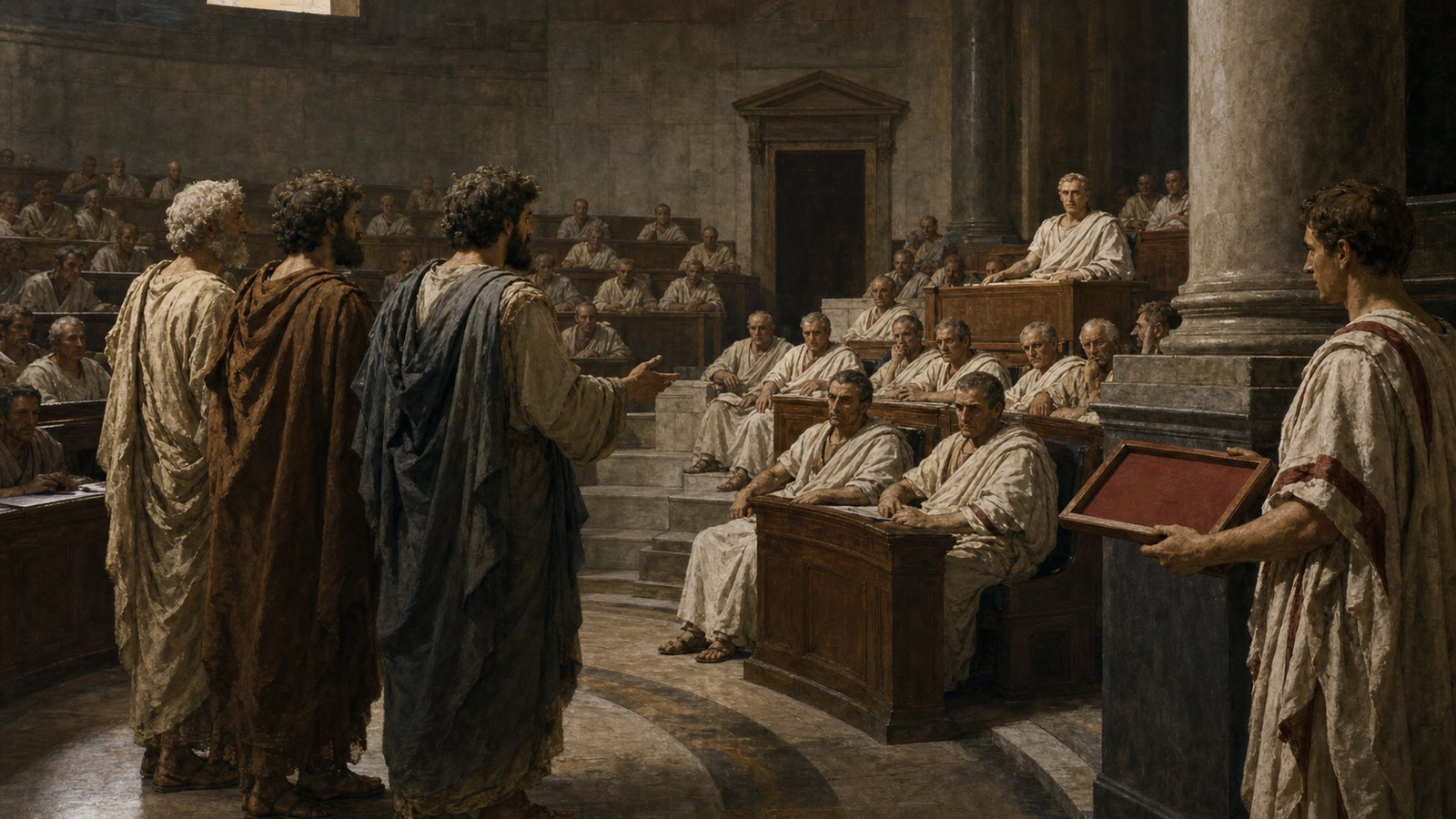
The delegation exposed Rome’s expanding role. A dispute involving Oropus, Athens and Sicyonian judges could end before Roman senators. The Republic was becoming a place where Mediterranean communities sought final leverage. Philosophers arrived because power had moved, even while Rome still treated Greek learning as an imported force.
Carneades wrote no surviving books. His influence depended on encounters, students and reports. An embassy suited that form of philosophy. He could turn a diplomatic delay into teaching, make the city itself an audience and leave behind not a text but a problem Romans retold for centuries.
The Surviving Story Is Strongest When Its Uncertainty Remains
Later retellings tempt us to stage a perfect two-day duel: justice triumphs, justice collapses, and Cato immediately panics. The sources do not justify that cinematic precision. Plutarch writes much later, other accounts serve their own arguments, and modern specialists dispute how much of the performance tradition is historical.
Restraint does not flatten the episode. Certain anchors remain: the 155 BC embassy, its three prominent philosophers, the Athenian petition, Roman attention and Cato’s hostility in the literary tradition. Carneades’ known skeptical practice makes argument on both sides intelligible even if the exact lecture schedule cannot be proved.
The five-hundred-talent judgment and the philosophical sensation belonged to the same visit. One asked Rome to reconsider a decision; the other made reconsideration itself into an intellectual discipline. That parallel explains why the mission could seem brilliant to students and unsettling to a guardian of custom.
Carneades did not need to leave Rome with a written doctrine to alter its memory. The remembered act was enough: defend a principle, turn around, test its foundations, and force the listener to distinguish confidence from knowledge. Athens came seeking relief from a judgment. Rome remembered the ambassador who made judgment harder.
Sources
Plutarch, Life of Cato the Elder, 22–23; Stanford Encyclopedia of Philosophy, “Carneades”; Encyclopaedia Britannica, “Carneades.”