
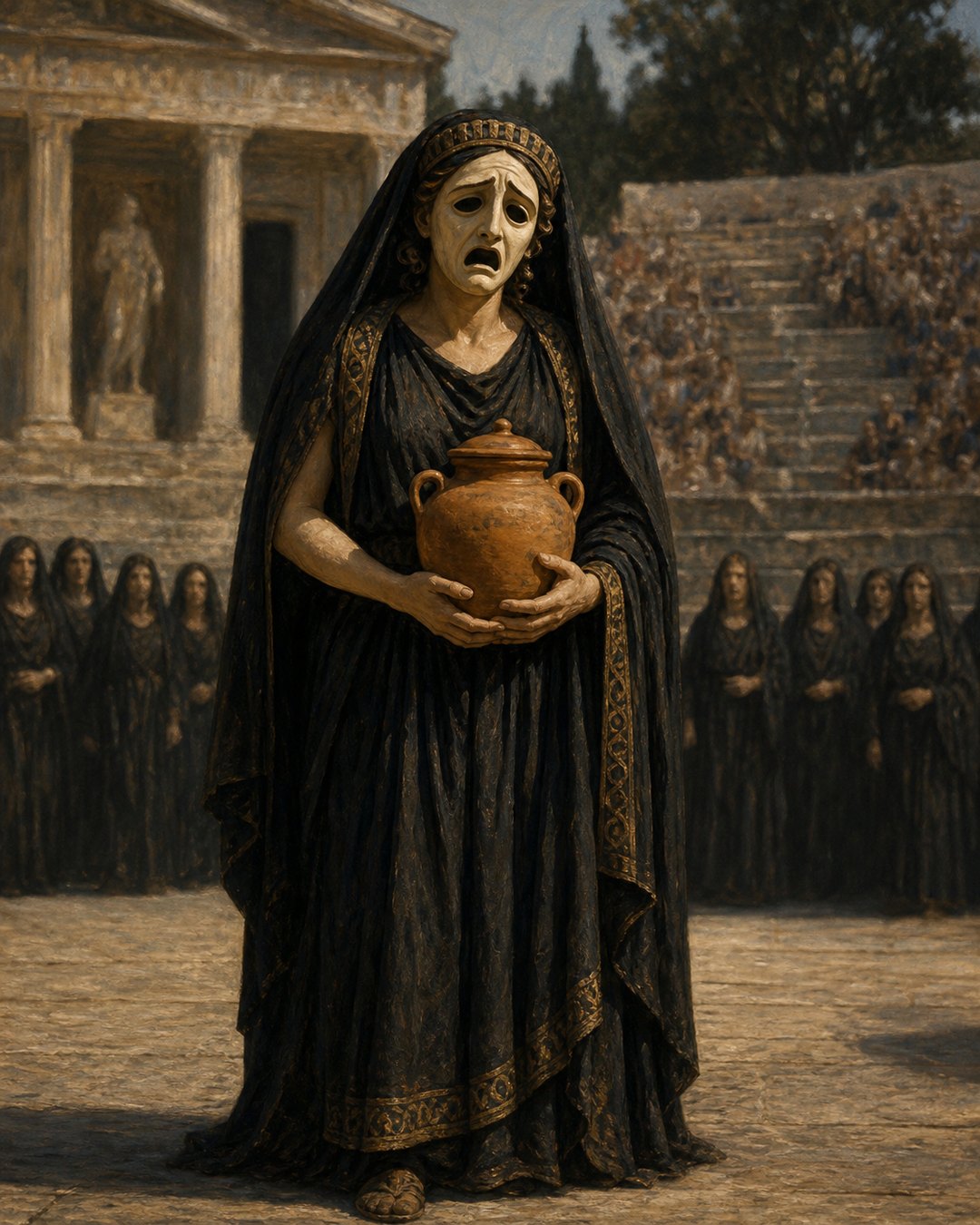
An Athenian audience knew what the urn was supposed to mean. In Sophocles’ Electra, the heroine receives what she believes are the ashes of her dead brother Orestes. Her lament belongs to the plot: the vessel is a prop, the death a deception, and the grief a test the actor must make convincing.
Aulus Gellius says the celebrated performer Polus altered that arrangement. After losing a beloved son and eventually returning to work, he played Electra with the actual urn that held his child’s ashes. Dressed for the role, he embraced those remains while speaking the heroine’s lament. Gellius insists that the theatre then contained not the appearance of sorrow but sorrow itself.
The story survives because it collapses categories that acting normally keeps apart. A performer lends a body and voice to another person’s pain while maintaining enough control to complete the scene. Polus, as Gellius presents him, placed the physical cause of his own mourning inside that discipline. The urn remained part of the play, but it could no longer be only theatrical.
Gellius Builds the Actor Before He Reveals the Urn
The account is brief, yet its order is careful. Gellius first establishes professional authority. Polus was widely known, excelled in clear delivery and graceful action, and repeatedly performed celebrated tragedy with intelligence and dignity. The reader meets a trained artist, not a bereaved amateur overwhelmed in public.
That preparation changes the meaning of what follows. Polus did not lack techniques for representing grief. He had voice, gesture, timing and experience. Gellius’s contrast therefore is not between bad acting and spontaneous feeling. It is between highly disciplined imitation and a decision to bring an irreducible private fact into the same controlled space.
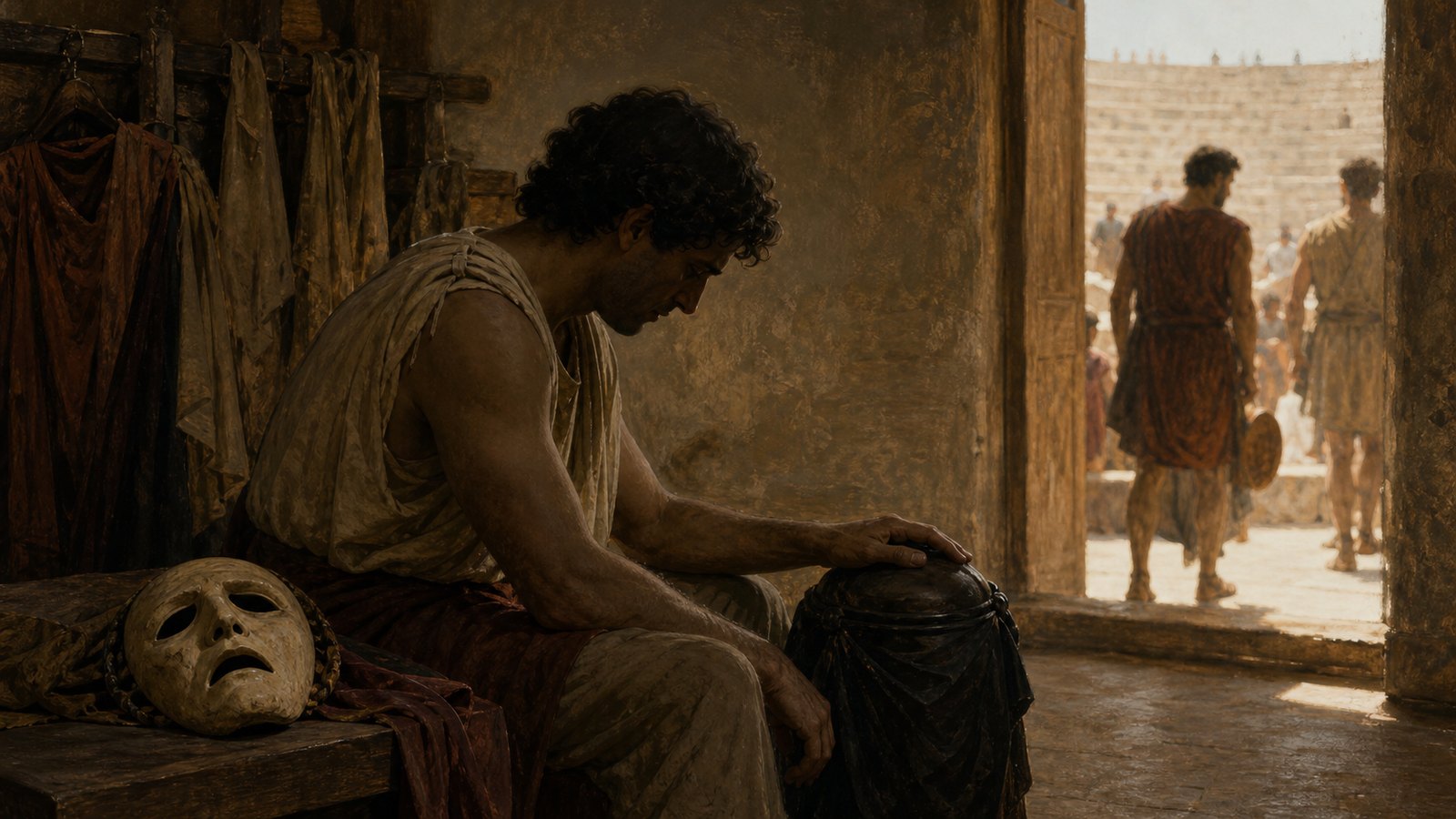
The narrative also gives mourning a duration without pretending to measure it. Polus, we are told, returned after he believed he had grieved sufficiently. The phrase does not mean that affection ended. It marks a social and professional threshold: at some point the actor resumed rehearsal and accepted a role that required him to stage a sibling’s bereavement.
Nothing in the passage records the son’s name, age or cause of death. Those absences matter. The child appears only through the father’s love and the urn. Any fuller domestic scene would be invention. Gellius preserves a famous performer’s act, not a family biography.
Electra’s False Ashes Met a Father’s Real Remains
Sophocles’ scene already depends on unstable knowledge. Electra believes Orestes is dead, though the audience knows the report is false. The urn’s dramatic force comes from that gap: a character responds sincerely to an object whose story is staged deception. The actor must make mistaken belief feel immediate.
Polus’s substitution added another layer that the play did not require. The vessel in his arms was theatrically assigned to Orestes while materially holding his own son. One object now carried two identities, one supplied by the script and one by private loss. The lines remained Electra’s; the weight against the actor’s body belonged to his life.
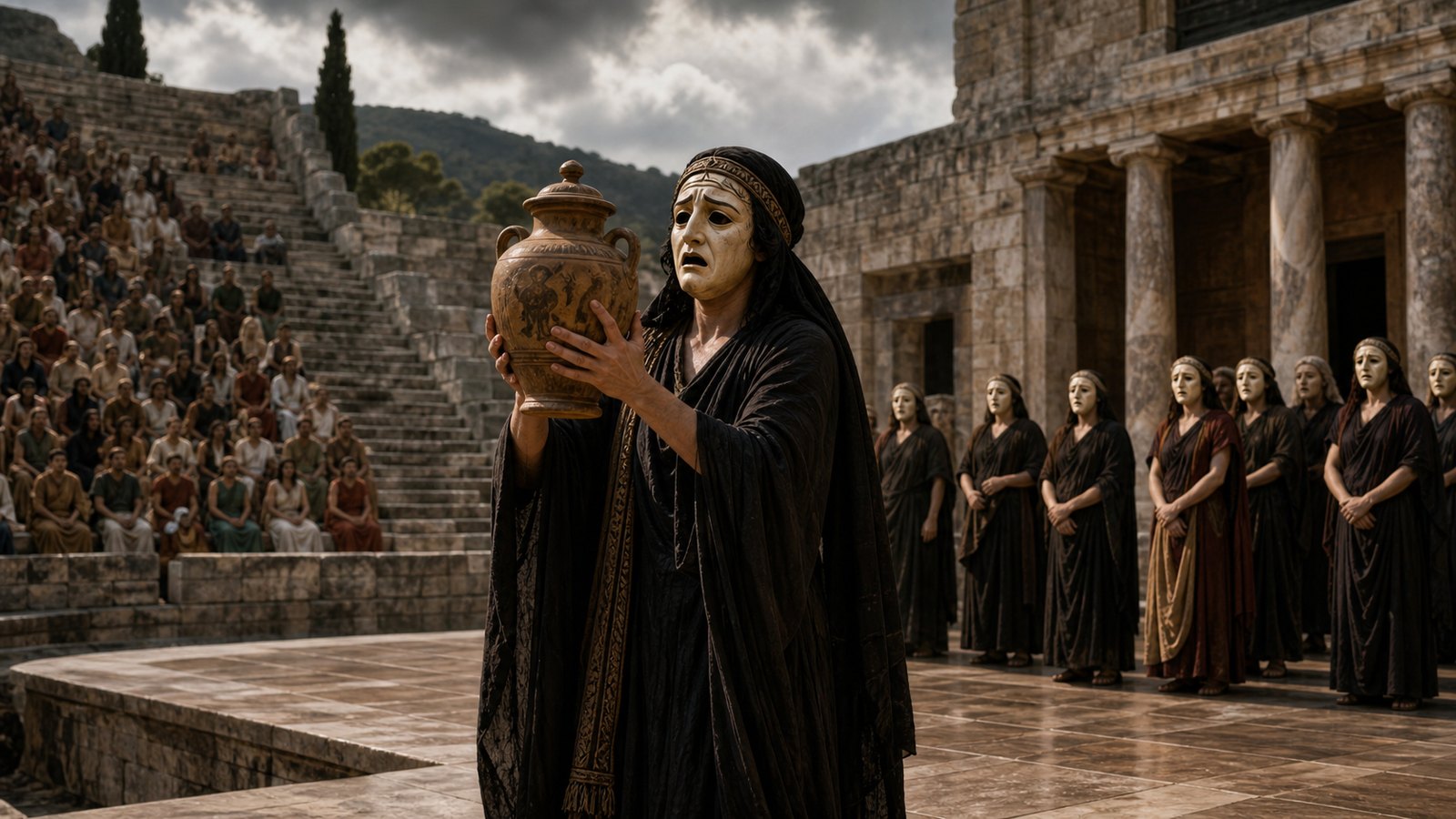
Roman and Greek theatre masks made roles visible across large spaces, allowing a performer’s identity to disappear behind a recognizable figure. Polus’s urn worked in the opposite direction. It brought a piece of the performer’s hidden identity onto the stage, even if spectators could not know its contents by sight.
The anecdote does not tell us whether the audience was warned. If they knew, expectation would shape every sound. If they learned later, the story would retrospectively transform what they had heard. Gellius is interested less in that practical question than in the philosophical contrast he can draw: imitation occupied the same scene as its real emotional source.
Professional Control Did Not Vanish When Grief Became Real
It is tempting to imagine Polus simply breaking down. Gellius does not say that. The actor completed a recognizable passage in a known play. He wore Electra’s mourning costume, carried the required object and delivered the lament in context. Genuine feeling entered a framework maintained by professional skill.
That distinction prevents the story from becoming a claim that suffering automatically creates great art. A grieving parent does not become an actor through grief. Polus could expose the feeling publicly because years of performance had taught him how to sustain voice, gesture and sequence before a large audience.
The episode also carried risk. Private mourning might overwhelm timing, damage speech or reduce a crafted scene to spectacle. The urn could become an exploitation of the son or of the audience. Gellius does not ask those ethical questions directly, but they remain visible because the choice was deliberate rather than accidental.
The account of Pacuvius listening to Accius recite Atreus shows Roman readers evaluating tragedy through craft, age and judgment. Polus brings another measure into view. Technique could ripen, but an actor’s life could also alter what a familiar line cost to speak.
A Roman-Era Anecdote Turns Performance into an Exemplum
Gellius wrote in the second century AD, long after the classical Athenian world in which Sophocles first staged Electra. His Attic Nights gathers memorable pieces of language, history and conduct. The Polus story reaches us inside that literary project, not through a theatre account written on the night.
That distance requires restraint. We can accurately say that Gellius reports the substitution and presents it as genuine grief. We cannot independently reconstruct the date, spectators, venue arrangements or the exact words Polus managed between sobs. The anecdote’s polish may reflect repetition before Gellius wrote it down.
Its literary shape does not make it useless. On the contrary, the way Gellius tells it reveals what his readers found remarkable about acting. A skilled performer could imitate passion, but the strongest contrast remained between representation and an emotion anchored in actual loss. The story gives that contrast a physical centre small enough to hold: one urn.
The source also makes grief legible through a man playing a woman. Polus’s personal identity and Electra’s role crossed without becoming identical. Gellius does not pause over gender, but the performance depended on trained audiences accepting the convention while recognizing emotional truth through it.
The Urn Preserves a Boundary Even as It Breaks One
Polus’s act is often summarized as the moment real grief replaced acting. That is too simple. Acting remained everywhere: costume, lines, character, plot, theatre and audience. What changed was the emotional material carried through those forms. The actor did not step outside the play to give a funeral speech; he made the play hold something it had not been designed to contain.
The urn also kept the son inaccessible. It was a sealed vessel, not a revived person or a disclosed biography. The audience encountered Polus’s relationship through gesture and sound while the child remained unnamed. Physical presence intensified the scene without supplying explanatory detail.
This is why the anecdote continues to trouble neat definitions of sincerity. Polus’s lament was scripted and genuine, borrowed and personal, public and private. None of those pairs cancels the other. Performance did not falsify his sorrow, and sorrow did not erase his craft.
Gellius closes by saying that real grief was enacted while a play seemed to be acted. The clever sentence risks turning bereavement into a rhetorical trick, yet it captures the mechanism he wants remembered. A prop became a reliquary; a role became a channel; and a professional return to the stage carried the dead with it.
Sources
Aulus Gellius, Attic Nights, 6.5; World History Encyclopedia, “Ancient Greek Theatre.”