
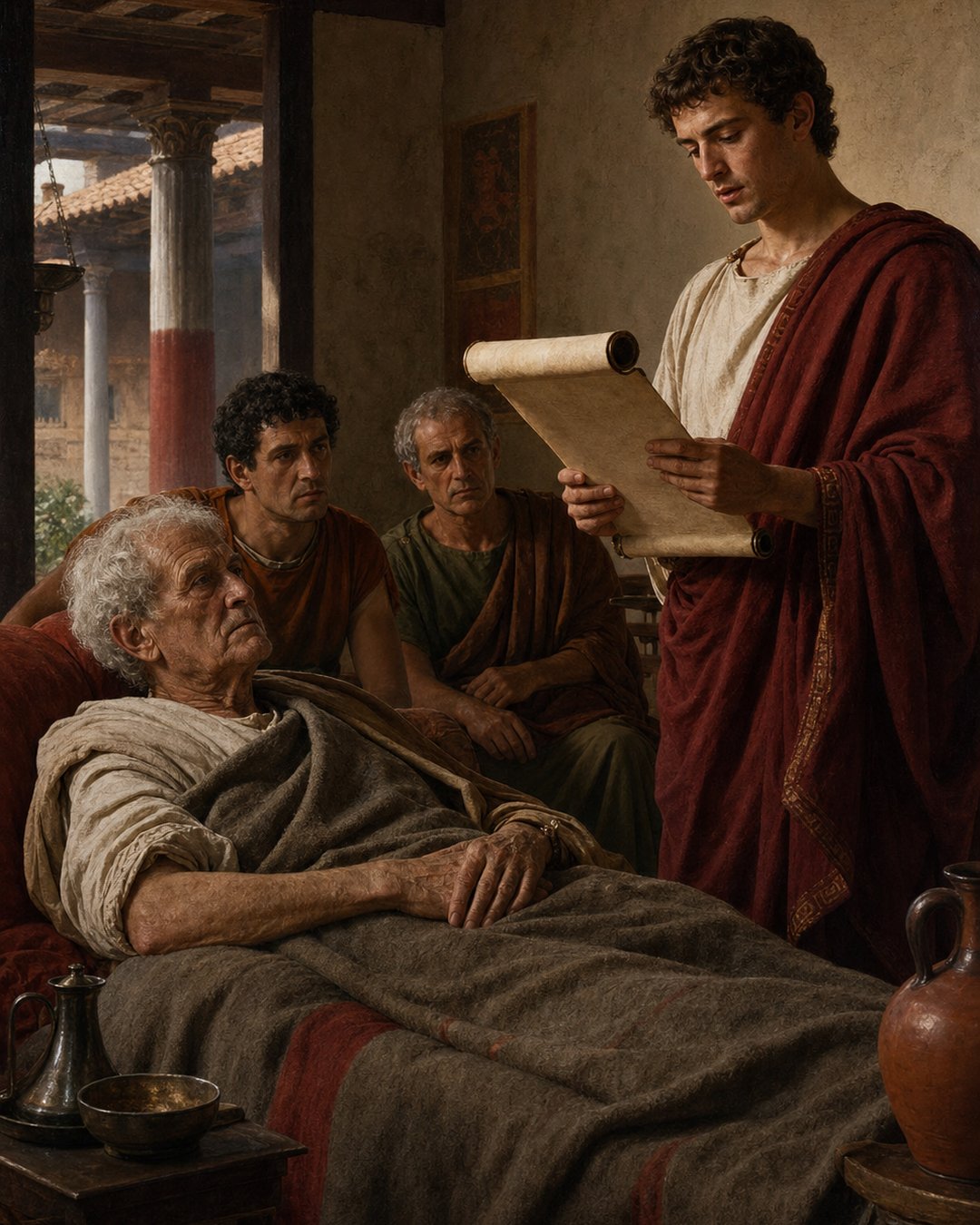
The younger poet did not send a finished scroll and wait for applause. He stood in an old man’s house and read.
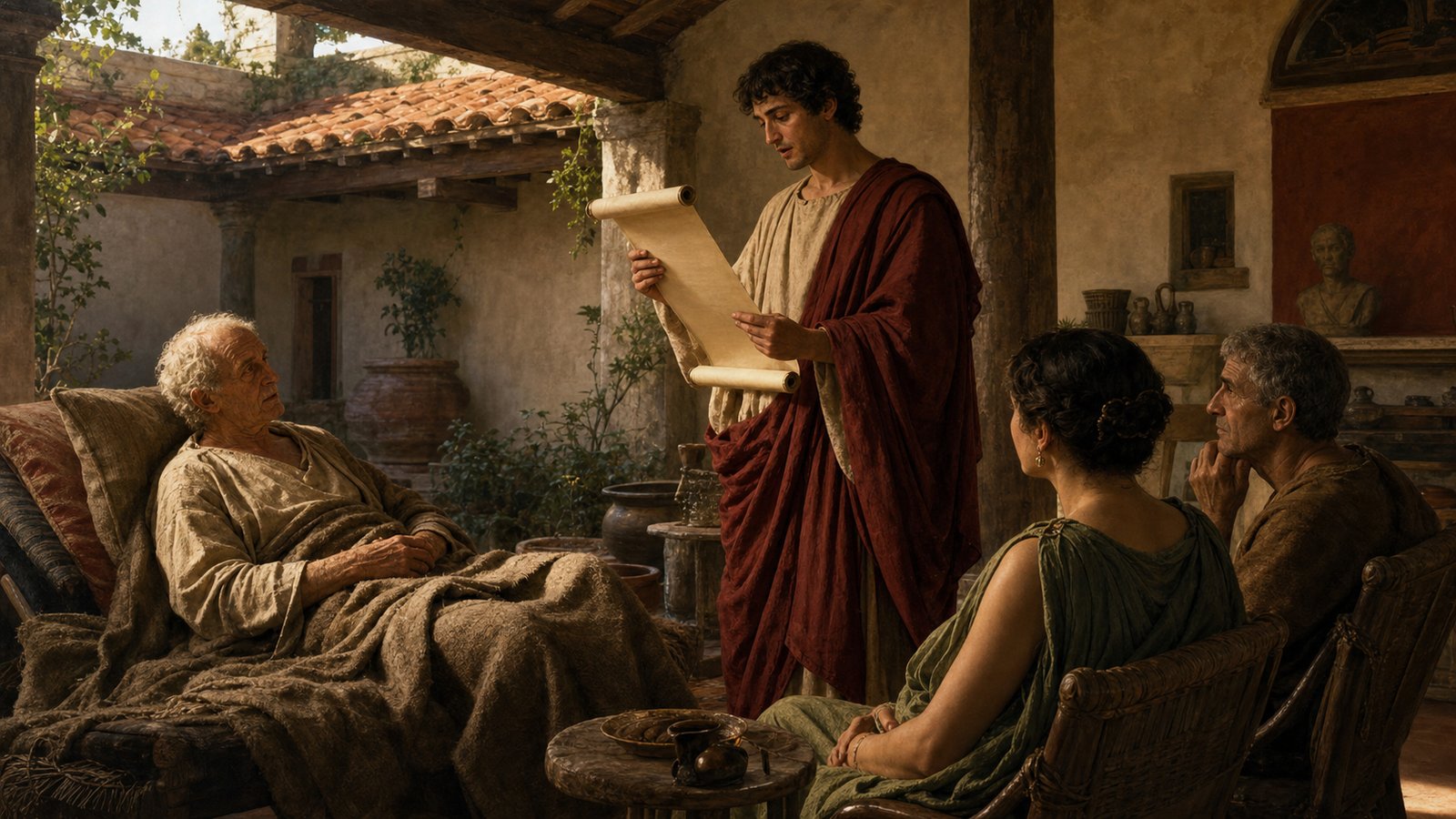
Aulus Gellius places Lucius Accius in Tarentum on his way to Asia. Marcus Pacuvius, already weakened by age and illness, had withdrawn there from Rome. He welcomed the visitor, kept him for several days and asked to hear part of Atreus. The scene has no theatre crowd and no official prize. It is criticism at conversational distance.
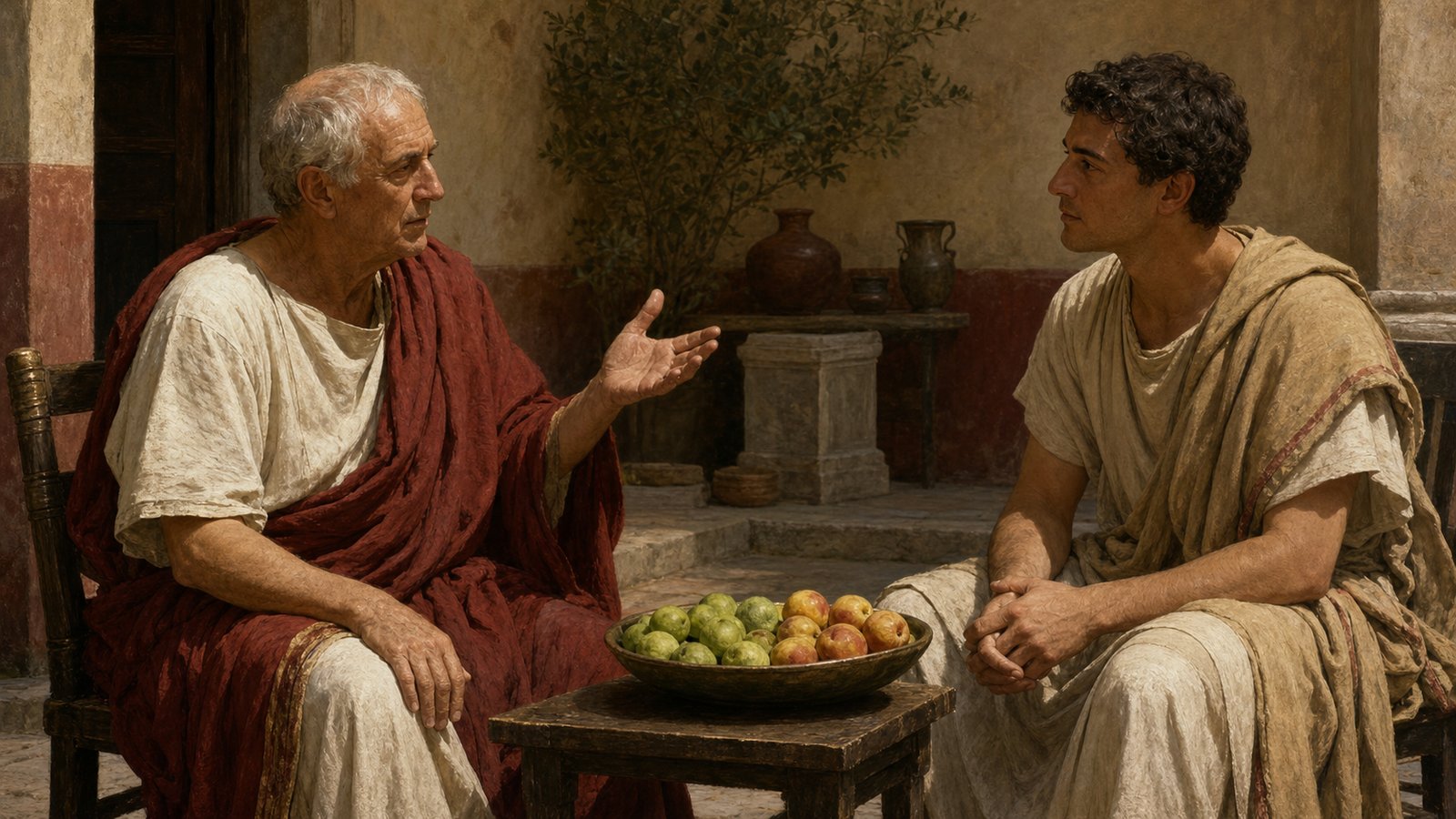
Pacuvius heard dignity and resonance, but also roughness. Accius did not deny the fault. He compared his mind with fruit that begins harsh and bitter, then becomes sweet as it ripens. Work that arrives soft too early, he said, may be heading not toward maturity but decay.
The reply is memorable because it neither dismisses the elder nor surrenders to him. Gellius preserves a small model of Roman literary succession: hospitality creates the room, recitation exposes the work, criticism names its mixed qualities, and the younger writer turns judgement into a schedule for improvement.
An old tragedian received a younger rival as a guest
Gellius says the story came from people who had taken the trouble to investigate the lives and periods of learned men. That introduction matters. He does not claim to have heard the exchange himself. He offers an anecdote already carried through literary memory, useful because it compresses two reputations into one encounter.
Pacuvius appears at the far edge of his career. Advanced age and continuing illness had left him physically weak, and he had moved from Rome to Tarentum. Withdrawal did not make him irrelevant. A younger tragedian travelling through southern Italy still sought his company, and the old poet remained someone before whom new work could be tested.
Accius was on his way to Asia, not arriving for a formal competition. Pacuvius detained him for several days with hospitality. The pause changes the emotional temperature of the reading. A guest owes courtesy, yet extended conversation permits more than ceremonial praise. They had time to listen and answer.
The article on seven judges testing poets at Alexandria shows criticism operating through a public contest and disputed rankings. Tarentum offers the opposite scale. One listener, one reader and a domestic setting could still stage a consequential argument about artistic quality.
Gellius does not describe manuscripts exchanged, corrections marked or a complete performance. The concrete action is oral. Accius reads from Atreus at Pacuvius’s request. Roman literature here is not only an object copied onto papyrus. It is sound placed before an experienced ear.
Pacuvius divided praise from approval
The elder’s response is carefully balanced. Accius’s writing seemed sonorous and full of dignity. Those are not trivial concessions. Tragedy depended on verbal force, elevated movement and language capable of bearing royal catastrophe. Pacuvius acknowledges that the younger poet can produce weight.
Then comes the limit: the work also seemed somewhat harsh and rugged. Gellius does not supply a faulty line, so a responsible reader cannot invent clumsy metre or bad diction. The criticism survives as a judgement of texture. Strength had not yet become finish.
That distinction protects the exchange from a familiar dramatic script in which an old master simply resents a successor. Pacuvius recognizes achievement and deficiency in the same work. His response is specific enough to sting, but not absolute enough to close discussion.
The mixed verdict also reveals what a reading can do. Silent inspection may identify argument and wording; performance tests how phrases occupy breath and ear. “Sonorous” and “rugged” are qualities that become vivid when language is voiced in a room.
Roman shorthand could chase public speech as it happened, but this encounter moved in the other direction: prepared poetry returned to speech so that craft could be judged. The written tragedy became temporarily vulnerable to the pace, emphasis and resistance of a living voice.
Accius made roughness part of development
Accius’s first move is agreement. “What you say is true,” he replies in Gellius’s account. He does not accuse Pacuvius of frailty, old-fashioned taste or jealousy. Accepting the observation allows him to dispute its meaning rather than its existence.
He does not greatly regret the harshness because it gives him hope for later writing. The answer would be empty bravado without the image that follows. Minds, Accius says, resemble fruit. What begins harsh and bitter can become mild and sweet. Early resistance may contain the conditions of ripening.
The comparison is not a claim that every rough work will improve by itself. Fruit can fail, and manuscripts do not revise themselves. Its force lies in direction. A hard beginning leaves room for maturation; premature softness may leave nowhere productive to go.
Accius sharpens the contrast with fruit that is juicy and mellow at the start. Such produce soon becomes not ripe but rotten. Immediate ease can be deceptive. What pleases instantly may lack enough structure to survive time.
His final formulation applies the metaphor directly to intellectual products: something should be left for time and age to mellow. He therefore treats criticism as evidence of unfinished growth. Pacuvius has identified the portion that time, practice and further judgement might transform.
The confidence is real, but bounded. Accius does not claim that his present Atreus is secretly perfect. He says later work may be better. The defence places value in a trajectory rather than demanding that the current reading receive full approval.
The anecdote preserved a chain of literary authority
Gellius writes centuries after both tragedians, and almost all of their plays survive only in fragments. The domestic conversation is therefore easier to see than the works being judged. That imbalance demands caution. The anecdote tells us how later literary culture imagined the relationship between major Republican poets; it is not a transcript certified by either man.
Yet the scene is valuable precisely as memory. Pacuvius’s authority does not rest on office or wealth. It comes from accumulated craft. Accius’s independence does not require humiliating the elder. He can accept a judgement and still articulate his own theory of making.
The visit also joins geography to succession. Rome’s literary past is encountered in Tarentum, while the younger man is moving onward toward Asia. Knowledge is not fixed in a single library or city. It travels with guests, voices and remembered replies.
Gellius gives no final revision of Atreus, no later reading and no declaration that time proved Accius right. The payoff remains inside the conversation. Pacuvius shows that praise can contain criticism; Accius shows that criticism can be accepted without becoming paralysis.
That is a more demanding picture of apprenticeship than passive obedience. The younger poet must hear the defect accurately, preserve what already has dignity and decide what ripening would mean in practice. The elder must judge without pretending that his taste ends literary history.
In the room at Tarentum, Roman tragedy became a fruit tested before it was fully sweet. The line between immaturity and decay could not be settled by flattery. It required an experienced listener, a writer willing to answer, and enough time for the next work to prove which direction the roughness would take.
The surviving title Atreus adds one final pressure to the scene. A tragedy about a royal house consuming itself demanded violence of emotion and severe language, so dignity without control could harden into mere noise. Pacuvius’s paired judgement suggests that force and finish were not opposites; the younger writer had to preserve the first while acquiring the second.
Gellius never tells us whether Accius altered the passage he read. Instead, the reply itself becomes the finished miniature. Its shape is economical: acknowledge the blow, change the time scale, then offer an image memorable enough to outlive the lost performance. Even if the anecdote was polished in transmission, that polish demonstrates the literary value it advocates.
Sources
Aulus Gellius, Attic Nights 13.2