
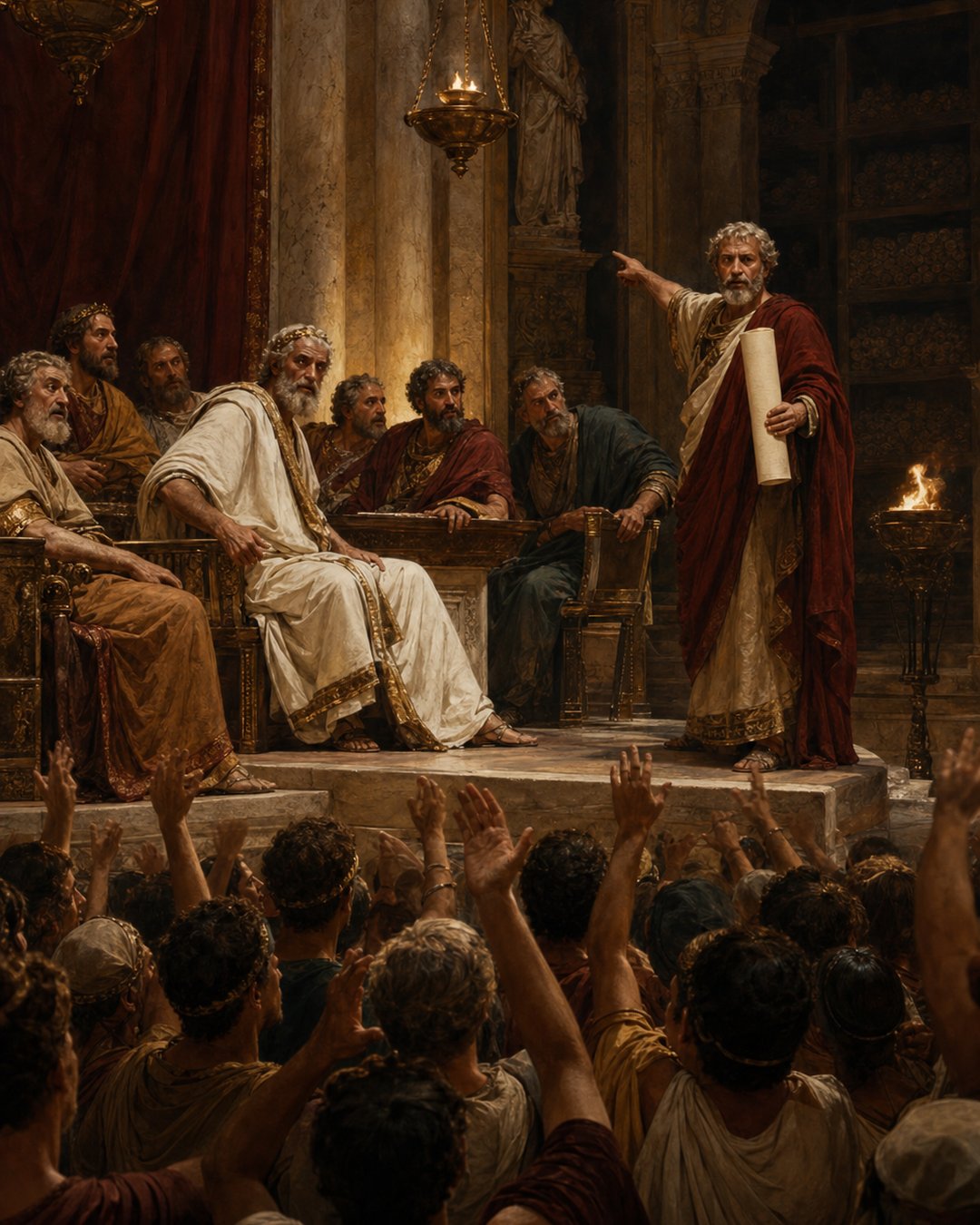
Alexandria’s audience had already made up its mind. The favorite poet had pleased the crowd, and six of the seven judges were ready to reward him.
The seventh judge produced the opposite ranking. Aristophanes said the best poet was the competitor whom the public had liked least. Vitruvius says the king and the multitude reacted with indignation. A literary celebration had suddenly become an argument over whether applause could identify authorship.
Aristophanes did not answer with taste alone. He claimed that only one competitor was truly a poet. The others, he said, had recited compositions taken from other writers. Then he led the dispute away from the stage and toward the shelves he knew from daily reading.
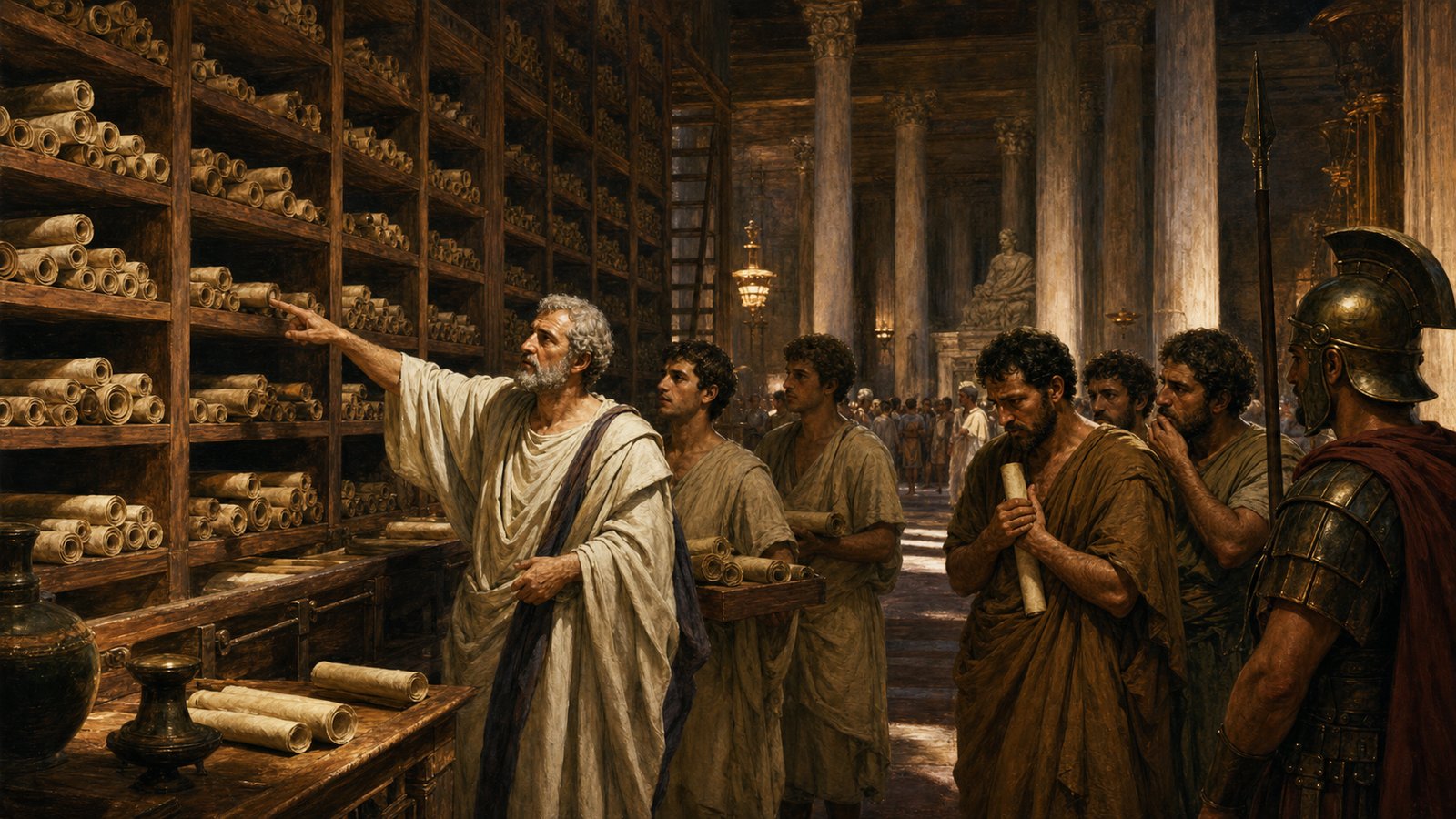
By naming books in the royal library and comparing them with what had just been performed, he made the reciters confess. The contest could be corrected because Alexandria possessed not merely many texts, but a reader able to retrieve the right ones under pressure. In Vitruvius’s story, the library became an engine for testing a public claim.
A royal contest borrowed the shape of an athletic game
Vitruvius places the episode in a competition founded by Ptolemy. He first recalls two great collecting projects: the Attalid kings had established a public library at Pergamum, and Ptolemy gathered a comparable collection at Alexandria. The Egyptian king wanted his library to keep increasing rather than remain a finished monument.
His literary games honored the Muses and Apollo. Vitruvius says they imitated contests for wrestlers, complete with rewards and honors for victors. Poems therefore entered a civic spectacle with an audience, ranked performances and prizes. Writing was made visible through bodies reciting before a crowd.
That format created a tension. A recitation could be judged by immediate effect, but authorship depended on a history no audience could hold in view all at once. The most stirring voice might be delivering words first composed somewhere else. Performance occupied minutes; comparison required access to years of accumulated reading.
Public book culture supplies useful background, but this episode narrows the question. Libraries made collected memory available beyond a single household. Vitruvius shows what could happen when that memory entered a live verdict. A shelf could challenge a theater full of confidence.
The games also made literary authority unusually crowded. Ptolemy supplied the institution and rewards; library keepers supplied a candidate judge; poets supplied recitations; the audience supplied applause; seven judges supplied rank. No participant controlled every stage. Aristophanes’s intervention mattered because one part of the institution—the reader formed by the collection—could correct another part when public enthusiasm outran verification.
The king chose six learned judges and then struggled to find a seventh. The people responsible for the library recommended Aristophanes. Their reason was practical rather than ceremonial: day after day, with sustained effort, he read through the books under their care. The missing judge was found through a habit of attention.
One vote separated popularity from composition
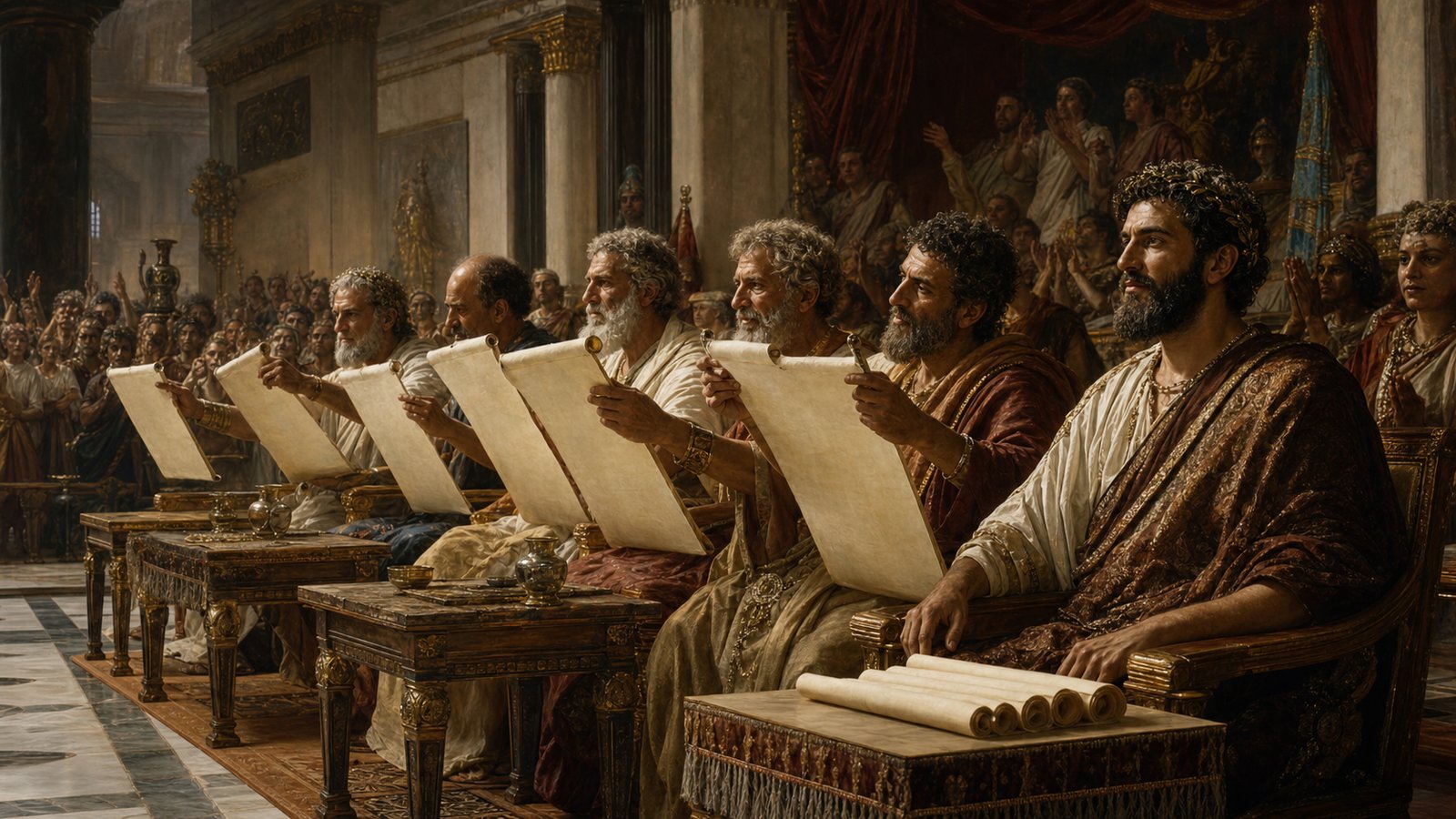
The poets recited first. The public unanimously indicated the piece it preferred, and six judges agreed that the crowd’s favorite deserved first prize. Another entrant would receive second. Consensus joined audience response to expert judgment so neatly that the result appeared settled.
Aristophanes broke that alignment. He placed the least popular contestant first. Vitruvius does not say that this poet gave the finest performance. Aristophanes’s category was more fundamental: this was the one competitor whose composition could be treated as his own.
The reversal angered both king and crowd because it seemed to reject the evidence everyone had just experienced. They had heard the poems; they had registered pleasure; the majority of judges agreed. Aristophanes asked for space to explain why those facts answered the wrong question.
He distinguished compositions from thefts. A judge could rank performances only after deciding that the competitors had brought eligible work. Without that prior test, a prize might reward the reciter most effective at borrowing. The least applauded entrant could therefore be the only real poet in the room.
Vitruvius tells this as an exemplary story, not a surviving court transcript. Its details should be read with that literary purpose in mind. Even so, the sequence he chose is concrete: seven seats, six aligned votes, one dissent, public anger, shelf references, comparison and confession.
Aristophanes carried the argument to exact shelves
Memory made the dissent more than contrariness. Aristophanes cited a large number of books on particular shelves. He compared those texts with the recitations, and the competitors acknowledged what they had taken. The library gave his private recognition a public route of verification.
A modern reader might imagine a catalogue search, page numbers or a formal doctrine of copyright. Vitruvius supplies none of those things. His mechanism is simpler and more physical. A man remembered books; books occupied findable places; attendants could bring them forward; spoken passages could be set beside earlier compositions.
This helps explain why his daily reading mattered. Possessing a collection did not automatically reveal a disguised borrowing. The useful instrument was the relation between collection and practiced reader. Aristophanes had moved through enough material to notice verbal ownership where others heard only a successful poem.
The making of each book also involved fragile labor. Papyrus sheets were built from crossed strips before texts could circulate on them. At Alexandria those physical objects accumulated into a comparison set large enough to defeat a false claim made in a single performance.
The evidence worked because it was recoverable. A vague declaration that a line sounded familiar would have left the king with rival opinions. Pointing toward identifiable shelves changed the dispute. The earlier authors were absent, but their works could still answer in material form.
The librarian’s reward followed the corrected verdict
Vitruvius says the king ordered proceedings for theft. After condemnation, the reciters were dismissed with disgrace. Aristophanes received great rewards and became librarian. The man recommended because he read the collection was placed in charge of it after proving what such reading could do.
The outcome tied office to demonstrated competence. Aristophanes did not win by pleasing the audience; he restored the terms of the contest against the audience’s preference. His promotion acknowledged that guarding a library meant more than preserving rolls from damage. It could also mean defending the distinction between an inherited text and a new composition.
There is an important limit to the analogy with modern plagiarism. Vitruvius does not provide rules about quotation marks, permissions or legal ownership across centuries. His charge concerns competitors presenting earlier compositions as the work being judged. The deception mattered because prize and reputation were about to attach to the wrong makers. Keeping that narrower claim avoids turning an ancient moral anecdote into a modern statute it never was.
Vitruvius uses the anecdote to frame his own architectural book. He says writers who borrow from others and publish the work as their own deserve censure. He also admits his debt to earlier authors and names the tradition from which he learned. The Alexandrian contest provides the warning: accumulated knowledge enables new work, but it can also expose concealed appropriation.
The crowd was not foolish for liking a performance. Its response simply could not settle provenance. Six judges were not incompetent because they heard the same immediate appeal. They lacked the comparison that Aristophanes supplied. Once the shelves entered the room, unanimity lost its authority.
Alexandria’s library is often imagined through scale: more books, more collecting, more royal ambition. Vitruvius gives it a sharper function. A collection could preserve enough memory to interrupt a prize ceremony at the exact moment when borrowed words were about to become a new author’s reputation.
Sources
Vitruvius, On Architecture, Book 7, preface 3–7