
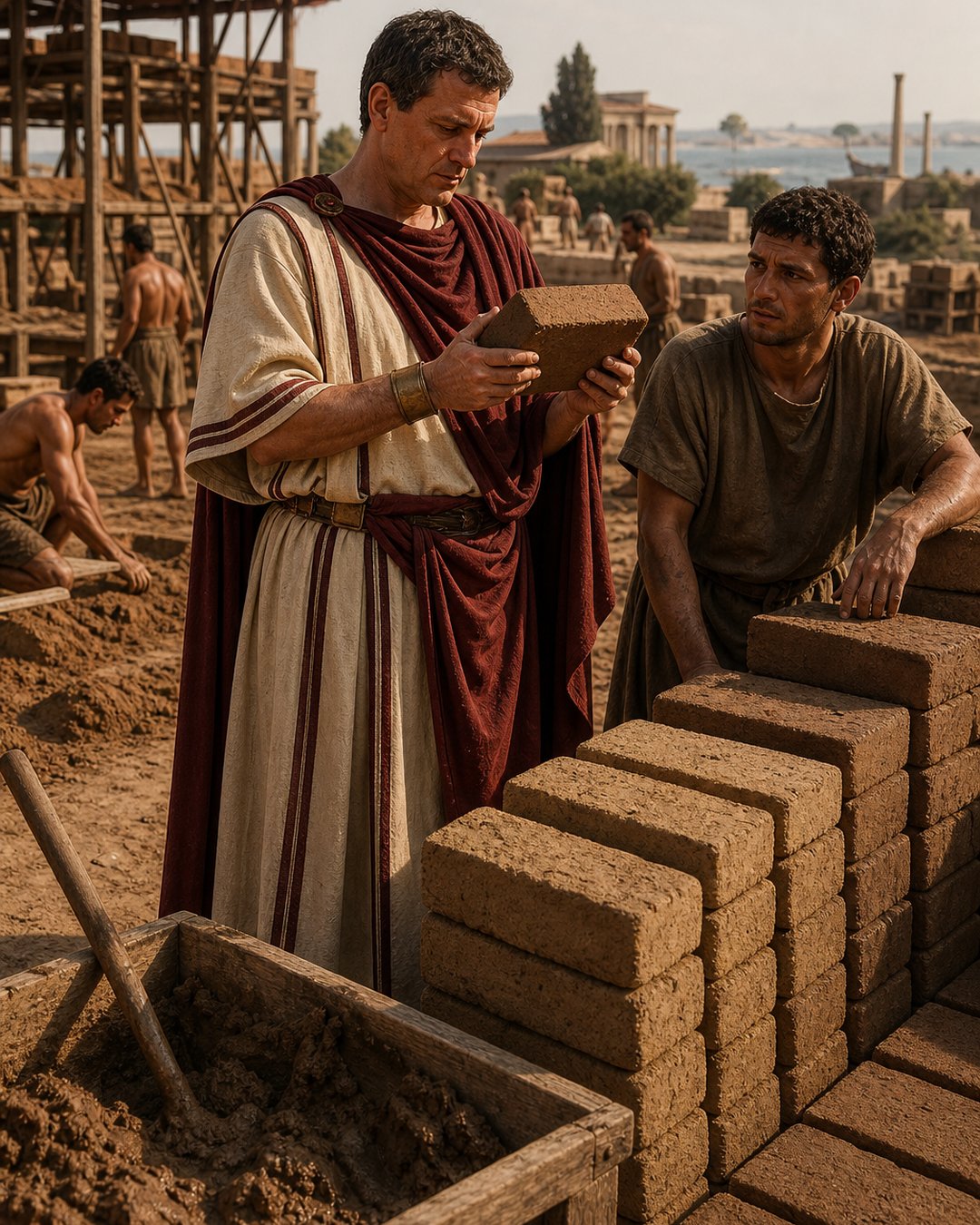
A wall in Utica began with five years of waiting.
Vitruvius says the city allowed no brick into a building unless it had reached that age and received a magistrate’s approval. His own general advice was already patient: the best bricks, he wrote, had dried for at least two years. Utica more than doubled the interval and added a civic decision.
The reason lay inside the clay, beyond a quick glance. A brick could look dry at the surface while remaining wet enough within to change shape later. Once placed under hardened plaster, that hidden moisture became a structural timing problem. The brick continued to shrink; the plaster did not follow; the finish cracked, and sometimes the wall suffered with it.
Vitruvius therefore makes brick quality a story about delayed evidence. Colour and hardness at the surface were not enough. The dangerous change appeared only as the material dried through. Utica answered that uncertainty with elapsed time and public inspection: a building component had to survive years before it was trusted with a wall.
The wrong earth failed before drying even began
Vitruvius starts with soil rather than law. Gravelly, pebbly and sandy clay, he says, should not be used for bricks. Such material produced heavy units, and walls made from them deteriorated under rain. Its rough character also prevented the mixed straw from binding the earth sufficiently.
His preferred materials were red or white chalky earth and what his translation calls a strong sandy earth. These were ductile and cohesive. They also produced bricks that were not excessively heavy, which made them easier to handle while workers carried them upward through a building project.
The contrast joins chemistry, labour and weather. A brick had to hold together during manufacture, endure lifting, sit in a wall and resist rain after completion. The choice of earth affected every stage. Material that was inconvenient in a yard could become weak in a storm years later.
This is why Roman brick should not be imagined as an interchangeable reddish block. Preparation began with selection. The maker judged grain and cohesion before straw could reinforce the mixture or a mould could impose dimensions. A successful wall depended on decisions made while its units were still loose soil.
The archive’s tile-yard footprints preserve the softness of clay during production. Vitruvius looks at the same vulnerable phase from the builder’s side. Before clay could record an animal’s step—or bear a roof or wall—it had to become a consistent material without hiding defects that later weather would reveal.
Summer sunlight created a convincing false surface
Season came next. Vitruvius recommends spring and autumn because bricks dried more evenly then. He specifically objects to production around the summer solstice, when intense heat worked too quickly on the outside.
The surface could acquire the appearance of sufficient dryness while the interior remained in a very different state. That phrase captures the inspection problem. The brick presented a finished face, but its centre had not completed the same transformation. Sunlight made the easiest part to see the least reliable guide to the whole.
As internal drying continued, the brick shrank. The portions hardened first could then crack as the wetter mass changed beneath or behind them. Vitruvius says this breakage destroyed strength. The defect was not simply cosmetic, and it did not necessarily announce itself when the brick left the mould.
Spring and autumn reduced the difference between skin and core by slowing and equalizing drying. The calendar functioned as a tool of production. Makers could not command moisture to leave every layer at once, but they could choose conditions less likely to create a shell around an unfinished interior.
This seasonal logic is distinct from firing pottery in a kiln. Vitruvius is discussing sun-dried building bricks whose readiness depended on air, time and controlled exposure. A hot day might accelerate the appearance of completion without accelerating the entire material safely.
Two clocks met where plaster covered the wall
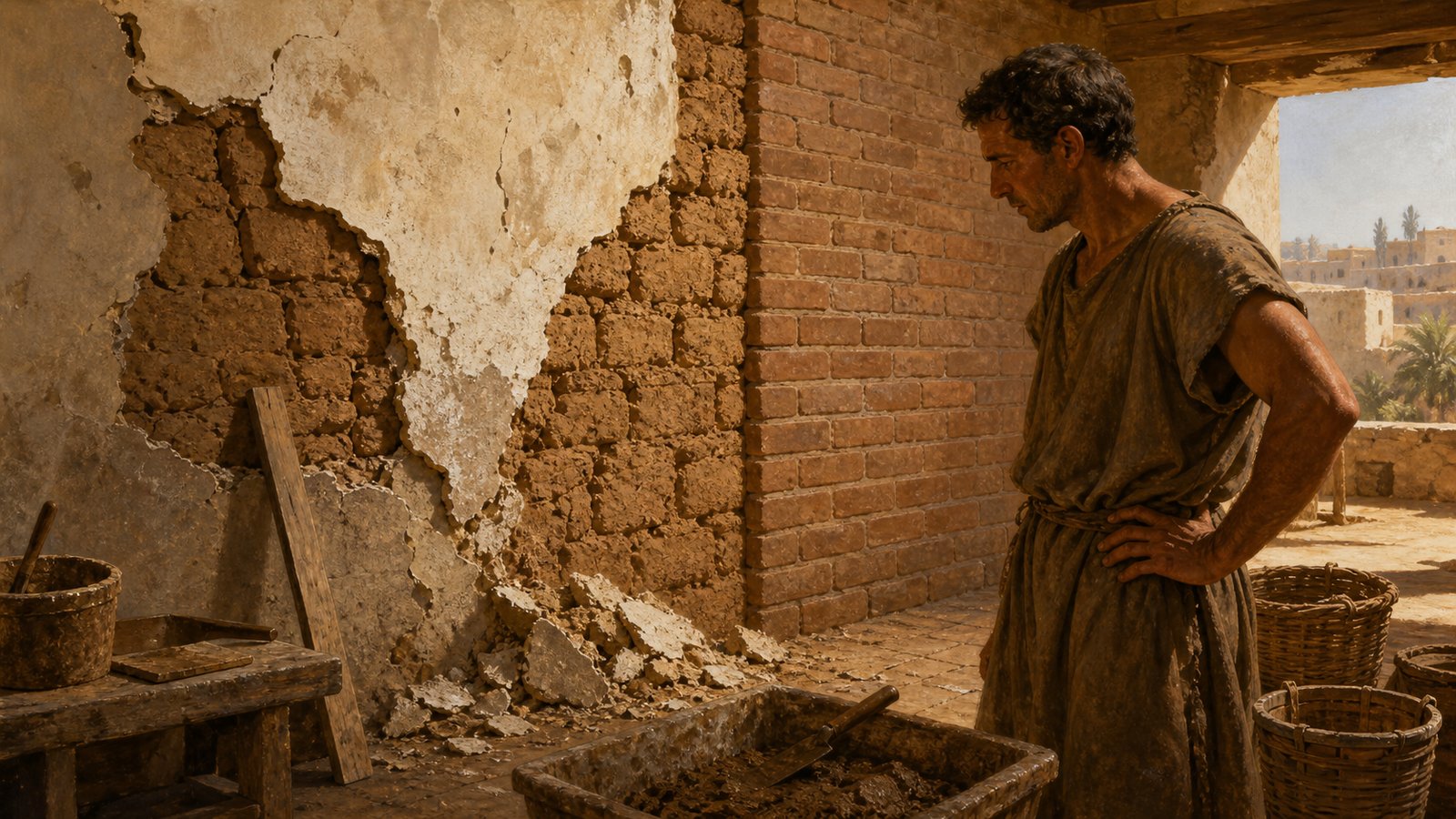
Vitruvius calls bricks at least two years old the best, because less time did not dry them thoroughly. The interval sounds extraordinary only if manufacture is treated as complete when the surface becomes hard enough to stack. In his account, the material still had a clock running inside it.
Plaster followed another clock. Applied wet, it set and hardened across the wall. If the bricks underneath were still drying, they later shrank and occupied less space. The plaster retained its earlier span. A gap in movement opened between finish and support.
Vitruvius describes the thin plaster as left standing by itself. Unable to support its own sheet, it broke into pieces. Sometimes, he adds, its failure drew the wall into failure too. A decorative or protective surface thus became evidence of a deeper mismatch between materials that had reached different stages of stability.
The mechanism helps explain why age mattered more than a single workshop inspection. A newly made brick might resist a hand, hold its edges and look uniform. None of those observations guaranteed that later shrinkage had ended. Waiting allowed the dangerous process to happen in the yard rather than under a finished wall.
Roman wall painters also worked against material time. pigment had to meet plaster while the surface was still receptive. Here the sequence was reversed: plaster that hardened successfully could be undermined by bricks that had not finished changing. Both crafts depended on knowing not merely what a material was, but when it was ready for the next layer.
Utica turned hidden moisture into a civic verdict
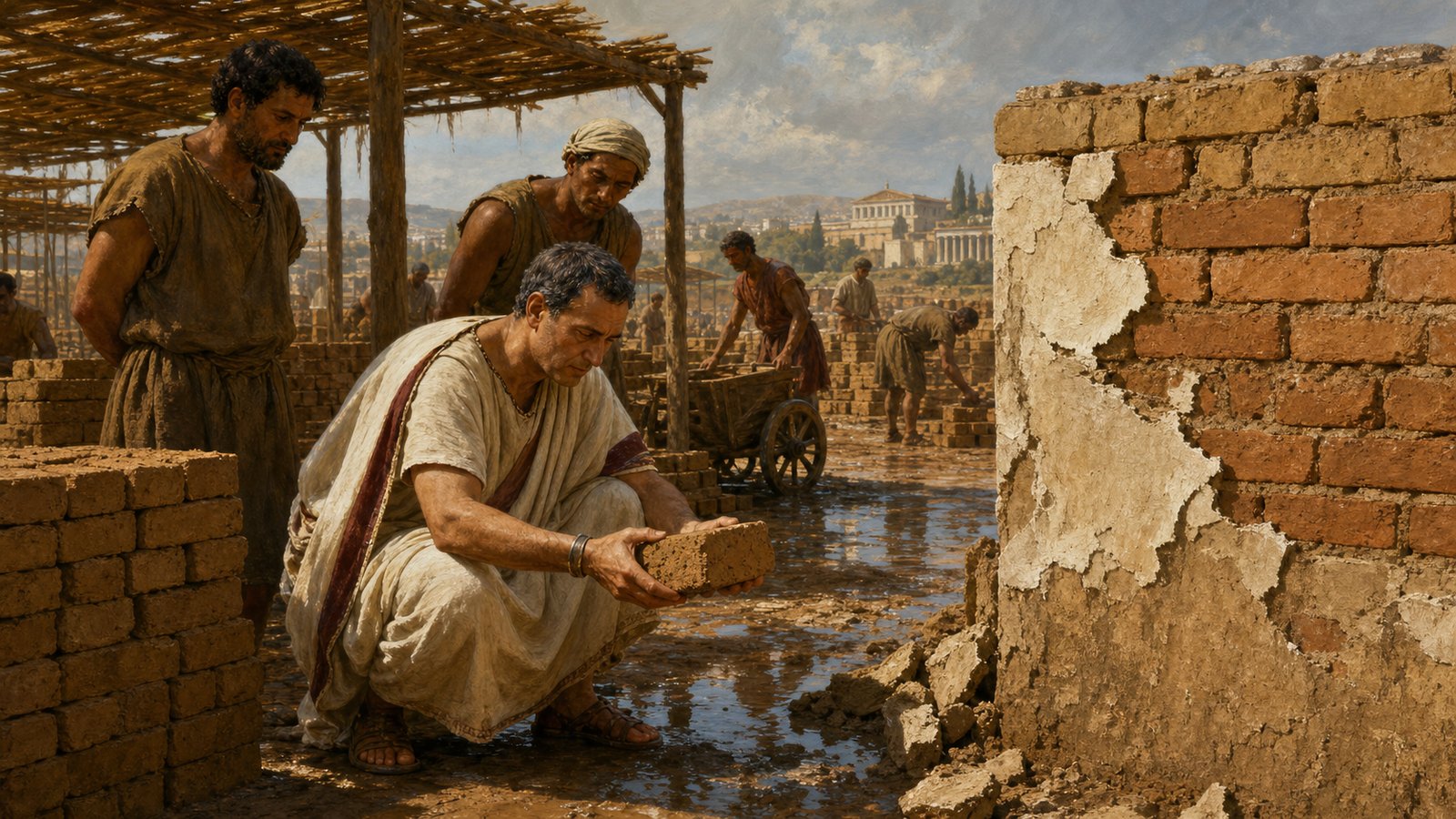
Vitruvius presents Utica’s rule as reasonable after laying out the failure chain. The city used no brick under five years old and required approval from a magistrate. Age alone was necessary but not sufficient; public judgment remained part of admission to the building site.
The five-year period created a long record without needing to break every brick open. Units that warped, cracked or weakened while drying could reveal themselves before they became masonry. Stable bricks had endured multiple cycles of season and storage. Time acted as a non-destructive test.
Magistrate approval placed responsibility beyond the maker and purchaser. Vitruvius does not explain the inspection procedure, so we should not invent stamps, laboratories or a detailed municipal office. What he does say is precise enough: civic authority stood between an aged brick and its use in a building.
That arrangement managed conflicting incentives. A builder might want available material; a producer might want stock sold; an owner might want work finished. The wall, however, would carry the consequences after the apparently dry brick had been hidden by plaster. Utica’s delay made readiness a public condition rather than a private promise.
Vitruvius then turns to dimensions. He gives the common Roman brick as one foot long and half a foot wide, and distinguishes Greek bricks measured by four or five palms. He says the larger Greek kind served public works and the smaller private buildings. Size varied by building tradition, but no dimension cancelled the moisture problem. A well-proportioned brick could still be too young.
The rule’s significance lies in the way it joined observation to administration. Vitruvius identified a physical sequence—uneven drying, shrinkage, unsupported plaster, breakage. Utica converted that sequence into two enforceable questions: how old is the brick, and has a magistrate approved it?
Five years did not make Roman construction modern, standardized or risk-free. It did make patience part of quality. The city refused to let a convincing surface settle the argument. Before clay entered a wall, it had to finish changing where failure could still be seen.
Sources
Vitruvius, On Architecture 2.3