
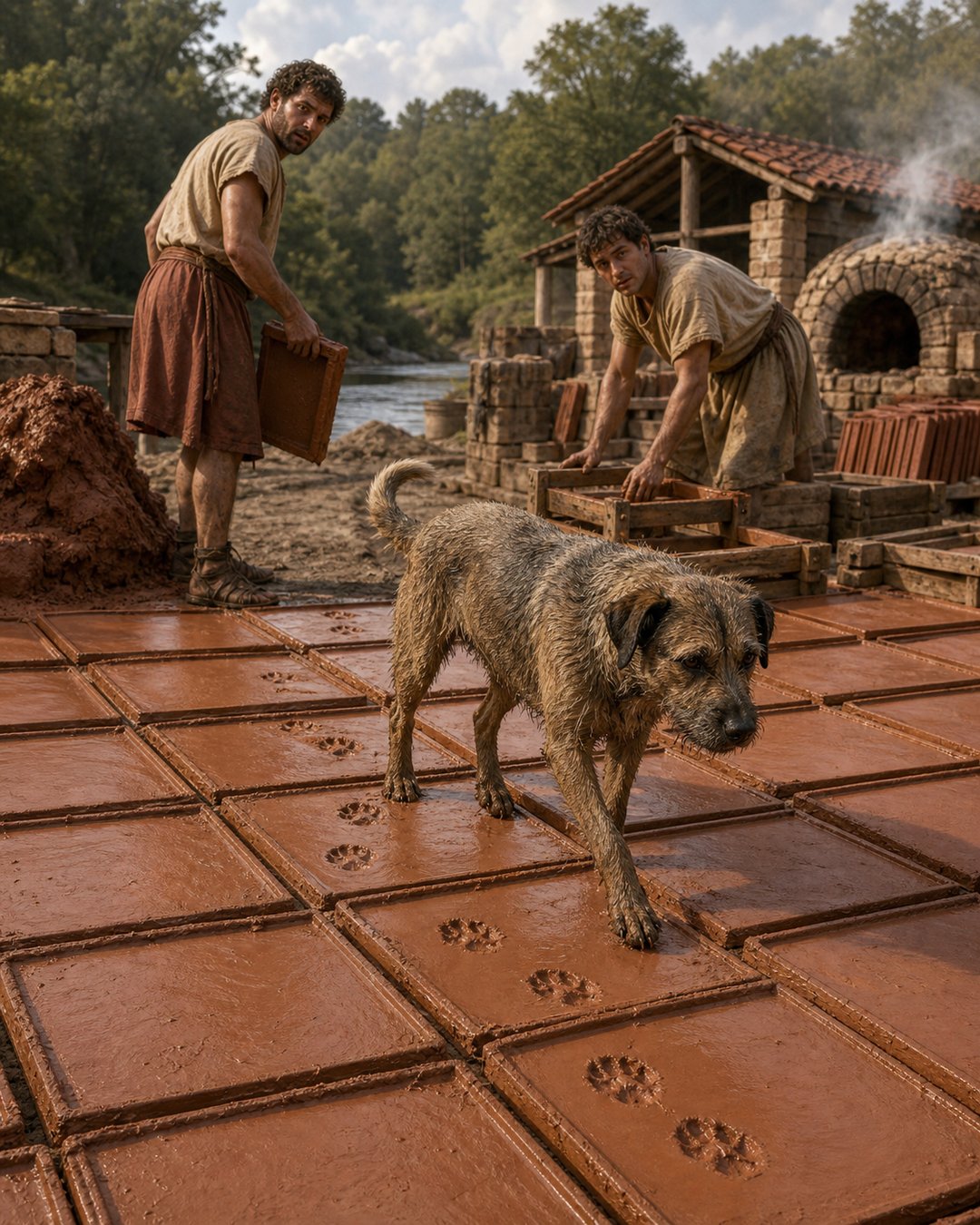
A dog crossed a Roman workshop at exactly the wrong moment for the tile maker and exactly the right moment for archaeology. The clay beneath its paw was firm enough to hold a roof tile’s shape but wet enough to receive pads and claws. Nobody smoothed the damage away. Heat later turned the mistake into stone-like ceramic, carrying a few seconds of movement far beyond the building for which the tile was intended.
Examples survive across Roman Britain. A fragment from Folkestone Roman Villa carries a dog print. A fired tegula in the London Museum bears three. At Rough Castle on the Antonine Wall, a thick tile from an underfloor heating stack preserves the step of a medium or large dog. Gloucester has yielded dog, boot and piglet marks, as well as a much rarer cat print noticed decades after excavation.
These are easy objects to sentimentalise, but their value is larger than a moment of recognition. Impressions form before firing, so they belong to the manufacturing yard rather than the finished roof or heated floor. Counted across an assemblage, paws, hooves, claws and human feet become evidence for when tiles dried, which animals moved nearby and what sort of landscape surrounded the kiln.
The Print Belongs to the Yard, Not the Finished Building
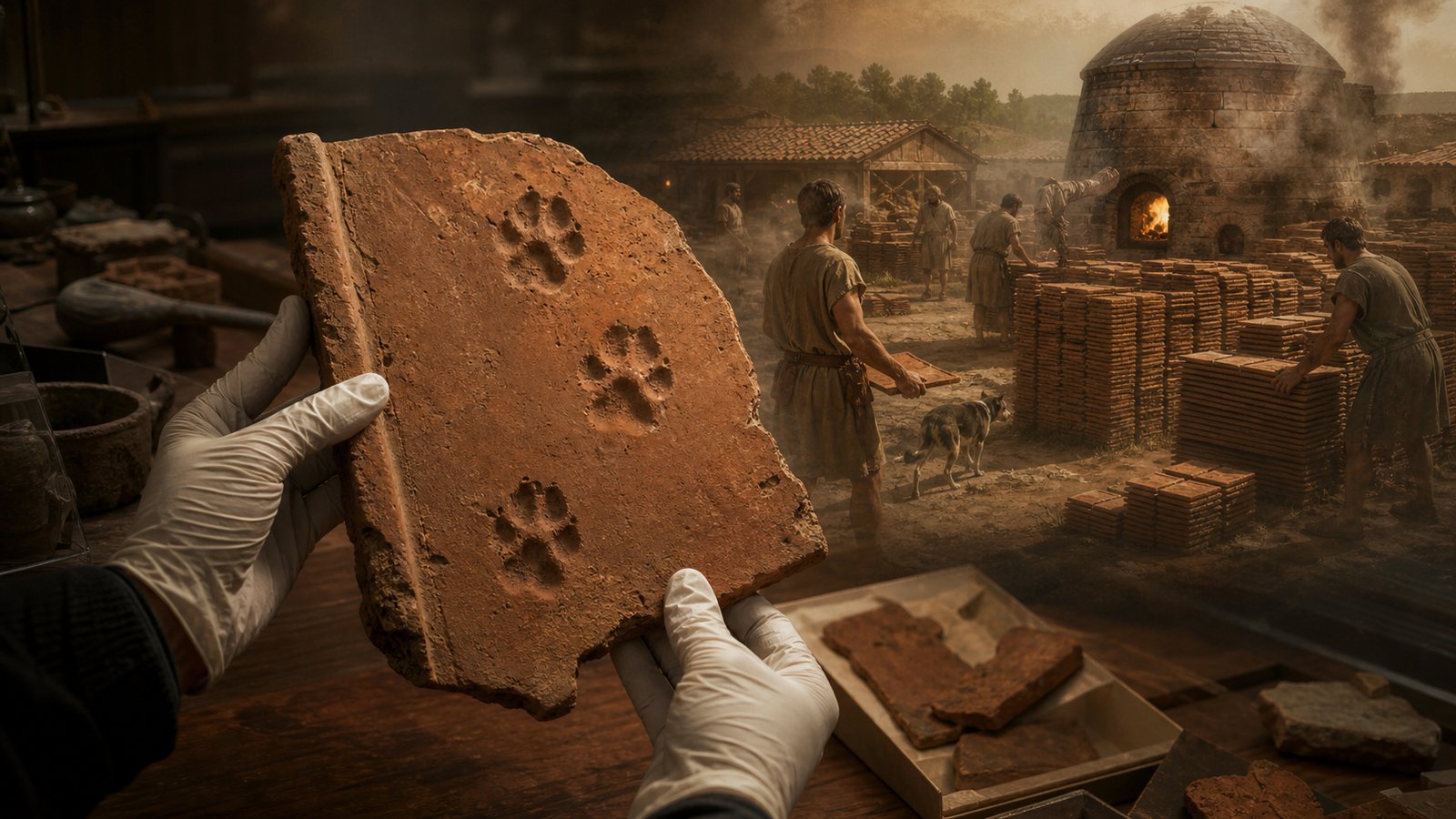
Roman builders commonly covered pitched roofs with two complementary ceramic forms. Flat tegulae had raised edges; curved imbrices bridged the joins and helped make the surface shed water. The London Museum’s paw-marked example is a tegula dated broadly to AD 75–200. Its surviving fragment measures 220 by 145 millimetres and holds three dog impressions.
The animal did not walk across an installed roof. Tiles had to lose moisture before they could be fired safely, and makers laid the newly formed pieces out to dry. A print pressed into that surface was then hardened in the kiln. The sequence matters: shape, dry, accidental crossing, fire. It fixes the encounter inside production rather than later use.
That manufacturing context separates these marks from scratches made after a building collapsed. A fired depression with the anatomy and stride of a paw points back to soft clay. It also explains why the tile could still be used. A small dog or cat might leave visible hollows without cracking the slab; a much heavier animal could ruin it.
The earlier article on how tegulae and imbrices controlled rain follows tiles onto a roof. Paw prints take us in the opposite direction, before the roof existed, when rows of clay occupied open ground and the weather mattered as much as masonry.
One Rough Castle Step Connects a Fort, a Furnace and a Dog
The Rough Castle fragment entered the Falkirk museum collection in 1926 with the Mungo Buchanan material. It is almost square, about 9.4 by 8.4 centimetres, and unusually thick at 4.8 centimetres. Its upper face carries a dog’s paw. The print size suggests a medium or large animal, although neither breed nor age can be recovered from a paw alone.
Its thickness changes the object’s story. The Falkirk account identifies it not as roof covering but as part of a pila, one of the small columns that supported a hypocaust floor. At a military fort, such heating is plausibly associated with an officer’s house. The same accidental mark therefore links an animal in a production yard to a carefully heated interior on Rome’s northern frontier.
Rough Castle is the second-smallest fort on the Antonine Wall and one of its best preserved. The tile does not tell us whether the dog belonged to a soldier, a worker or someone living nearby. It cannot prove that the animal guarded stores or hunted. The safest reconstruction is narrower and more vivid: wet structural clay was accessible long enough for a dog to cross it before firing.
That restraint is important. Roman dog remains from sites such as Vindolanda show animals of very different sizes living around forts, but this single impression supplies no name, task or owner. What it gives with confidence is contact: animal, workshop surface and a precise stage in the making of a heated building.
Silchester Turns Charming Accidents into a Species Count
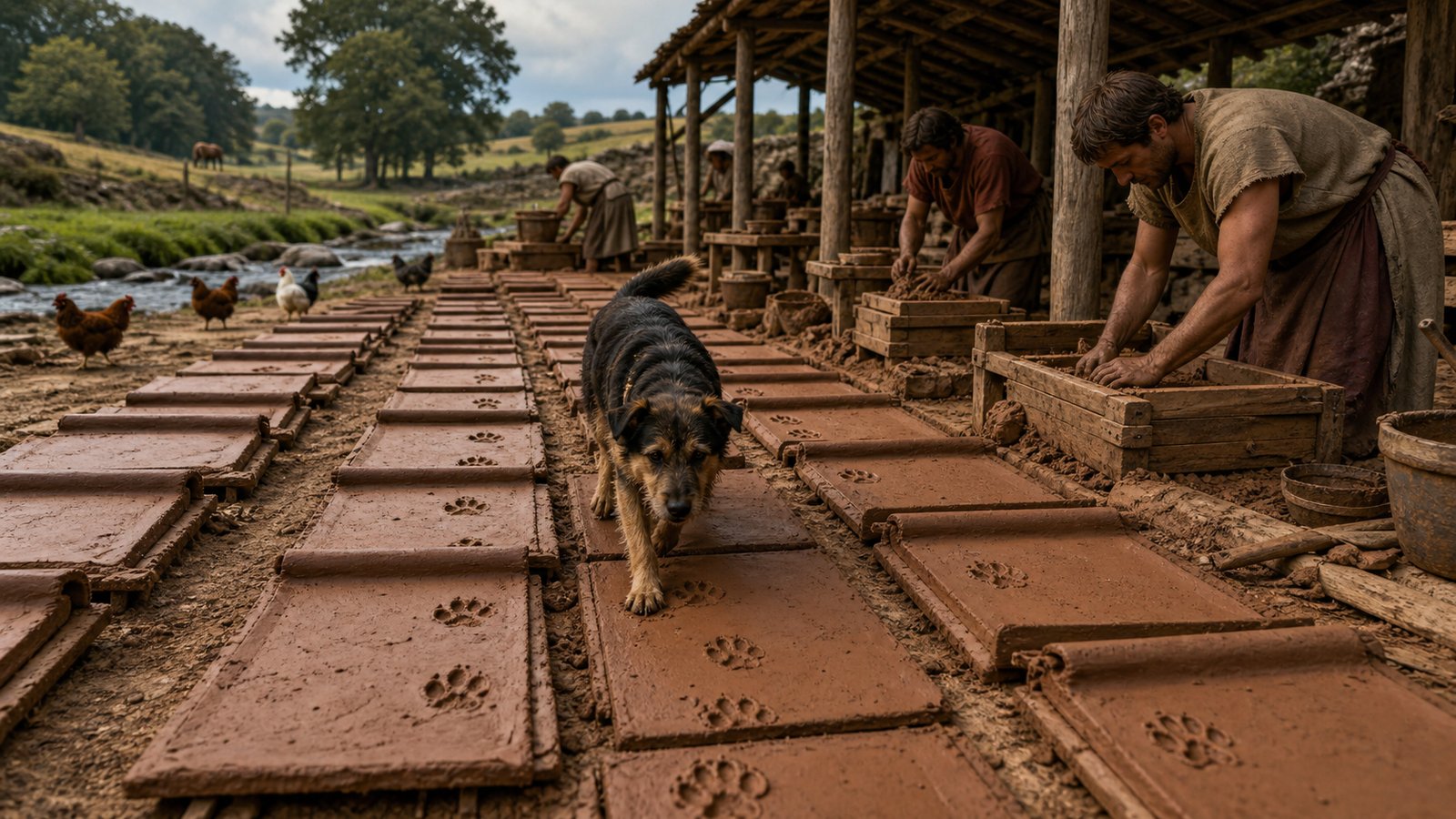
A single paw is an anecdote. The University of Reading’s work on Silchester shows what happens when impressions are studied as an assemblage. Researchers identified ten bird species and seven mammal species from marks on Roman brick and tile, plus six kinds of hoofed animal. Domestic chicken appeared beside wild crane, tawny owl, raven and crow; mammals included dog, cat, weasel, hare and fox.
Dogs dominate the mammal evidence. They account for nearly 75 percent of identified mammal prints in the Silchester collection, while cats contribute a further 16 percent. Different paw sizes reveal variation among the dogs present, but size alone cannot safely identify breed or age. The numbers describe traffic through the working landscape, not a census of pets.
Hooves widen that picture. Cattle, sheep or goats crossed the area, as did red and roe deer. Newborn cattle are disproportionately visible because an adult stepping on a soft brick would be more likely to destroy it. Young sheep can be more informative about season: the main lambing peak in March and April places at least some drying activity near that part of the year.
One chicken print at Silchester records a bent fourth toe, interpreted as an old break that had healed well enough for the bird to walk. A small crane print belongs to a young bird; crane chicks generally hatch from May to July. Red deer young, born mainly between mid-May and late July, add another seasonal clue. Each track remains modest evidence, but several together give the tile yard a calendar.
Tracks Map Water, Woodland and Work Around the Kiln
Tile making required more than clay and fire. The common reconstruction for Roman Britain is a cycle spread across the year: clay could be extracted in autumn and weathered through winter; fuel timber was conveniently cut when trees were bare; forming and drying concentrated in warmer months; firing followed once the pieces had dried sufficiently. Tracks entered during the most exposed part of that chain.
Wild species help locate that exposure. Wading birds point toward fresh water. Roe and red deer favour woodland or its margins. The mix at Silchester fits a tilery near water, trees, pasture and small-scale animal keeping—the same resources and open ground needed for ceramic building production. Prints make the workshop’s surroundings legible without a written plan.
They also complicate the image of a sealed industrial compound. Sheep, goats, cattle, chickens, dogs and cats moved close enough to drying stock to leave evidence. This does not prove that tile makers ran large farms. The Silchester interpretation instead favours limited husbandry compatible with demanding kiln work, perhaps supporting the people operating the tilery.
Fire completed the record. As the kiln’s separated fire and firing chamber helped ceramic survive intense heat, it also fixed the soft impressions. An inconvenience that escaped rejection became part of the material itself.
A Cat Print Waited in Storage for Someone to Look Again
The Gloucester cat print shows that discovery can happen twice. The tegula was excavated in Berkeley Street in 1969, but the paw was noticed only when an archaeologist examined thousands of Roman roof-tile fragments decades later. The tile is thought to date to about AD 100. Dog paws, boot marks and even a piglet’s trotter were already known from Roman Gloucester; cat prints were described as rare.
Museum storage did not make the object mute. Re-examination changed an ordinary building fragment into evidence of an animal crossing a drying surface. That matters for collections dominated by repetitive material. Roof tiles can look interchangeable when catalogued by the crate, yet edges, stamps, fingerprints, footprints and firing scars preserve separate stages of work.
The Folkestone fragment offers another compact example. Found during excavations at the Roman villa between 2010 and 2013, it is catalogued as an earthenware roof-tile fragment dating within the Roman occupation of Britain, AD 43–410. Its dog print says little alone about the villa’s household, but securely returns the object to wet clay before the finished building.
The best question is therefore not whose beloved dog this was. It is what had to be true for the mark to survive. Tiles lay exposed; animals crossed the yard; some damaged pieces were still serviceable; kiln heat preserved the encounter; builders carried the fired product away; collapse buried it; excavation recovered it; and a curator or specialist finally recognised the track.
That chain turns sentiment into method. The paw print is touching because it feels immediate, but useful because its timing is constrained. A dog’s ordinary step becomes evidence for Roman manufacture precisely because clay, weather and fire trapped it between shaping and construction.