
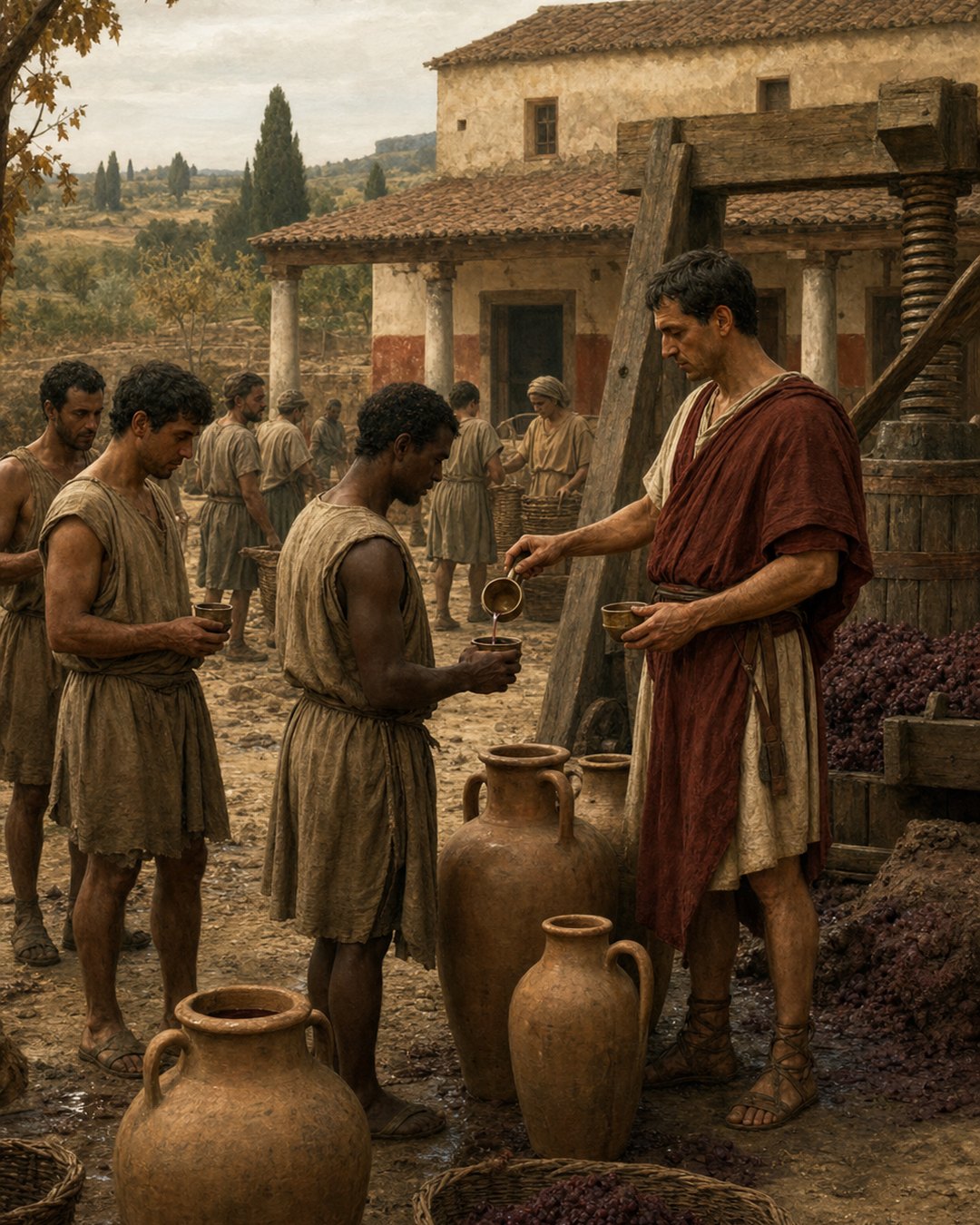
Cato’s farm did not issue the same wine all year. It counted forward from the vintage.
For three months, the hands received after-wine made from grape residue. In the fourth month came a hemina a day. The daily amount rose again through months five to eight, then reached three heminae in the final four months. Saturnalia and Compitalia brought additional issues.
The table appears in On Agriculture beside grain, bread, olives, fish pickle, oil, salt, clothing and shoes. It is tempting to read the numbers only as evidence of Roman food. They are also evidence of control. Cato was budgeting the subsistence of people whose labour and movement the estate commanded, including a chained gang.
Seasonal precision joined agricultural experience to coercion. Work, crop stage and festival altered what the farm distributed. Human need entered the owner’s manual as a cost to be timed, measured and recovered where possible.
Bread rose when the vines demanded more work
Cato begins with grain. Field hands receive four modii of wheat in winter and four and a half in summer. The overseer, housekeeper, foreman and shepherd receive three. The differences sort people by role and season rather than presenting one household standard.
His instruction for the chained gang is even more explicit. Their bread allowance stands at four pounds through winter, rises to five when work on the vines begins and falls back to four when the figs ripen. The ration follows tasks in the field.
The passage does not record workers choosing this arrangement, bargaining over it or describing hunger in their own words. It speaks from the owner’s side. That silence is part of the evidence. People appear as categories whose consumption can be adjusted against expected labour.
The phrase “chained gang” should not be softened into generic farm staff. Cato’s estate economy included enslaved people held under direct physical coercion. The numerical clarity of the ration does not make the system humane; it shows how thoroughly compulsion could be organized.
Cato advised buyers to inspect a farm repeatedly before trusting its appearance. The ration chapters reveal the same managerial eye turned inward. A profitable estate depended not only on land and equipment but on regulating the bodies forced to work them.
The wine year began with what the press left behind
Wine distribution follows the vintage. For the first three months after harvest, Cato tells the owner to issue after-wine. The translation uses that term for a weaker drink produced from the remains of pressing rather than the estate’s main wine.
In month four, each person receives a hemina a day, which Cato calculates as two and a half congii per month. In months five through eight the issue doubles to a sextarius daily, five congii monthly. In months nine through twelve it rises to three heminae a day, summarized as an amphora each month.
The progression converts the agricultural year into a consumption schedule. It does not map neatly onto modern calendar months because its starting point is the vintage. The crop itself resets the clock.
Cato gives extra wine for Saturnalia and Compitalia: three and a half congii per person across the two festivals. Those additions acknowledge ritual and social time without releasing the estate from accounting. Celebration enters as a line in the annual allowance.
He totals the ordinary issue at seven quadrantals for each person and says ten quadrantals is not excessive for a year. The chained gang may receive more in proportion to work. Even an apparent upper allowance remains connected to productivity.
Roman wine presses made harvest a sequence of controlled force. Cato carries control beyond the pressing floor. The primary product and its residue were assigned different destinations, and the weaker result became the first quarter of the labourers’ drinking year.
Relish, oil and salt were designed to last
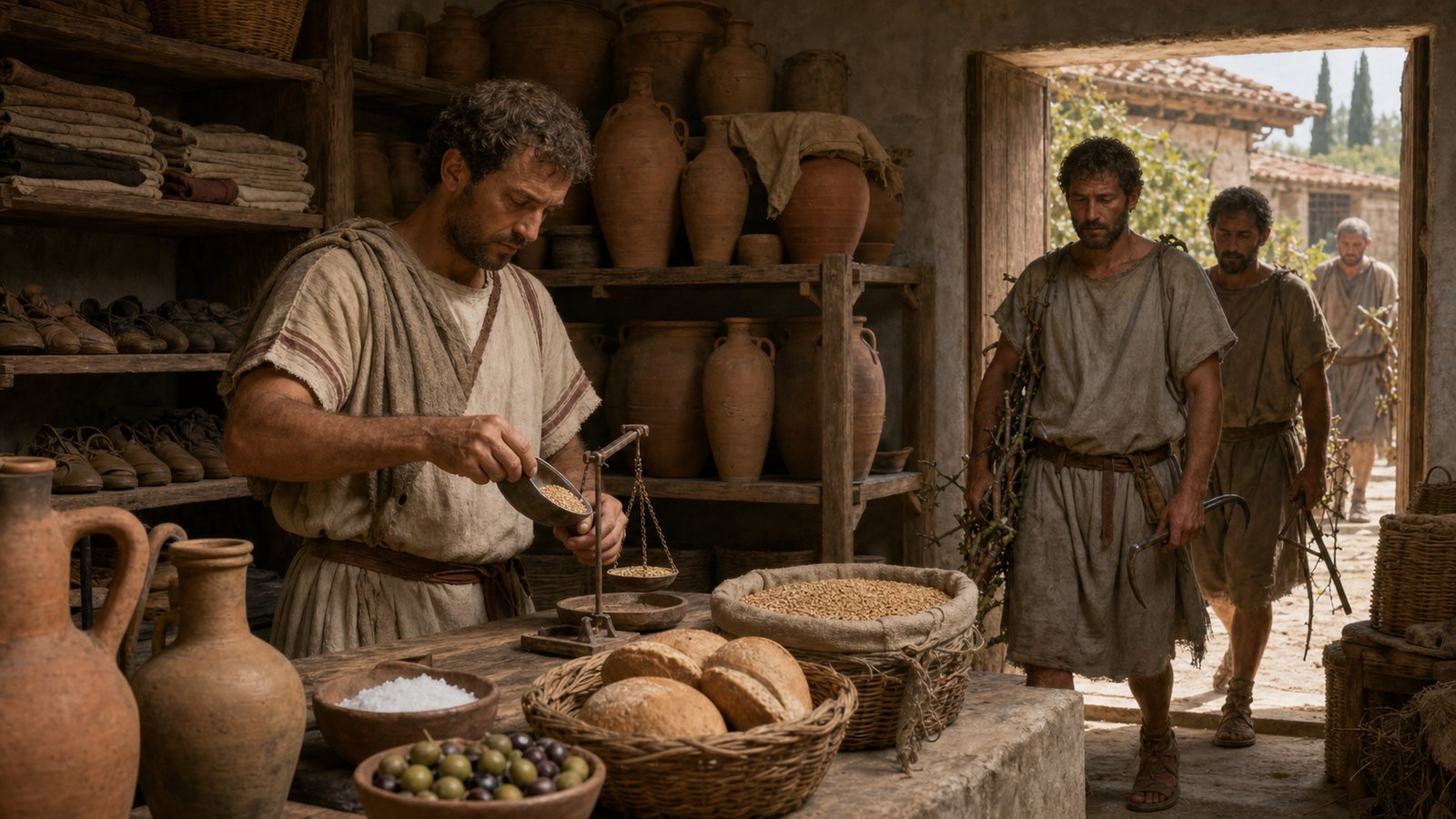
The next chapter moves from drink to what accompanied staple food. Cato instructs the owner to save as many windfall olives as possible, then mature olives that would yield little oil. They are to be issued sparingly and stretched for as long as they last.
This is a hierarchy of uses. Valuable olives could become oil or saleable produce. Fallen or low-yield fruit could become workers’ relish. Nothing in the instruction is wasted if a lower-value input can replace a higher one.
When the olives are gone, fish pickle and vinegar take their place. Oil is limited to a pint per person each month, while one modius of salt is declared sufficient for a year. The language of sufficiency belongs to the manager, not the recipient.
Together these items show why a ration cannot be reconstructed from one headline figure. Wheat or bread supplied bulk, but taste, fat and preservation came through smaller issues. Their timing depended on stores running down.
The lists are physically concrete: sacks of grain, loaves, amphorae, windfall olives, pungent pickle, vinegar, oil and salt. Yet the system they form is abstract. Each item becomes interchangeable inside a budget for sustaining labour at minimum planned cost.
Even a worn tunic returned to the account
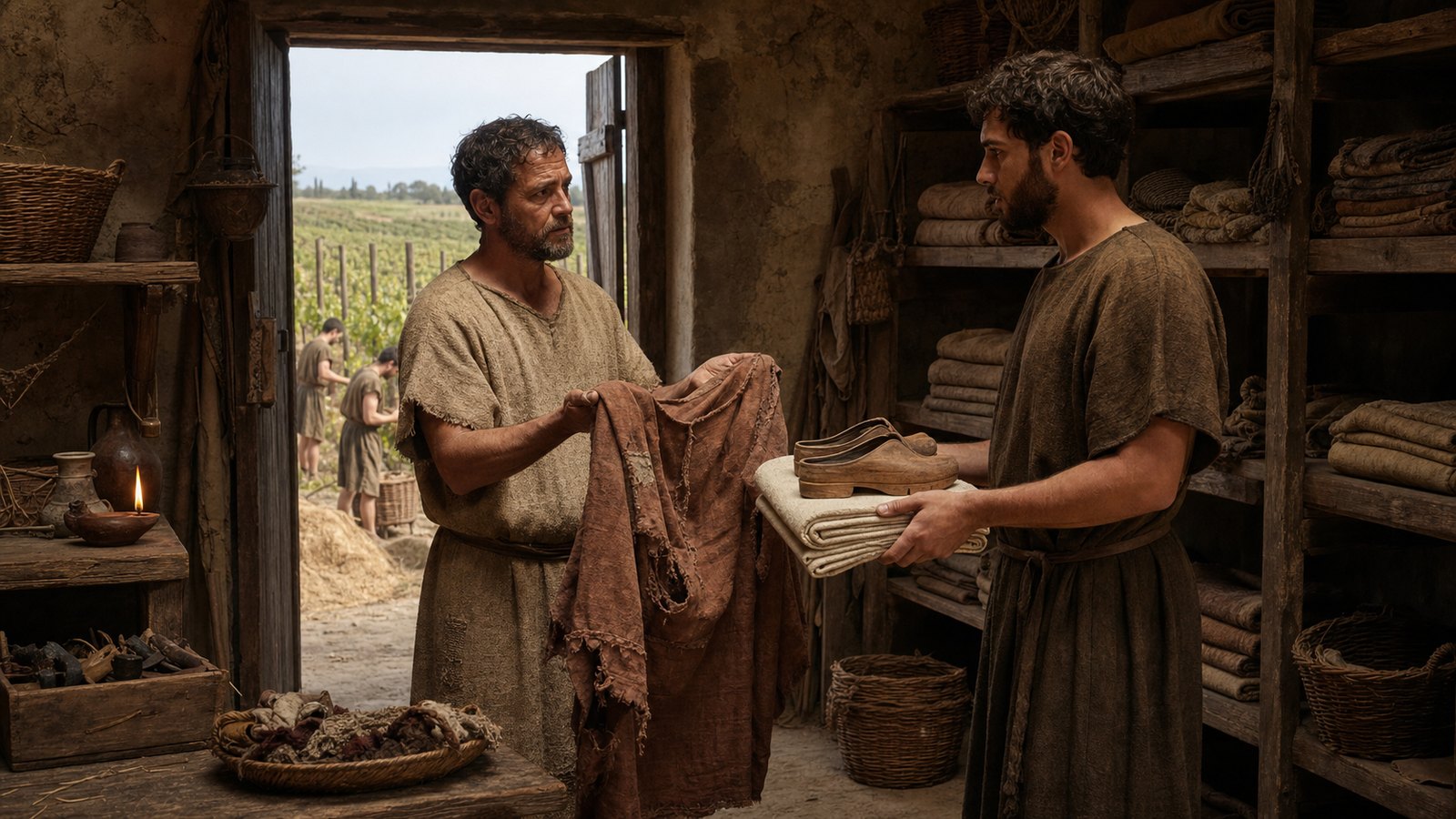
Cato’s clothing rule extends the same logic across years. A tunic and blanket are issued every other year. When the new item is handed out, the old one must first be taken back and used for patchwork.
The exchange prevents worn cloth from leaving the owner’s inventory. An object may cease to serve as a full garment but remain useful as repair material. Replacement is therefore also recovery.
Stout wooden shoes arrive on the same two-year cycle. Cato does not describe comfort, fit or individual wear. A repeated interval substitutes for personal assessment, making footwear predictable from the estate’s perspective.
These chapters sit near a ration for a yoke of steers. That textual neighbourhood is uncomfortable and revealing. Cato moves from food and clothing for hands to fodder for draught animals with the same practical tone. It does not mean he thought every category identical; it does show that his manual organized living bodies as productive assets.
The repeated calculations also allowed an absentee owner to imagine control at a distance. Monthly and yearly totals gave the overseer targets that could be checked against stores. If amphorae emptied too quickly or grain vanished before the seasonal change, the discrepancy became visible to management even when the owner had not watched each issue.
A modern reader should resist turning the table into a cheerful farm menu. The exact figures are valuable because they expose the owner’s priorities: raise bread when labour intensifies, begin wine with residue, add festival allowances without losing the annual total, stretch low-value olives, ration oil and salt, reclaim old cloth, replace shoes on schedule.
Cato’s farm calendar was written into stomachs and clothing. Vintage, vines, figs and festivals did not merely tell workers what season it was. They told the estate what those workers would receive. The result is one of Roman agriculture’s clearest documents of management—and one of its starkest records of unequal power.
The surviving schedule cannot tell us how closely every estate followed it, how recipients supplemented it or how often illness and bad harvest disrupted the plan. It does show what one influential author thought could be standardized. The gap between that managerial ideal and lived experience should remain open rather than being filled with a tidy reconstruction.
Sources
Cato the Elder, On Agriculture 56–59