
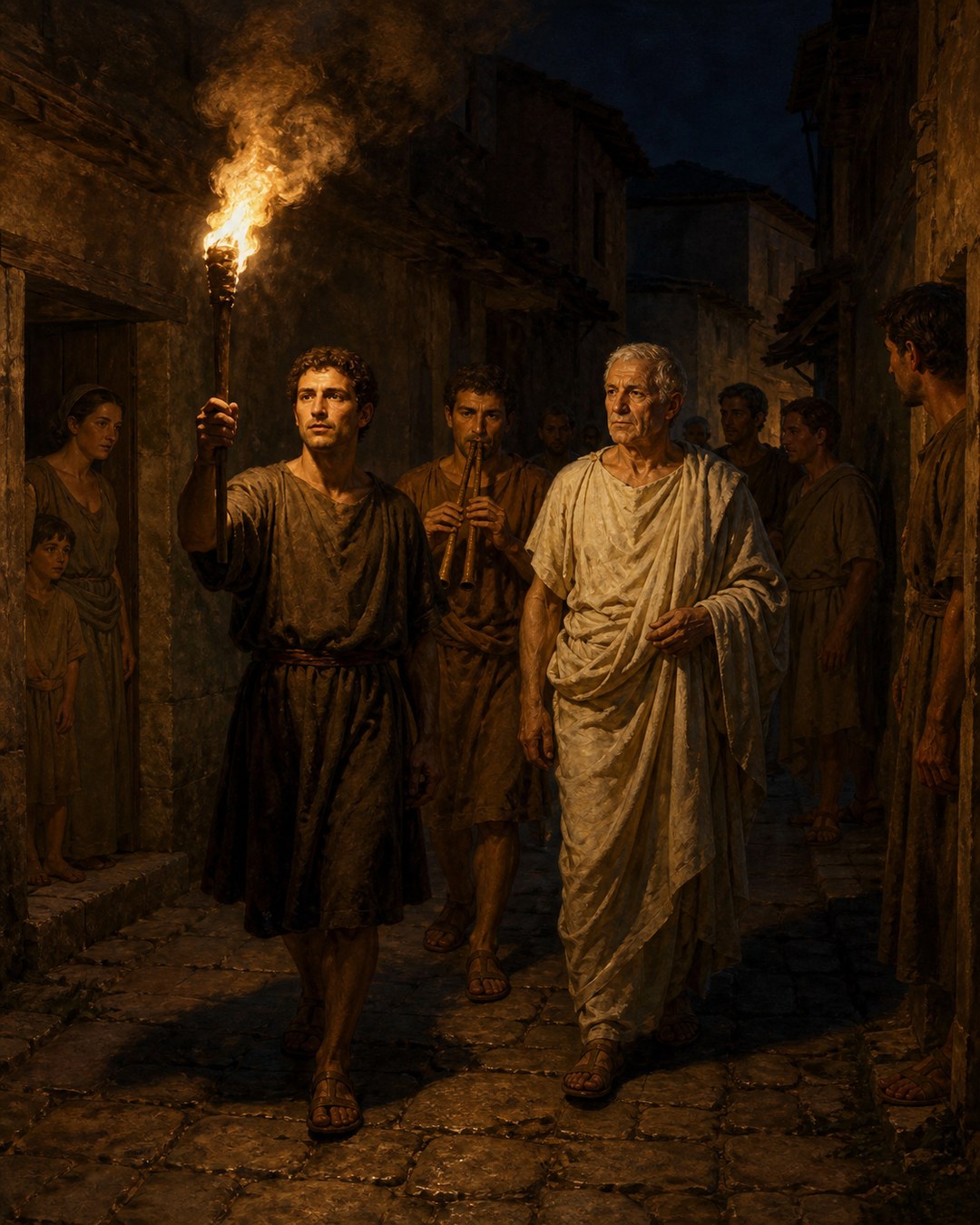
Long after Rome’s first naval triumph had ended, its sound could still be heard after dinner. An old Gaius Duilius walked home through the city with two attendants: one playing a flute, the other carrying a wax torch. Cicero says he saw this more than once as a child. The detail is small enough to feel domestic, yet he treats it as something no private citizen had done before.
Duilius had earned fame at Mylae in 260 BCE, where Roman ships defeated a Carthaginian fleet. Rome answered with its first naval triumph, a column dressed with captured ship beaks and a temple funded from spoils. The night escort did something those fixed monuments could not. It made victory move again whenever the old commander left a banquet.
The pair of attendants did not recreate a whole triumphal procession. They extracted two elements—music and carried fire—and placed them on an ordinary route from dining room to doorway. The result was a recurring public signal. Neighbors could hear it before they saw it, then watch the brief pool of light pass and disappear.
Cicero remembered the honor as a street scene
The surviving anecdote comes with a witness built into it. In On Old Age, Cicero has his speaker recall Gaius Duellius, son of Marcus, as the first Roman to win a naval victory over the Carthaginians. He was already old when the speaker was young. This is not a report of one formal ceremony preserved only in official language; it is a memory of repeated encounters in the city.
Duilius was seen returning from dining out. A torch-bearer and flute-player attended him because, Cicero says, the arrangement delighted him. The phrase gives the old victor agency and pleasure without turning the escort into a purely private indulgence. Cicero immediately measures it against civic convention.
He calls the display an ostentation assumed by a private citizen without precedent, then adds that Duilius’s glory allowed so much latitude. Both halves matter. The escort was conspicuous precisely because normal private movement did not carry triumphal sound and light as a standing privilege. Its acceptability depended on a public achievement large enough to excuse an exceptional form of arrival.
Cicero places the anecdote in a discussion of aging and moderate conviviality. Duilius is not on campaign or reviewing a fleet. He is an old man coming back from a meal. Military fame has entered the rhythm of later life, where it can be recognized without armor, office or a mass audience assembled in advance.
Mylae supplied the victory, but not the article’s mechanism
The achievement behind the escort was Rome’s breakthrough at sea during the First Punic War. Polybius introduces Duilius after describing the boarding bridge that let Roman marines cross onto an enemy deck. At Mylae, the Roman fleet captured Carthaginian ships and prisoners on a scale that made the result politically unforgettable.
Eric Kondratieff’s study of Duilius’s column and coinage assembles the ancient and inscriptional evidence: a captured flagship, thirty other captured vessels, more than a dozen sunk and 7,000 prisoners. Those figures belong to the commemorative tradition around the victory, not to the tiny escort itself. They explain why Rome could regard Duilius’s name as capable of carrying unusual honors.
The battle’s hardware already has its own story in the corvus and the fight on deck. Here the important transition comes afterward. A spectacular event had to be translated into forms that could survive beyond the day of victory: distributions, buildings, inscriptions and repeated behavior.
Duilius returned to Rome for the first naval triumph in Roman history. Kondratieff places it at year’s end, on the Kalends of an intercalary month. The rostral-column inscription also records naval booty distributed to the populace. Triumph therefore joined captured objects, public generosity and bodily procession before any later monument fixed the claim in stone.
A flute and wax torch reduced a triumph to two cues
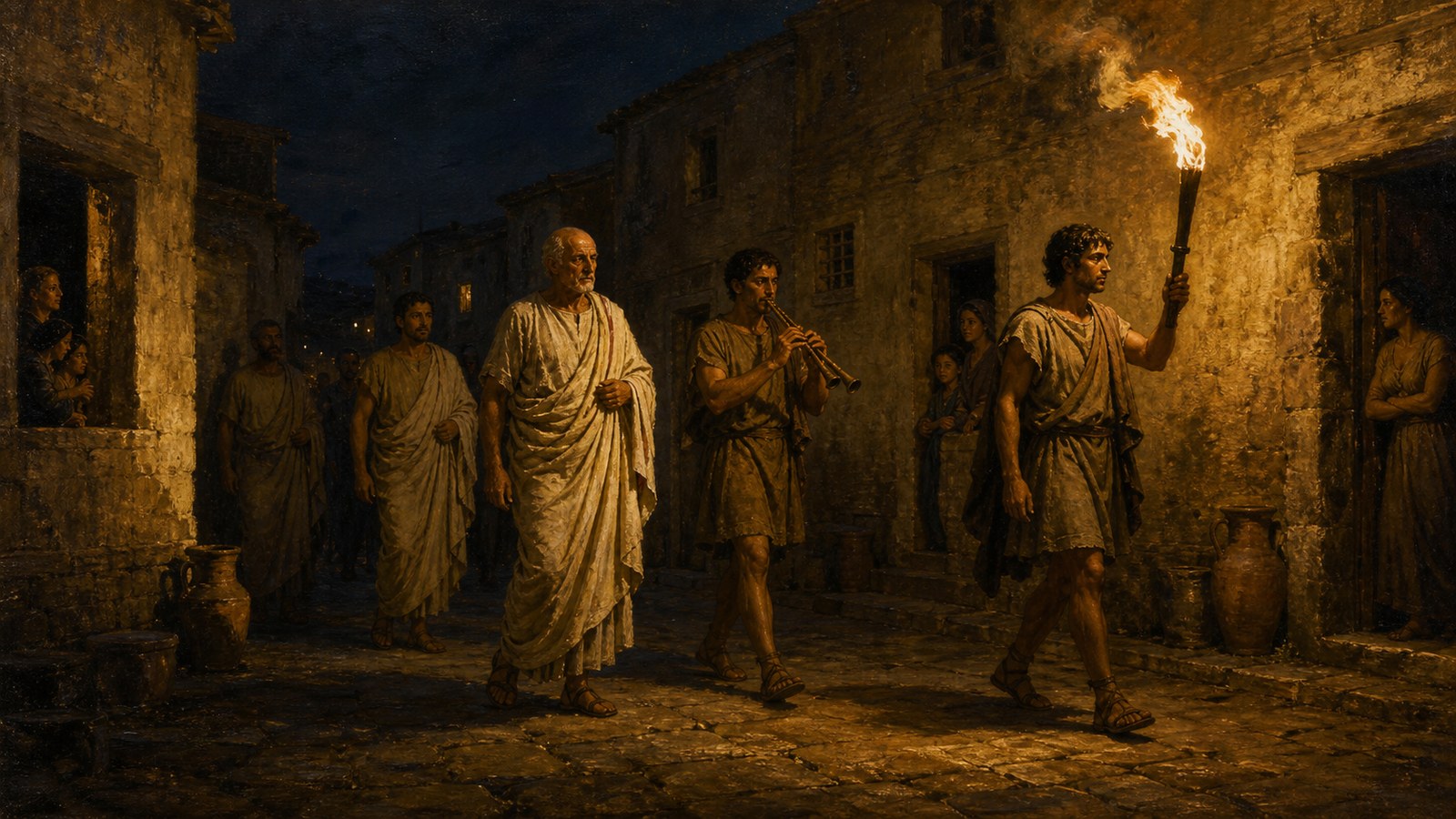
A full triumph required a special day, an authorized route and a crowd. The post-banquet honor was radically smaller. One musician supplied a sound associated with ceremonial movement; one attendant made the group visible at night. Nothing else was needed for observers to register that this was not an anonymous man making his way home.
Sound enlarged the escort beyond its physical size. A flute could turn corners before the walkers did and pull attention toward the approaching group. Torchlight then separated faces and cloth from the dark street. The two cues worked in sequence: announcement, appearance, recognition and departure.
The route mattered as much as the objects. Duilius was not standing beside his column waiting for viewers. He moved from other people’s dining rooms toward his own house. Every return created a temporary line through the city, and each doorway along it offered another possible audience. The performance borrowed its force from ordinary urban circulation.
The Augustan elogium, as reconstructed and discussed by Kondratieff, treats the escort as permission. Later testimony even specifies public expense. The evidence does not require us to imagine an identical procession every night of Duilius’s old age. It does show that Roman memory preserved a continuing right, not merely one charming personal habit.
Rome gave the same victory several different bodies
The nocturnal escort sat within a much larger commemorative system. The senate and people ordered a rostral column in the Forum, decorated with the beaks of captured warships. The column made naval spoils stand vertically in Rome’s political center. An inscription converted action into named, countable achievement.
Duilius also built a temple to Janus from war booty in the Forum Holitorium, perhaps dedicating it as censor in 258 BCE. The building moved the victory into sacred space and tied captured wealth to a lasting public structure. Unlike the escort, it could be visited without Duilius being present.
These forms were not redundant. A temple organized worship and benefaction. A column asserted honor in the Forum. The distributed booty gave citizens a material share in success. The escort attached remembrance to Duilius’s living body. One victory could therefore be encountered as architecture, inscription, possession, story and moving sound.
This layering helps explain the larger Roman triumph’s work on public emotion. A triumph did not simply announce that a commander had won. It sorted captives, spoils, spectators and the victor into an authorized civic image. Duilius’s later escort preserved only a fragment of that image, but repetition gave the fragment a long life.
The unusual right survived because writers found it useful
Cicero was not the only ancient author to preserve the flute and torch. Kondratieff traces the honor through Livy’s summary, Valerius Maximus, Florus and later writers, as well as the Augustan elogium. The sequence warns us not to treat every wording as contemporary evidence from 260 BCE, yet it also shows how durable the anecdote became.
Its attraction lies in the contrast between scale and economy. Mylae involved fleets, boarding equipment, captured hulls and thousands of prisoners. The remembered reward required two attendants. Roman storytelling could compress a naval victory into a sound and a light without making the honor feel trivial.
There is also tension in Cicero’s phrasing. He notices delight and ostentation, precedent and exception. Duilius’s glory does not erase the normal boundary around private display; it explains why Rome permitted him to cross it. Honor becomes visible as a negotiated privilege rather than a vague reputation.
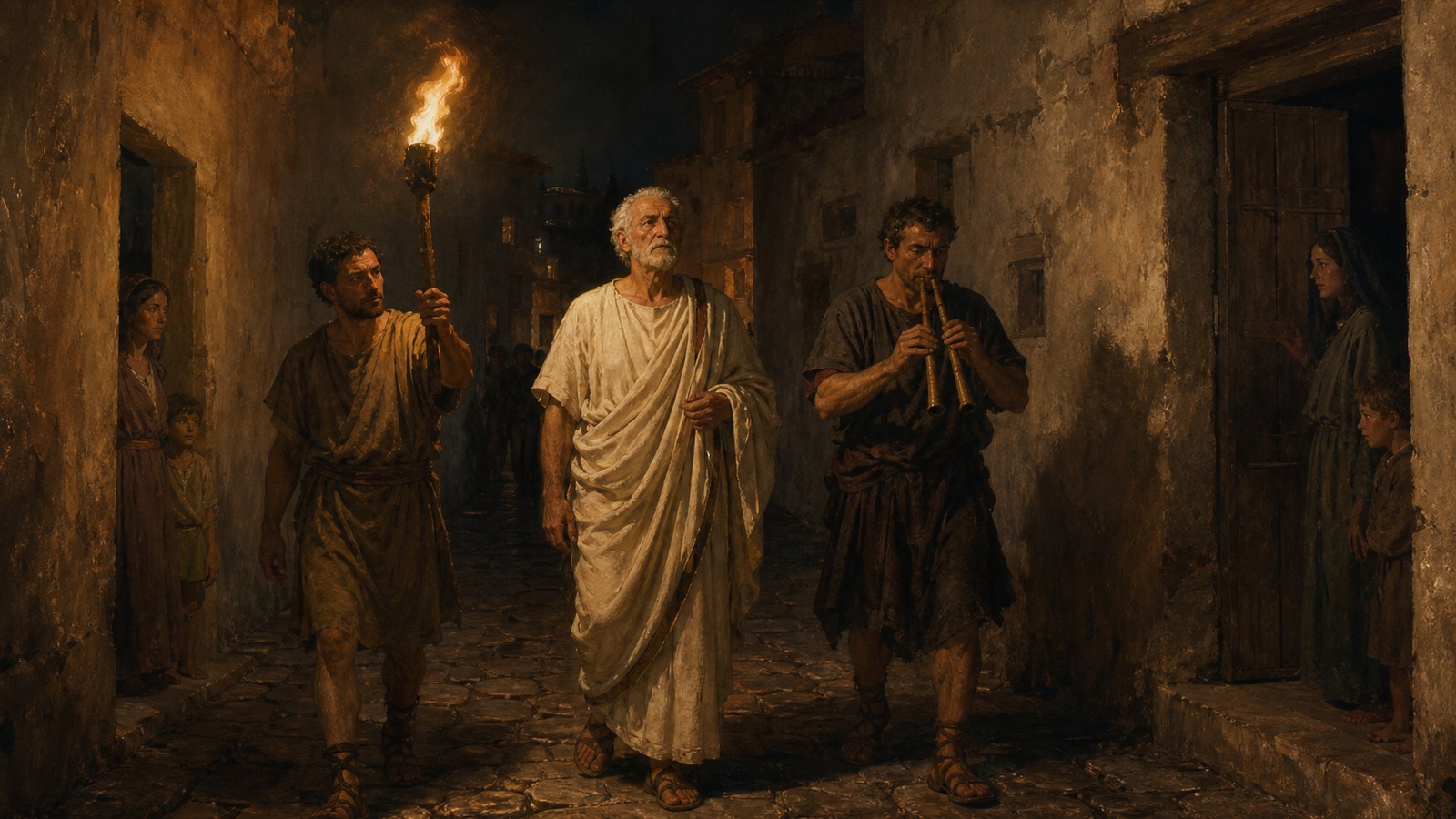
The old victor eventually vanished from the route. The column’s fabric changed, the inscription was restored and scholars still debate its phases. The anecdote kept moving because it was easy to stage in the mind: dinner ends, a flute begins, wax catches fire, and an elderly man walks through streets that recognize what those two attendants mean.
Sources
Cicero, On Old Age, 44; Polybius, Histories, 1.22–23; Eric Kondratieff, “The Column and Coinage of C. Duilius.”