
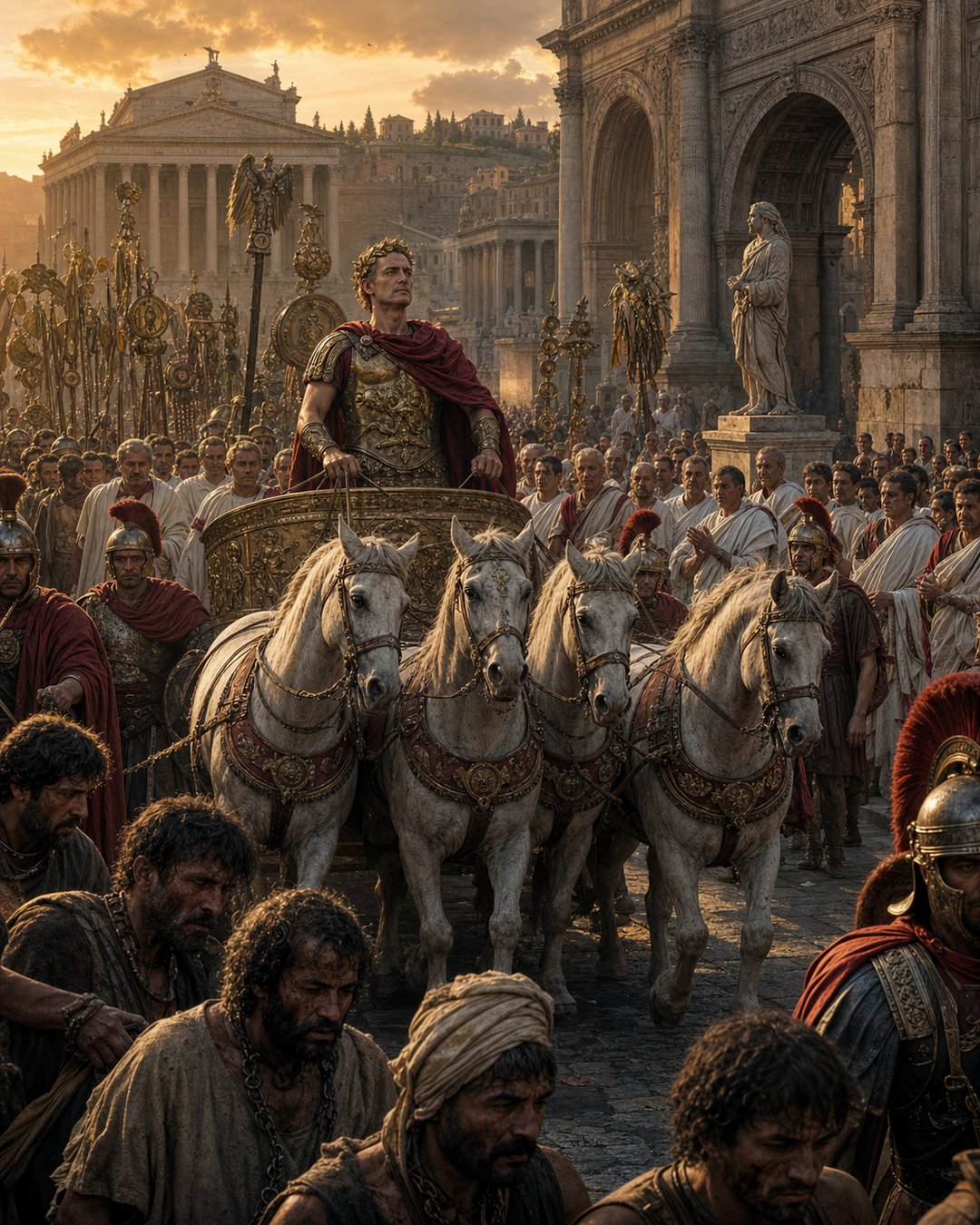
The triumph was not Rome’s way of saying, politely, “we won.”
It was Rome forcing victory to walk. Captured armor clattered through the streets. Prisoners moved in front of the crowd. The commander came behind them, lifted into a near-divine costume for a few hours, while the city watched foreign defeat become Roman memory. A triumph looked like celebration because celebration was the skin. Under it was a warning.
Rome did not only defeat enemies on battlefields. It taught its own citizens how defeat should look.
The captive came before the conqueror
The basic order mattered. William Smith’s nineteenth-century summary of the Roman triumphus, drawing on ancient evidence, describes the victorious general entering the city in a four-horse chariot, preceded by captives and spoils, followed by his troops, passing along the Via Sacra and ascending the Capitol for sacrifice to Jupiter. That sequence is not decorative. The defeated people, their objects, and their symbols were placed before the man who claimed the victory.
Rome made the enemy visible first. The crowd did not simply hear that a war had ended; it saw bodies, weapons, standards, plate, statues, and royal households moving under Roman control. The city received a lesson before it received a hero.
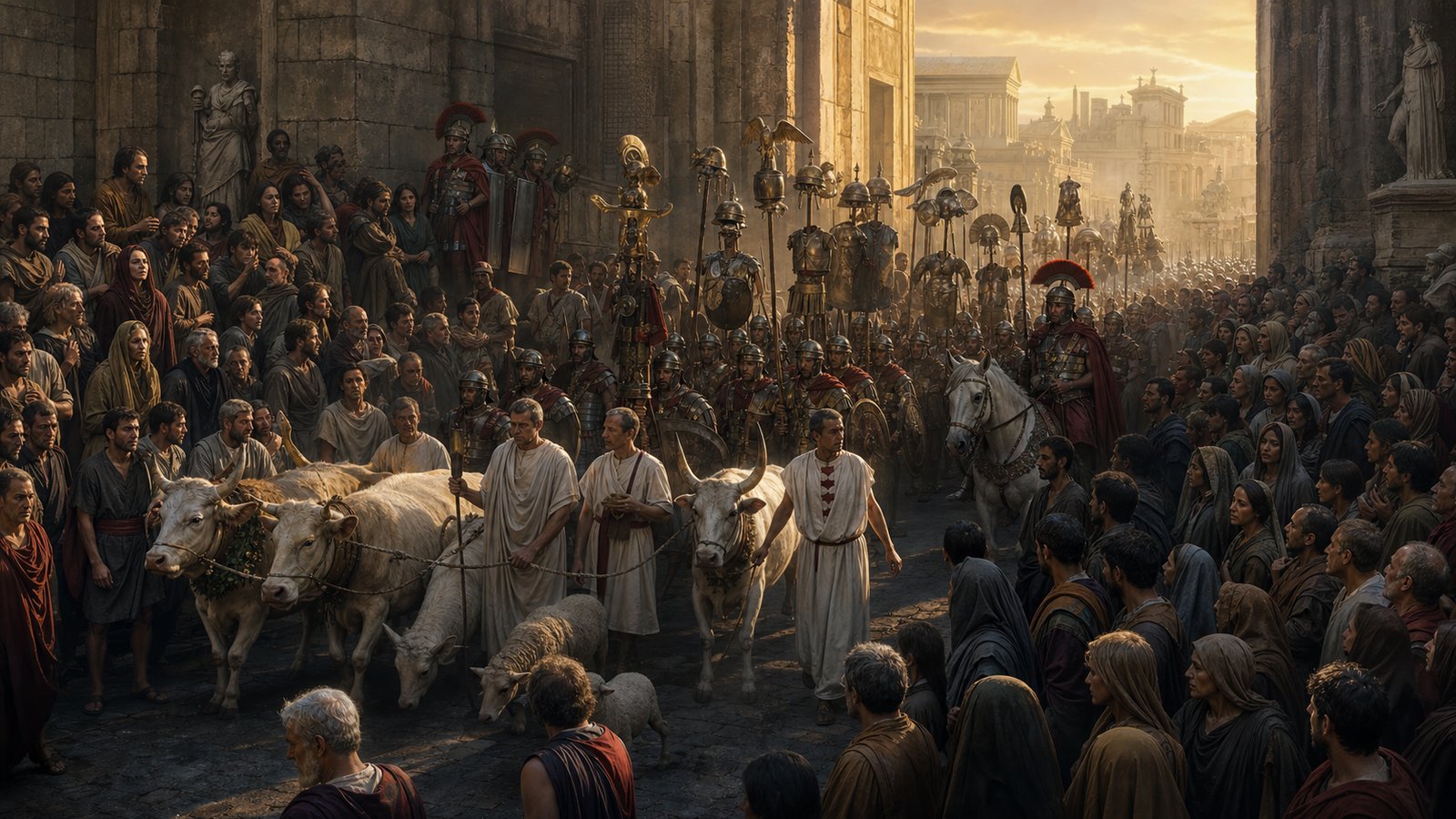
Spoils were evidence, not decoration
Ancient triumphs could become almost unbearable catalogues of things taken from someone else. Plutarch’s account of Aemilius Paullus after the defeat of Perseus of Macedon is the clearest example. He says three days were assigned to the procession. The first day was barely enough for captured statues, paintings, and colossal figures, carried on hundreds of chariots. The second day displayed Macedonian arms arranged in glittering heaps, a sight Plutarch says was not without terror even though the weapons belonged to a conquered enemy.
That detail is pure Rome. Even disarmed weapons still worked. Bronze and steel could be harmless in the literal sense and still do political work in the street. They told the spectator that an army, a kingdom, and a world of prestige had been reduced to exhibits.
A triumph made fear public and orderly
Fear in Roman politics was not always a panic. Often it was choreographed. Lictors kept space open. Priests moved with sacrifice. Soldiers followed in formation. The procession took violence and gave it order, which made it more persuasive. The city saw not a battlefield’s confusion but a controlled translation of war into ritual.
That is why a triumph belongs beside the other public systems of Roman power. As with Roman roads, the practical thing was also a message. Roads moved armies and orders. Triumphs moved memory. Both made distant power feel present in the capital.
The general was exalted, but not alone
The commander’s chariot was the image everyone remembers, and with reason. Smith’s account notes the four-horse chariot, the ascent to the Capitol, the sacrifice to Jupiter, and the extraordinary dress of the triumphator. Other ancient details made the scene even stranger: the general could be accompanied by young children, and a public slave stood behind him holding a crown.
This was not ordinary rank. It was temporary elevation under rules. Rome allowed the victorious commander to look almost superhuman, but only inside a script controlled by the state, the gods, the route, and the watching city. The triumph gave glory, then contained it.
That tension explains why the ceremony was so politically charged. Rome needed great commanders. Rome also feared great commanders. A triumph solved nothing permanently, but for one day it made the contradiction beautiful enough to survive.
Prisoners turned conquest into memory
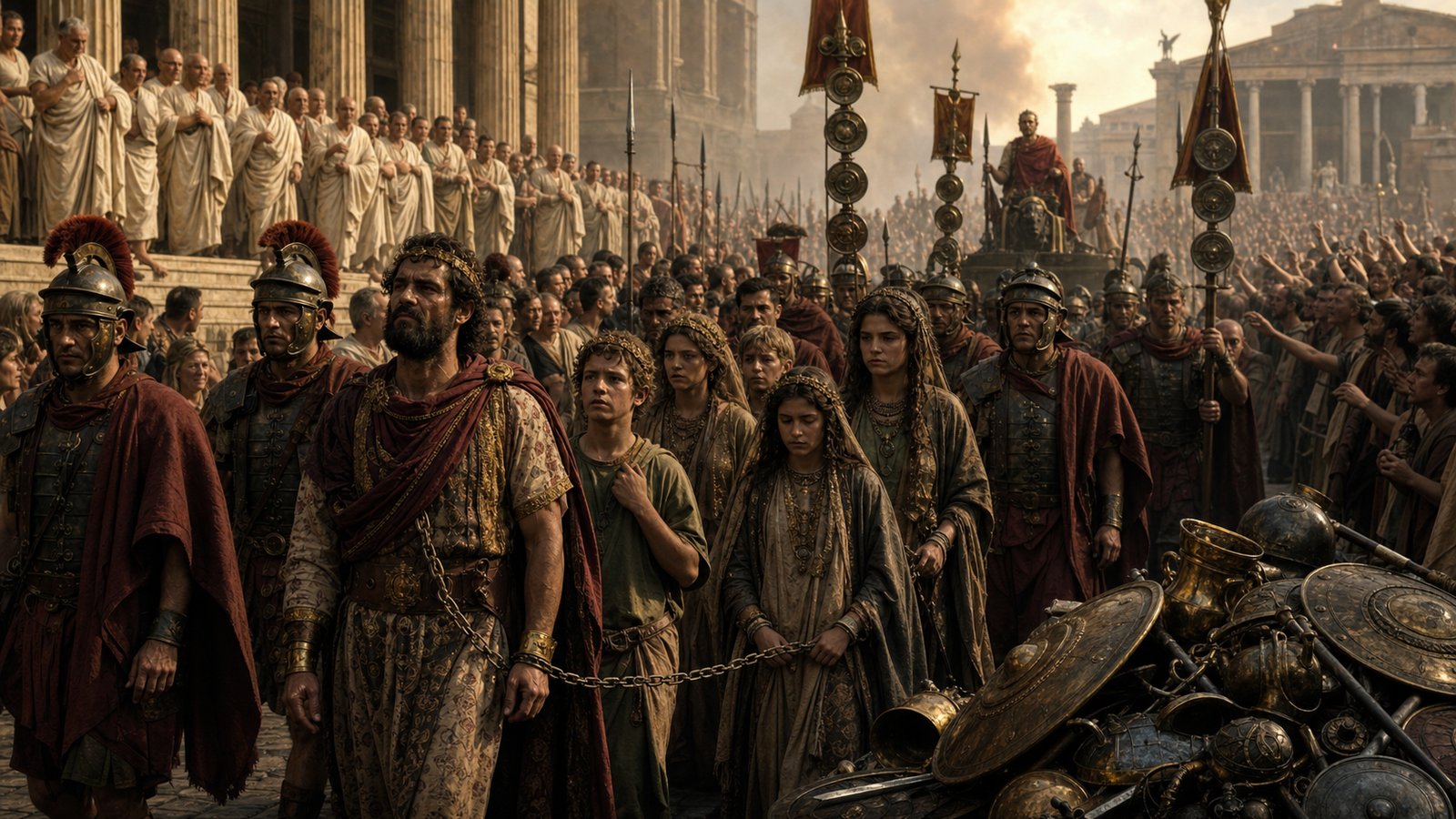
Plutarch’s life of Pompey lists captives in his triumph: pirates, royal relatives, Aristobulus of Judaea, members of Mithridates’ family, Scythian women, and hostages from peoples on the edges of Rome’s eastern wars. The names mattered because they turned geography into spectacle. Places most Romans would never see appeared in the city as people under guard.
This is where the parade becomes darkest. A Roman spectator could look at a captive child or a foreign queen and understand empire without reading a line of policy. The message was immediate: these people had belonged to another order of power; now their defeat belonged to Rome.
Soldiers, crowds, and the city all had roles
A triumph was not only propaganda directed downward from a commander. Soldiers were part of the performance too. The troops followed, the populace watched, and the route itself turned Rome into a stage. As with later imperial spectacles, public emotion mattered. An emperor or commander needed more than power; he needed power to be acknowledged in front of other people. That same Roman habit helps explain why emperors needed crowds as much as armies.
The crowd’s presence made victory socially real. Applause, songs, insults, jokes, wonder, resentment — all of it belonged to the day. Rome did not ask citizens merely to receive the news. It asked them to help turn the news into a shared memory.
The triumph was celebration with teeth
Modern people like triumphs because they are cinematic. Chariots, laurels, captives, temples, trumpets: the scene almost frames itself. But that is also the trap. If we treat the triumph as a parade in the modern sense, we make it too harmless.
The Roman triumph celebrated victory by showing what happened to the defeated. It honored the commander by making him pass through a city that could praise him and measure him at the same time. It thanked Jupiter, rewarded soldiers with memory, and reminded citizens that Roman order rested on organized force.
So yes, the triumph was glory. But Julian would not leave it there. Rome’s genius was making glory do harder work. The triumph taught the city whom to admire, whom to fear, and what defeat looked like when Rome had the power to arrange it into a procession.
The Fear Was Carefully Counted
The triumph’s intimidation was not vague. Plutarch’s account of Aemilius Paullus makes the scale concrete: three days were assigned to the procession; one day displayed captured statues and colossal figures on 250 chariots; another displayed Macedonian arms in heaps, a sight he says was not without terror. The point was not simply that Rome had won. The point was that victory could be counted, arranged, and made to pass before Roman eyes in an order chosen by the victors.
That detail changes the mood of the parade. A triumph did not only flatter the general in the chariot. It taught the crowd how far Roman force could reach and what happened to kings, weapons, and cities once they entered Rome’s ritual machinery.
Sources & Further Reading
- William Smith, A Dictionary of Greek and Roman Antiquities, “Triumphus,” via LacusCurtius: https://penelope.uchicago.edu/Thayer/E/Roman/Texts/secondary/SMIGRA*/Triumphus.html
- Plutarch, Life of Aemilius Paullus, especially the Macedonian triumph after Perseus: https://penelope.uchicago.edu/Thayer/E/Roman/Texts/Plutarch/Lives/Aemilius*.html
- Plutarch, Life of Pompey, triumphal display and captives: https://penelope.uchicago.edu/Thayer/E/Roman/Texts/Plutarch/Lives/Pompey*.html