
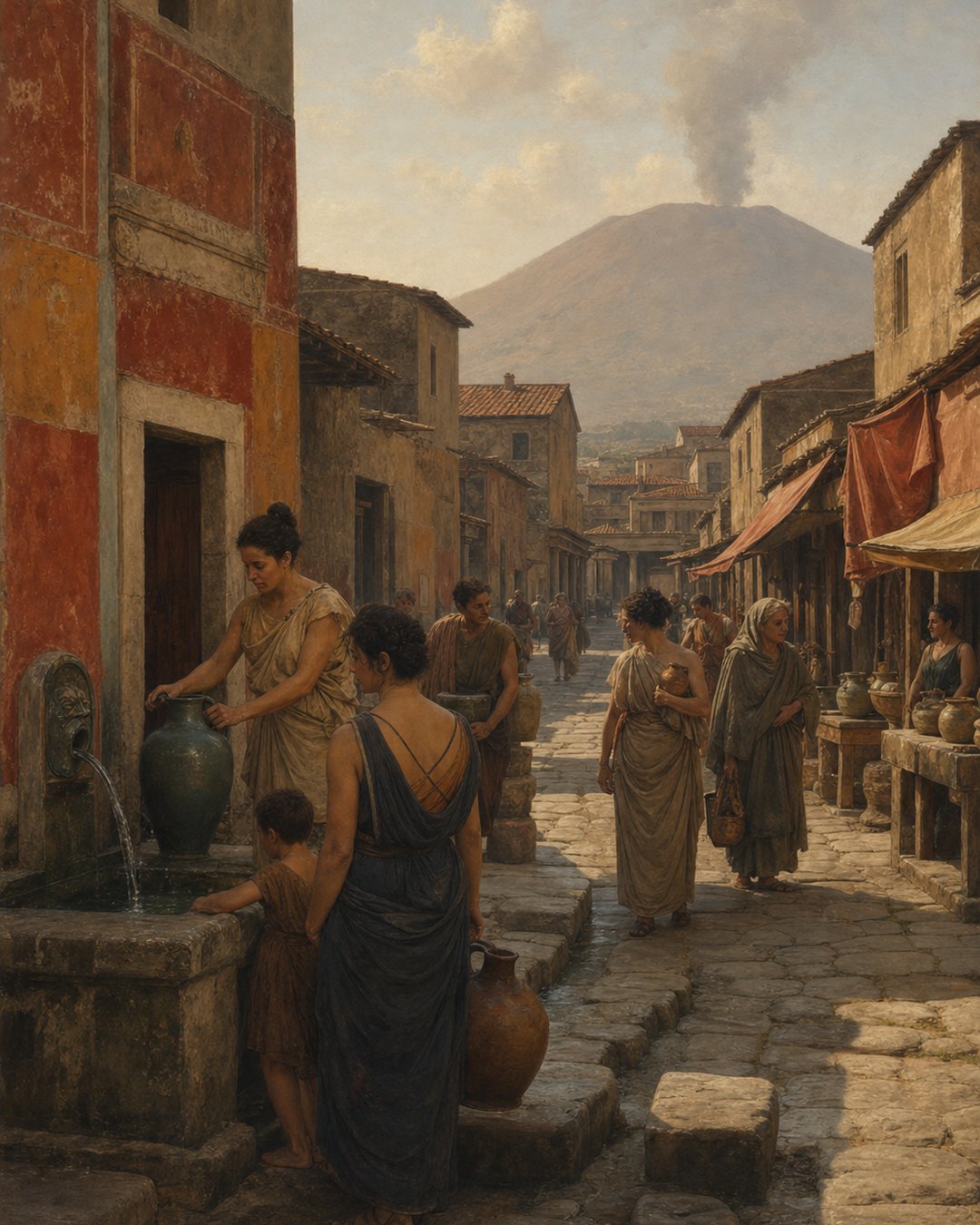
Pompeii feels close because it did not leave us only emperors.
It left doorways. Counters. Street fountains. Wheel ruts. Political scrawls. Shrines small enough to fit into an ordinary household’s day. You can stand in the city and feel, dangerously, that you understand it. A Roman town suddenly looks less like a marble abstraction and more like a place where someone forgot to finish an errand.
That is exactly why Pompeii also feels far away. Its familiarity is real, but it is not sameness. The city pulls us near with preserved details, then reminds us that Roman assumptions about status, slavery, religion, public space, sex, politics, and death were not ours wearing sandals.
The disaster froze ordinary time
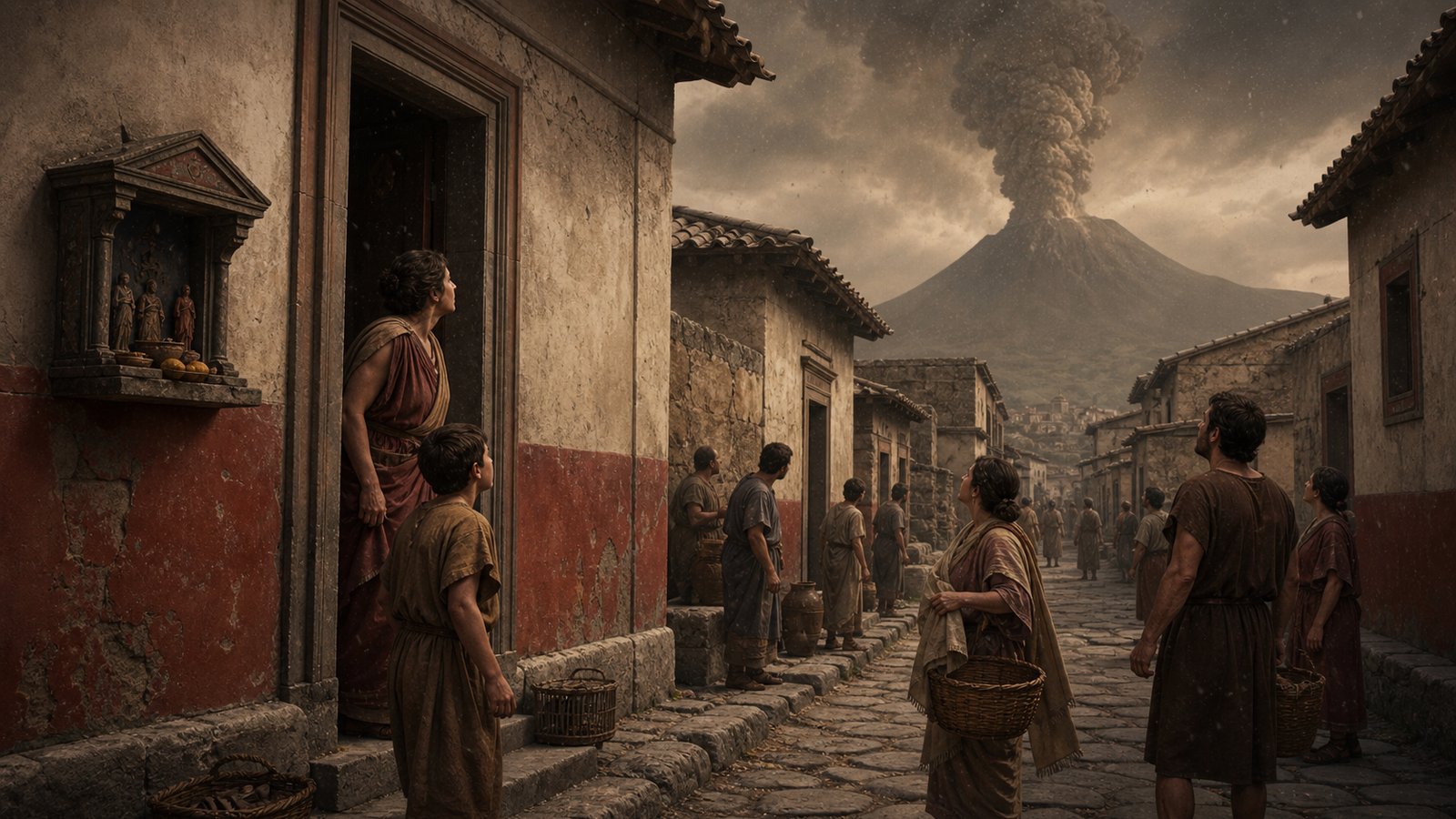
The eruption of Vesuvius in AD 79 became famous partly because Pliny the Younger described it in letters about the death of his uncle, Pliny the Elder. In one letter he remembers a cloud rising from the mountain in a form he compares to a pine tree: a trunk lifting upward, then spreading into branches. In another, written about his own experience at Misenum, he describes darkness, ash, panic, and people debating whether to stay under cover or flee into the open.
Those letters matter because they do not read like myth. They read like a mind trying to organize fear after the fact. The mountain is not a symbol yet. It is weather, noise, darkness, uncertainty, and human decision.
The streets make the city feel modern
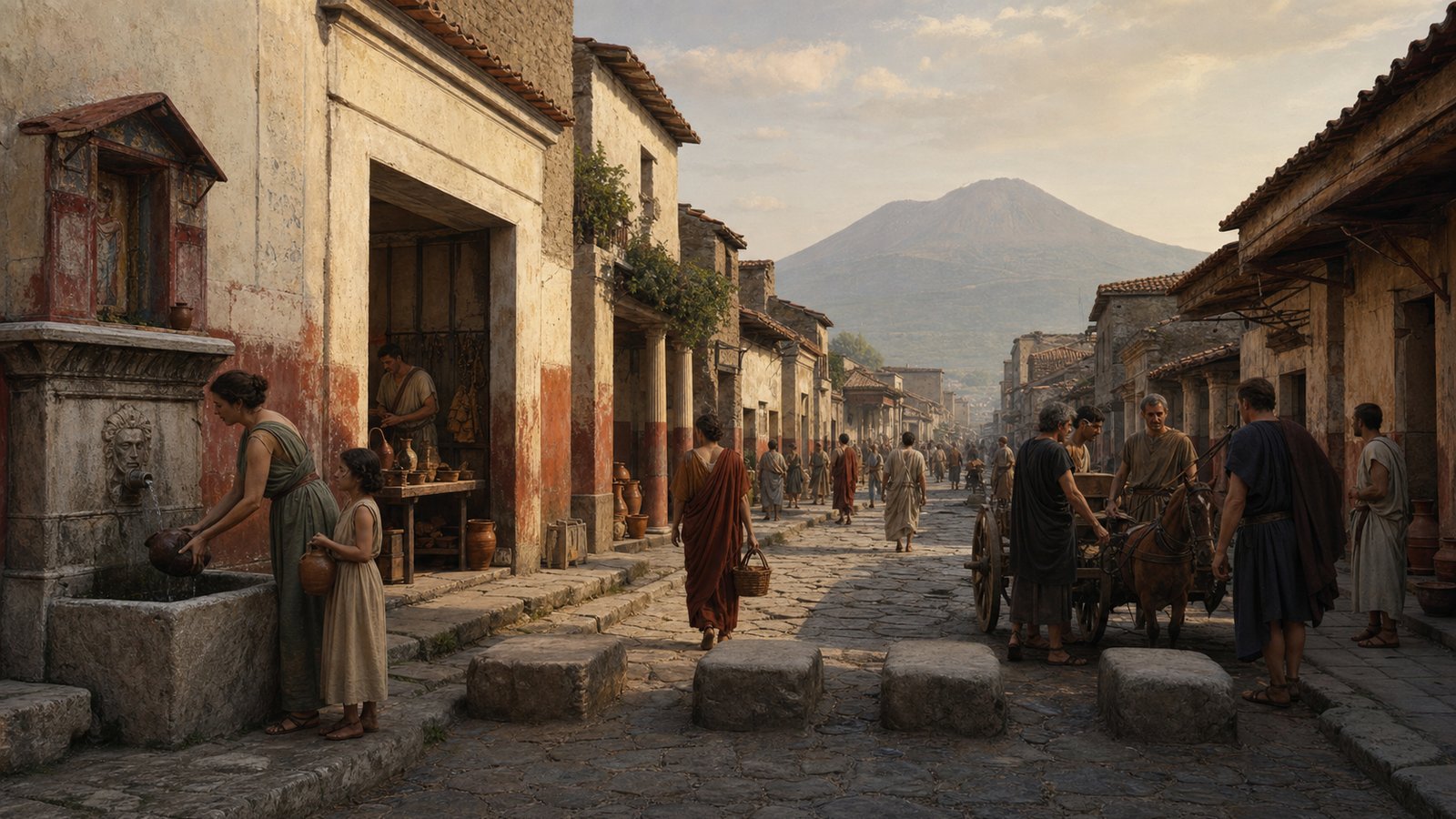
Walk Pompeii in imagination and it is hard not to reach for modern comparisons. There are streets with raised stepping stones, storefronts open to traffic, public fountains, painted walls, houses organized around courtyards, and rooms that suggest cooking, display, business, and privacy all pressing against one another. The Archaeological Park’s visitor material rightly presents Pompeii as a city made legible through neighborhoods, houses, streets, baths, theaters, temples, and shops.
This is why the site is so powerful for readers who are tired of Rome as only conquest. Pompeii lets us see urban texture. It makes daily life visible in a way a battle narrative rarely can. The same empire that built roads for control also filled towns with habits, shortcuts, thresholds, and routines. That is why Pompeii belongs beside a story like Roman roads as instruments of control: both show Rome as infrastructure, not just legend.
Familiar details can mislead us
The trap is thinking that recognizable things are automatically understandable things. A shop counter looks familiar. A wall message feels like social media’s ancient cousin. A household shrine looks charming. A street fountain looks civic and practical. But every one of those details sat inside a Roman world structured by hierarchy.
A household was not simply a private family unit in the modern sense. It could include enslaved people, freed people, clients, business interests, ancestral memory, and ritual obligations. A street was not just a neutral public corridor. It was where status performed itself, where politics advertised itself, where neighbors watched, and where the poor, enslaved, and powerful crossed paths without becoming equal.
Pliny’s darkness is not cinematic
Modern retellings often want the eruption to become a perfect catastrophe scene. Pliny is more uncomfortable than that. He remembers ash falling, the sea made difficult, people tying pillows over their heads for protection, darkness like a closed room, and cries of women, children, and men separated from one another. He also shows hesitation: what is safer, a collapsing building or the open air under falling debris?
That uncertainty is the part worth keeping. Disaster does not arrive as a clean story to the people inside it. It arrives as bad choices.
The bodies are not props
Pompeii’s human remains can make the site feel painfully immediate. The famous casts are often treated as icons of the eruption, but Julian would insist on a little discipline here. They are not illustrations placed for our emotional convenience. They are the traces of particular people caught in a particular disaster.
The city asks for two reactions at once: attention and restraint. Attention, because the evidence is unusually intimate. Restraint, because intimacy can become consumption very quickly. Pompeii is not powerful because it lets us stare at death. It is powerful because it refuses to let daily life and death separate neatly.
Pompeii survived by being interrupted
The cruel irony is that Pompeii’s closeness comes from destruction. The eruption interrupted a city before later rebuilding, forgetting, renovation, and reuse could erase more of its texture. The result is not a perfect time capsule — archaeology is always partial, damaged, interpreted, and revised — but it is a rare density of ordinary Roman evidence.
That evidence is why Pompeii keeps working on us. It gives us Rome with dust under its fingernails. Not only senators, generals, and emperors, but people buying food, honoring household gods, crossing streets, gossiping near walls, working behind counters, and looking up when the sky changed.
The closeness is the warning
Pompeii feels close because human routines are stubborn. People eat, sell, decorate, pray, flirt, complain, hurry, and delay. It feels far away because the meanings around those actions belonged to another moral and social universe.
That is the city’s real power. Pompeii does not say, “Romans were just like us.” It says something sharper: ordinary life can look familiar even when the world underneath it is profoundly different. And then, in one day, even that ordinary world can become archaeology.
Closeness Can Become a Trap
The danger of Pompeii is that its familiar details can make us too confident. A street, shop, bath, or doorway looks understandable at once, but the lives behind those spaces were shaped by Roman household hierarchy, slavery, local status, religion, and public performance. The city feels close because ordinary routines survived. It feels far away because those routines belonged to a society with assumptions very different from ours.
Pliny’s account keeps that distance visible. His pine-tree cloud, falling ash, darkness, and people tying pillows over their heads are not scenic effects. They are reported attempts to understand danger while it was still unfolding. The archaeological city should be read the same way: not as a decorative time capsule, but as evidence left by real people whose last ordinary day became history by catastrophe.
The city therefore asks for two readings at once. The doorway, counter, street rut, and bath wall invite recognition. The eruption, ash, social order, and human remains demand restraint. Pompeii is powerful because those two reactions cannot be cleanly separated.
That tension is the point.
Sources & Further Reading
- Pliny the Younger, Letters 6.16 and 6.20, translated selection: https://faculty.georgetown.edu/jod/texts/pliny.html
- Parco Archeologico di Pompei, visitor and site overview: https://pompeiisites.org/en/archaeological-site/
- Parco Archeologico di Pompei, map and site areas: https://pompeiisites.org/en/pompeii-map/
- World History Encyclopedia, “Pompeii”: https://www.worldhistory.org/pompeii/