
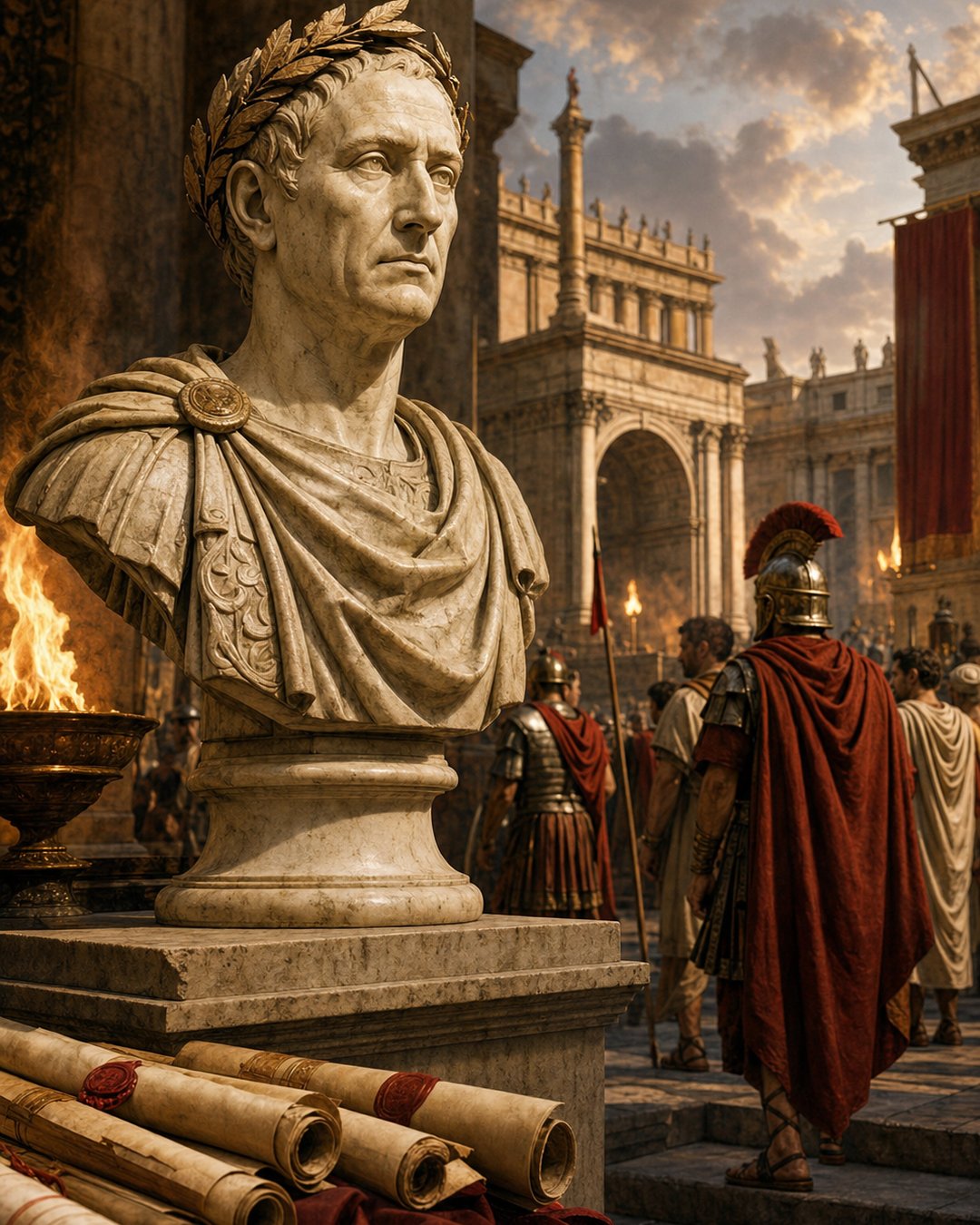
Why Julius Caesar’s Name Outgrew Julius Caesar
Julius Caesar died as a man with enemies, wounds, clients, debts, veterans, and a name. The strange part is what happened afterward. The man could be stabbed in 44 BCE. The name could not be killed so easily.
That is the part the familiar story often skips. “Caesar” did not become powerful simply because Julius Caesar had been famous. Rome had many famous men. His name survived because the next generation discovered that a name could do political work: it could claim inheritance, calm soldiers, frighten rivals, flatter memory, and make one-man rule sound less like a naked seizure.
The result was not instant monarchy with a clean label. It was messier and more Roman. A murdered aristocrat’s family name became a public instrument, then an imperial habit, and finally a title that rulers far from Caesar’s own world still wanted to borrow.
The Name Entered Politics Through Adoption
The first step was not a crown. It was a will. Julius Caesar adopted Gaius Octavius, his young great-nephew, and Octavius took the name Gaius Julius Caesar. In Roman society adoption was not sentimental paperwork. It moved status, ancestors, expectations, and obligations from one house into another. A name could carry a dead man’s following into a living man’s hands.
The timing made that name explosive. Caesar had been murdered on the Ides of March in 44 BCE, and his veterans, supporters, enemies, and assassins all understood that memory was now a battlefield. Octavian was only nineteen when, as Augustus later put it in the Res Gestae, he raised an army “by private initiative and at private expense.” That sentence is polished propaganda, but it preserves the essential detail: the heir needed more than youth and ambition. He needed Caesar’s name to make his ambition legible.

To Caesar’s veterans, the adopted name suggested continuity. To rivals, it was a warning. To the Roman crowd, it tied the young man to funeral emotion, public honors, and the growing cult of the deified Julius. Octavian did not have to persuade Rome that he was Julius Caesar reborn. He had to persuade enough Romans that the relationship mattered.
A Murdered Man Became a Source of Legitimacy
Suetonius records the extraordinary honors Caesar received before his death, the kind of honors that made Romans uneasy because they seemed to lift one citizen above the old republican frame. After the assassination, those honors did not simply vanish. They could be rearranged into a story of loyalty and revenge. Caesar was no longer only the controversial dictator; he was the murdered benefactor, the divine father, the man whose heir could claim to finish unfinished business.
Even the calendar helped keep the name public. Quintilis became July in Caesar’s honor. A month is not an army, but it is a form of daily memory. Romans did not need to debate constitutional theory every morning to meet Caesar’s name again. The name entered time, ritual, coins, vows, and public speech.
This mattered because Rome still disliked the word king. The old hatred of rex did not disappear because one faction won a civil war. A successful ruler needed language that sounded Roman enough to survive. “Caesar” was useful because it could point backward to inheritance and victory instead of forward to an openly royal title.
Augustus Made the Inheritance Look Like Order
In 27 BCE Octavian received the name Augustus. That new honor did not replace Caesar; it completed the package. “Augustus” suggested revered public dignity. “Caesar” carried the inherited connection to Julius and the emotional charge of civil war. Together they let the ruler appear exceptional while still speaking the language of Roman offices, honors, and restoration.
Cassius Dio’s account of the settlement of 27 BCE captures the Roman artifice: powers could be given back in form while supremacy remained in fact. The genius of the arrangement was not that nobody noticed. The genius was that enough people had reasons to accept the performance. Senators kept titles and ceremonies. Soldiers had a paymaster. Provincials had a single figure through whom authority could be imagined. The city had peace after years of blood.
Caesar’s name helped hold that performance together. It did not say, “I am a king.” It said, “I stand in the line of the man whose death and divinity reshaped the state.” That was safer, sharper, and more flexible.
A Family Name Became an Office Before Anyone Admitted It
Once a name works, institutions learn to repeat it. Later rulers used Caesar as part of imperial titulature even when blood connection was thin, invented, or politically convenient. The name became less a biography than a credential. It told soldiers, governors, petitioners, and rival claimants where authority was supposed to flow.
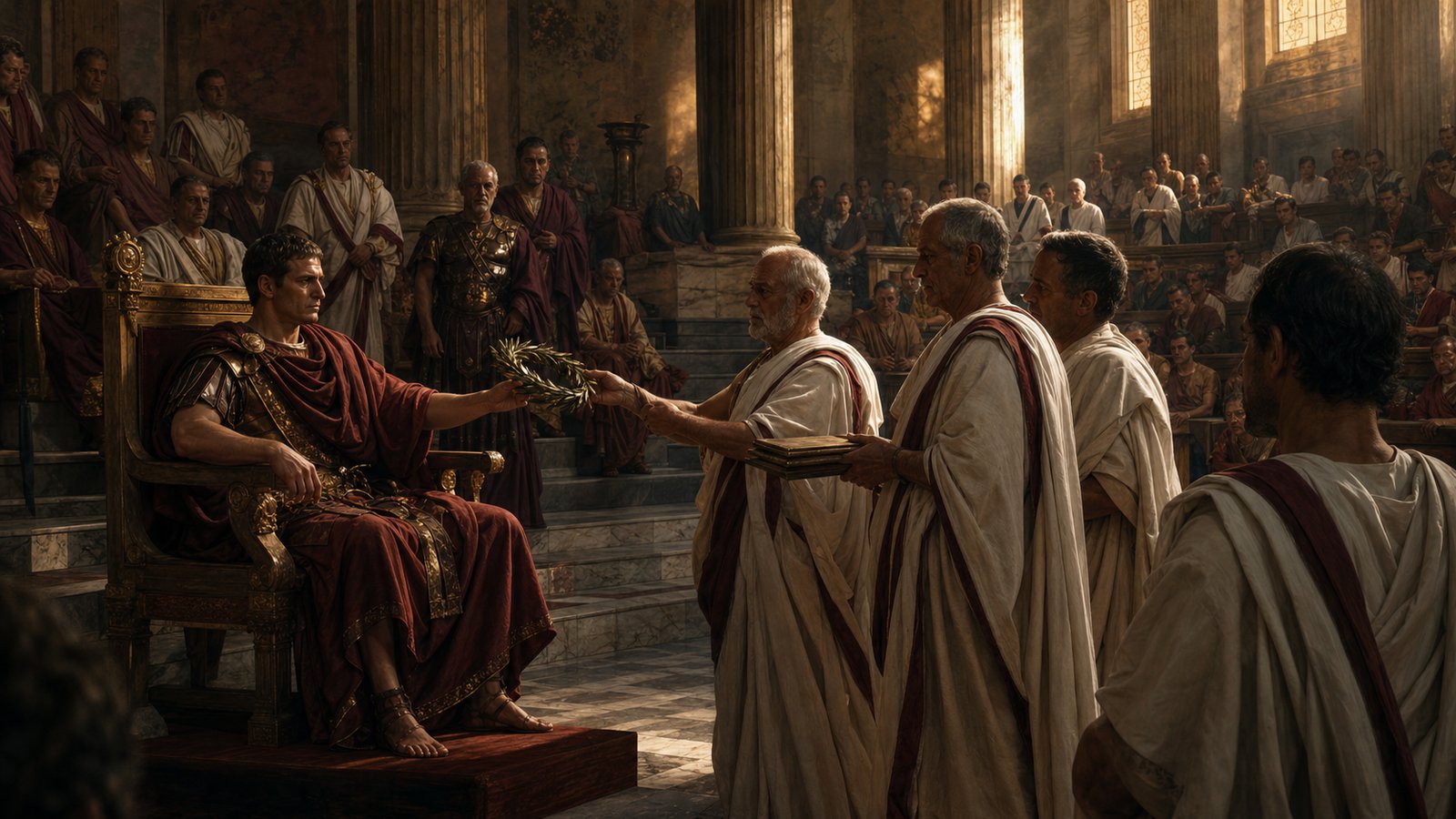
By the time of the Tetrarchy, the transformation was unmistakable. Caesar could mean a junior imperial rank beneath an Augustus. That is a long journey for a family name from the late Republic. It began with inheritance and murder; it ended as a place in an administrative hierarchy.
The change also shows how Roman power preferred continuity even when it was inventing something new. A man could be new. A title could pretend not to be. “Caesar” made fresh power look older than it was.
The Afterlife Was Bigger Than the Man
Julius Caesar’s own career was extraordinary, but the afterlife of his name depended on more than greatness. It depended on political usefulness. The name could bless an heir, frame revenge, soften monarchy, and organize succession. It could move from one body to another without admitting that Rome had crossed a line it still disliked naming.
This is why the most important question is not whether Julius Caesar was famous enough to deserve a title. Rome did not work that way. The better question is why later rulers needed him to remain usable. The answer is concrete: after assassination, civil war, and the settlement of 27 BCE, the name Caesar offered a bridge between republican memory and imperial command.
The man died in a room full of knives. The name survived because Rome found too many uses for it.
Why the Title Could Travel
The final proof that Caesar’s name had escaped the man is that it could travel into circumstances Julius Caesar never imagined. It no longer required the Senate-house crisis of 44 BCE or the personal charisma of the dictator. A later ruler could use the name to announce rank, succession, or proximity to supreme power. The older story still mattered, but the word had become portable.
That portability is the concrete historical clue. A private name had become public equipment. It could be placed on coins, documents, acclamations, and official titulature. It could make a new claimant sound less new. It could suggest that command had a lineage even when the lineage was political theater. Rome’s genius was not forgetting that the name began with a man; it was learning how to use the man until the name became larger than biography.
Sources
- Suetonius, Julius Caesar, 76–88
- Augustus, Res Gestae, 1–2, 34
- Cassius Dio, Roman History, 53
- Livius, “Augustus”
- Encyclopaedia Britannica, “Caesar”
- Encyclopaedia Britannica, “Augustus”