
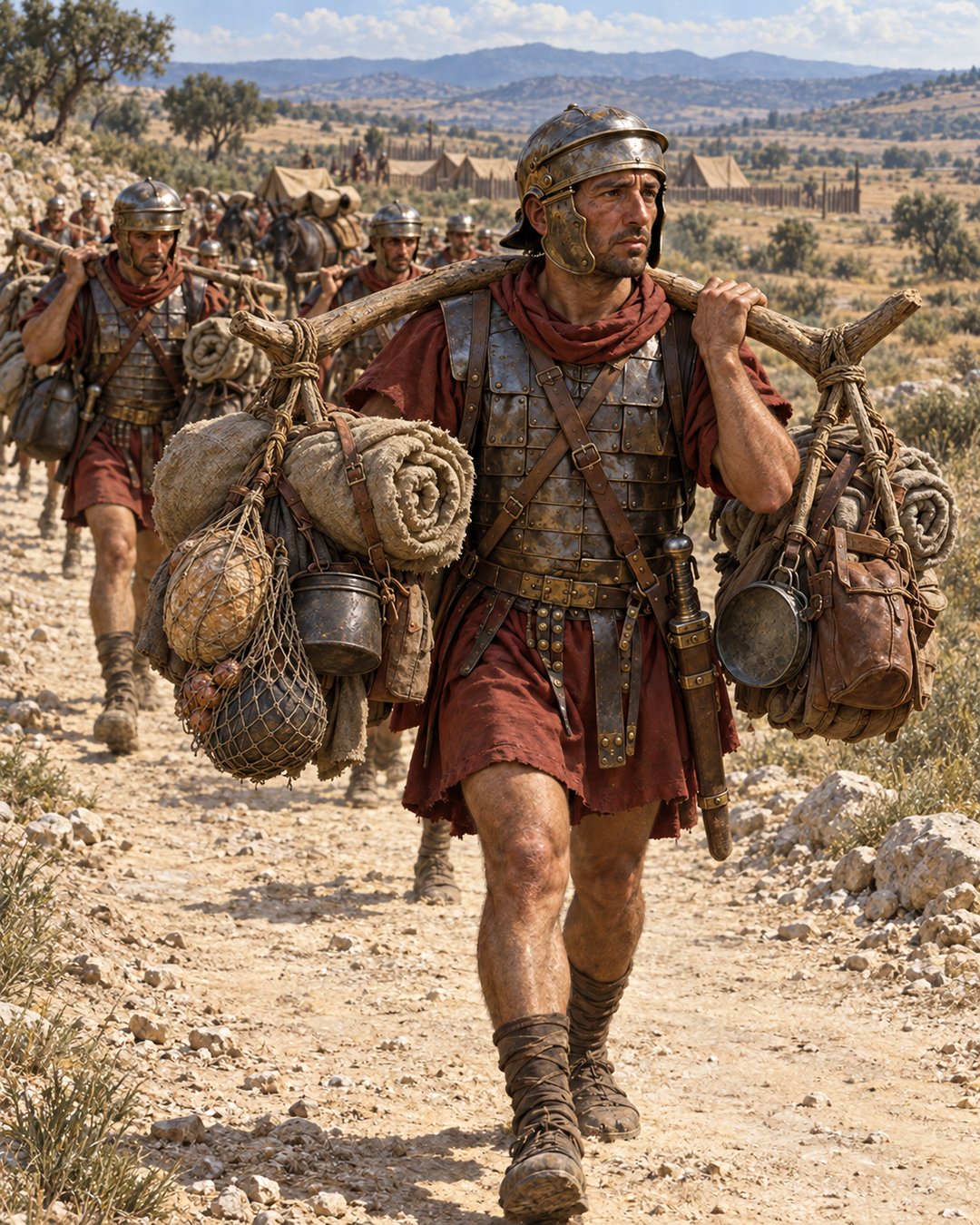
The fork in the pole mattered as much as the weight. A Roman soldier could bind food and utensils into a compact load, hang it from a carrying staff, and put the burden down without scattering the pieces across the road. Frontinus presents this arrangement as Marius’s answer to a logistical problem: too many pack animals slowed an army on the march.
The solution produced a joke that outlived the march. Soldiers trained to carry their own baggage became “Marius’s mules.” Plutarch repeats that explanation, but he also preserves a rival story in which the name began with an actual mule that Marius kept in unusually good condition during Scipio’s siege of Numantia. The disagreement is valuable. One version emphasizes a system imposed on an army; the other turns Marius himself into the model of patient care and readiness.
Taken together, the sources show how Roman military memory condensed movement, discipline, and character into one animal nickname. A mule could mean reduced transport, a soldier’s organized load, or a man who accepted hard work without complaint.
The baggage train became a marching problem
Frontinus introduces the device through its purpose. Marius wanted to reduce the number of pack animals because they especially hampered the army’s movement. The passage does not claim that animals disappeared from Roman campaigning. Its point is narrower: every load shifted from an animal to a soldier reduced one source of delay and dependence.
Animals required their own place in the column and their own handling. Frontinus does not provide a complete inventory or a calculation of speed, so it would be wrong to invent one. He instead gives the commander’s practical judgment. Pack animals were numerous enough, and obstructive enough, for Marius to redesign what each soldier carried.
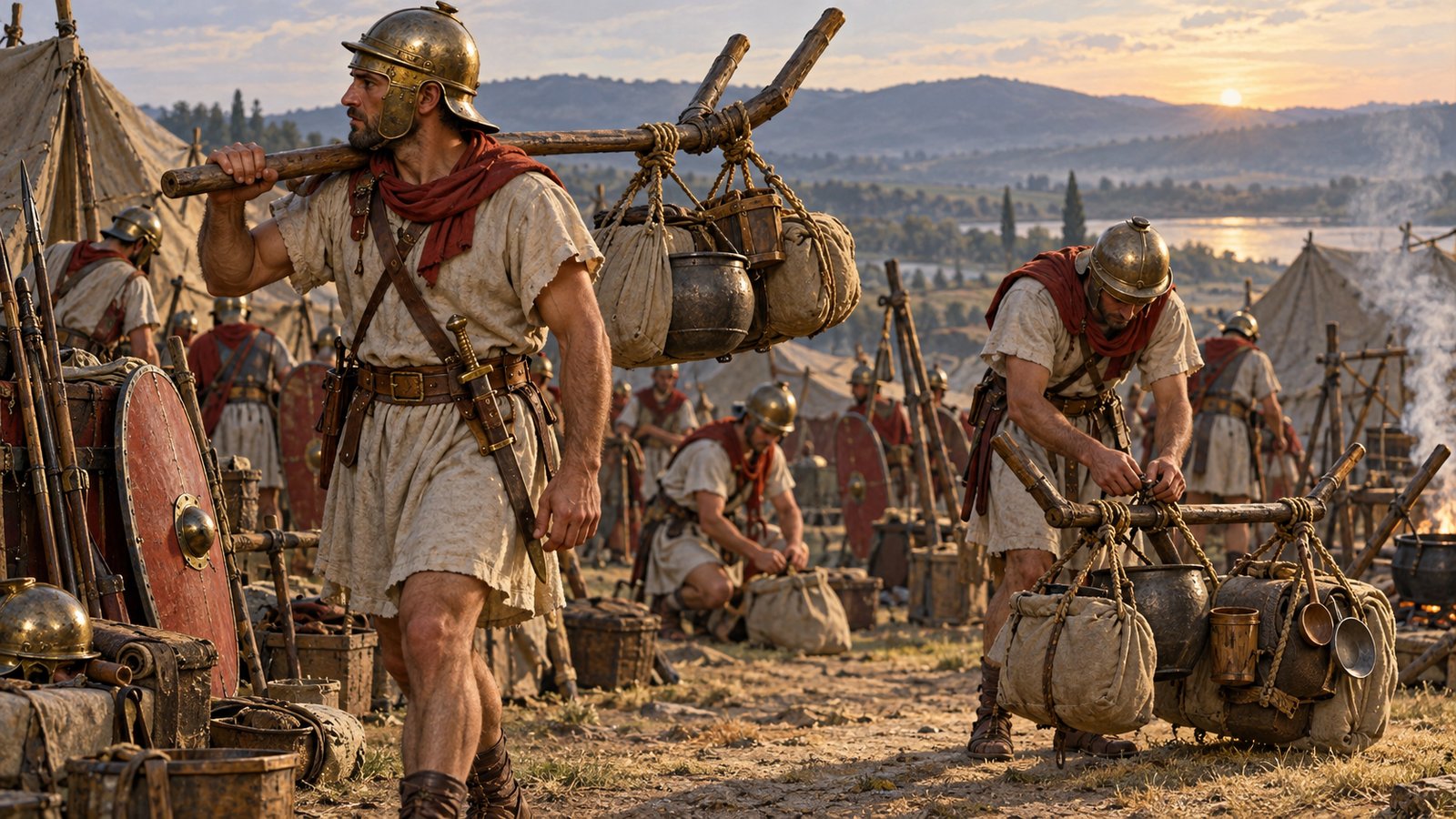
The response began with ordinary objects. Food and utensils were fastened into bundles rather than left as loose pieces. Those bundles were hung from forked poles. The fork separated or supported the load, while the staff gave the soldier a single object to lift, shoulder, and set down.
Frontinus explicitly says the arrangement made the burden easier and also facilitated rest. That second benefit keeps the device from looking like a simple demand for endurance. A load needed to work when the column stopped as well as when it moved. The carrying pole organized the pause: the soldier could lower one assembled burden instead of unloading a disorderly collection.
Training put the whole routine on the soldier
Plutarch places the nickname inside a wider program. As Marius led his army on campaign, he practiced the men in different kinds of running and in long marches. He compelled them to carry their own baggage and prepare their own food.
These tasks joined movement to maintenance. Running tested bodies without a baggage burden; marching required men to keep formation and continue over distance; carrying made equipment part of that endurance; preparing food forced the soldier to turn supplies into a meal after the day’s movement. None of those details needs a heroic battle scene. Their importance lies in repetition.
The routine belongs beside the swimming practice that taught recruits to cross the Tiber. Both forms of training pushed a future campaign problem into ordinary preparation. Water would not always wait for a bridge, and a marching column could not afford to become helpless whenever transport thinned out.
Yet the carrying system was not only a test of toughness. Frontinus’s forked pole suggests attention to ergonomics within a severe program. Marius did not merely add weight and demand silence. He had the load fastened and balanced in a repeatable form that eased both carriage and rest.
Plutarch says the nickname later applied to people who loved toil and performed what was assigned contentedly, without murmuring. The phrase therefore moved beyond a literal bundle. “Marian mule” became facetious praise for a disposition: patient, reliable, and difficult to exhaust.
Numantia supplied a second origin story
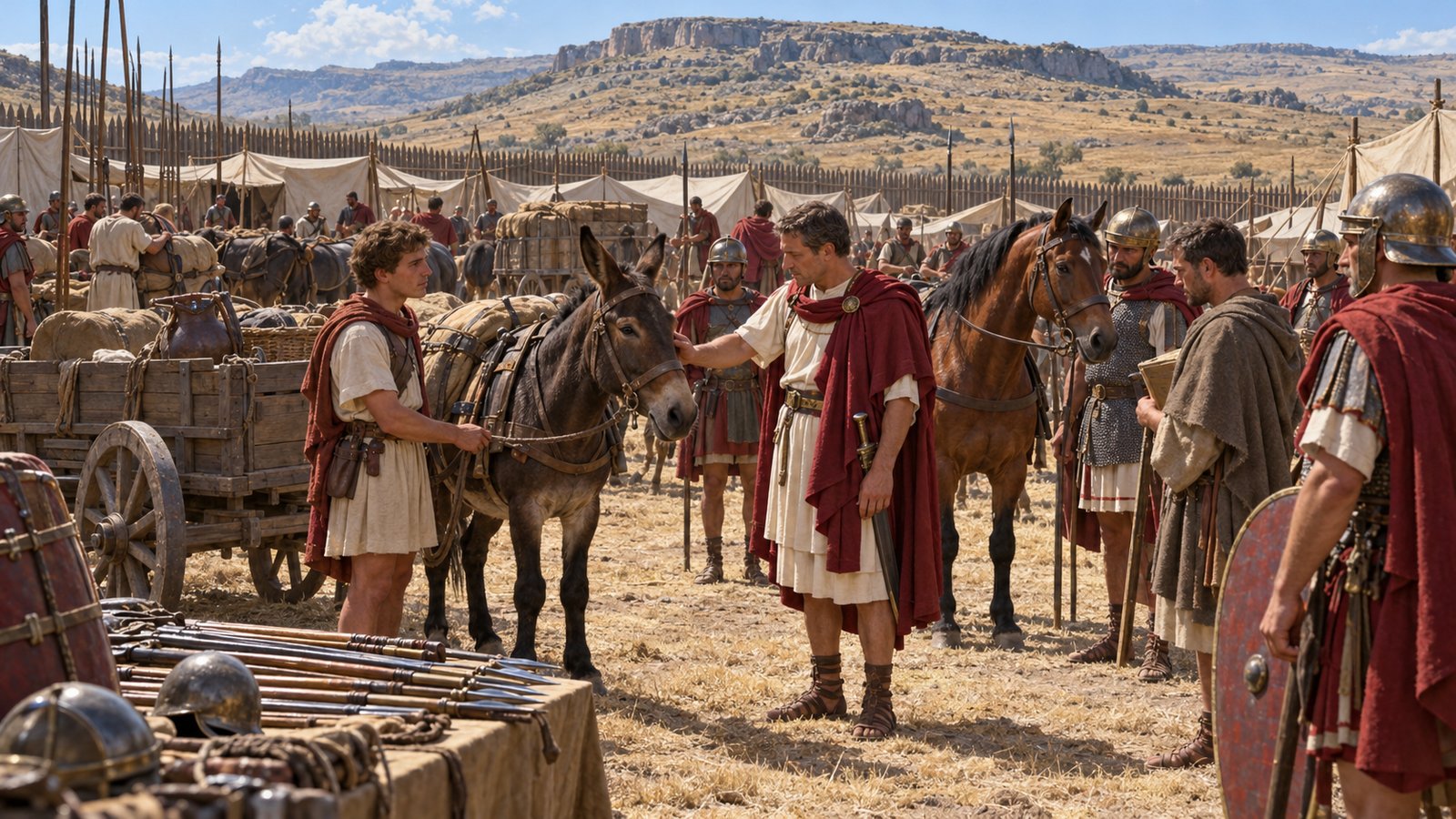
Plutarch does not pretend that everyone agreed about the expression. He interrupts the training explanation with another account, set during Scipio’s siege of Numantia, where Marius had served earlier in his career.
In this version, Scipio inspected not only weapons and horses but mules and wagons. Every item and animal was supposed to be ready and in good order. Marius brought forward a horse he had cared for exceptionally well and a mule that surpassed the others in health, docility, and strength.
The scene changes the scale of discipline. Frontinus’s account begins with an army-level transport problem. Plutarch’s alternative begins at inspection, with one subordinate responsible for the condition of particular animals. The commander notices readiness through visible evidence: a sound horse, a manageable mule, and equipment fit to move.
Scipio was pleased and reportedly spoke often about Marius’s animals. Over time, Plutarch says, people used “Marian mule” as humorous praise for a persevering, patient, laborious man. The actual mule becomes a comparison for its keeper. Marius earned the phrase not by being loaded like an animal but by presenting an animal whose condition demonstrated his own diligence.
The two explanations cannot simply be fused into one event. Plutarch labels the Numantine account as a different origin. Preserving that distinction is more informative than choosing the tidier story. Ancient readers encountered at least two memories of the phrase, both concerned with work but focused on different acts.
A nickname joined equipment to character
Both versions make readiness visible through things that could be inspected. In Frontinus, food and utensils are fastened into a portable unit. In Plutarch’s second account, animals and wagons stand ready in good order. The first reduces reliance on the mule; the second praises the man who cared for one.
That shared concern explains why the rival stories could coexist. Neither treats labour as shapeless suffering. The good soldier carried an organized burden. The good keeper produced a healthy, docile, strong animal. Endurance mattered because it was disciplined, not because discomfort had value by itself.
The emphasis on self-carried baggage also complements the measured routine that turned open ground into a Roman camp. A marching army had to arrive with enough order left to build, eat, guard, and move again. Personal equipment was one small system nested inside the larger column.
Neither source gives license to credit Marius with every feature of Roman marching equipment or to imagine that his measures eliminated a baggage train. Frontinus identifies a specific attempt to limit pack animals. Plutarch describes carrying, cooking, running, and marching as training. Their evidence supports a reform in habits and loads, not a claim that Roman logistics suddenly became animal-free.
The phrase survived because it could compress these distinctions. It teased soldiers by comparing them with beasts of burden, praised workers who accepted a task without complaint, and recalled the commander whose own mule supposedly excelled under inspection. Humour made logistics memorable.
At the center of the story is an unglamorous object: a forked pole with a bundled load. It links the strategic desire for a less obstructed march to the physical act of shouldering utensils and food. Frontinus lets us see the device; Plutarch lets us see the reputation it produced. Rome remembered the result not as a technical manual, but as the moment disciplined men acquired a mule’s name.
Sources
Sextus Julius Frontinus, Stratagems, 4.1.7. Plutarch, Life of Marius, 13.1–2.