
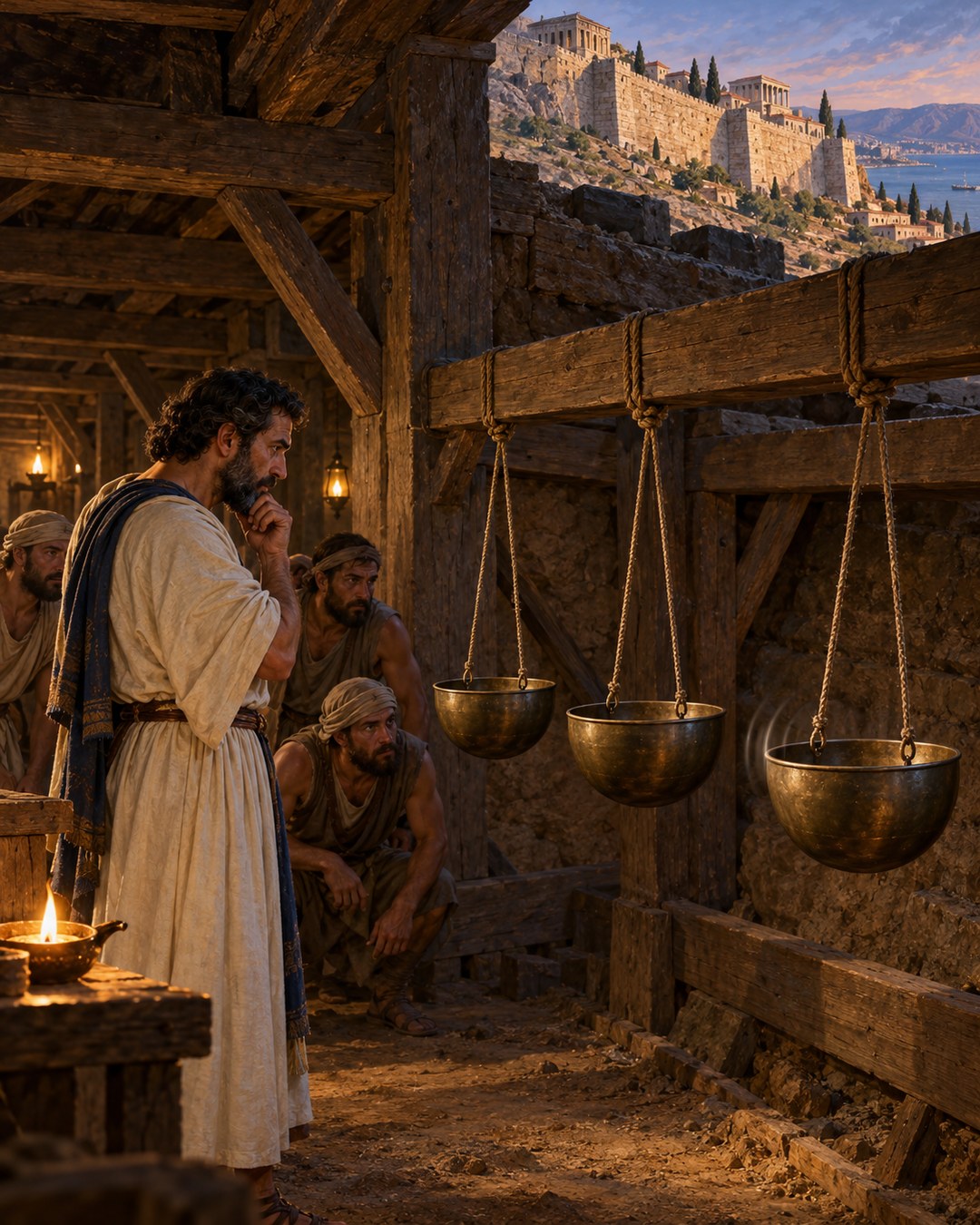
The defenders of Apollonia had a warning but no location. Spies reported that besiegers were tunnelling toward the fortress, yet nobody knew where the hidden passage would break through or when the attack would arrive. A wall could stop what approached in daylight. It offered less reassurance against picks moving through earth beneath it.
Trypho of Alexandria, the city’s architect, answered uncertainty with several excavations rather than one guess. He extended them from inside the wall to a distance Vitruvius calls an arrow’s flight beyond it, then suspended bronze vessels in the underground spaces.
One vessel began to ring. The sound did not come from a musician or a hand striking metal. Blows from the enemy’s mining tools travelled through the ground near the vessel and made the hidden approach audible. Direction came before retaliation.
A spy’s warning left the crucial question unanswered
Vitruvius introduces Apollonia after two other defensive episodes. At Chios, defenders altered the seabed so attacking vessels grounded near the wall. At Apollonia, the dangerous terrain could not be seen at all. The attack occupied a volume of soil below the city’s defences.
The besiegers hoped to penetrate the fortress unperceived. Mining offered a way to evade the visible contest around a wall: ladders, towers, rams, missiles, and men could all be watched, while a gallery advanced behind its own curtain of earth.
Apollonia was not wholly blind. Spies disclosed that the attempt existed. That information mattered, but Vitruvius says it produced dismay because the defenders did not know the time or precise spot of emergence.
The distinction is the centre of the story. Intelligence had established what was happening without supplying where. Digging randomly toward a suspected tunnel could waste labour, miss the attackers, or weaken the defenders’ own ground.
Trypho’s office also matters. Vitruvius calls him the architect to the city, not a prophet who divined the enemy’s position. The solution belonged to someone expected to understand excavation, walls, materials, distance, and the behaviour of constructed spaces.
His response complements the subterranean contest at Uxellodunum, but the two narratives turn on different problems. Caesar’s engineers sought and diverted a water supply. Trypho first had to locate another excavation while it remained concealed.
The defenders therefore needed an instrument of search. Vitruvius does not say that they waited at the wall for cracks or listened with an ear pressed to stone. Trypho created new underground positions from which the enemy’s work might reveal itself.
Several galleries sampled the ground beyond the wall
Trypho ordered several excavations within the wall. The plural is essential. A single passage could only test one line; several gave the defenders more than one place from which to detect transmitted activity.
Vitruvius says the digging advanced an arrow’s flight beyond the fortification. The phrase supplies scale without pretending to be a surveyed modern unit. The galleries were not tiny recesses cut into a cellar. They projected the search outward beneath the contested approach.
Inside these spaces, bronze vessels were suspended. Suspension kept each vessel free to respond rather than resting heavily on the floor. The text does not provide their exact shape, dimensions, alloy, spacing, or tuning, so a reconstruction should not invent a standardized acoustic array.
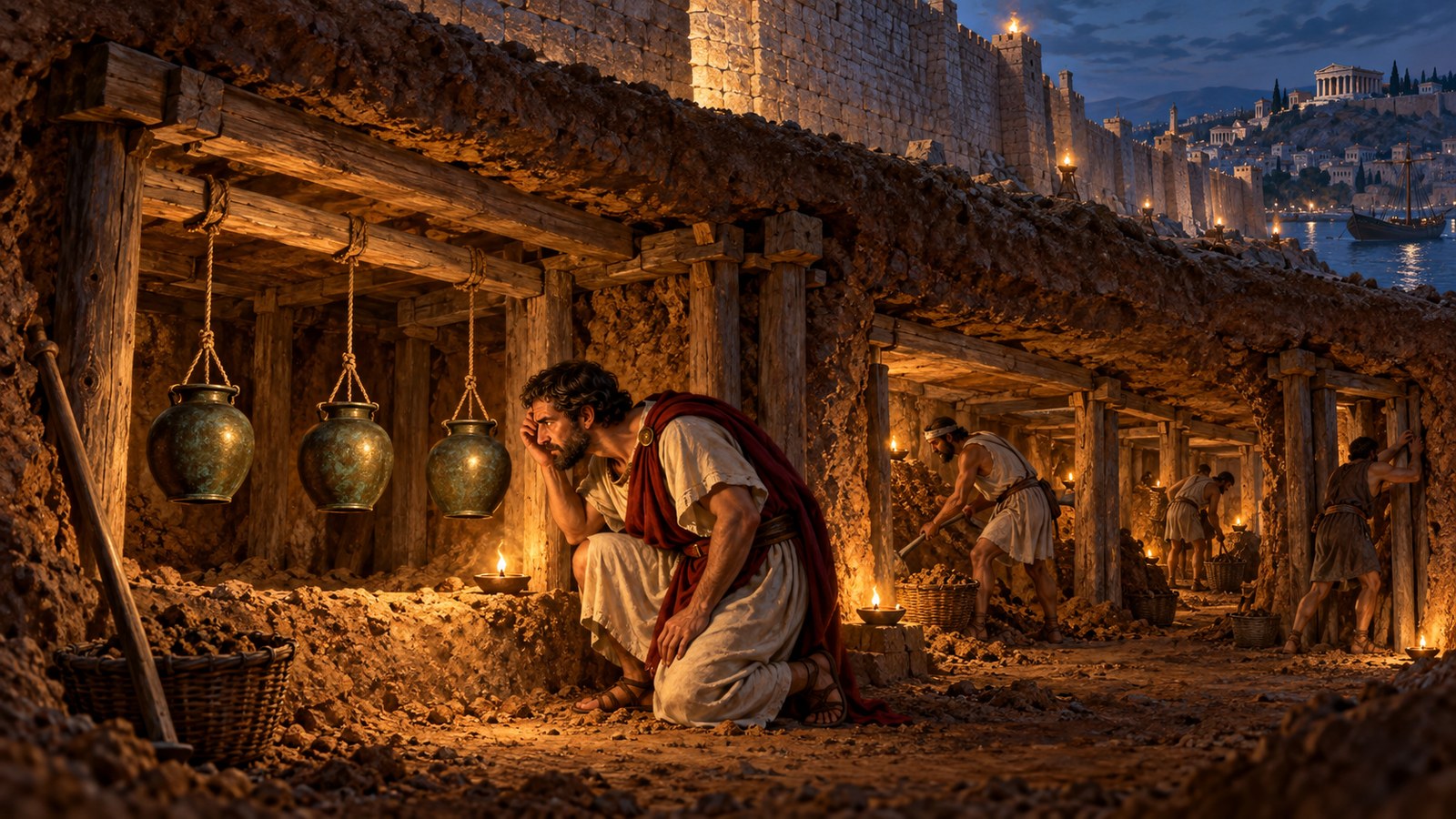
What Vitruvius does give is the effect. In an excavation close to the enemy mine, the bronze vessels began to ring from the blows of mining tools. A repeated impact made in one hidden space produced a detectable response in another.
The metal did not show the tunnel on a plan. It narrowed the problem through comparison: a vessel near the activity responded, allowing Trypho to infer the direction in which the besiegers were trying to penetrate.
That use differs from the bronze vessels Vitruvius placed in a theatre. Theatre vessels were arranged to reinforce selected musical resonances for an audience. Apollonia’s vessels served as warning indicators in rough excavations where the desired signal was the impact of tools.
The shared material should not collapse the two systems into one. Vitruvius’s siege paragraph does not describe theatre ratios or tuned notes. Its operational sequence is simpler: excavate, suspend, listen, compare, identify direction.
Ringing metal changed uncertainty into a point of action
Once the bowls rang near one approach, Trypho could stop treating the whole perimeter as equally threatened. The signal joined the spies’ general warning to a physical location under the ground.
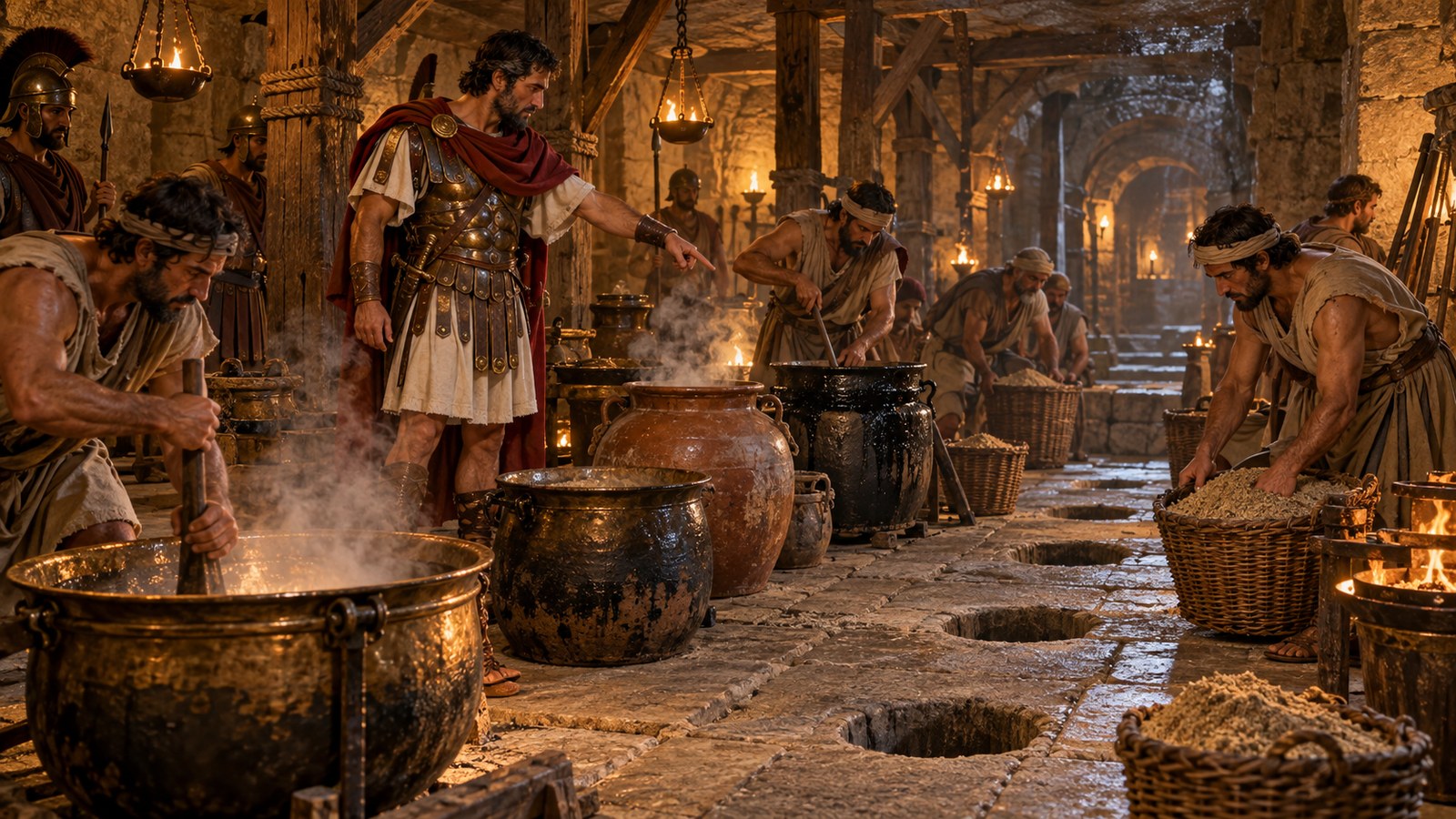
This is why the detection stage deserves more attention than the materials that followed. Boiling water, pitch, human dung, and heated sand are vivid enough to dominate a retelling, but none could be directed effectively until the enemy gallery had been found.
Vitruvius says Trypho prepared vessels holding those materials and bored many holes at night. Through the openings, the defenders suddenly poured the mixture onto the miners. His account ends the episode with the attackers’ destruction rather than with details of a continuing underground fight.
The narrative is brutal, as siege accounts often are, but it is also tightly ordered. Spies detect intention. The defenders recognize a location problem. Galleries create observation points. Suspended bronze responds to impact. Direction guides holes and a night action.
Nothing in the passage requires the vessel itself to identify distance, depth, or time to breakthrough. Trypho interprets a nearby response and derives direction. That modest claim is already technically interesting without turning the system into a modern sensor network.
The episode also exposes the double edge of digging. The attackers relied on earth to hide them, but the same medium carried their impacts. Concealment from sight did not mean silence.
The defenders’ galleries were both search infrastructure and preparation for a countermove. By working beyond the wall line, they created access to the space through which a mine would have to approach.
Vitruvius offers no independent casualty count and no name for the besieging force in this paragraph. The secure evidence is about method: warning, distributed excavation, suspended bronze, transmitted blows, inferred direction, and a targeted response.
Vitruvius made ingenuity the final defensive machine
Apollonia appears near the end of the tenth and final book of On Architecture, after descriptions of lifting devices, pumps, artillery, siege engines, and defensive expedients. It works as a compact demonstration of the book’s broad definition of technical skill.
The surrounding examples keep changing the medium through which danger travels. Chians modify water and seabed. Apollonians listen through earth. At Massilia, defenders lower a ditch until mine openings are exposed or flood the underground approach so water collapses its supports.
These are not interchangeable tricks. Each begins by reading the attacker’s dependence: a ship requires depth, a mine requires hidden stable ground, a timber rampart can burn, and a ram needs freedom to swing.
Trypho’s bowls belong to this logic because they exploit an unavoidable part of tunnelling. Picks and tools must strike. Repeated blows release energy into the surrounding material. The defender does not need to see the tool if a nearby suspended object announces its work.
Vitruvius closes the sequence by saying cities preserved freedom not by machines alone but by expedients suggested through the ready ingenuity of architects. That contrast should not be read as hostility to equipment; an entire book has praised and explained machines. It distinguishes possession of a large device from the ability to diagnose a particular problem.
Apollonia’s solution was materially restrained. Earth had to be dug, bronze vessels had to be hung, and people had to listen. The decisive achievement was arranging those ordinary actions so that an invisible approach acquired a direction.
Under a threatened wall, sound became a map of one fact. A ringing bowl did not win a siege by itself. It told Trypho where the hidden contest had finally come close enough to answer.
Sources
Vitruvius, On Architecture, Book 10, chapter 16, sections 9–12.