
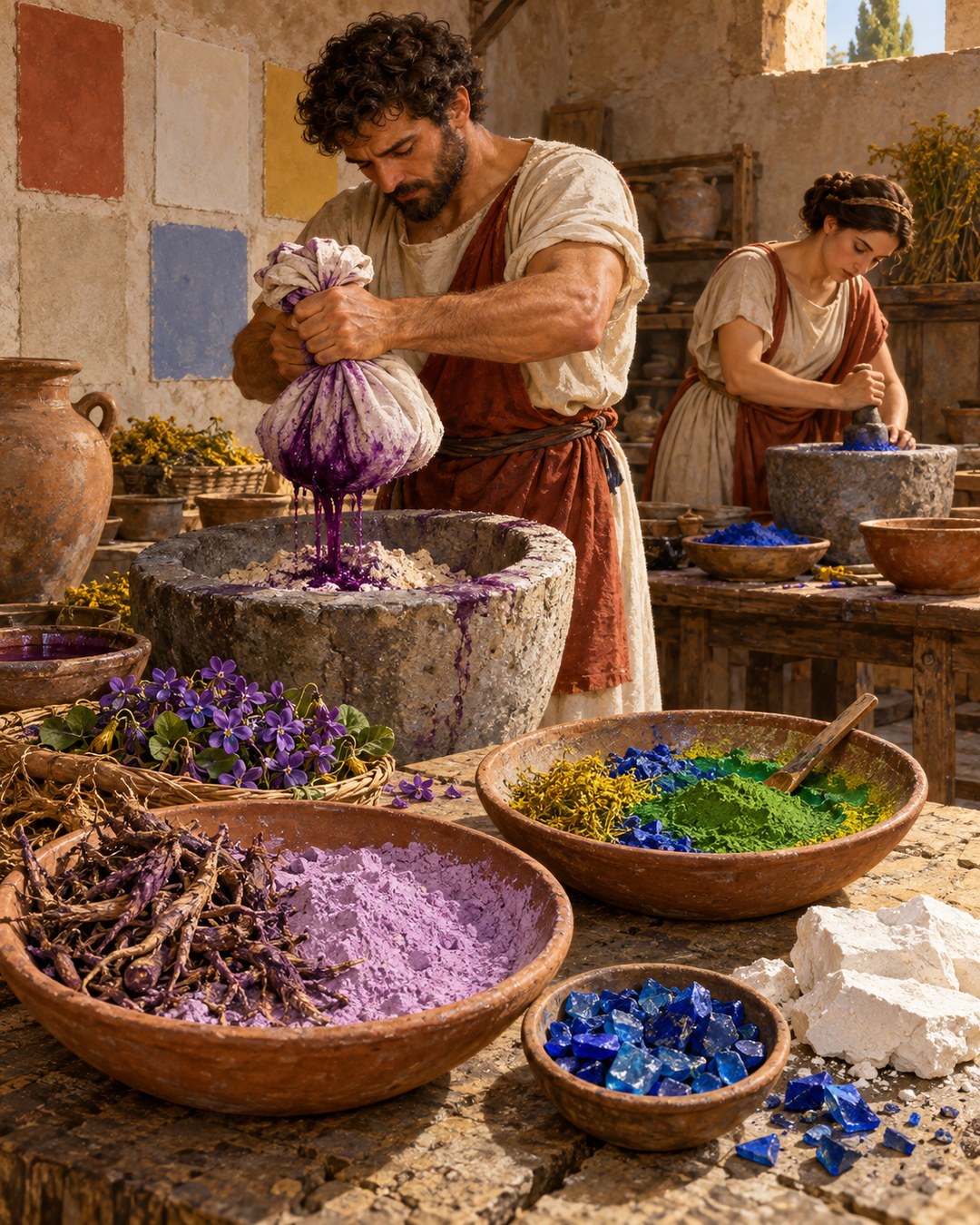
Dried violets entered a pot, boiled in water, and gave up their colour to cloth. Hands squeezed the wet bundle over a mortar. The collected liquid then met Eretrian earth and the mixture was ground until, Vitruvius says, it imitated Attic ochre.
This recipe appears at the end of his book on finishes, immediately after costly shell purple. The contrast is deliberate. One colour began with marine shells broken by iron bars; others began with chalk, roots, flowers, milk, weld, blue pigment, and glass.
Vitruvius names the latter group “factitious colours.” Their importance lies not only in resemblance. Each formula solved a material or economic constraint by attaching a wanted hue to ingredients a workshop could process differently.
Rare shell purple established the problem of cost
Before listing substitutes, Vitruvius describes purple obtained from a marine shell. He values it above other colours for rarity as well as visual quality, joining scarcity and appearance in the same assessment.
The colour was not uniform. He maps brown, pale, violet, and red results onto different regions and their relation to the sun. Whatever the accuracy of that geography, his workshop reader encountered purple as a material whose place of origin affected expectation.
Processing demanded force. Gathered shells were broken into small pieces with iron bars. Coloured liquid oozed out “like tears,” drained into mortars, and was ground.
Saltness created another problem because the colour dried quickly. Vitruvius says honey was used in preparing it. The admired pigment therefore arrived with a chain of conditions: a particular animal source, regional variation, collection, breakage, drainage, grinding, and management of drying.
That sequence belongs beside the salted processing of murex purple, but Vitruvius’s next chapter moves in another direction. He does not try to make a shell cheaper. He lists different materials that could supply or imitate desired colours.
Substitution begins with a visual target and works backward. If the workshop wants purple, Attic ochre, brilliant green, or indigo-like blue, what carrier and colourant can produce a serviceable result without the prestigious source?
The answer is not one universal adulterant. Chalk behaves differently from milk; flower water enters earth differently from powdered glass. Vitruvius’s category groups recipes by purpose, not by identical chemistry.
Violet water had to pass through cloth before it reached earth
The Attic-ochre imitation is Vitruvius’s most complete substitute procedure. Dried violets are boiled in a vessel. The contents then go onto a cloth rather than directly into the mortar.
Workers squeeze the cloth with their hands, and the water coloured by the violets falls into the mortar below. The cloth functions as an intermediate stage between boiled plant matter and the liquid selected for mixing.
Eretrian earth is then added and ground with the coloured water. A flower does not become paint merely by being crushed beside a wall. Its colour is extracted, separated through cloth, transferred to earth, and mechanically worked into a new material.
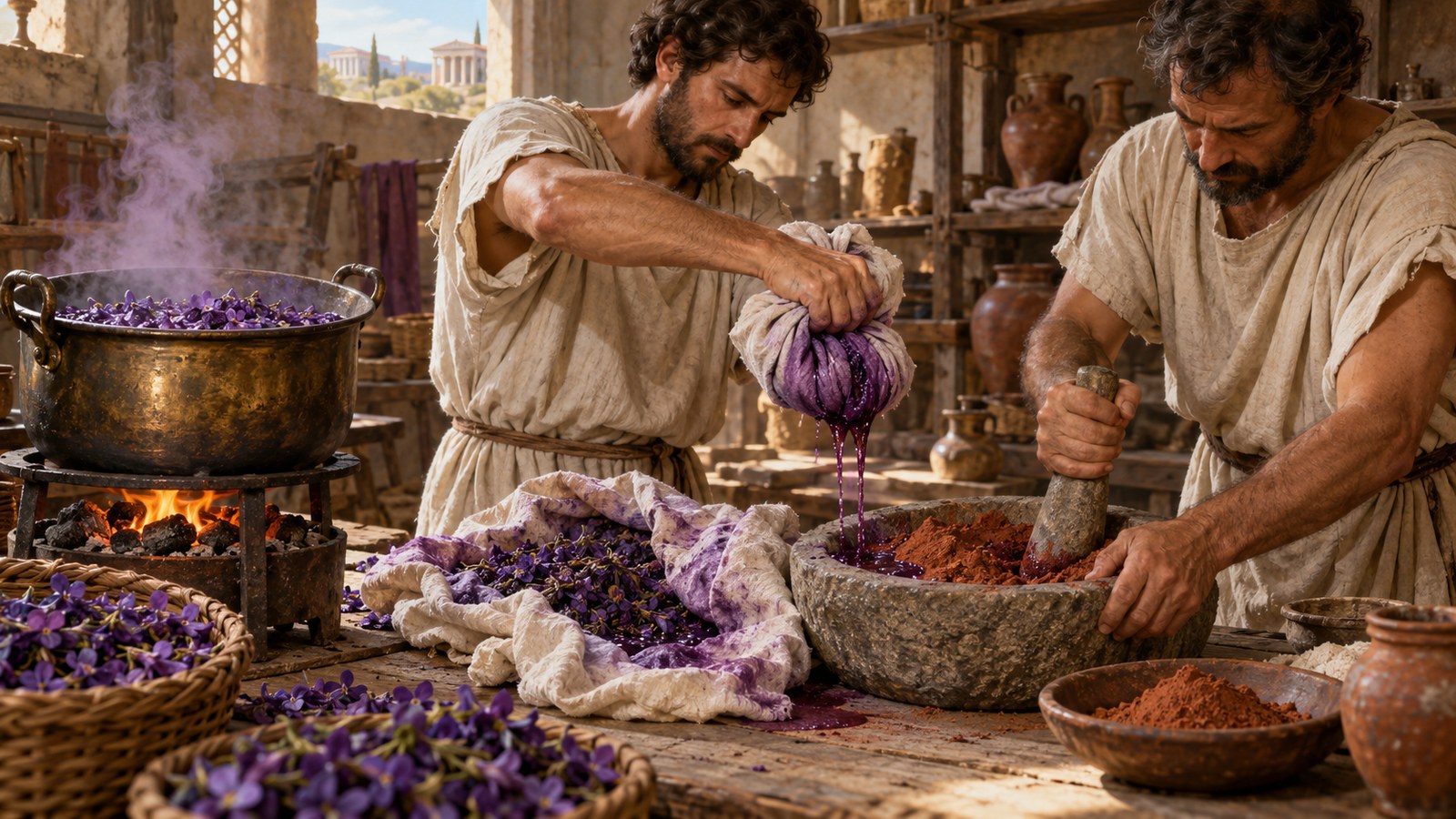
The target is Attic ochre, a named colour associated with another source. Vitruvius does not say the substitute is chemically identical. “Imitate” defines success as an achieved appearance suitable to the intended work.
The stages also make quality depend on handling. Too little extraction, poor separation, an unsuitable proportion of earth, or incomplete grinding could all alter the result, even though Vitruvius supplies no measurements for a modern reconstruction.
His silence about proportions is important. The text preserves a process outline, not a laboratory protocol. It tells us what entered the sequence and in what order, while leaving workshop judgement inside phrases such as boiling, squeezing, mixing, and grinding.
That embodied labour differs from the sealed-vessel conversion of lead into white pigment. One recipe depends on vapour acting over time; the violet substitute depends on extraction and transfer performed in visible steps.
Roots, milk, and weld widened the substitute palette
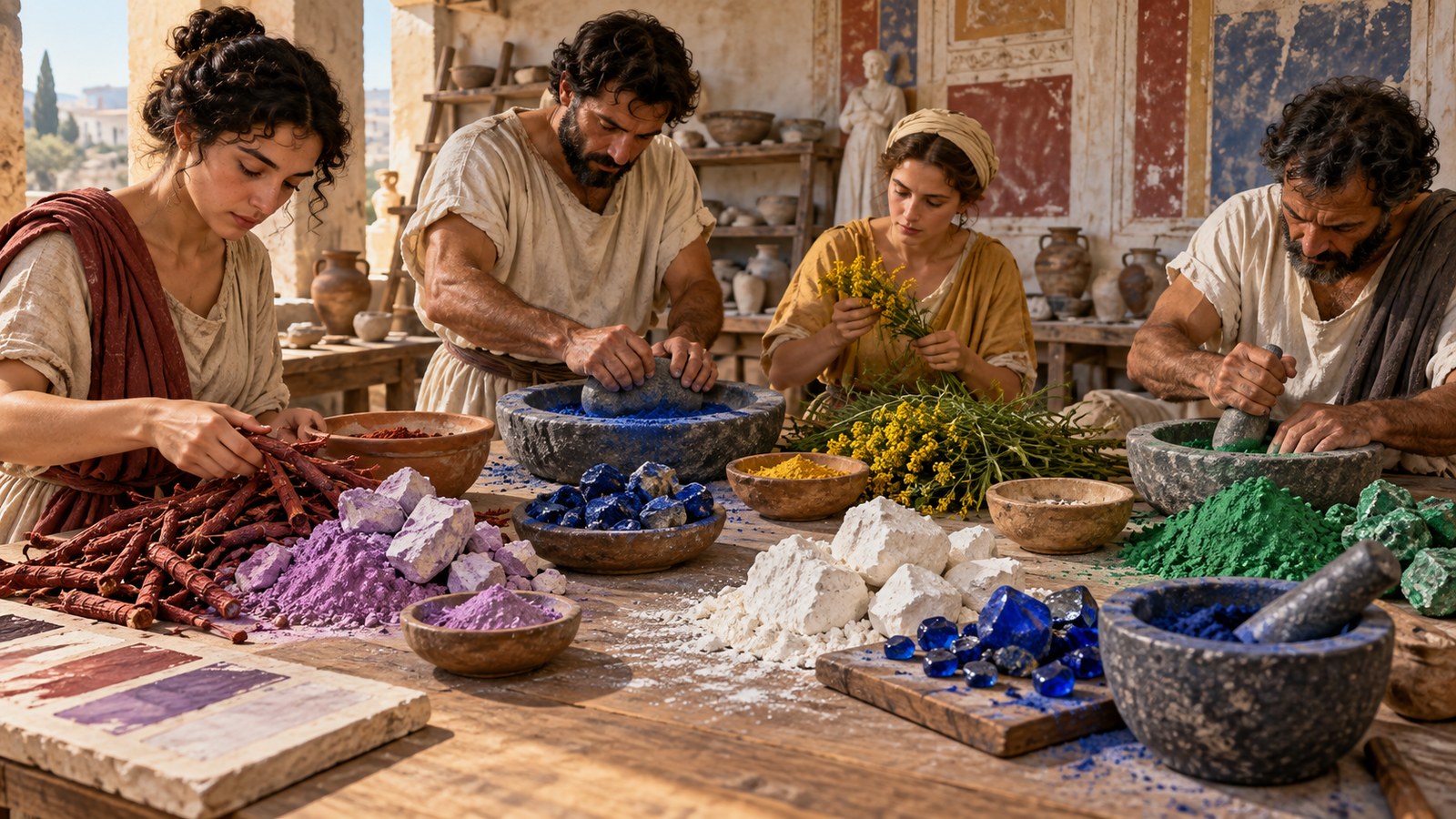
Vitruvius begins the chapter with another route to purple: chalk could be coloured with madder root and hysginum. The valued hue no longer required a crushed shell if a mineral carrier could receive plant colour.
He then says vaccinium mixed with milk produced an excellent purple. The exact botanical identification represented by the Latin name has been debated, so the safest claim follows his recipe language: a named plant product and milk formed another purple preparation.
The green substitute begins from inability to afford chrysocolla. Vitruvius tells workers to mix blue with the herb weld and says the result is a brilliant green.
This is a different logic from simply stretching a costly green with neutral filler. A blue ingredient and a plant associated with yellow colour are combined to reach the target. The target is built from contributors rather than diluted from an original piece of chrysocolla.
Affordability is explicit. The worker acts because chrysocolla cannot be afforded. This makes the recipe evidence for workshop decision-making, not merely for a curiosity cabinet of ancient substances.
The customer, patron, or painter may still have cared whether a surface used the prestigious source. Vitruvius does not describe disclosure, deception, contracts, or price negotiation here. He records an available alternative and the colour it was expected to yield.
“Factitious” therefore should not automatically be translated into “fraudulent.” The word marks something made or contrived. The recipe can be a legitimate technical solution even when resemblance to an expensive material supplies its reason.
Durability remains part of the larger architectural problem. At the close of the book, Vitruvius says he has explained colour-making so finishes can be durable and appropriate. A cheap colour that immediately failed on plaster would not answer that stated purpose.
Chalk and glass made an indigo without indigo
Indigo receives the chapter’s clearest price statement. Because it was dear, Vitruvius says, Selinusian chalk—or chalk used for making rings—was mixed with glass to imitate it.
The recipe is terse. He does not provide furnace conditions, grain size, source of the coloured glass, or proportions. It would be wrong to fill those gaps with a modern formula and attribute it to him.
Even so, the choice of materials reveals a strategy. Chalk supplies a mineral body; glass contributes the component by which an indigo-like visual result can be built. Grinding and mixing turn separate solids into a paint ingredient.
The method also closes a spectrum of substitutions. Purple can come from coloured chalk or a plant-and-milk mixture. Ochre can be imitated by violet extract fixed into earth. Green can be composed from blue and weld. Indigo can be approached through chalk and glass.
Across those cases, the desired colour is detached from one privileged origin. Marine animal, imported mineral, plant matter, earth, milk, and glass become parts of a workshop vocabulary whose terms can be recombined.
Vitruvius places the recipes inside architecture rather than in a merchant’s price list. They matter because wall finishes require materials that can be prepared, applied, and expected to look appropriate after the builder leaves.
The chapter is short, but its economy is unusually visible. “Those who cannot afford” and “on account of the dearness” explain why technical invention happens. Constraint does not end colour; it changes the route by which colour reaches a surface.
A violet crushed on the floor would be a stain. A violet boiled, filtered through cloth, transferred into earth, and ground became part of an architectural pigment. The substitute was made not by renaming a cheap ingredient, but by designing a sequence around what that ingredient could carry.
Sources
Vitruvius, On Architecture, Book 7, chapters 13–14.