
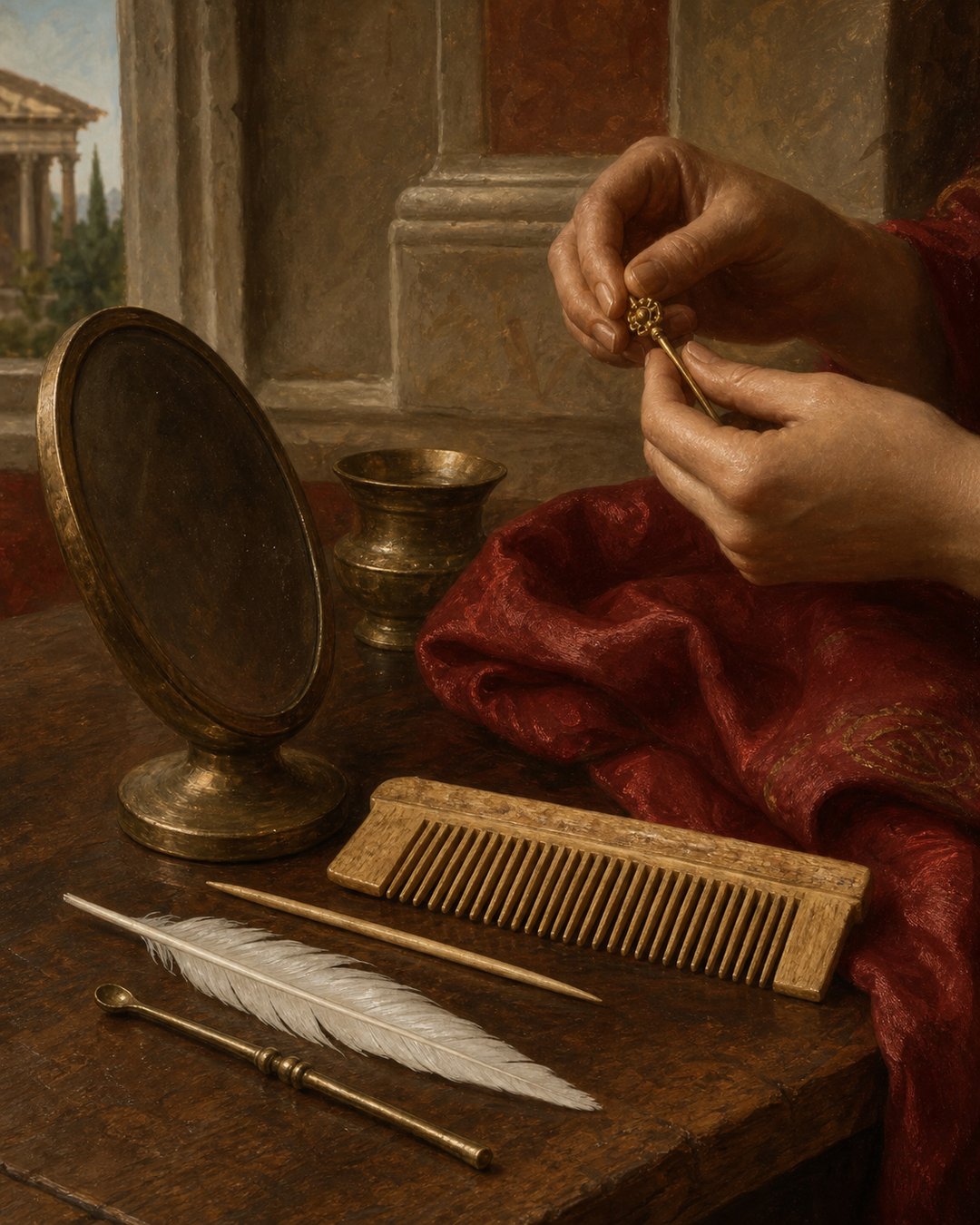
A sliver of lentisc wood passed between the teeth. A narrow implement answered an itch in the ear. A gold pin lifted oiled hair clear of silk, while a boxwood comb waited for a recipient whom the poet promptly declared bald. In Martial’s gift book, Roman grooming arrives not as a single morning routine but as a procession of small objects, each made to solve one precise problem.
The sequence occupies only a few paired lines in Book 14 of the Epigrams. Its scale is exactly what makes it valuable. Martial names materials, body parts and visible consequences without pretending to write a beauty manual. Lentisc, quill, gold and boxwood sit between discomfort and appearance. Together they show personal care built from tiny tools whose usefulness could be admired, mocked or displayed.
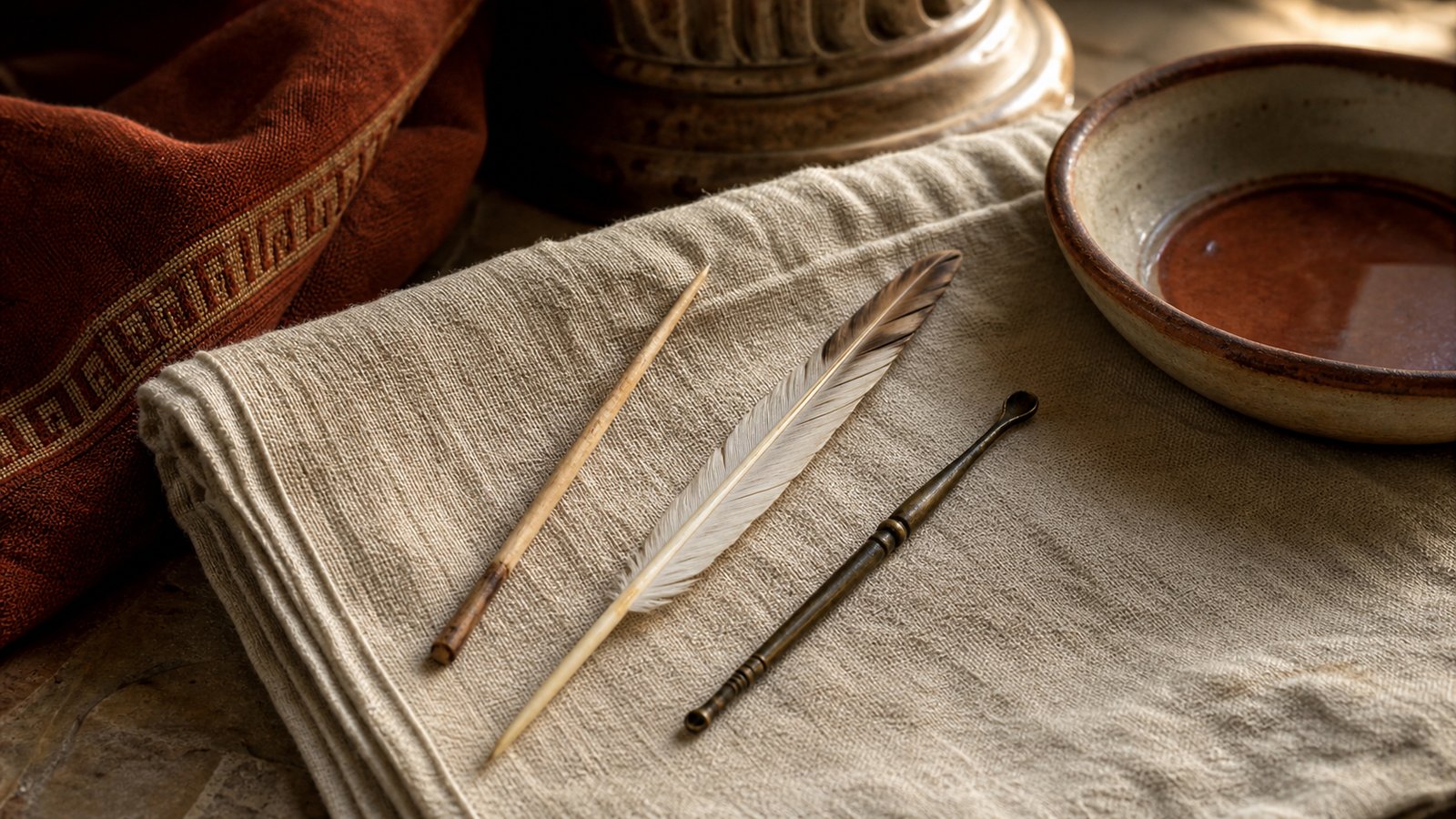
Lentisc and quill entered where fingers could not
Martial frames Book 14 as a collection of gifts for feast guests and announces that every subject can be completed in two lines. The tooth-pick in Epigram 14.22 therefore has no space for a workshop history. It gives a preference and an alternative. Lentisc wood is best; if lentisc cannot be obtained, a quill may relieve the teeth.
That couplet preserves a miniature hierarchy of materials. The task is narrow enough to require a slender object, yet the object is not treated as interchangeable rubbish. One plant material is preferred. A feather component can substitute. The distinction assumes that a recipient understands both the sensation after eating and the advantage of a tool shaped for the gap.
Nothing in the poem specifies length, point angle or whether the lentisc was sold in bundles. Responsible reconstruction stops there. The secure physical picture is still vivid: a piece of wood small enough to work between teeth and a quill fine enough to perform a similar service. Martial turns the humble act of dislodging food into something presentable as a feast gift.
The setting creates a neat loop. Food makes the implement useful, and the feast distributes the implement as a gift. The tooth-pick belongs after appetite but also inside hospitality. A host can hand over the means of repairing what dinner has left behind.
An irritated ear received its own instrument
The next epigram moves only a few centimetres across the body. Its object is an ear-pick, offered when troublesome tickling or irritation needs relief. Again, the tool exists because a fingertip is too broad or awkward for the desired precision.
Martial does not identify its material in this couplet, describe a spoon-shaped end or prescribe a medical treatment. Calling it a surgical instrument would exceed the evidence. What the poem does prove is specialization: the ear-pick has a named bodily destination and a recognized annoyance to answer.
Placed after the tooth-pick, it creates a pair. Both objects are slender extensions of the hand. Both enter small spaces. Both turn a private irritation into a gift that can be named in public. Their value lies less in mass than in access. A tiny object can reach where an entire hand cannot.
This concern with narrow control also appears in the Roman tweezers that made a fingertip more precise. The mechanisms differ—one implement reaches, another pinches—but the design problem is related. The body presents small targets, and craft answers by reducing the working end of the hand.
Gold kept oil away from silk
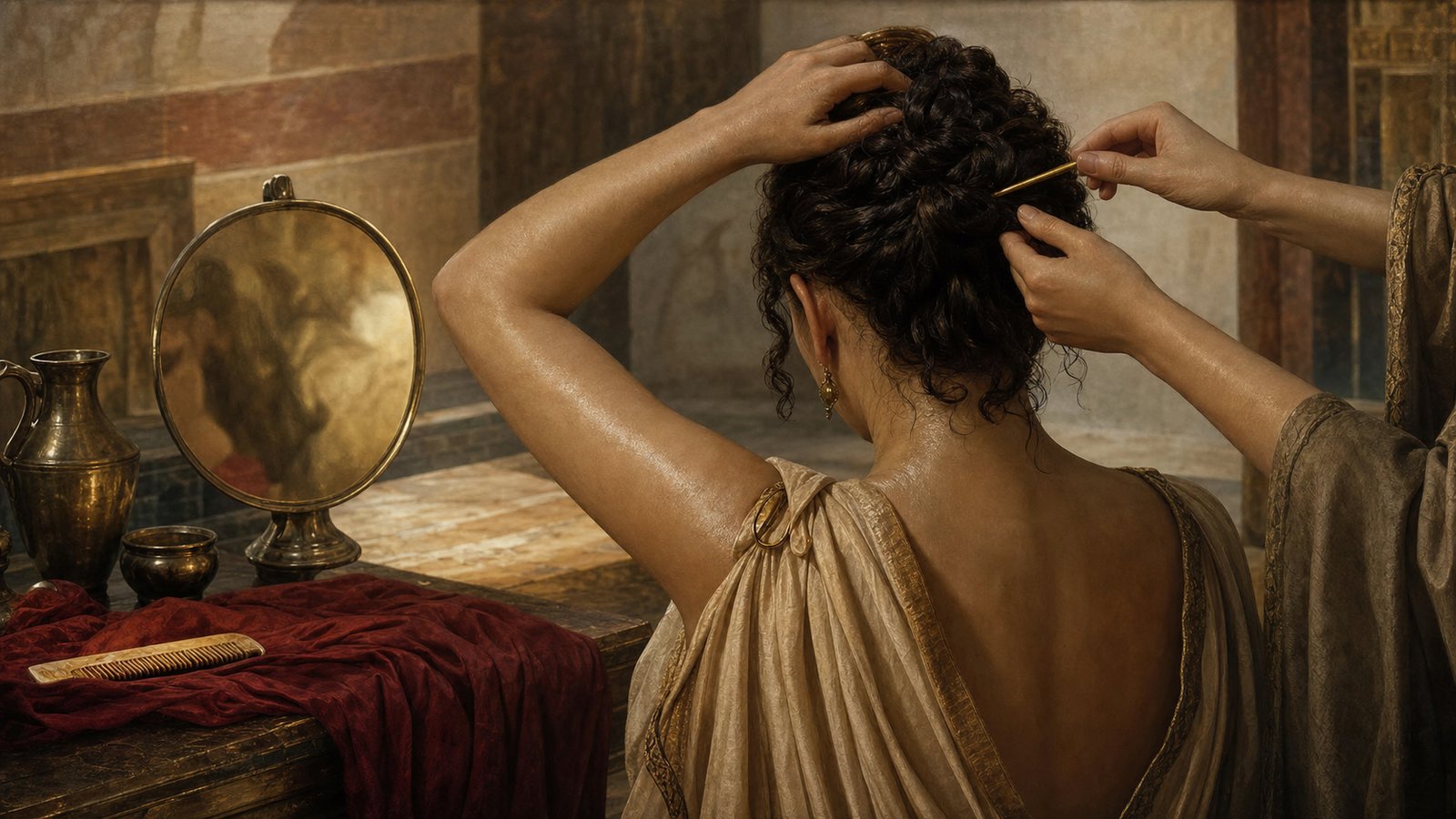
Epigram 14.24 changes the scale of display. The object is a golden hair-pin. It is told to fix twisted hair in place and keep oiled tresses from damaging a splendid silk dress. Material, hairstyle and clothing meet in one practical instruction.
The gold matters because the pin is visible ornament as well as fastener, but Martial gives it work to do. Hair has been oiled. It has been twisted upward. The garment below is valuable enough to protect. The pin maintains the arrangement and preserves a boundary between treated hair and silk.
That boundary makes dressing a sequence rather than a pile of luxuries. Oil belongs on the hair but not on the dress. Silk belongs against the body but should not receive the oil. Gold holds the hair where appearance and protection require it. The richest object in the group is also a piece of preventative maintenance.
The poem offers no name for the wearer, no quantity of oil and no design for the pin’s head. Its concreteness comes instead from contact: tresses can touch cloth, oil can mark it, and a fastener can stop the transfer. Luxury is vulnerable to another luxury unless a small tool keeps them apart.
Boxwood teeth made baldness visible
The comb in Epigram 14.25 is cut from boxwood into many teeth. Martial immediately asks what use it can be to a person who has no hair. The joke destroys the gift by removing its necessary surface.
Before the insult lands, the line gives a compact account of manufacture. One piece of wood has been divided into repeated narrow projections. The human analogy is unavoidable because Martial names those projections teeth immediately after a tooth-pick has appeared nearby. The crafted edge multiplies the narrow reach that a single point supplied.
A comb requires hair to resist and separate. Without hair, the boxwood remains carefully cut but functionless. The joke therefore depends on mechanism, not merely appearance. A bald recipient cannot activate the object’s design, however finely its teeth were made.
The comb also belongs to a visual world in which the quality of a Roman reflection depended on the mirror’s material. Mirror and comb could both participate in preparation, yet neither guaranteed the desired result. One surface might return a shadowed face; one toothed tool might meet no hair at all. Martial finds comedy where ownership and usefulness separate.
Hair colour became the final unstable gift
The next two poems continue with hair but shift from arranging it to changing its colour. Epigram 14.26 offers a pomatum whose caustic force reddens German hair and claims that its user can surpass the tresses of an enslaved attendant. The comparison makes colour social. The compound promises not merely alteration but competitive display.
Epigram 14.27 addresses an eighty-year-old who wants to change white hair with Mattiac balls. Then Martial repeats the comb’s trap: why bother, he asks, when the recipient is bald? The desired transformation is defeated because the material to be transformed has disappeared.
These lines should not be inflated into a complete chemical recipe. Martial does not list ingredients for either preparation in this sequence. He does preserve the claimed action of the pomatum, the association of Mattiac balls with changing white hair, the age of the imagined user and the baldness joke. That is enough to show products marketed through visible outcomes while remaining exposed to satire.
The sequence then steps outdoors. A parasol promises protection against excessive sun and can serve as a veil against wind. A broad-brimmed hat attends Pompey’s theatre because the awning gives too little shelter from the wind. Grooming opens into presentation: after teeth, ears and hair have been managed, weather can still disturb the prepared body.
Martial’s gift labels do not reveal one universal Roman routine. They preserve options arranged by task and material. Lentisc is preferred but quill can substitute. The ear has a dedicated implement. Gold controls oiled hair above silk. Boxwood becomes useful teeth only when the recipient has hair. Colouring compounds promise change, and shade devices defend the result against sun and wind.
The comedy keeps every object honest. A precious pin can prevent a stain. A cheap sliver can relieve the teeth. A beautifully cut comb can be useless. A colour treatment can promise youth to someone with nothing left to colour. Roman grooming in these couplets is neither pure vanity nor simple hygiene. It is a practical negotiation between the body, crafted matter and the gaze waiting outside the room.
Sources
Martial, Epigrams, 14.1, 14.22–29