
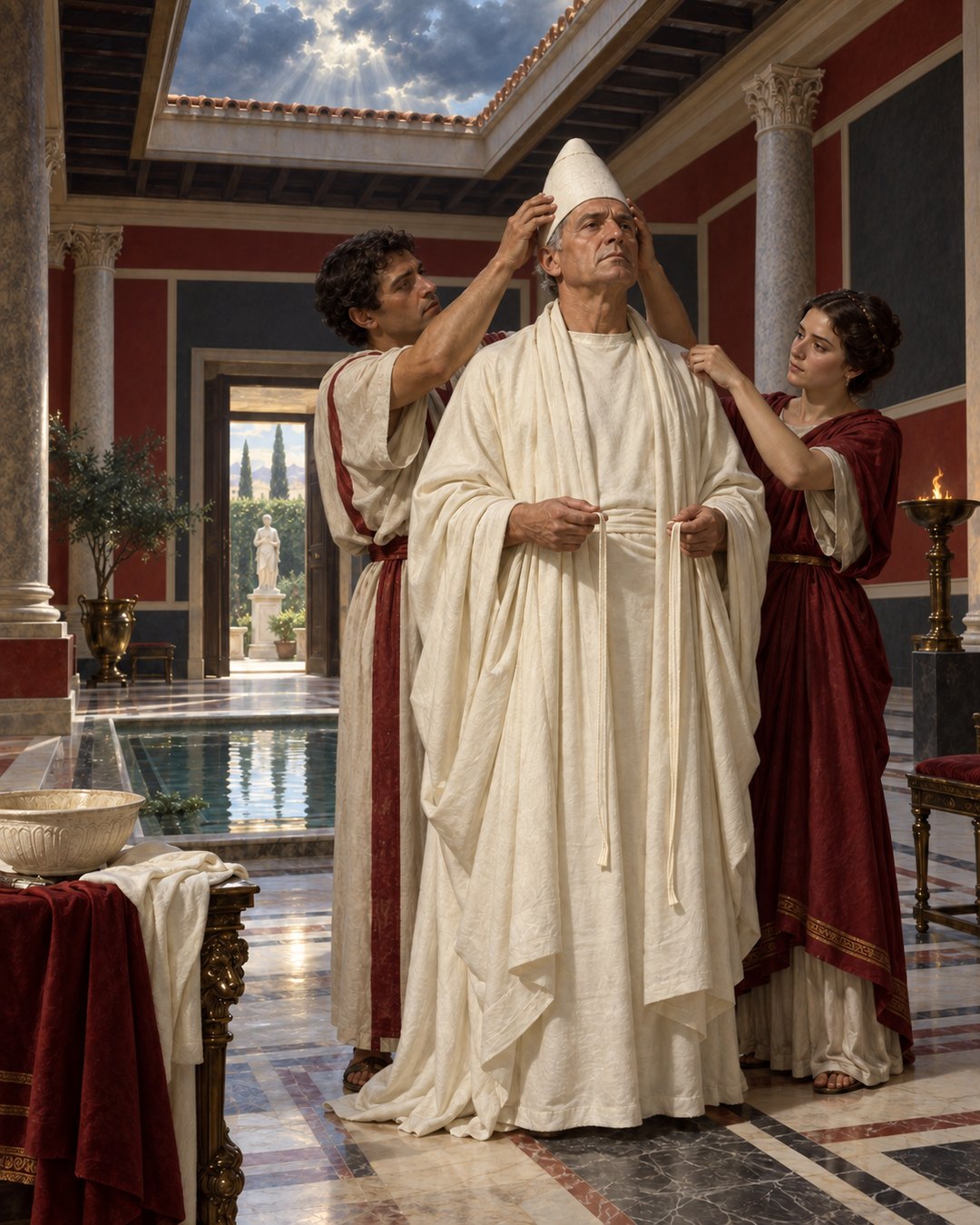
A knot in a belt was not a small matter when the belt belonged to Jupiter’s priest.
Aulus Gellius lists rules that followed the flamen Dialis from the public road to his atrium, his dining place, his bed, his hair, and his marriage.
The office did not wait for a festival to become active. Every day was holy.
Knotless Clothing Made the Body Part of the Cult
Gellius collected the ceremonial restrictions of the flamen Dialis from earlier books and public records. His chapter reads less like one ritual script than a map of a life under permanent conditions.
The rule about knots is among the most vivid. The priest could have no knot in his head-dress, girdle, or any other part of his clothing.
Dress therefore had to be inspected not only for material and rank but for fastening. A loop pulled tight could violate the form demanded by office.
Another restriction applied to his ring. It had to be perforated and without a gem.
Both rules reduced closure. The garment could not be bound by a knot, and the ring could not present a sealed solid setting.
Gellius does not give one explanatory theory that safely decodes every item in the list. Modern readers should resist turning all of them into a single symbolic formula.
What the list securely reveals is repetition. Dressing each morning renewed the conditions of priesthood. An attendant handling cap, belt, tunic, and ring participated in maintaining public religion.
The cap was especially persistent. The flamen could not go into the open air without it. A later pontifical decision, cited through Masurius Sabinus, allowed him to go bareheaded inside the house.
That concession defined the house as a different ritual environment from open sky. Crossing the threshold altered what the priest could wear, but it did not end his restrictions.
Roman religion often worked by controlling sequence and contact rather than by separating belief from action. The Vestals’ pointed water vessel likewise made the handling of an ordinary substance depend on a specialised object. For Jupiter’s priest, the specialised object was also his dressed body.
Bonds Had to Leave through the Roof
The flamen’s house did more than shelter him. It changed the condition of another person who entered it.
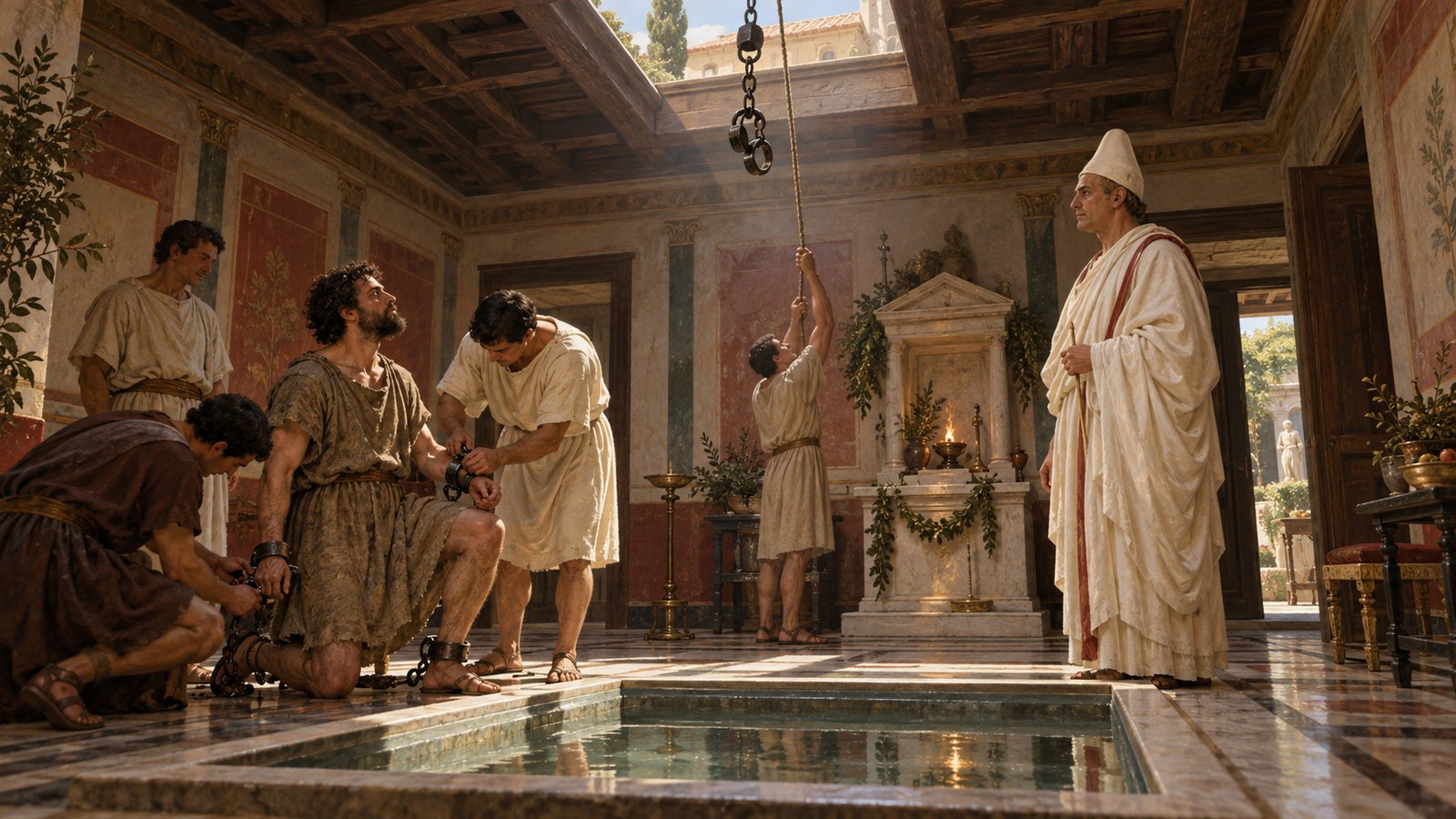
If someone in fetters came inside, Gellius says the person had to be released.
The empty restraints could not simply remain by the doorway. They were drawn upward through the impluvium to the roof and then lowered into the street.
The wording makes a striking route through the Roman atrium. Rain normally entered through the central opening and collected below. In this ceremony, bonds travelled in the opposite direction: up toward the opening, across the roof line, and down beyond the house.
Release was therefore spatial as well as physical. The person was freed inside; the instruments of constraint were expelled without retracing an ordinary path through the doorway.
Gellius gives another protection to a suppliant at the priest’s feet. If a person about to be flogged reached that position, flogging was forbidden for that day.
These clauses did not make the flamen a general magistrate of prisons. They created specific effects around his person and residence.
The contrast with the ban on knots is hard to miss, though Gellius does not explicitly explain it. Bound clothing was excluded from the priest; bound people could not remain bound in his house.
The ritual logic was carried by acts: untie the person, lift the bonds, pass them beyond the roof, postpone the beating.
For an observer, the household displayed a zone where constraint could not retain its ordinary form.
That zone had limits. The source does not say that a released entrant’s legal problems vanished, or that the priest could pardon a sentence. It says that fetters inside the house triggered release and that supplication at his feet stopped a flogging on that day.
The narrowness of the rule made compliance concrete. The household did not need to solve justice in the abstract. It had to know what to do when iron crossed its threshold.
Bed, Hair, and Bread Extended Ritual into Routine
Sleep did not place the flamen outside office.
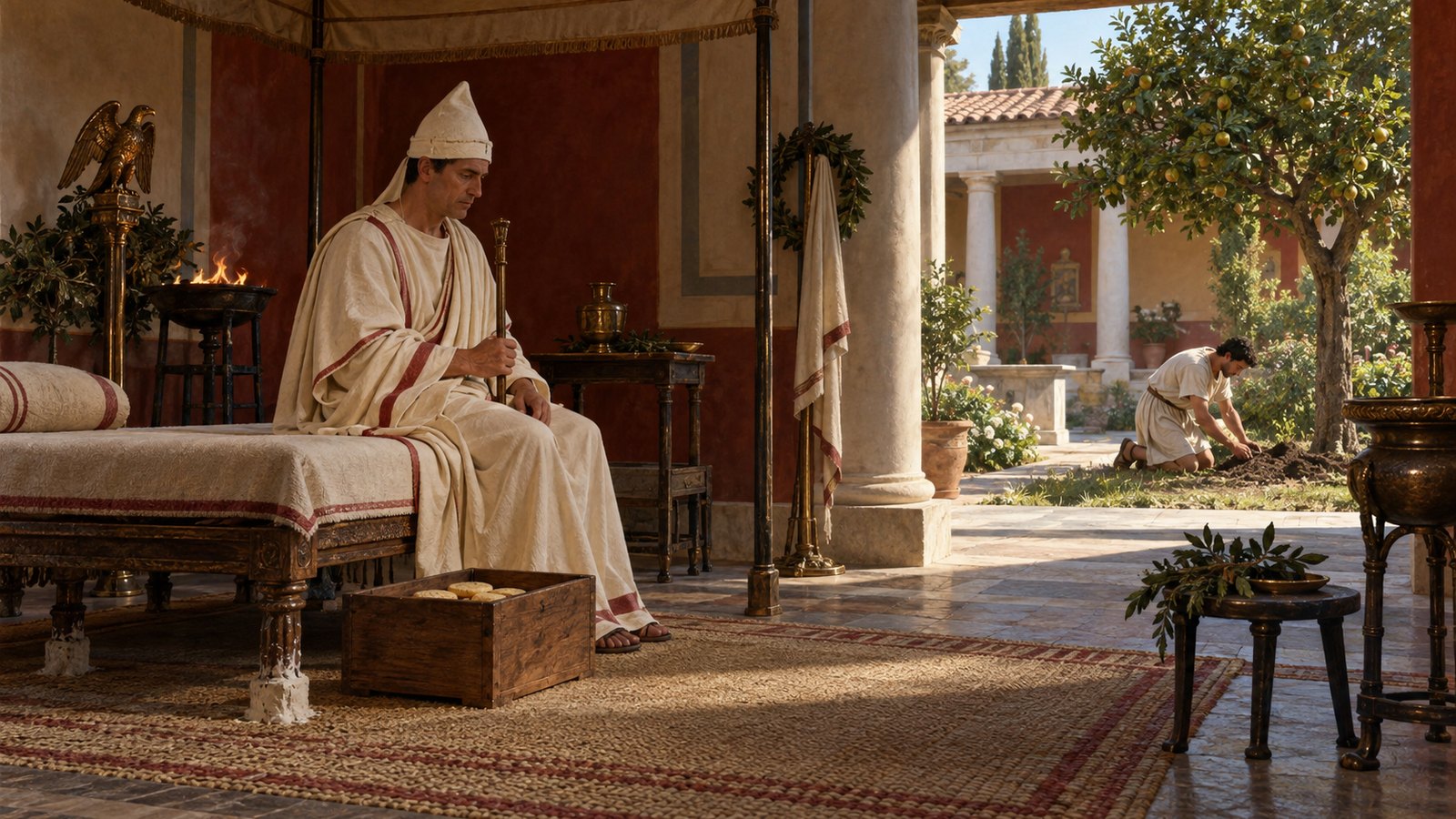
The feet of his couch had to be smeared with a thin coating of clay. No one else could sleep in that bed.
He could not spend three consecutive nights away from it. Travel was possible only within a limit that pulled him back to the dedicated sleeping place.
A box of sacrificial cakes stood at the foot of the couch. The bed was framed by ritual material even while the priest rested.
Grooming carried its own obligations. Only a free man could cut the flamen’s hair.
Clippings from hair and nails did not become casual refuse. They were buried in the earth beneath a fruitful tree.
Parts removed from the priest’s body therefore received controlled disposal. The rule connected grooming to status, soil, and fertility without allowing the remnants to circulate as ordinary rubbish.
Food and speech were regulated too. Gellius says the priest could not touch, or even name, a she-goat, raw flesh, ivy, and beans. He also could not touch bread fermented with yeast.
The chapter does not invite us to imagine the flamen inventing personal preferences. These were inherited conditions attached to his role.
A household serving him had to organise around them. Cooks, servants, barbers, attendants, and guests all needed practical knowledge of what could approach his hands, clothes, table, and bed.
The restrictions made ritual expertise collective. The flamen bore the office, but others prevented prohibited contact and prepared the permitted environment.
Even rank at table was specified. No one sat above him except the rex sacrificulus, the priestly “king of rites.” Dining order converted cult hierarchy into seating.
The result was not a private ascetic programme. It was a publicly recognised priesthood made visible through domestic routines.
Marriage Held the Office Together
The flamen Dialis did not occupy his post as an isolated man.
Gellius says that if he lost his wife, he abdicated the priesthood. Their marriage could not be dissolved except by death.
The wife, the flaminica Dialis, observed related and additional ceremonies. She wore a dyed robe and carried a twig from a fruitful tree in her head-dress.
Her movement had limits: she was forbidden to climb more than three rungs of a ladder except on a particular kind called Greek.
On the procession to the Argei, she neither combed nor arranged her hair.
The paired offices made marriage structural rather than decorative. The husband’s qualification depended on the continued life of his wife, while her own dress and conduct embodied the cult.
This gives the household restrictions greater weight. The priestly home was not merely a residence where one officeholder happened to sleep. It supported a ritual couple whose marriage could not be voluntarily broken while the office continued.
The flamen’s relationship to death was carefully bounded. He never entered a burial place and never touched a corpse, though he was allowed to attend a funeral.
Presence and contact were not identical. He could participate at a distance that preserved the prohibition.
Vestal selection shows another priesthood built through bodily status, family qualification, and public procedure. The flamen’s rules show what happened after selection: office continued through thousands of ordinary choices.
Horseback travel, an army in battle array outside the pomerium, an oath, a gemmed ring, a tied belt, a fermented loaf, three nights away, a funeral threshold—each could become the edge of priestly permission.
Gellius’s list is memorable because it refuses to confine religion to temples. Jupiter’s priest carried the cult in the way he dressed, slept, ate, travelled, married, and received a stranger at home.
The missing knot was not an eccentric accessory. It was a daily sign that the office had no off-duty hour.
Sources
Aulus Gellius, Attic Nights, book 10, chapter 15.