
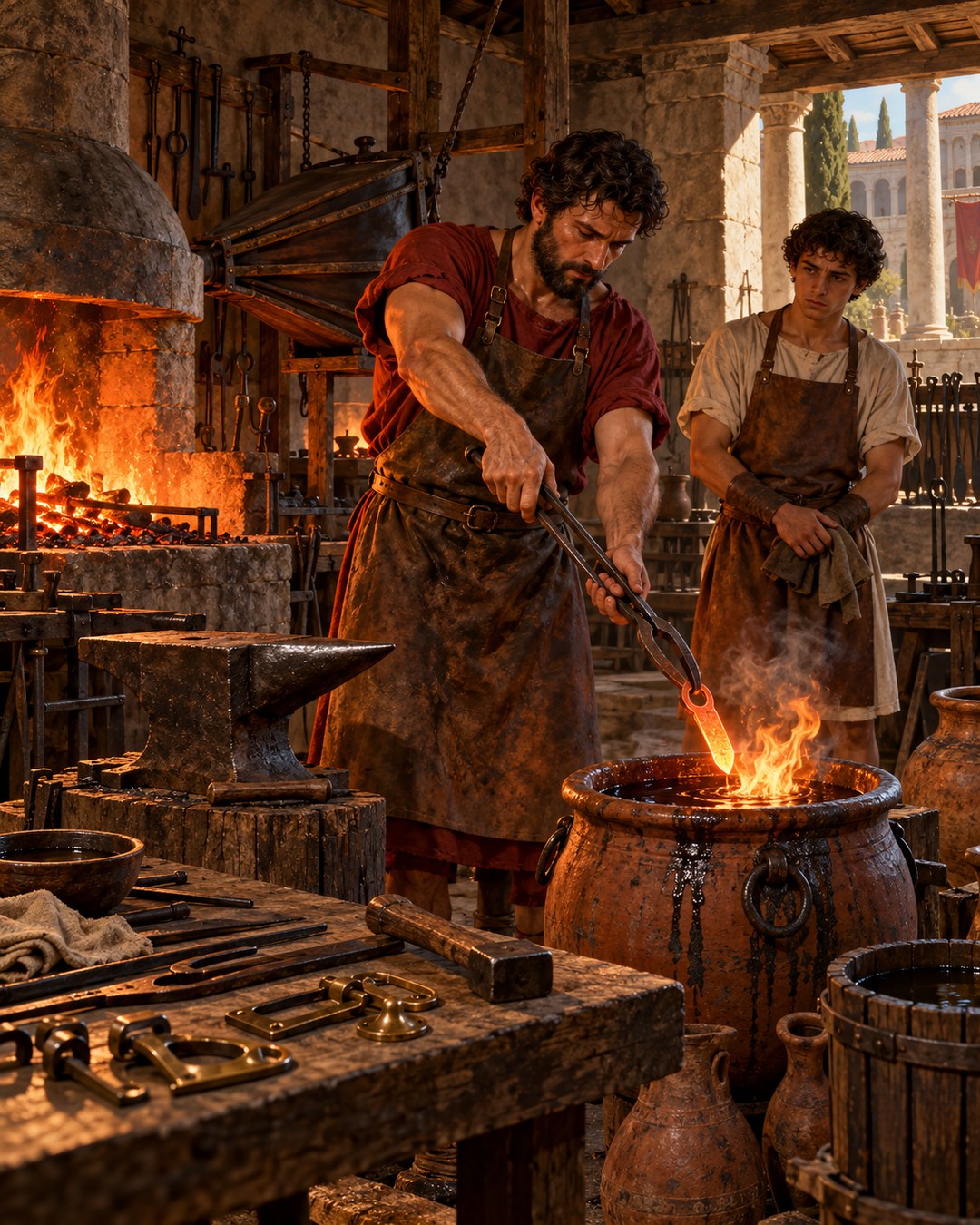
A small iron object left the fire glowing. The next step could preserve its usefulness or turn hardness into a hidden weakness. Pliny the Elder reports that smiths commonly quenched smaller forgings in oil because water might harden them enough to make them brittle.
The line is short, but it captures a workshop decision rather than a magical recipe. The cooling liquid, the size of the piece, the desired edge and the iron itself all mattered. A smith was not merely trying to make metal as hard as possible. He was trying to keep an object from breaking after the heat was gone.
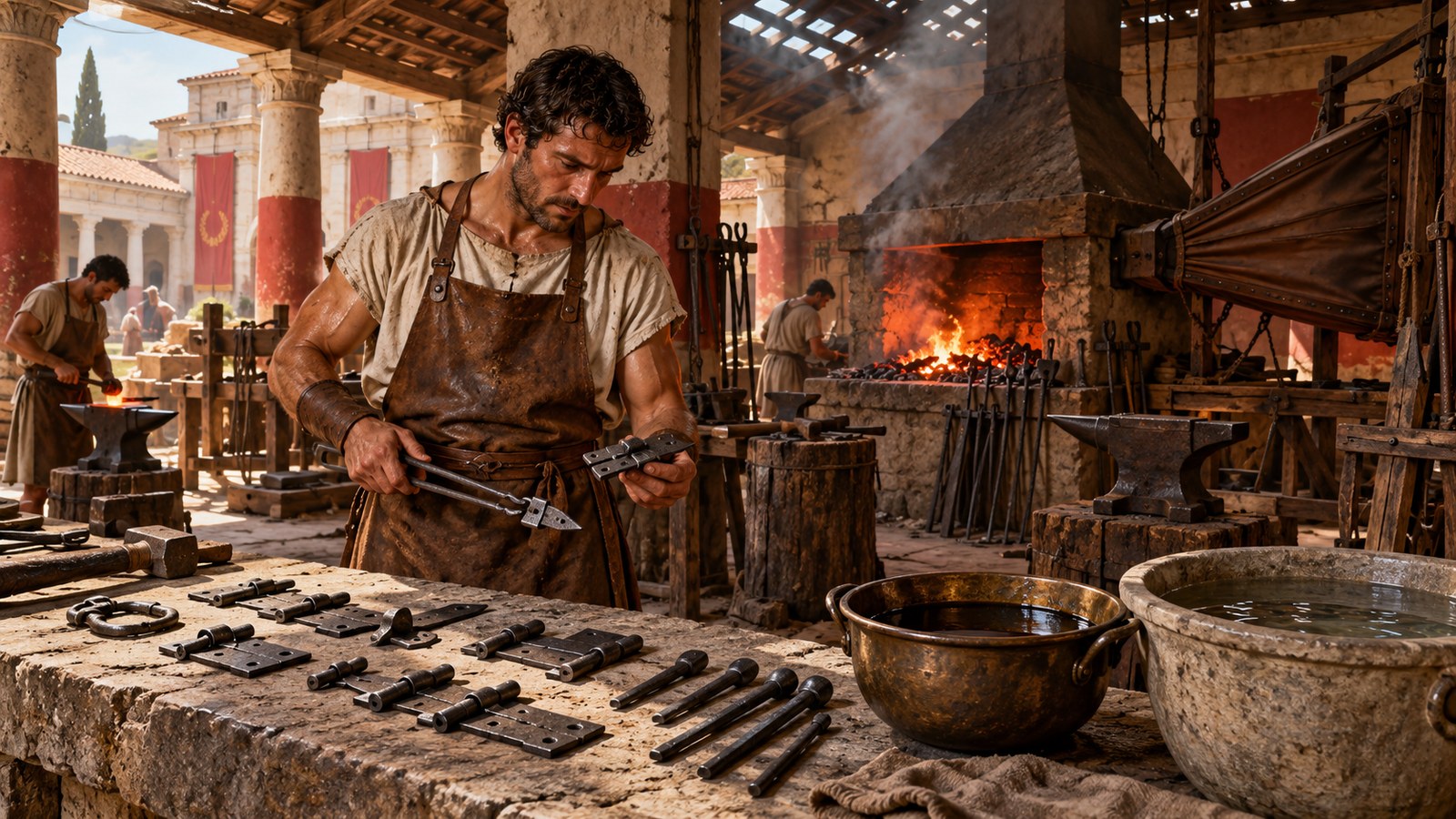
Good iron began before the quench
Pliny did not attribute every difference in iron to one final action. In his survey, quality could come from the ore-bearing lode, from the method of working or even from local water. He named the country of the Norici for ore quality and Sulmo for workshop practice.
That list places the finished object at the end of a chain. The ore arrived with its own composition. Smelting changed stone into workable metal. Repeated heating and hammering shaped and consolidated the piece. Cooling and edge preparation then altered how that piece behaved in use.
Pliny also ranked imported varieties. He placed Seric iron first and Parthian iron second, and said other irons commonly had a softer alloy welded into them rather than being forged from pure metal. His geography and explanations should be read as ancient technical knowledge, not modern laboratory classification, but they show buyers and writers distinguishing materials by origin and behaviour.
The earlier stages demanded their own craft. Charcoal making controlled fuel before a forge could use it, while smithing converted heat into shape through repeated work. Quenching belonged to the last part of that longer material story.
Water offered speed and danger
Water removes heat quickly. Pliny’s account does not calculate cooling curves, but it preserves the practical consequence craftsmen feared: on a small forging, water could produce enough hardness to make the object brittle. The danger was not softness. It was hardness acquired too abruptly or too completely for the piece’s purpose.
A brittle object may look sound while it rests on a bench. Its weakness appears when force concentrates at an edge, point or narrow section. Small scale leaves less material to absorb a crack. The very features that made a tool precise could make the result unforgiving.
Pliny’s wording also shows that ancient craftsmen understood a trade-off through repeated observation. They did not need a modern vocabulary of crystal structures to notice that objects cooled in different liquids failed differently. Custom accumulated around what survived.
That is why the report specifies smaller forgings. It does not declare oil the universal medium for every iron object. The choice was connected to scale. A large mass, a thin point and a compact fitting do not release heat or meet force in the same way.
Oil made the cooling step gentler
The customary answer for small work was oil. Oil cooled the hot iron less violently than water and reduced the risk that the sought-after hardness would cross into damaging brittleness. The liquid in the quench vessel was therefore part of the design.
The act itself demanded control. The smith had to move a hot piece from fire to bath while its temperature still mattered, immerse it coherently and avoid treating the bath as a passive bucket. Heat, smoke and the possibility of flame made oil a material to manage, not merely a safer substitute.
Pliny does not identify every object made by this method. It is tempting to fill the gap with a precise catalogue of needles, blades or fittings, but the passage gives only “smaller forgings.” The defensible claim is about the relationship between size, medium, hardening and brittleness.
A different iron craft solved flexibility by construction rather than cooling alone. Roman mail distributed protection through thousands of linked rings. The small forged object in Pliny’s quench vessel faced another problem: preserving integrity in one compact piece.
An edge had its own liquid choice
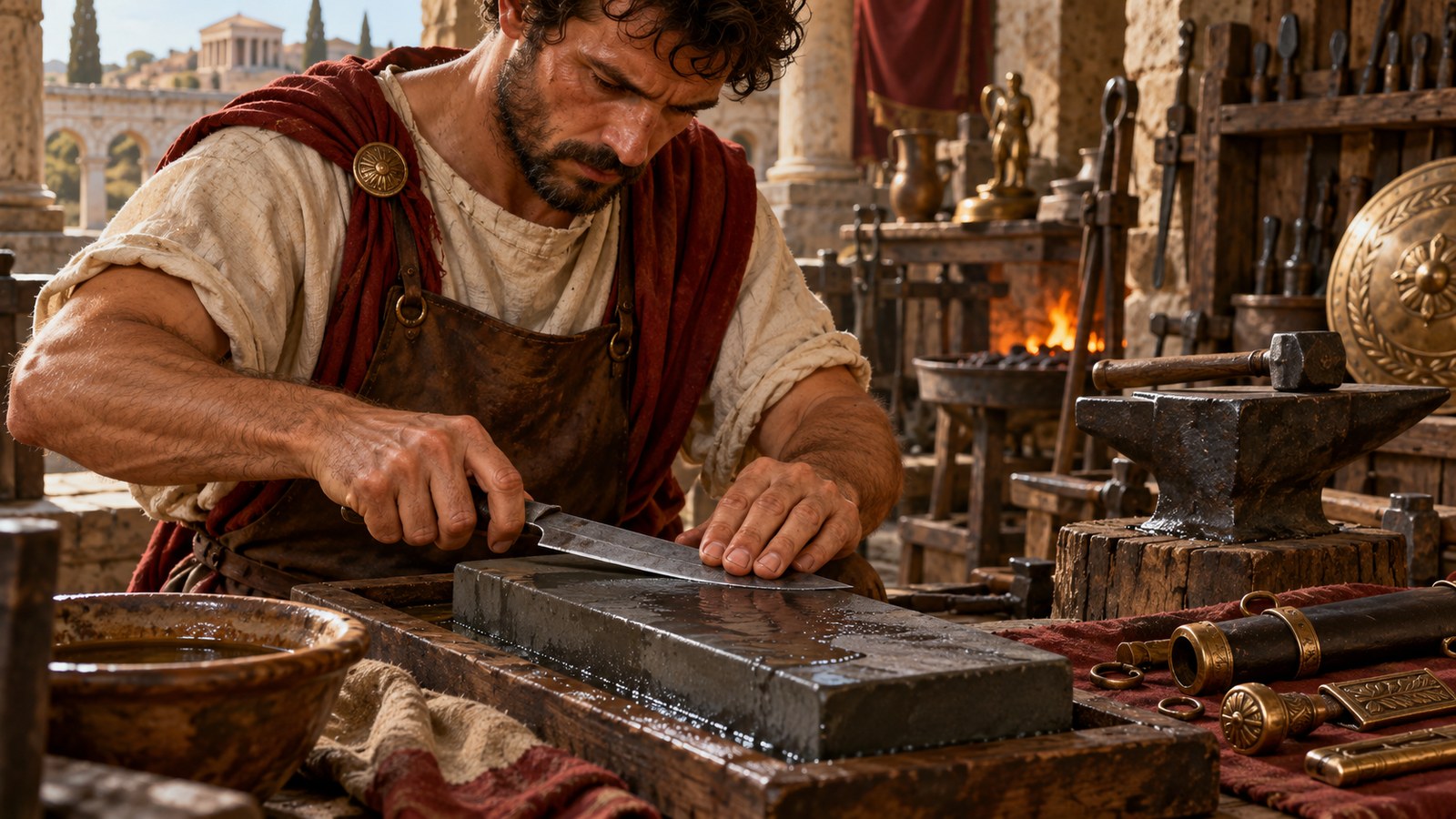
Pliny placed a comparison of whetstones beside his comments on iron quality. He distinguished stones used with oil from those used with water and said oil produced a finer edge. Sharpening and quenching are separate operations, but his sequence makes the workshop’s liquid choices unusually visible.
An edge was not simply a line added after forging. Its angle, finish and supporting metal determined whether it cut, rolled or chipped. A fine edge made poor sense if the body beneath it was too brittle to survive contact. Cooling and sharpening had to answer the same practical question from different directions: what should this tool endure?
The mention of local water adds another layer. Craftsmen did not work with an abstract substance called water whose qualities were identical everywhere. Pliny believed water could help explain regional differences in iron. Whether every causal claim was right, workshops had reason to compare outcomes tied to place.
Technical writing often preserves just such compressed rules: use this medium for this scale; this place is known for this result; this stone leaves this edge. They are fragments of an empirical culture in which failure was expensive enough to remember.
Pliny recorded a process, not a formula
The same passage describes iron becoming liquid like water when ore was fused and later acquiring a spongy, brittle texture. That observation reminds us how many transformations stood between ore and tool. Iron could flow, congeal, be consolidated, reheated, shaped and cooled, with each stage changing the next.
Pliny’s language sometimes compresses distinct processes, and his rankings cannot be tested from the text alone. He was assembling knowledge from workers, traders and earlier authorities. The passage tells us what a Roman encyclopaedist thought worth preserving about iron, including uncertainty and regional reputation.
Its most useful detail remains the modest one. Water could make a small forging too hard. Oil could reduce that risk. The successful object was not the one pushed to the maximum value of a single property, but the one balanced for its job.
That balance is the craft lesson hidden inside the quench. Heat made iron workable; cooling fixed the result; the wrong speed could make improvement self-defeating. A vessel of oil beside the forge represented accumulated caution—proof that Roman metalworkers judged quality not at the moment an object shone, but after it had survived use.
The regional examples prevent the oil rule from floating free of production. Norican ore, Sulmo’s working method and unnamed local waters offered three explanations for quality in three different places. Pliny did not force them into one theory. He preserved the possibility that material, technique and environment each altered the outcome.
That makes the passage valuable even where its science is incomplete. Ancient technical knowledge could be comparative: one source of iron was preferred to another, one town’s workmanship had a reputation, one liquid produced a different edge, and one quench was safer for a smaller piece. The comparisons gave craftsmen and buyers a language for judging results.
The rule about oil is also cautious in form. Pliny called it customary, not infallible. Custom records what workers repeatedly chose under familiar conditions. It leaves room for different objects and workshops while still identifying a failure they feared enough to avoid: a compact forging hardened into brittleness by water. The sentence preserves a decision at the scale of the hand, where one hot piece, one vessel and one cooling choice determined whether earlier labour remained useful.
Sources
Pliny the Elder, Natural History, 34.144–146.