
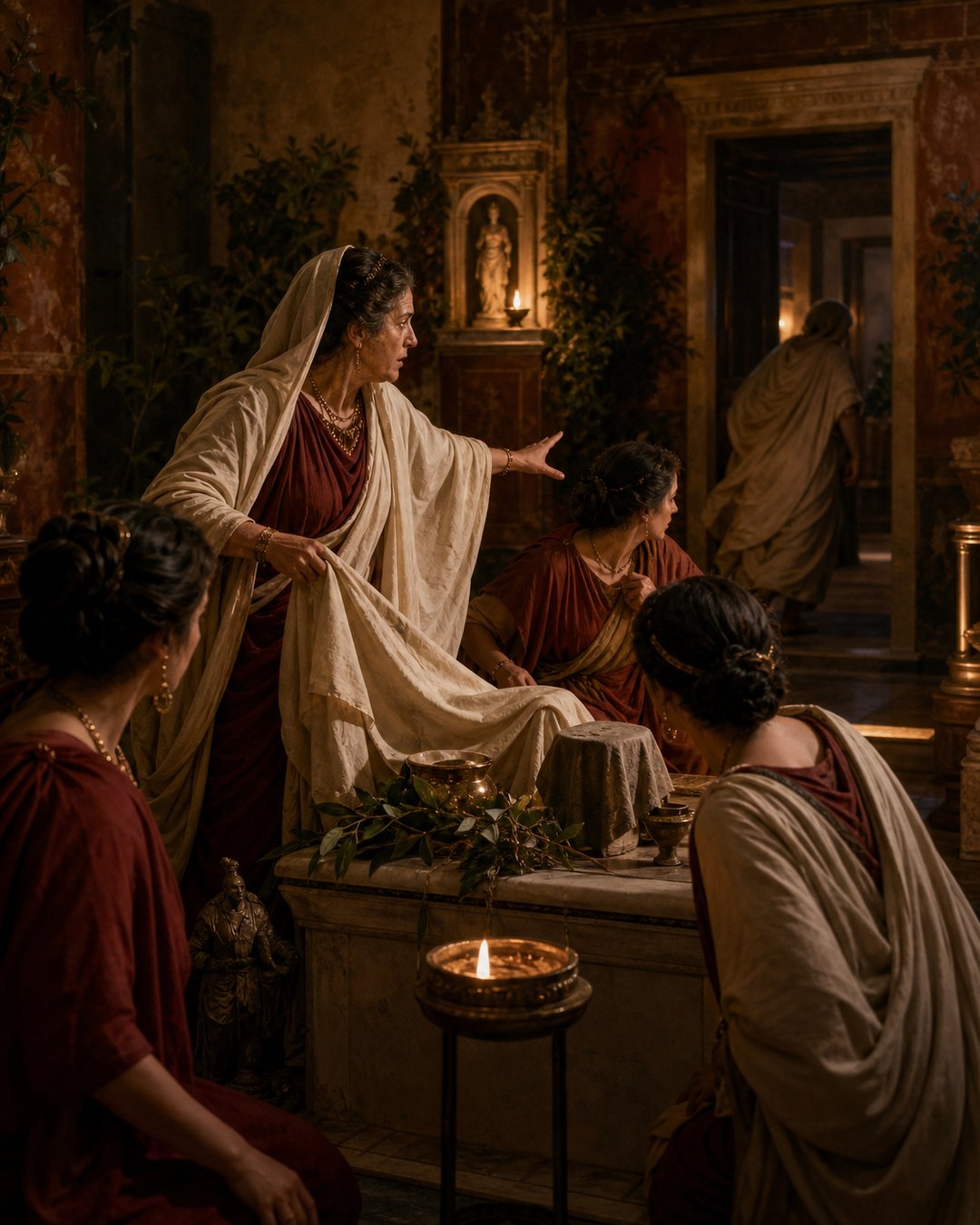
The disguise had carried Publius Clodius Pulcher through the door. Dressed as a woman and still young enough to lack a betraying beard, he entered the house where Rome’s elite women were celebrating the Bona Dea. Men were excluded. Julius Caesar himself had withdrawn from his own home for the night.
Inside, Clodius lost his guide.
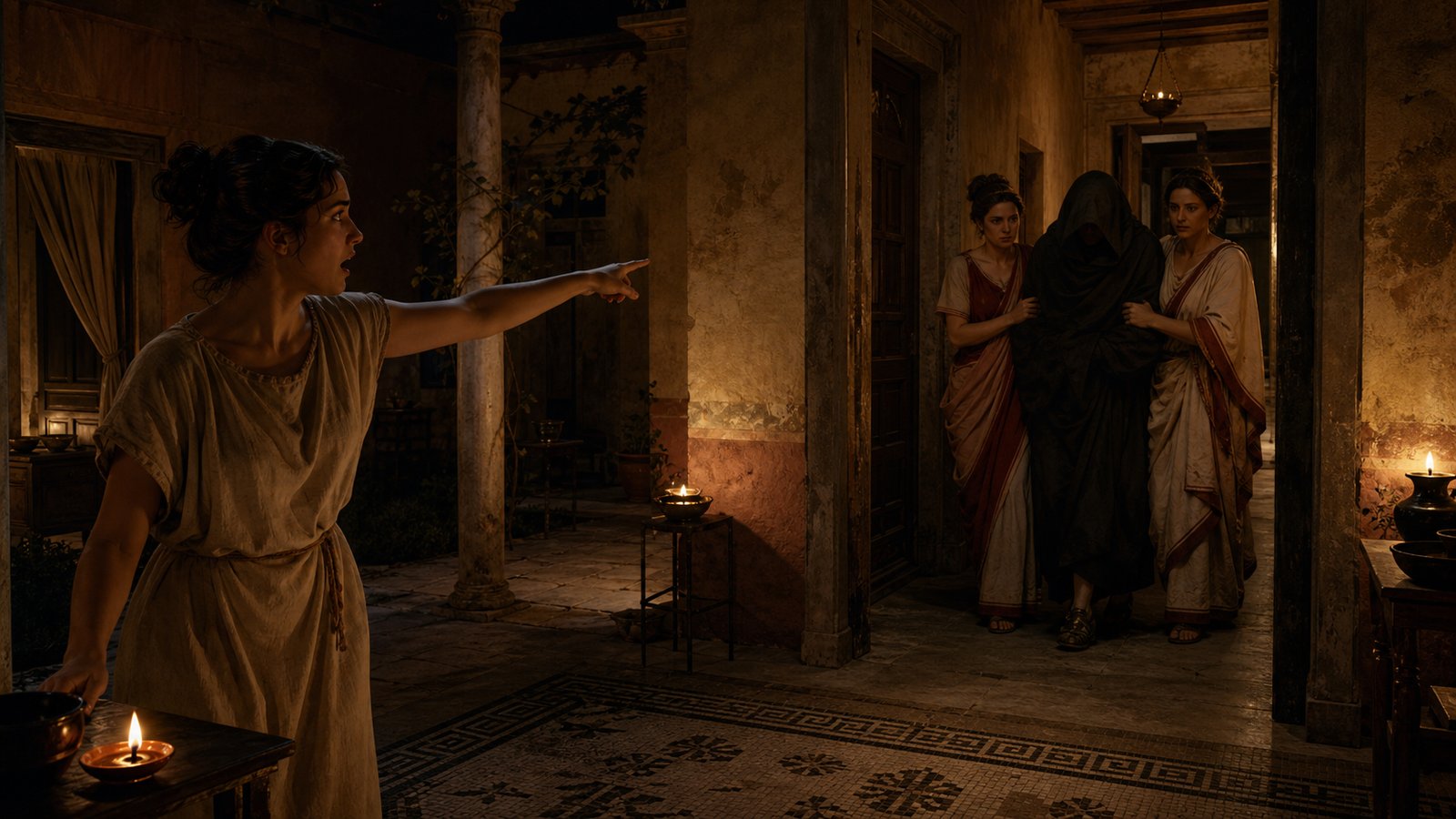
Another servant approached the unfamiliar visitor and tried to draw her into conversation or play. Clodius refused. The answer came in a voice the costume could not change. The servant cried out that she had found a man.
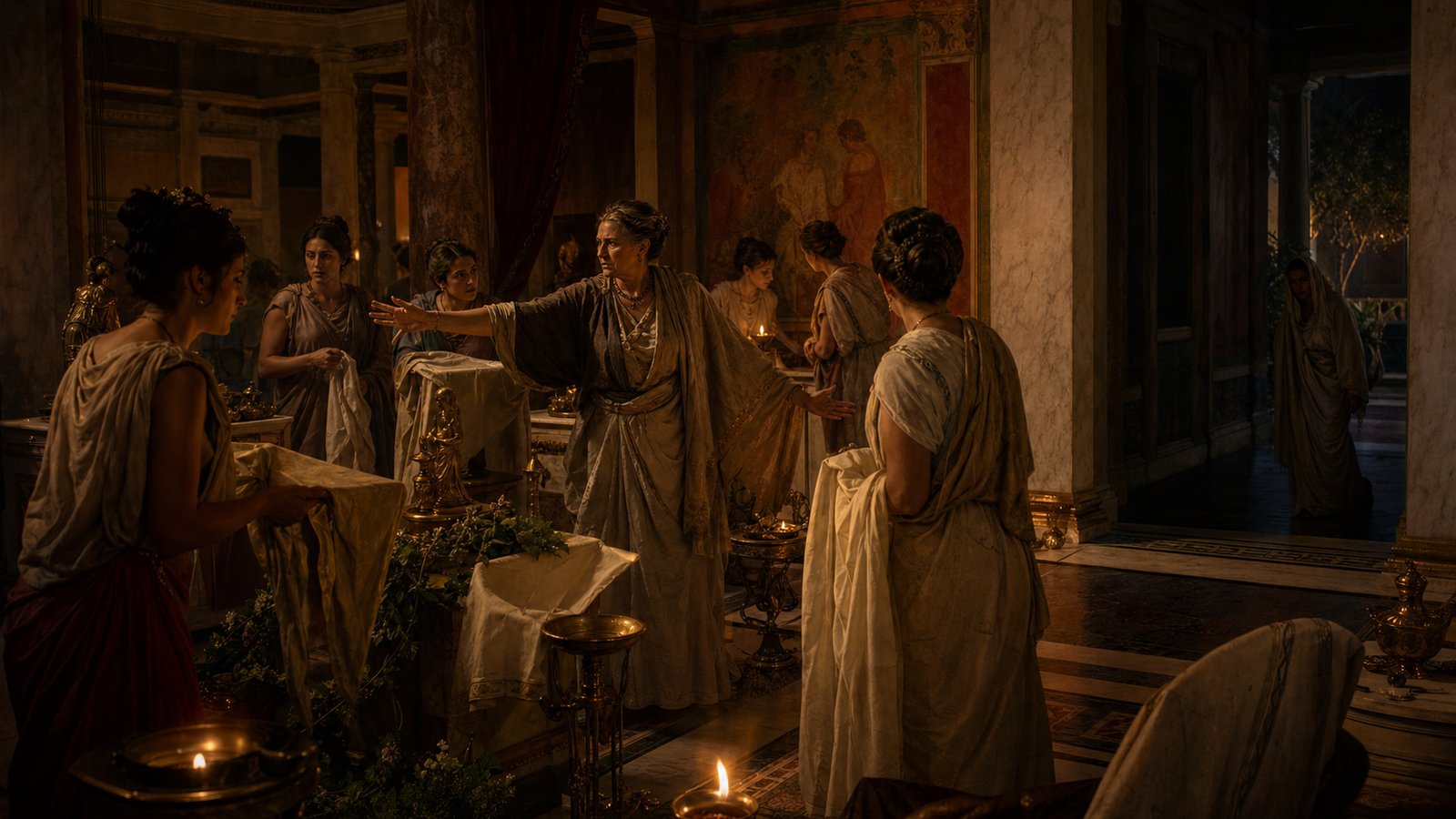
Plutarch’s scene turns on that brief sound. Aurelia, Caesar’s mother, halted the ceremony, covered the sacred objects and ordered the house searched. Clodius was discovered and driven out. By morning, a breach inside a controlled household had become a religious and political scandal for the city.
The pontifex’s house had become women’s sacred ground
The December rites of the Bona Dea were unusual not because Roman women otherwise lacked religious roles, but because male exclusion defined this ceremony so sharply. The celebration brought elite matrons and the Vestal Virgins into a space temporarily reorganized for the goddess. Male presence was not an awkward social mistake. It violated the ritual boundary on which the night depended.
In 62 BC the host household belonged to Caesar, then pontifex maximus. His office connected public religion to his domestic building, while his wife Pompeia occupied the leading female role within the event. Aurelia helped supervise. The arrangement makes modern categories of “private” and “public” misleading. The house was privately owned, yet the rites performed there concerned Rome.
Caesar’s withdrawal demonstrates the boundary’s seriousness. He did not gain access because he owned the rooms or held Rome’s highest priesthood. For the ceremony, women controlled movement, objects and participation inside his home.
That inversion gave Clodius’s intrusion its charge. He did not interrupt a spectacle in the Forum where thousands could watch. He crossed into a protected interior whose religious legitimacy depended on excluding him. A successful disguise attacked the household’s ability to serve as sacred enclosure.
The ritual separation belongs beside the formal roles in the ten-witness confarreatio marriage. Roman ceremony often worked by assigning precise people to precise actions. At the Bona Dea, one of the clearest assignments was negative: no man had a part inside.
A household search interrupted the goddess’s night
Ancient accounts attach scandalous motive to Clodius, usually an attempted meeting with Pompeia. Motive was politically useful and difficult to separate from hostile retelling. The physical sequence is more secure and more revealing. He entered in female clothing, moved with assistance from a maid, became isolated, and was exposed when another servant heard him speak.
The servant is not ornamental to the story. Elite women had gathered for the rite, but the household’s working staff controlled corridors, recognized expected participants and noticed someone out of place. The intrusion failed through ordinary social contact, not a miraculous sign or senatorial investigation.
Once the alarm sounded, Aurelia took command. Plutarch says she stopped the rites and covered the sacred objects. Those actions protected what could still be protected. The women then searched the house, treating every room as part of the compromised ritual perimeter.
Clodius’s flight could not restore the ceremony. Cassius Dio reports that the rites had to be performed again by the Vestals. Repetition was an acknowledgment that the first performance had been polluted. The night’s labor, sequence and sanctity could not simply continue after a man was removed.
The response differs from the battlefield omen in the sacred chickens before Drepana. There, a commander publicly rejected an unfavorable sign before a military disaster. Here, women inside a house recognized human intrusion and repaired ritual procedure. Both stories show Roman religion operating through prescribed acts, but the people enforcing them occupy very different positions.
Rumor escaped faster than the intruder
Clodius got out of the house; the event did not remain there. News moved through Rome and converted a nocturnal discovery into a charge of sacrilege. The alleged sexual pursuit gave opponents vivid material, but prosecution did not depend only on marital gossip. The formal danger was that a rite belonging to the Roman community had been profaned.
The case pulled hidden ritual into public argument. Women had been the principal participants and witnesses, while male magistrates, jurors and political allies would contest what the intrusion meant. That transfer changed the evidence. Household testimony had to survive faction, reputation and patronage.
Clodius was no anonymous trespasser. He belonged to an elite family and possessed the alliances needed to turn accusation into a political struggle. His opponents could present the episode as proof of contempt for divine and social order. His supporters could attack testimony, motive or procedure. The trial ended in acquittal, a result ancient writers associated with corruption and intimidation.
An acquittal did not return the scandal to secrecy. The event became part of Clodius’s public identity and of Cicero’s later hostility toward him. A disguise intended to erase male identity produced one of the most durable identifying stories attached to his name.
The pathway matters: doorway, corridor, voice, alarm, search, rumor, court. Rome did not possess a separate institution called the media to manage that sequence. Elite households, servants, witnesses, senatorial debate and forensic performance carried the event outward. The sacred boundary was local; the consequences were civic.
Caesar separated legal evidence from political appearance
Caesar divorced Pompeia after the incident. Yet when called in the proceedings, Plutarch says he testified that he knew nothing against his wife. Asked why he had divorced her, he answered in the logic remembered as the demand that Caesar’s wife be above suspicion.
The formulation was not a finding that Pompeia had participated in Clodius’s plan. It separated two standards. A court required evidence for a charge. Caesar’s household and future demanded distance from suspicion itself. Divorce managed political appearance even while his testimony withheld an accusation.
That distinction also protected Caesar’s position. As pontifex maximus and master of the host house, he could not treat the breach as trivial. As a politician navigating Clodius’s connections, he had reasons not to become the prosecution’s most useful witness. Removing Pompeia displayed severity without proving the narrative his rivals wanted.
The women’s ritual repair, Clodius’s acquittal and Caesar’s divorce therefore answered three different questions. Could the ceremony continue? No; it had to be repeated. Could a court convict Clodius? In the end, no. Could Caesar allow his household to remain attached to suspicion? He decided it could not.
One servant’s cry forced those questions apart. It exposed the intruder, but it could not determine every consequence that powerful Romans later built from the discovery. The Bona Dea scandal endured because a domestic sound crossed several boundaries at once: male and female, sacred and polluted, household and state, evidence and reputation.
The surviving accounts were written after the night and shaped by political memory, so their neat dramatic details deserve care. Yet the event’s institutional outline does not depend on accepting every hostile insinuation about Pompeia or Clodius. A forbidden man entered, women stopped the rite, the ceremony required repair, and a sacrilege case followed. Those consequences show what the boundary meant to contemporaries. The servant’s alarm matters because it moved the breach from possible concealment to witnessed fact. From that instant, every participant had to decide not whether the household had been disturbed, but who would control the meaning of the disturbance.
The answer never belonged to one person. Aurelia controlled the search, the Vestals the ritual restoration, jurors the verdict and Caesar his household’s public response. Clodius escaped conviction, but he did not recover anonymity.
Sources
Plutarch, Life of Caesar 9–10
Cassius Dio, Roman History 37.45
Bona Dea religious reference
Publius Clodius Pulcher biographical reference